Company · About
A restoration company, built like infrastructure.
Tidewright was founded in Hobart in 2016 by an aquaculture engineer who watched a heatwave erase the forest she loved, and an autonomous-systems designer who believed vessels could carry the fix. The conviction between them: restoration only survives if it pays its own way.
What we hold to
Four rules that outrank the quarterly.
Forests first, spreadsheets second
Growth targets never get to vote against a reef. When the biology says slow down, we slow down — and we say so publicly.
Local knowledge outranks our models
Rangers, fishers and divers hold decades of reef knowledge no sensor array matches. Programs are co-designed with the people who live with the coast.
Publish everything, especially the failures
Methods, data and mistakes are open by default. A restoration industry that hides its error bars is building on sand.
Restoration must pay its own way
Philanthropy starts programs; revenue sustains them. Harvest sales and verified credits fund the next season of seeding — always.
The story so far
2016 → today: shed, ship, system.
2016
Founded above a boat shed
Dr. Ines Velasquez and Marcus Hale found Tidewright in Hobart with one dive boat, a cold room, and a conviction: restoration only survives if it pays its own way.
2017
First Holdfast hatchery
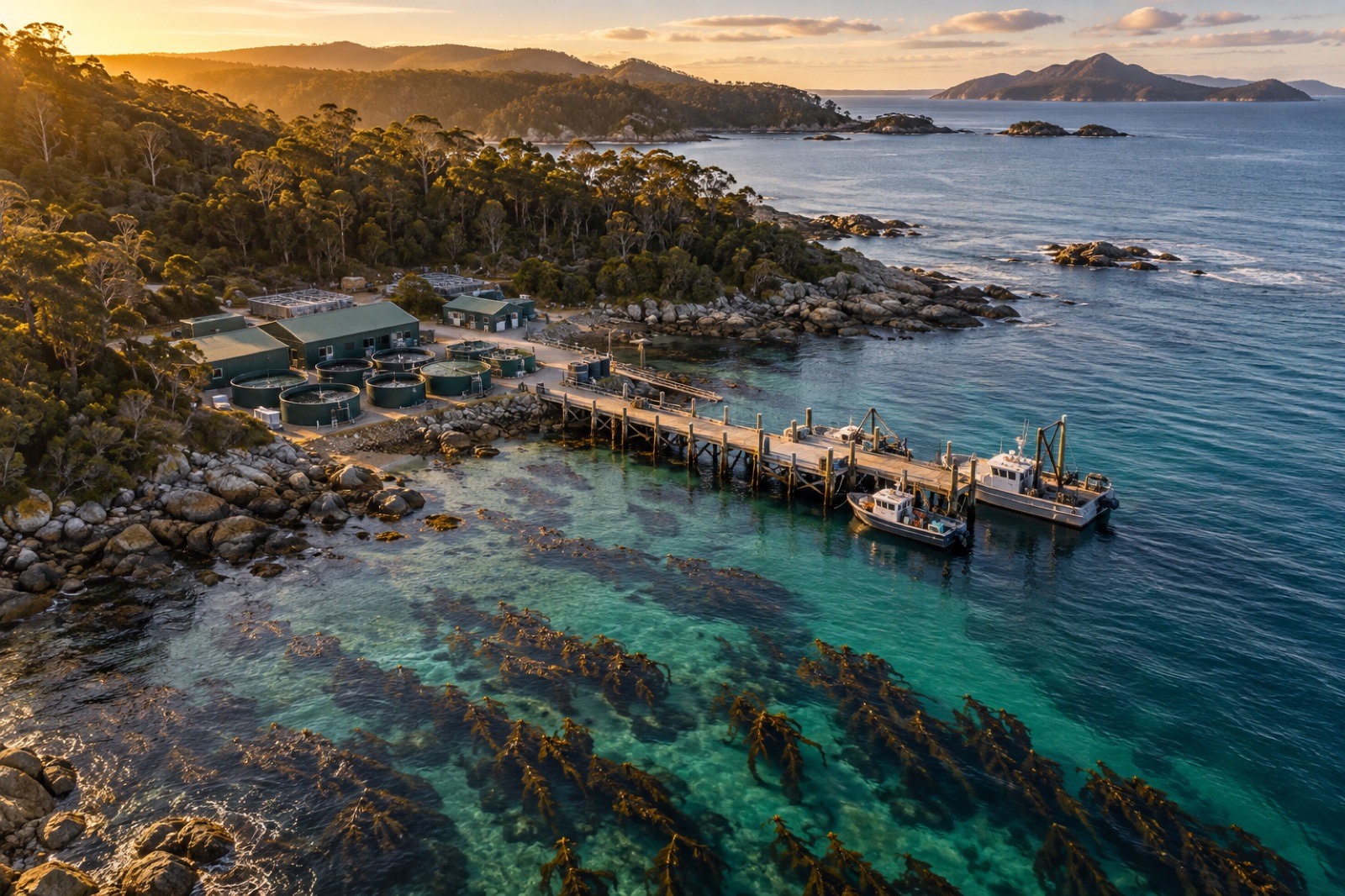
A disused fish-processing shed in Triabunna becomes the first Holdfast nursery, growing giant kelp seedstock on biodegradable lines matched to local genetics.
2018
Drifter D-1 takes to the water
The first autonomous reseeding vessel — solar-electric, sonar-eyed, stubborn as a seabird — seeds its first hectare without a human on board.
2019
Tasmania program opens
The Lumeriah Coast program seeds its first 40 hectares of urchin barren. Divers hand-lay the lines; the Drifter fleet is still being born.
2021
Canopy Ledger verification framework
Tidewright publishes its first measurement, reporting and verification framework: satellite canopy maps, drone photogrammetry and diver quadrats, tied to an open methodology.
2022
First blue-carbon credits issued
The Lumeriah program issues its first verified credits. Revenue goes straight back into seedstock — the flywheel starts turning for the first time.
2023
First program outside Australia
Mendocino County, California: bull kelp corridors and a partnership with urchin ranchers. The model proves it travels.
2024
Tidewright Harvest launches
Food-grade kelp, biostimulants and bioplastic feedstock from restoration-adjacent farms go on sale. Programs open in Norway, Japan and South Australia.
2025
4,200 hectares milestone
Sixty-three sites across six coastlines; 184 species recorded returning to restored reefs. The Reef Partners school program reaches its 10,000th student.
2026
Third fleet, second hemisphere push
A third Drifter fleet is commissioned and the Humboldt Coast program begins seeding. The 2030 target: 25,000 hectares under restoration.
The people
12 leads, four time zones, one ocean.
Tidewright is a fictional company created as a design and content demonstration.