The platform — Kelp products that pay for the forest
Tidewright Harvest
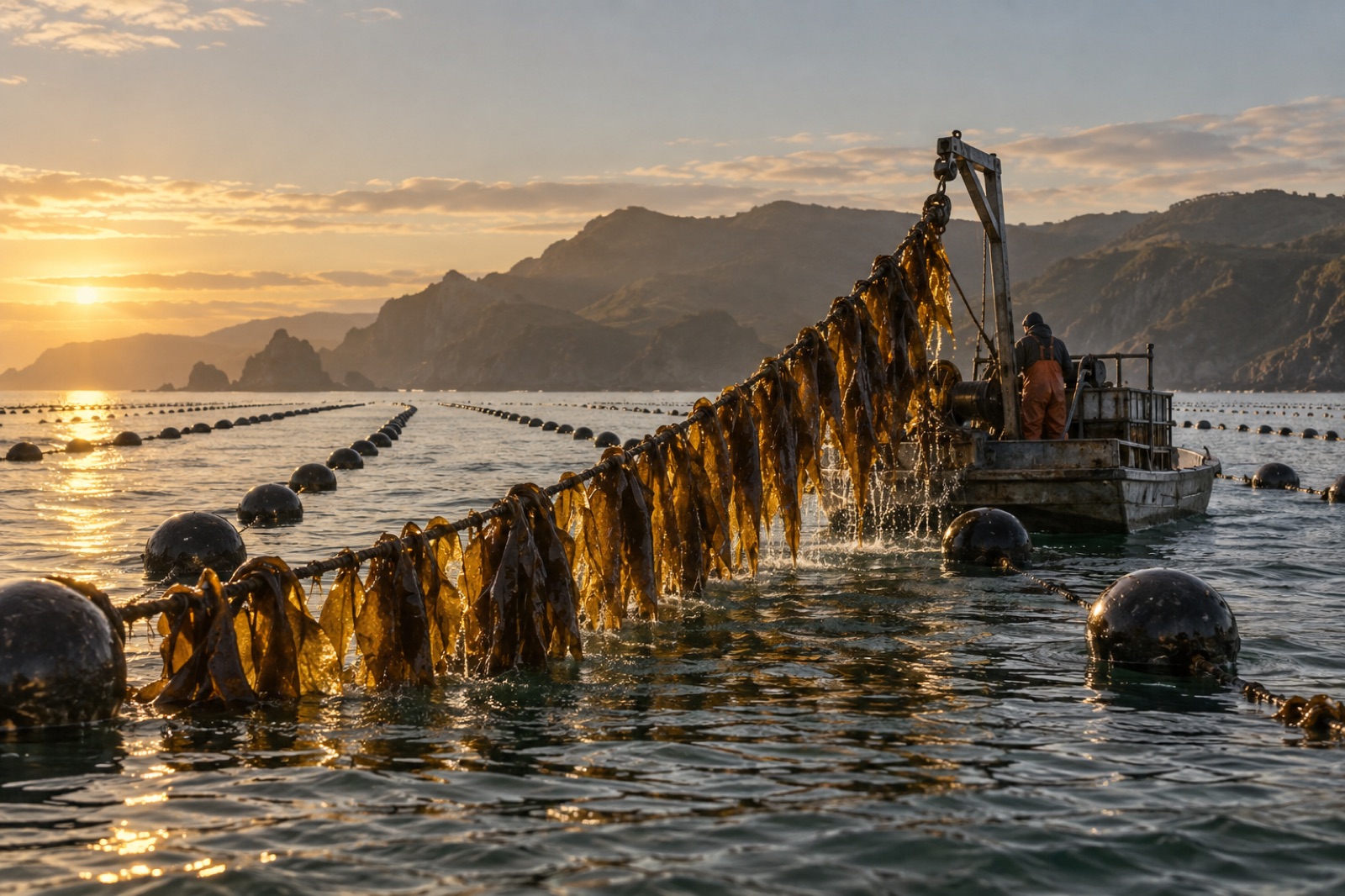
Restoration needs revenue that renews itself. Tidewright Harvest farms kelp on longlines adjacent to restoration sites — close enough to share genetics and logistics, far enough to protect wild canopy — and turns it into food, biostimulants and bioplastic feedstock. Every tonne sold underwrites the next reef.
Why it exists
Restoration that outlives its funding.
Philanthropic restoration has a quiet failure mode: it stops when the grant does, which is usually about the time a young forest needs its most expensive years of monitoring and maintenance. A reef you can’t afford to keep isn’t restored — it’s postponed.
Harvest is Tidewright’s answer to permanence money. Longline farms run beside our restoration sites, under the same provenance and monitoring rules, and sell into food, agriculture and materials. Thirty percent of Harvest net revenue is contractually routed to the Reef Fund before anything else is paid — the forest holds the first lien on the farm that shares its water.
In the field
- of Harvest net revenue contractually routed to the Reef Fund
- 30%
- feed, freshwater or fertiliser inputs per tonne grown
- 0
- from landing boat to drying racks
- 6 h
Tidewright’s own fictional system figures, shown for demonstration.
Anatomy
Inside Tidewright Harvest
A Harvest farm in plan view: anchored longline arrays beside — never inside — the restoration site, with revenue routed shore-side first to the Reef Fund.
The flow
How Tidewright Harvest works
Farm beside the reef
Longline farms operate adjacent to restoration sites under the same provenance and monitoring rules — sharing vessels, hatcheries and survey data without touching credited canopy.
Grow on sunlight alone
Subtidal longlines need no feed, no freshwater and no fertiliser. The crop draws on ambient nutrients and daylight, with the farm monitored for biofouling and grazing pressure all season.
Cut above the meristem
Blades are harvested by cutting above the growth zone, so every plant regrows through the season and one seeded line yields multiple light-touch harvests.
Process within hours
Shore-side facilities dry, mill and ferment the landing the same day — the difference between food-grade kelp and compost is a few hours of handling discipline.
Route revenue to the Reef Fund
A fixed 30% of Harvest net revenue moves contractually into the Reef Fund, which pays for restoration deployment, the 20-year monitoring horizon and buffer-pool costs.
Specification
The Tidewright Harvest spec sheet
The numbers that define a working deployment — sized for real coastlines, weather and budgets, and consistent across every Tidewright program.
Specifications describe Tidewright’s fictional systems and are illustrative.
- Products
- Food-grade kelp, soil biostimulants, bioplastic feedstock
- Farm type
- Subtidal longline, no feed or freshwater input
- Harvest rule
- Blade-only cut above the meristem
- Reef Fund share
- 30% of Harvest net revenue
- Traceability
- Batch-level tracking from line to product
- Carbon
- Farmed volume separate from credited restoration
- Genetics
- Same provenance rules as restoration seedstock
- Monitoring
- Water quality, fouling and wildlife interactions logged
Go deeper
From the journal and the field
Who uses Tidewright Harvest?
Questions
Tidewright Harvest FAQ
- Do Harvest farms damage wild kelp beds?
- No — farms sit adjacent to restoration sites, never inside credited canopy, and operate under the same genetic provenance rules as our restoration stock. Wild beds gain monitoring attention and genetic insurance from having a farm next door, not pressure.
- Is farmed kelp counted as carbon removal?
- No. Farmed volume is excluded from credited restoration by design; the accounting keeps the two pools physically and contractually separate. What we sell as product is product — what we issue as credit is verified restoration outcome.
- What does “cut above the meristem” mean?
- The meristem is the kelp’s growth zone, at the base of the blade. Cutting above it takes the season’s growth while leaving the plant alive and anchored — like mowing rather than uprooting — so one line can yield several light harvests a season.
- Where does the money actually go?
- After operating costs, 30% of net revenue goes to the Reef Fund by contract, funding deployment, two decades of monitoring per site and the credit buffer pool. The split is reported in our annual impact reporting.
The rest of the platform
Put Tidewright Harvest on your coastline.
Councils, fisheries, carbon buyers and community partnerships — the Reef Partners program scopes sites, budgets and timelines around your water.