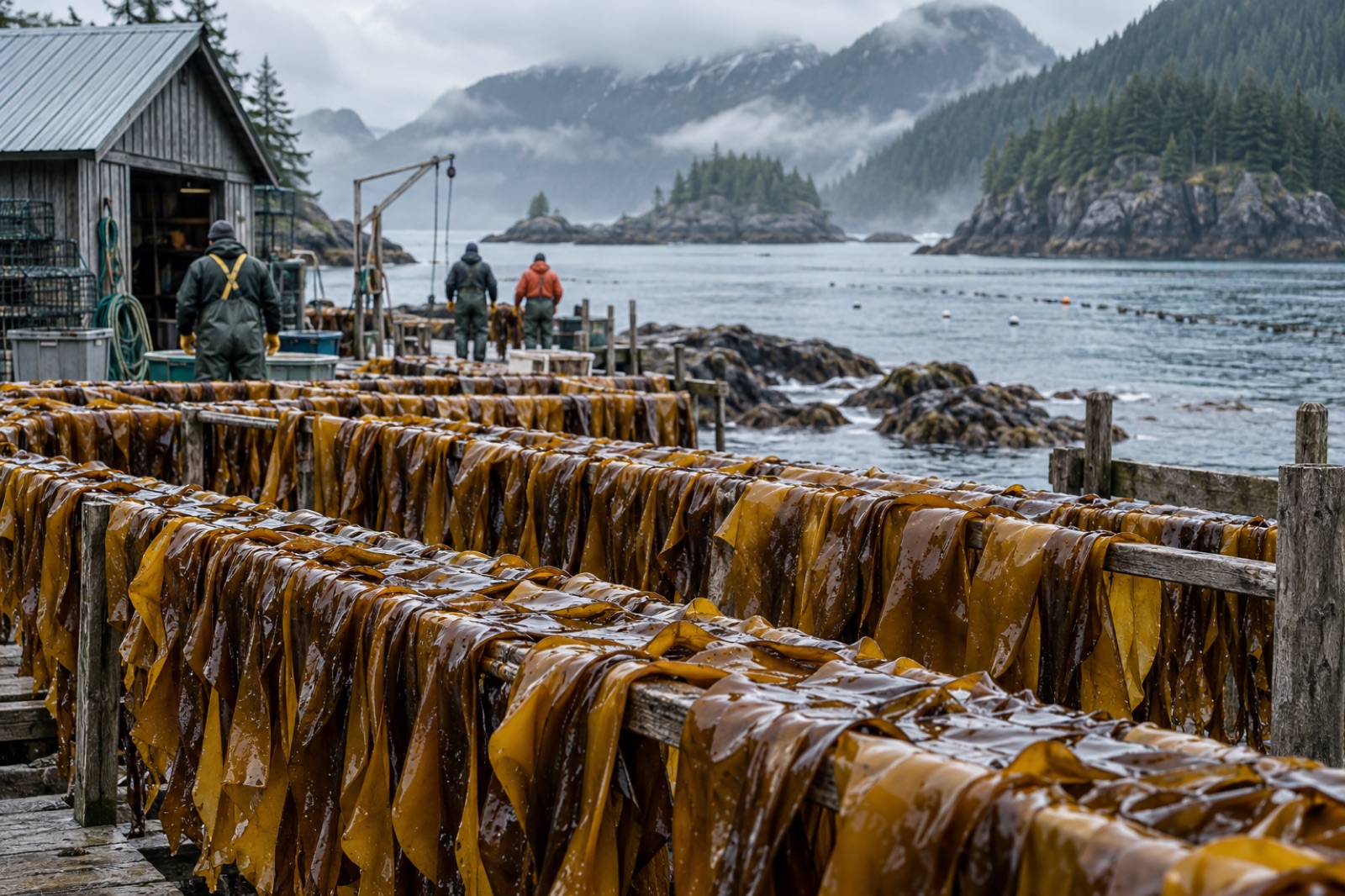
Harvest day tells you what you grew; drying day tells you what you get to sell. Fresh kelp and other farmed seaweeds arrive on deck at 85–90% water, which means every tonne you lift is carrying nearly a tonne of seawater that has to leave — quickly, evenly and without cooking the colour, aroma and nutrients out of the crop. Drying is the single most consequential step in the whole post-harvest processing chain, and the method you choose depends more honestly on your climate, your volume and your end market than on any catalogue. This guide compares the five main approaches — sun, ambient air, cabinet dehydrators, industrial dryers and freeze-drying — with the numbers that matter, so you can match the method to your farm.
The targets: what "dry" means for seaweed
Two numbers govern everything else:
- Moisture content. Dried seaweed for shelf-stable storage should come down to roughly 10–12% moisture or below. Much above that, mould and yeast wake up; much below, you have spent energy removing water no one needed removed.
- Water activity (a_w). The measure that actually predicts spoilage. Below about 0.6, microbial growth effectively stops; between 0.6 and 0.85 you are in mould territory. You cannot see water activity — you need a probe — but it is the metric food-safety auditors will ask about.
There is also a quality window that many farmers learn the hard way: seaweed dried too fast and too hot goes brittle, bleaches and loses volatile aroma compounds; dried too slowly in damp air, it reabsorbs moisture overnight and can start to ferment. Good drying is a controlled race.
Method 1: Sun and open-air drying
The oldest method, still the backbone of the industry in sunny dry climates. Crop is spread on racks, nets or clean sheets off the ground and turned periodically.
Strengths. Zero fuel cost; gentle temperatures that protect colour and heat-sensitive compounds; enormous capacity limited only by land and labour; excellent for species and products destined for extraction (alginate, biostimulants, animal feed) where cosmetic perfection doesn't pay.
Weaknesses. Weather is your boss. A single night of dew can undo a day's work; UV degrades pigments over long exposures; dust, insects, birds and salt-laden wind are constant contamination risks; and sun drying is effectively impossible to validate for premium food markets in humid-temperate climates — think of the shoulder-season reality on any North Atlantic or Northeast Pacific farm, where the harvest window lands squarely in the damp months.
Honest verdict: unbeatable where the weather cooperates, irrelevant as a primary method where it doesn't. Many temperate farms use it only as an emergency backup or for feed-grade crop.
Method 2: Indoor air drying and dehumidified rooms
Hang or rack the crop inside a ventilated shed, greenhouse or dedicated drying room, moving air with fans and — the key upgrade — stripping moisture with dehumidifiers or mild background heat.
Strengths. Removes the weather risk while keeping temperatures low (20–35°C), which preserves colour well; modest capital cost (a converted barn with racks and fans is a working start); scales to a few tonnes per batch with labour as the main input.
Weaknesses. Slow: days, not hours, for thick stipes. Requires airflow through the bed, so crop must be spread thin; deep piles go mouldy from the inside. Energy costs are real but manageable if the structure is insulated — dehumidifier heat stays in the room, which is the whole trick.
Honest verdict: the sensible first step up from open air for a small or medium farm in a cool climate, especially for whole-leaf products like dulse and sugar kelp where gentle handling was the point of the crop.
Method 3: Cabinet and rack dehydrators
Purpose-built food dehydrators — from twenty-tray countertop cabinets to room-scale rack units with controlled temperature and airflow — are the small farm's most reliable tool.
Strengths. Predictable, food-safe and repeatable: 40–50°C and moving air will take sliced kelp to shelf-stable in 6–12 hours, whole thin blades overnight. Temperature control means you can stay below the thresholds where carrageenan-containing reds soften or brown kelps go leathery; HACCP documentation is easy because the process is defined.
Weaknesses. Capacity. Even a serious rack dehydrator handles tens, not hundreds, of kilograms per cycle. Energy per kilogram is the highest of the "hot air" family, because small boxes lose heat fast.
Honest verdict: the right choice when your crop is small, your market is premium human food, and your bottleneck is grade rather than tonnage — which describes most farms in their first three seasons.
Method 4: Industrial hot-air dryers — tunnel, belt and rotary
At commercial scale, drying becomes continuous engineering. Wet crop is chipped or shredded, spread on perforated conveyors (belt dryers), loaded onto trays that travel through tunnels, or — for robust feed-grade material — tumbled through rotary drums. Air at 60–80°C passes through the bed, and the whole cycle completes in one to a few hours.
Strengths. Throughput in the tonnes-per-day class; moisture uniformity you can set a watch by; easily integrated with blanching and milling so the line runs harvest-to-powder.
Weaknesses. Capital, mainly — a mid-size belt dryer is a serious facility decision, and fuel costs assume cheap heat (industrial operators site them near waste heat where they can). High temperatures darken colour and mute aroma, which is why the food-grade lines run gentler temperature profiles with staged zones: hot early, warm late.
Honest verdict: the destination for any farm — or cooperative — moving real tonnage into ingredients, feed or biostimulants. For most growers the smarter route is a shared regional dryer, which is precisely the infrastructure gap holding back seaweed farming in many temperate regions.
Method 5: Freeze-drying
Frozen crop has its water sublimed under vacuum — no liquid phase, almost no heat. The result is seaweed with near-fresh colour, aroma and nutrient profile, in a crisp, instantly rehydratable form.
Strengths. Peak quality by a wide margin; excellent for flakes, garnishes, snacks and nutraceutical products where the market pays for character.
Weaknesses. Cost. Equipment is expensive, cycles run 24–72 hours, and energy use is multiples of hot-air drying. Economics only close on high-value products.
Honest verdict: a specialty tool. If your buyer is paying per hundred grams for texture and colour, freeze-drying pays; for everything else it's a luxury.
Choosing your method: a decision framework
Work through these in order:
- What is the crop? Thin-bladed kelps and reds (dulse, sugar kelp, nori-types) dry gently and well at low temperatures; thick-stemmed species and whole stipes need forced air and cutting into pieces.
- What is the market? Feed and extraction tolerate hot, fast, cheap. Human food needs validated, uniform, cooler drying. Premium snack and culinary grades can justify freeze-drying.
- What is your climate? Reliable sun and dry air changes everything; cool-humid coasts force indoor methods regardless of philosophy.
- What is your volume — honestly? Buy the dryer for next season's realistic crop, not the dream crop; dead capital is the most common way small farms fail.
- What is your energy? Access to waste heat or cheap wood can flip the arithmetic toward hot-air industrial dryers even at moderate volumes.
Finally: drying is where moisture numbers get locked in, but it is storage that keeps them — dried seaweed reabsorbs atmospheric humidity fast in coastal air, so sealing, desiccant and dark cool storage are part of the drying decision, not an afterthought. And on the site-selection side, any serious farm plan should already know how and where it dries before the first line goes in; a crop without a drying plan is a perishables problem, not a product.
Key takeaways
- Fresh farmed seaweed is 85–90% water; target final moisture below ~12% and water activity below 0.6 for shelf-stable product.
- Sun and open-air drying are unbeatable where climate cooperates, and effectively unusable for food-grade production on damp temperate coasts.
- Dehumidified indoor air drying is the natural first upgrade for small-to-medium cool-climate farms; cabinet and rack dehydrators suit premium small-batch human food.
- Industrial belt and tunnel dryers are the tonnage answer — best accessed through shared regional facilities for most growers.
- Freeze-drying is a specialty tool for high-value products where colour, aroma and rehydration justify the cost.
FAQ
How long does seaweed take to dry?
Anywhere from hours to days depending on method and form. Sliced kelp in a 45°C cabinet dehydrator: 6–12 hours. Whole blades on indoor air racks: 1–3 days. Sun drying in a hot dry climate: 1–2 sunny days, sometimes hours for thin species like sea lettuce. Thick stipes are the outlier — cut them or accept much longer cycles in any system.
What temperature should you dry seaweed at?
For food-grade colour and aroma, stay in the 40–55°C band. Industrial ingredient drying runs 60–80°C because throughput dominates, with staged zones that start hotter and finish cooler. Freeze-drying avoids heat almost entirely. The consistent rule across methods: never let the wet material sit warm and stagnant — that is where fermentation and mould start.
Can you dry seaweed in a regular home oven?
Technically yes — lowest setting, door ajar, slices on racks — but temperature control is crude and hot spots scorch edges while centres stay damp. A $60 food dehydrator does the same job more safely and more cheaply per kilogram. For anything beyond kitchen-scale experimentation, use purpose-built equipment.
Does drying destroy the nutrition in seaweed?
Gentle drying preserves the great majority of minerals — iodine included — and most fibre and protein, while moderate heat reduces some heat-sensitive vitamins and volatile aroma compounds. Harsh high-temperature drying and prolonged UV exposure cause the real losses. This is why gentle, controlled drying is the quality method: you trade a little time for a much better product, as covered in more depth in our seaweed nutrition guide.
What is the cheapest way to dry seaweed commercially?
Sun drying where the climate allows, and dehumidified ambient-air rooms where it doesn't — with the caveat that "cheapest per kilogram" depends on labour, energy prices and crop value. For small premium-food farms, the true cheapest route is usually a rack dehydrator run at full loads, because wasting a batch to mould costs more than a season's electricity.