The platform
Industrial-scale restoration, end to end.
Most restoration stalls at the scale of goodwill. The Tidewright platform closes the loop: survey and seed with Drifter, grow resilient stock with Holdfast, prove outcomes with Canopy Ledger, and fund the next reef with Tidewright Harvest.
Autonomous reseeding vessels
Drifter
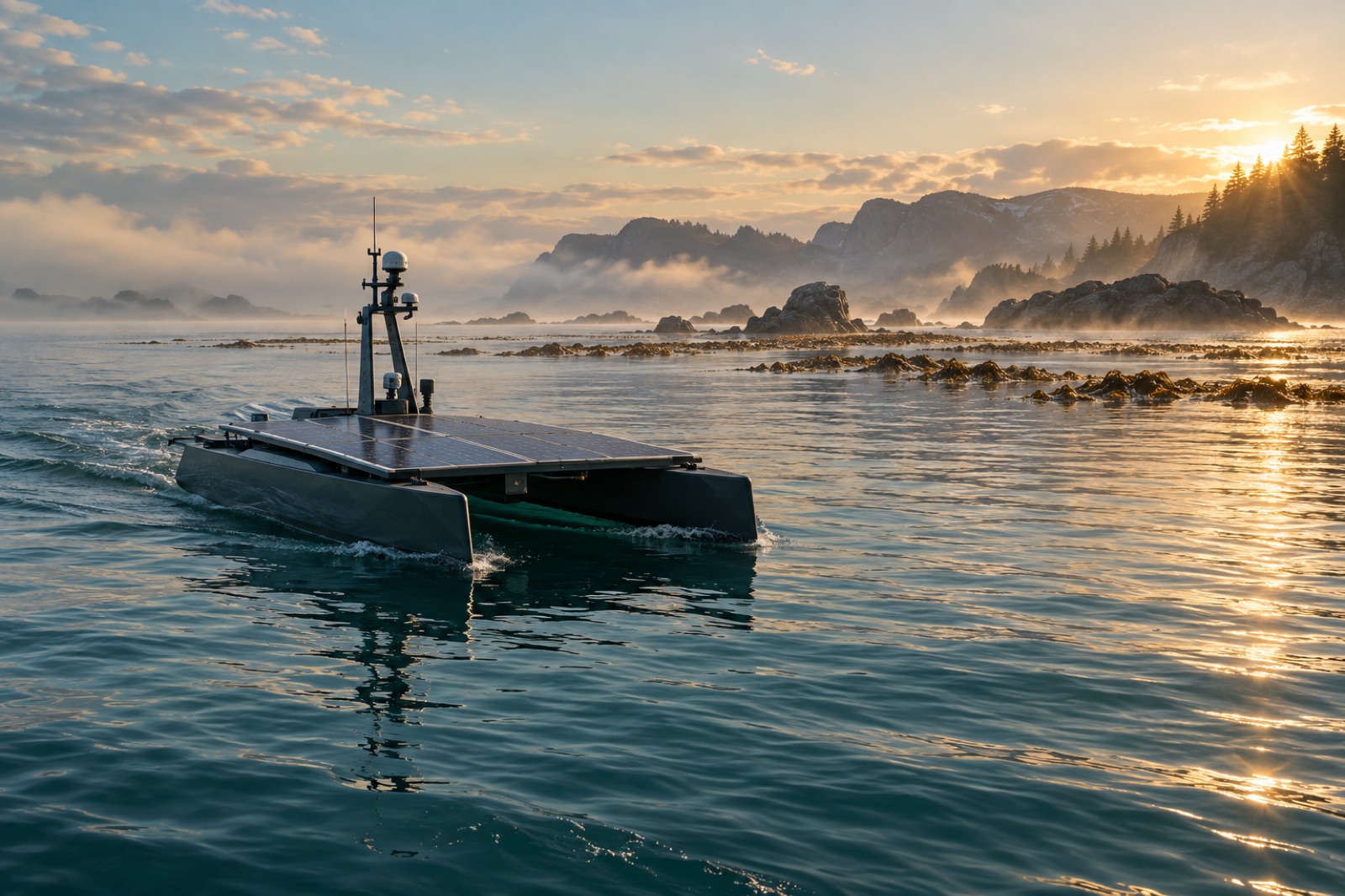
Drifter is a fleet of solar-electric catamarans that do the work a dive team never could at scale. Each vessel surveys rocky reef with multibeam sonar and stereo cameras, builds a habitat suitability map, then lays Holdfast lines — thin, biodegradable cords dense with kelp gametophytes — directly onto the substrate most likely to hold a forest.
How it works
Survey the reef
Multibeam sonar and 4K stereo cameras map reef rugosity, urchin density and available light at 10 cm resolution, building a three-dimensional picture of every site before a single line is laid.
Score every metre
An onboard suitability model grades the surveyed reef for holdfast grip, swell exposure, canopy potential and grazing pressure — turning habitat maps into a ranked planting plan.
Seed along contours
Spore-seeded Holdfast lines spool off the stern reel and are pinned to rock along scored contours by the laying arm. RTK positioning keeps placement within ±0.3 m of plan.
Log everything
Position, depth, line tension, water quality and imagery stream to the operations room and into Canopy Ledger, so each deployment arrives with its own evidence trail.
Key specifications
- Hull
- 8.4 m solar-electric catamaran
- Endurance
- Up to 90 days on station
- Sensors
- Multibeam sonar, stereo 4K cameras, eDNA sampler, CTD
- Seeding rate
- 6 ha of reef seeded per day
- Navigation
- RTK-GNSS + acoustic positioning, ±0.3 m line placement
- Crew
- Uncrewed; supervised from shore ops
Specifications describe Tidewright’s fictional systems and are illustrative. Full spec sheet →
Climate-resilient kelp nurseries
Holdfast
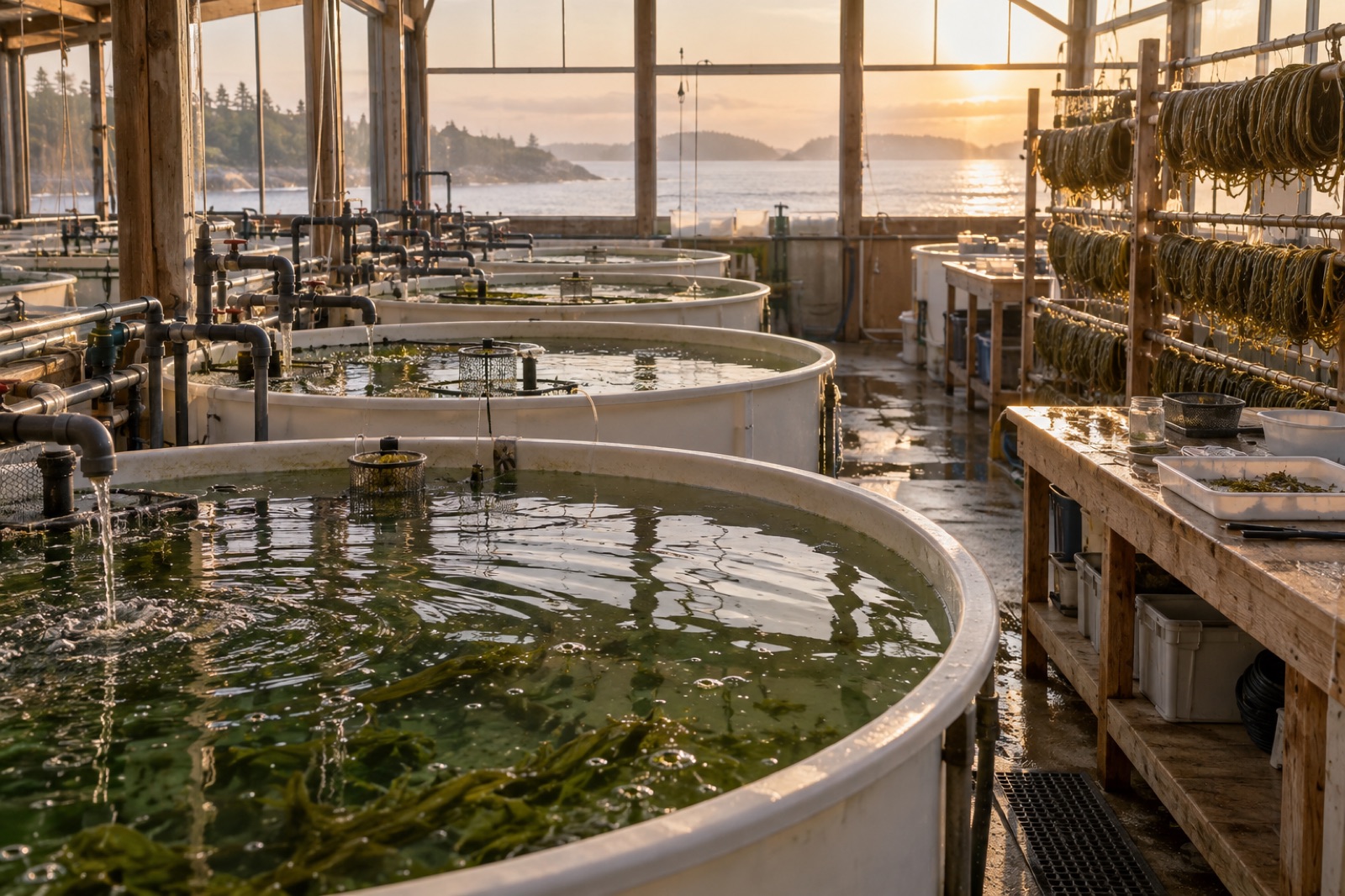
A forest is only as strong as its seed. Holdfast hatcheries culture kelp gametophytes from wild broodstock collected near each project site, selecting for the warm-water tolerance the next decade demands. Lines are spun from biodegradable fibre and shipped to Drifter crews ready to lay — genetics matched to place, never imported blind.
How it works
Collect local broodstock
Mature sporophylls are gathered with local partners and sea-country rangers inside agreed provenance zones, so the archive starts from the genetics that evolved on that coast.
Bank the gametophytes
Microscopic gametophyte cultures are held cold and dim — a living library of local genetics with five-plus years of viability, insuring each coast against the next heatwave.
Blend for resilience
For each deployment site we select up to twelve regional genotypes, weighting the blend toward warm-water tolerance measured in our thermal stress trials.
Seed the line
Biodegradable coir-blend lines pass through spore tanks and emerge carrying roughly 1.8 million viable gametophytes per kilometre, cured and quality-checked before shipping.
Key specifications
- Substrate
- Biodegradable coir-blend line, gone in 18–24 months
- Density
- ~1.8 M viable gametophytes per km of line
- Genetics
- Up to 12 regional genotypes per deployment
- Hatchery capacity
- 1.2 M seeded-line metres per site per year
- Cold bank
- Regional gametophyte archive, 5+ year viability
- Species
- Giant kelp, bull kelp, golden kelp, longline-farmed browns
Specifications describe Tidewright’s fictional systems and are illustrative. Full spec sheet →
Monitoring, verification & blue carbon
Canopy Ledger
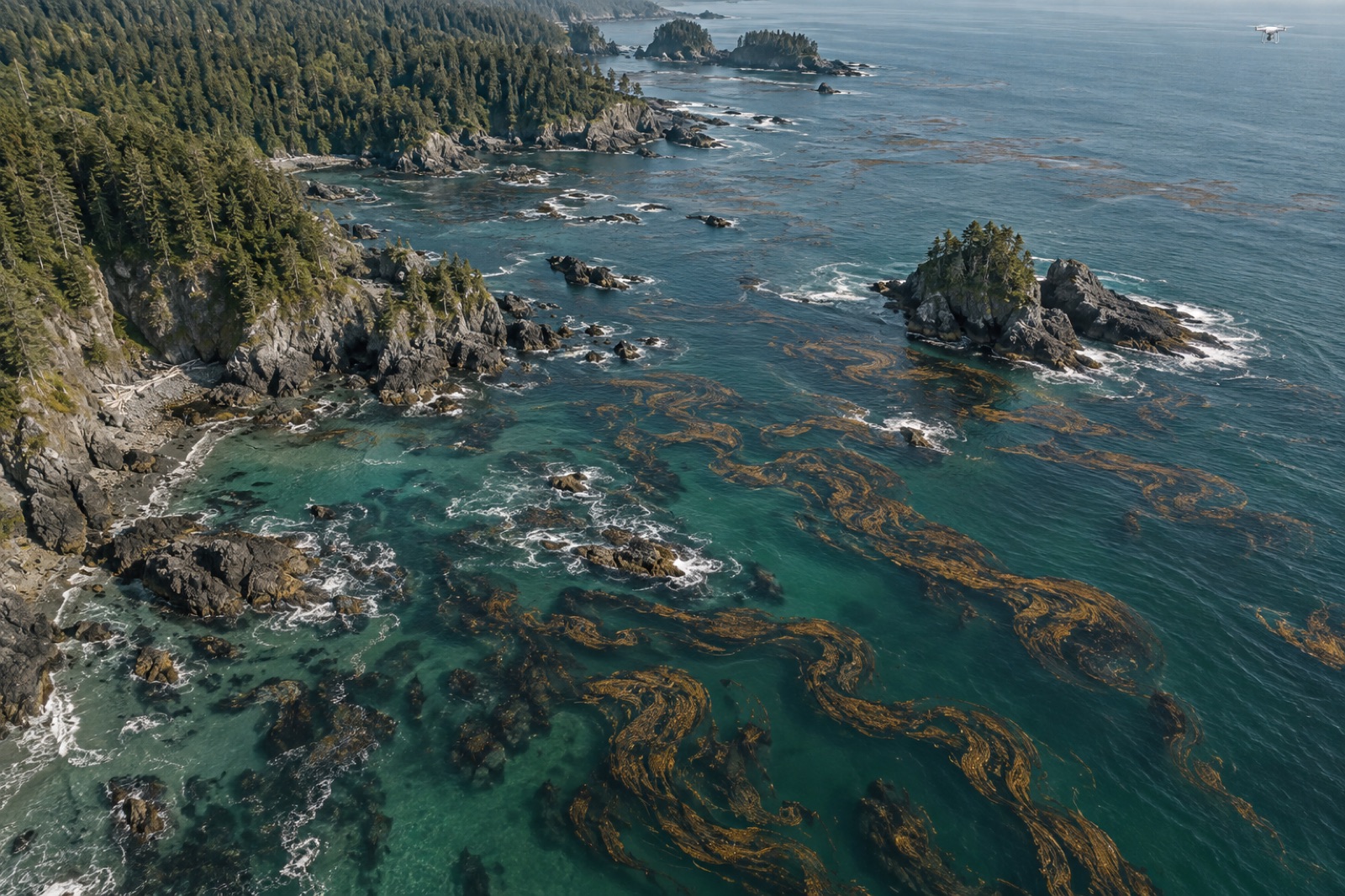
Restoration only counts if you can prove it. Canopy Ledger fuses satellite imagery, drone photogrammetry and in-water surveys into a public record of every hectare Tidewright touches — then turns verified canopy and biodiversity gains into credits that council budgets and corporate buyers can actually purchase.
How it works
Map the canopy
Satellite passes trace canopy extent weekly through every season; monthly drone photogrammetry resolves density and edge condition over active sites.
Survey in the water
Drifter camera runs, dive transects and eDNA samples count recruits, urchins, fish and returning predators — the living picture under the canopy.
Model the outcomes
Biomass, export and biodiversity models are fitted against permanent field plots, so every site number traces back to measured plots, not global averages.
Verify independently
Third-party reviewers audit the models, the plots and the chain of custody annually. Nothing is issued before that audit closes.
Key specifications
- Canopy detection
- F1 0.93 on held-out winter imagery
- Revisit rate
- Weekly satellite; monthly drone over active sites
- Verification
- Independent third-party audit, annual
- Transparency
- Site-level canopy data published open access
- Credit types
- Blue carbon (CO₂e) and biodiversity uplifts
- Permanence
- 20-year stewarded sites with buffer pools
Specifications describe Tidewright’s fictional systems and are illustrative. Full spec sheet →
Kelp products that pay for the forest
Tidewright Harvest
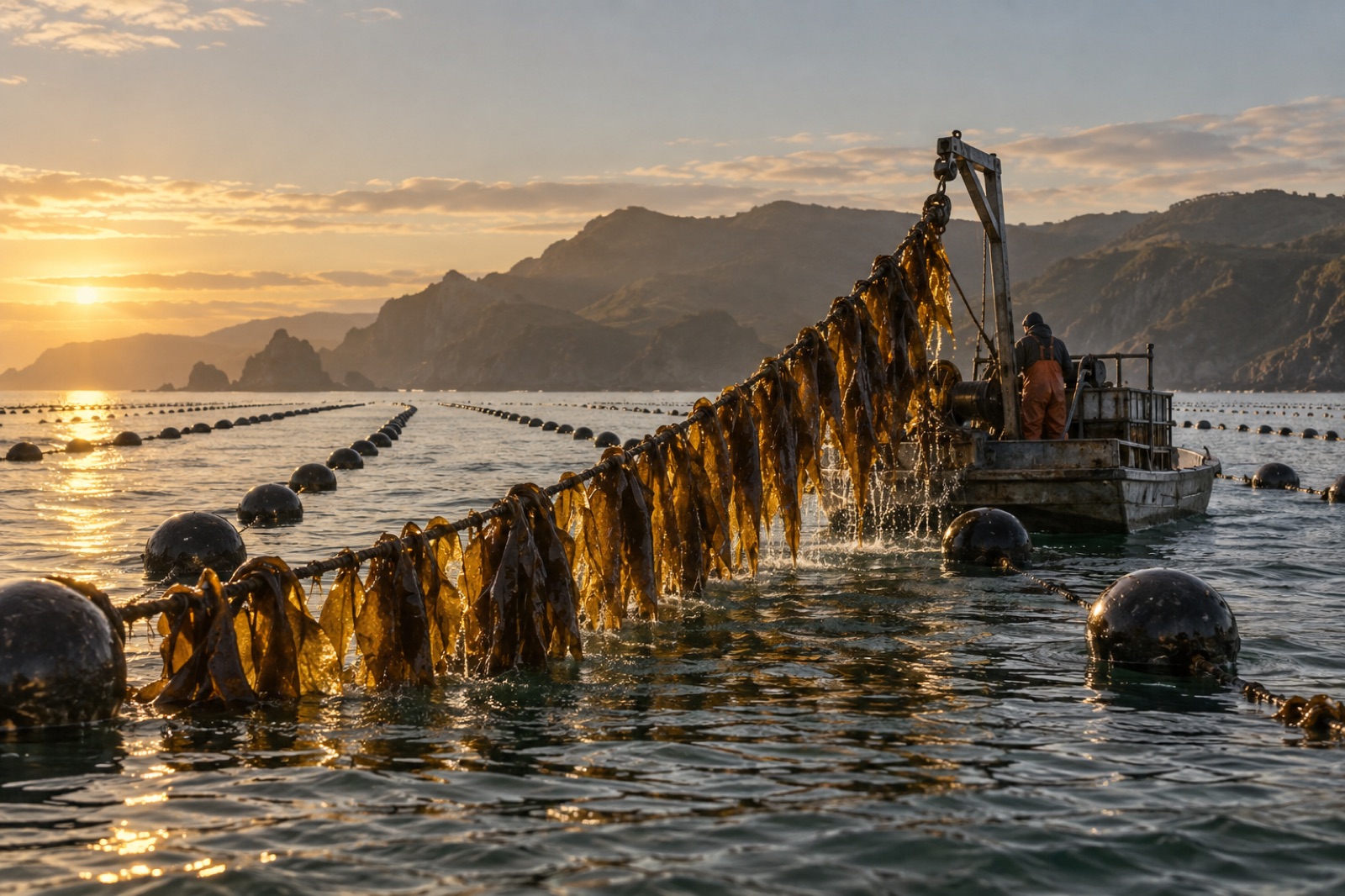
Restoration needs revenue that renews itself. Tidewright Harvest farms kelp on longlines adjacent to restoration sites — close enough to share genetics and logistics, far enough to protect wild canopy — and turns it into food, biostimulants and bioplastic feedstock. Every tonne sold underwrites the next reef.
How it works
Farm beside the reef
Longline farms operate adjacent to restoration sites under the same provenance and monitoring rules — sharing vessels, hatcheries and survey data without touching credited canopy.
Grow on sunlight alone
Subtidal longlines need no feed, no freshwater and no fertiliser. The crop draws on ambient nutrients and daylight, with the farm monitored for biofouling and grazing pressure all season.
Cut above the meristem
Blades are harvested by cutting above the growth zone, so every plant regrows through the season and one seeded line yields multiple light-touch harvests.
Process within hours
Shore-side facilities dry, mill and ferment the landing the same day — the difference between food-grade kelp and compost is a few hours of handling discipline.
Key specifications
- Products
- Food-grade kelp, soil biostimulants, bioplastic feedstock
- Farm type
- Subtidal longline, no feed or freshwater input
- Harvest rule
- Blade-only cut above the meristem
- Reef Fund share
- 30% of Harvest net revenue
- Traceability
- Batch-level tracking from line to product
- Carbon
- Farmed volume separate from credited restoration
Specifications describe Tidewright’s fictional systems and are illustrative. Full spec sheet →
Questions
Platform FAQ
- Can a council or fishery contract Tidewright directly?
- Yes. Reef Partners programs are structured around local budgets — from single-site pilots to multi-year regional restoration. Write to hello@tidewright.earth with your coastline and goals.
- Is the carbon from kelp restoration permanent?
- We only issue credits against carbon pathways with credible durability — long-lived biomass export to deep water and stewarded sites with 20-year commitments and buffer pools. Our Canopy Ledger methodology pages explain what we count and, just as importantly, what we don’t.
- Do Harvest farms compete with wild kelp beds?
- No. Farms sit adjacent to restoration sites, operate under the same genetic provenance rules, and are excluded from credited restoration areas. Their revenue is what keeps restoration non-philanthropic.
- How do local communities and Traditional Owners take part?
- Sea-country rangers and local councils co-design provenance zones, run paid monitoring dives, and hold seats on each project’s steering group. Restoration on someone else’s coast without that partnership is not restoration we do.
Reef Partners
Bring your coastline back to life.
Coastal councils, fisheries, carbon buyers, dive operators and schools — tell us about your water and we’ll tell you what it could grow.
Tidewright is a fictional company created as a design and content demonstration. Enquiries go nowhere — but the demo is real.