The platform — Climate-resilient kelp nurseries
Holdfast
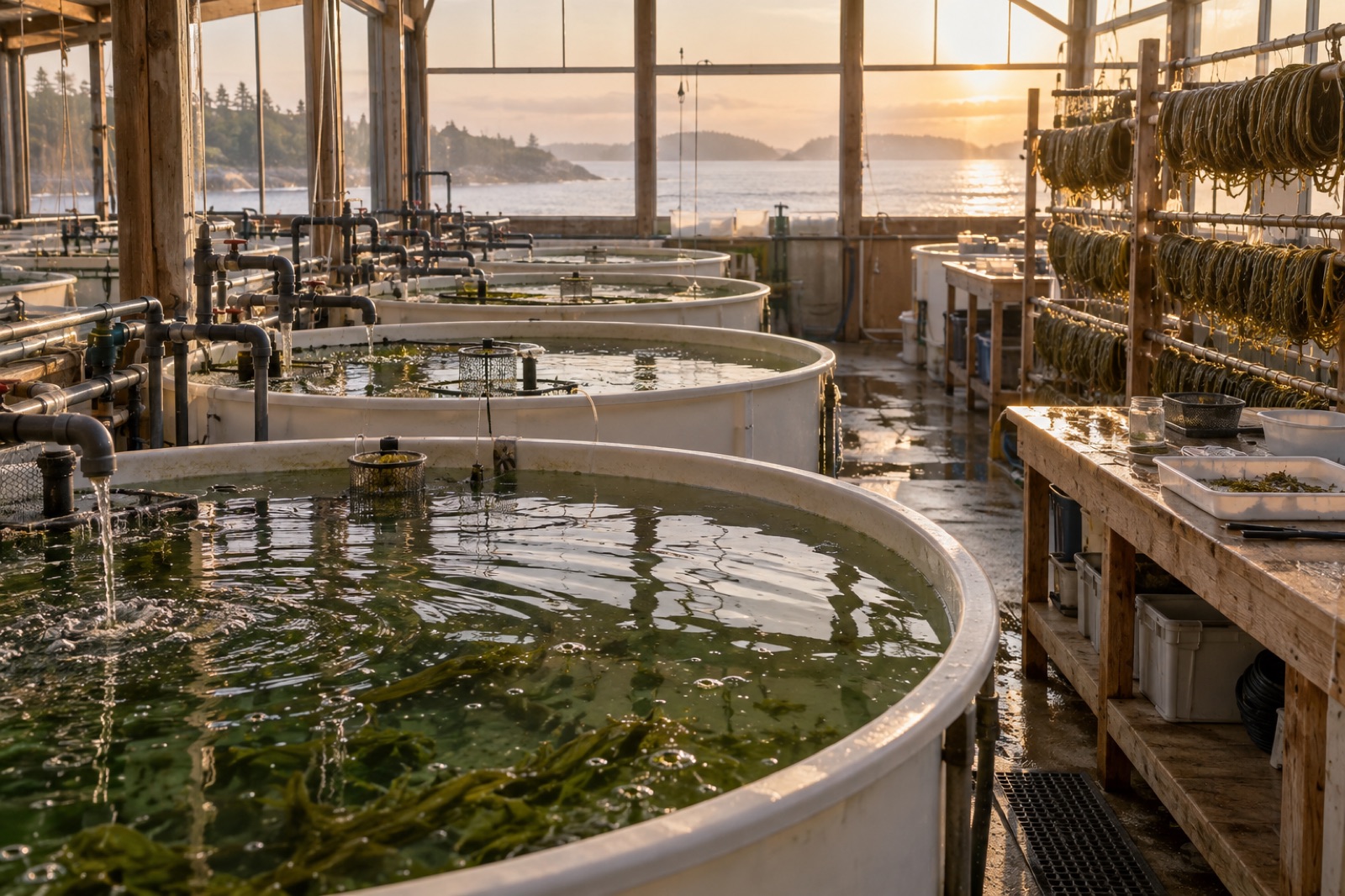
A forest is only as strong as its seed. Holdfast hatcheries culture kelp gametophytes from wild broodstock collected near each project site, selecting for the warm-water tolerance the next decade demands. Lines are spun from biodegradable fibre and shipped to Drifter crews ready to lay — genetics matched to place, never imported blind.
Why it exists
A forest is only as strong as its seed.
Most restoration fails before it begins, at the seed. Wild spore supply collapses exactly when a forest collapses, and importing stock from distant populations trades one problem for another: outbred maladaptation, or worse, a forest with no defence against the next heatwave.
Holdfast treats seedstock as infrastructure. Broodstock is collected inside strict provenance zones agreed with local partners and sea-country rangers, banked as living gametophyte cultures, and blended into deployment lots of up to twelve regional genotypes — each lot tuned for the thermal future of the coast it is going back to. The same discipline runs every Tidewright farm line, so cultivation and restoration never work against each other.
In the field
- viable gametophytes per km of seeded line
- 1.8 M
- regional genotypes per deployment blend
- 12
- gametophyte viability in the cold archive
- 5+ yrs
Tidewright’s own fictional system figures, shown for demonstration.
Anatomy
Inside Holdfast
The Holdfast pipeline: from provenance-zone broodstock to a chilled spool of seeded line, with the cold archive insuring every step.
The flow
How Holdfast works
Collect local broodstock
Mature sporophylls are gathered with local partners and sea-country rangers inside agreed provenance zones, so the archive starts from the genetics that evolved on that coast.
Bank the gametophytes
Microscopic gametophyte cultures are held cold and dim — a living library of local genetics with five-plus years of viability, insuring each coast against the next heatwave.
Blend for resilience
For each deployment site we select up to twelve regional genotypes, weighting the blend toward warm-water tolerance measured in our thermal stress trials.
Seed the line
Biodegradable coir-blend lines pass through spore tanks and emerge carrying roughly 1.8 million viable gametophytes per kilometre, cured and quality-checked before shipping.
Ship ready to lay
Seeded spools travel chilled to the project site and go directly onto the Drifter laying arm — hatchery to reef in days, with viability logged at every handoff.
Specification
The Holdfast spec sheet
The numbers that define a working deployment — sized for real coastlines, weather and budgets, and consistent across every Tidewright program.
Specifications describe Tidewright’s fictional systems and are illustrative.
- Substrate
- Biodegradable coir-blend line, gone in 18–24 months
- Density
- ~1.8 M viable gametophytes per km of line
- Genetics
- Up to 12 regional genotypes per deployment
- Hatchery capacity
- 1.2 M seeded-line metres per site per year
- Cold bank
- Regional gametophyte archive, 5+ year viability
- Species
- Giant kelp, bull kelp, golden kelp, longline-farmed browns
- Provenance
- Collection zones co-agreed with local partners
- Quality control
- Settlement density and viability logged per spool
Go deeper
From the journal and the field
Questions
Holdfast FAQ
- Why not just collect spores and spread them?
- Because unblended, unbanked spores are a gamble on one season’s genetics. Culturing gametophytes lets us hold local diversity in reserve, test it against future temperatures, and deploy a measured blend rather than a lottery ticket.
- Does selecting for heat tolerance weaken the stock in other ways?
- That risk is exactly why we blend rather than replace. A deployment lot carries up to twelve regional genotypes and never one lab super-strain — resilience here means keeping options open, not breeding a monoculture.
- How long does the seeded line last?
- The line is doing its job if it is gone inside 18 to 24 months. The coir-blend fibre holds gametophytes through settlement and early sporophyte growth, then biodegrades — by the time it disappears, the young kelp’s own holdfasts should be anchored to rock.
- Can outside hatcheries or communities use Holdfast seedstock?
- Within a provenance zone, yes — we supply seeded line to restoration partners and Reef Partners programs under the same blending and logging rules we use ourselves. Stock never crosses provenance zones.
The rest of the platform
Put Holdfast on your coastline.
Councils, fisheries, carbon buyers and community partnerships — the Reef Partners program scopes sites, budgets and timelines around your water.