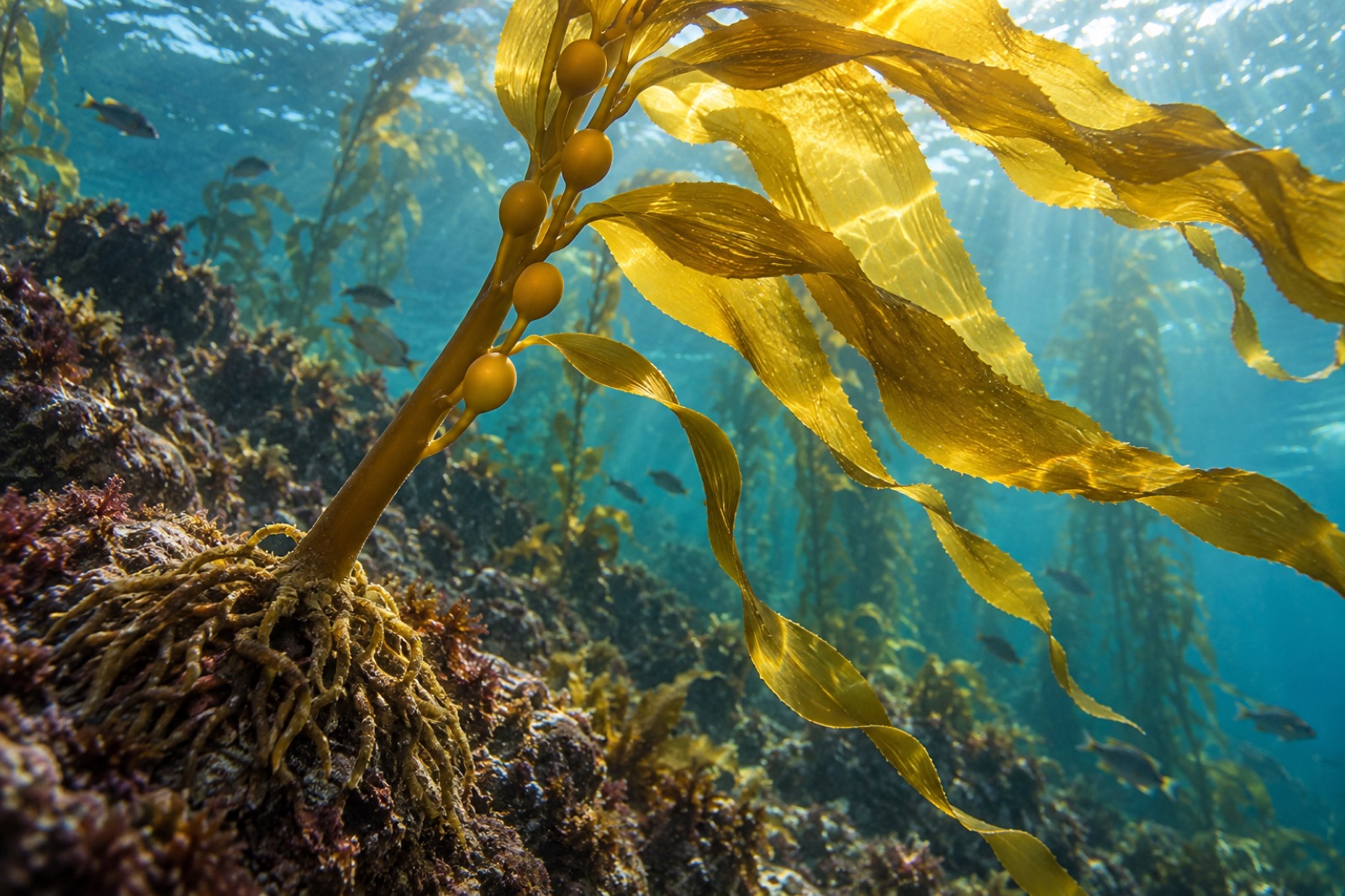
Giant kelp (Macrocystis pyrifera) is the largest alga on Earth and one of the fastest-growing organisms of any kind, adding up to half a metre of height in a single day under good conditions. It forms the towering underwater forests of cool-temperate coasts — from California to Chile, Tasmania to South Africa — and those forests shelter hundreds of other species. If you understand giant kelp, you understand what Tidewright exists to protect.
Fast facts
|
|
| Scientific name |
Macrocystis pyrifera |
| Group |
Brown algae (Phaeophyceae), order Laminariales |
| Maximum length |
Over 45 metres from holdfast to canopy |
| Growth rate |
Up to ~50 cm per day in spring conditions |
| Depth range |
Typically 6–30 m, on rocky substrate |
| Temperature preference |
Roughly 8–20 °C; stressed above ~21 °C |
| Distribution |
Cool-temperate coasts of both hemispheres: the northeast Pacific (Alaska to Baja California), Chile and Argentina, Peru, Tasmania and New Zealand, South Africa, and subantarctic islands |
Anatomy of a forest giant
Giant kelp is not a plant, and its structures are easy to misread if you think in plant terms.
The holdfast
At the base sits the holdfast — a tangled, root-like mass of haptera that anchors the alga to bare rock. It absorbs no nutrients; it is pure engineering, gripping the substrate against swell. A healthy holdfast community is itself habitat: brittle stars, worms and juvenile abalone shelter in its crevices. You can read more about the biology of this anchor in our explainer on holdfasts and how kelp grips the reef.
Stipes, blades and pneumatocysts
From the holdfast rise dozens of stipes — long, flexible stripes of tissue that carry the blades. Each blade grows at its base and wears away at its tip, so the kelp renews itself continuously, like a conveyor belt of tissue. Every blade has a small gas-filled float, a pneumatocyst, at its base; these lift the fronds toward the sunlight and give a forest its characteristic cathedral-light quality.
The surface canopy
When fronds reach the surface they spread into a canopy that can cover hectares. That canopy is what satellites see, what sea otters wrap themselves in, and what our Canopy Ledger monitoring system measures from orbit and by drone.
A two-generation life cycle
Like all brown kelps, giant kelp alternates between two generations.
- The sporophyte is the giant you see on a dive. Adult blades grow patches of tissue called sori that release millions of microscopic zoospores.
- Those spores settle on rock and grow into the gametophyte generation — a few cells, invisible to the naked eye, producing eggs and sperm.
- Fertilisation produces a new microscopic sporophyte, which grows into the next giant.
Crucially, the microscopic stage persists even when the visible forest is gone. A barren reef may still carry dormant gametophytes waiting for conditions to improve — one reason restoration seeding works, and the biological basis of our Holdfast nursery system, which raises this microscopic generation on lines at industrial density.
Where giant kelp lives — and why there
Giant kelp needs three things: cool water, nutrients, and rock.
- Temperatures above about 21 °C degrade growth and reproduction, which is why marine heatwaves are so destructive — a few weeks of anomalously warm water can deforest a coastline.
- Nitrate is the limiting nutrient, delivered by upwelling and by terrestrial runoff. The great kelp coasts of the world — California, Chile's Humboldt coast, Tasmania — are all places where cold, nutrient-rich water reaches the sunlit shallows.
- It cannot anchor in sand. Rocky reef in 6–30 m of water is forest floor; the Coastal Atlas maps these coastlines region by region.
The ecosystem engineer
A giant kelp forest is a three-dimensional habitat that changes the oceans around it:
- Nursery. Juvenile fish, including commercially important rockfish, recruit into the canopy.
- Grazing ground. Sea urchins feed on drift kelp at the forest floor; in balance, they are part of the system. Out of balance — when predators like sea otters or large rock lobster are missing — they can graze a forest into a barren.
- Carbon engine. Kelp fixes carbon as fast as terrestrial forests do per unit area. Some of that carbon, exported as drifting fragments, reaches the deep sea — a pathway we explore in our blue carbon coverage.
- Coastal buffer. A kelp canopy measurably reduces wave energy reaching the shore.
Threats
The pattern repeats on every continent:
- Warming reduces nutrient supply and physiologically stresses the plants.
- Marine heatwaves deliver acute deforestation events.
- Urchin outbreaks convert recovering forests to barrens when predator populations are missing.
- Sediment and pollution cloud the shallow light kelp needs.
Many of these pressures interact — a heatwave weakens kelp, urchins multiply on the wreckage, and the system flips into a barren state that resists recovery. Breaking that feedback loop is the core engineering problem of kelp restoration, and the reason Tidewright pairs reseeding vessels with urchin management and long-term monitoring.
Conservation status and outlook
Giant kelp as a species is widespread and not considered at risk of global extinction — but that framing is misleading. The species persists as scattered stands while the forests, and the ecosystem services they provide, have collapsed locally. A kelp plant surviving on a harbor wall is not a kelp forest. Protecting the ecosystem means protecting the conditions that allow whole forests to persist: cool, clean water, intact food webs, and room to recover after the heatwaves that are now arriving more often.
Key takeaways
- Giant kelp is the fastest-growing organism on Earth — up to ~50 cm per day — and forms forests on cool, rocky, nutrient-rich coasts worldwide.
- It alternates between a giant sporophyte generation and a microscopic gametophyte generation that can persist on barren reefs.
- It anchors with a holdfast, rises on stipes and blades, and floats a surface canopy on gas-filled pneumatocysts.
- Warming, marine heatwaves and urchin outbreaks are its principal threats, and they compound one another.
- Restoration is possible — the microscopic life stage and modern seeding techniques give us the tools — but must be paired with predator recovery and monitoring.
FAQ
Is giant kelp a plant?
No. Giant kelp is a brown alga — more closely related to certain single-celled plankton than to any land plant. Its holdfast, stipe and blades look plant-like but evolved independently, and the holdfast absorbs no nutrients.
How fast does giant kelp grow?
Under ideal spring conditions — cool, nutrient-rich water and long days — growth of around 30–50 cm per day has been measured. Fronds then elongate over metres per week. Few multicellular organisms grow faster.
Can giant kelp survive warm water?
Briefly, but poorly. Growth and reproduction degrade above roughly 20–21 °C. During marine heatwaves, giant kelp forests can lose most of their canopy within weeks, especially when warm water also suppresses the nutrient supply kelp needs to regrow.
What eats giant kelp?
Sea urchins are the main grazers, along with abalone and some fish. In a balanced forest, much of what urchins eat is drift kelp — detached fronds washing down to the reef. When predators that control urchins (sea otters, lobsters, large fish) disappear, urchins can graze living kelp faster than it can grow.
How is giant kelp restored?
Tidewright's approach seeds barren reefs with cultured gametophytes raised on biodegradable lines in our Holdfast hatcheries, laid by Drifter vessels, then verified through our monitoring platform as a forest re-establishes.