Encyclopedia10 min read
Atlantic Wolffish (Anarhichas lupus): The Shell-Crusher of Cold Reefs
Meet the Atlantic wolffish — a fanged, antifreeze-blooded reef fish that crushes sea urchins and has declined badly from trawl bycatch.
Dr. Theo Nakamura ·
241 articles
Meet the Atlantic wolffish — a fanged, antifreeze-blooded reef fish that crushes sea urchins and has declined badly from trawl bycatch.
Dr. Theo Nakamura ·
Plunging from thirty metres at highway speed, the Australasian gannet runs the baitfish economies of southern kelp coasts. Meet Morus serrator, the takapu.
Dr. Theo Nakamura ·
A species profile of the Australian fur seal, Bass Strait's biggest pinniped — nearly sealed out of existence, now recovering along the kelp coasts of the south.
Dr. Mara Ellison ·
Europe's biggest wrasse rules the kelp rocks: nest-building, sex-changing, shell-crushing — and now conscripted onto salmon farms as a cleanerfish. Full profile.
Dr. Mara Ellison ·
The banded morwong is a slow-growing, site-loyal grazer of Tasmania's kelp reefs — a fish that can live for generations and taught fisheries a hard lesson.
Dr. Theo Nakamura ·
Basket stars unfurl branching arms into cold currents to sieve plankton at night. Meet Gorgonocephalus eucnemis, the kelp coast's living gorgon head.
Dr. Mara Ellison ·
The bat ray is a winged, shell-crushing ray of Pacific bays and kelp edges. Biology, the famous feeding pits, and why divers mistake it for something grander.
Dr. Mara Ellison ·
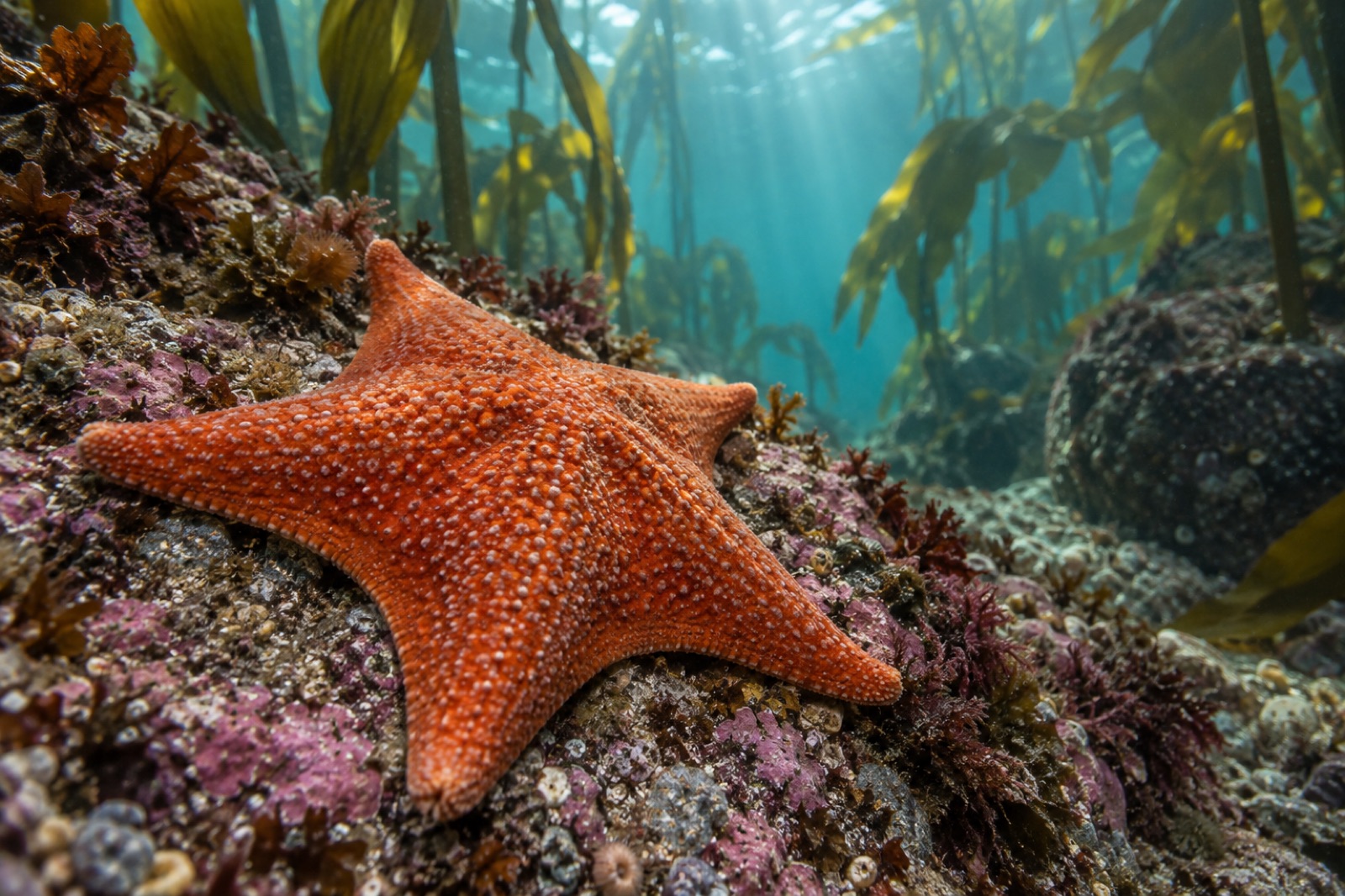
The bat star (Patiria miniata) is the kelp forest's web-fingered clean-up crew — a slow omnivore that turns detritus into reef fertility. Facts, ecology, where to see one.
Dr. Theo Nakamura ·
The big skate is the Pacific's largest skate — a 2.4-metre flatfish-eyed predator of the kelp-edge sands, famous for giant mermaid's-purse egg cases with twins inside.
Dr. Mara Ellison ·
The black-and-yellow rockfish holds one crevice for years and defends it with venom-tipped spines — a lesson in how site-attached reef fish live and recover.
Dr. Elias Brandt ·
The black croaker drums after dark in Southern California's kelp beds. How to identify Cheilotrema saturnum, where to find it, and why it sings.
Dr. Mara Ellison ·
The black surfperch (Embiotoca jacksoni) is the thick-lipped, slow-browsing seaperch of California kelp beds — live-bearing, territorial and endlessly photogenic.
Dr. Mara Ellison ·
The black-and-yellow rockfish is one of the most boldly patterned fish of California's shallow kelp reefs — dark as kelp shadow, patched with shout-yellow.
Dr. Theo Nakamura ·
Pale, black-eyed and hovering nose-down over the reef: how to find, identify and read the blackeye goby, one of the kelp forest's most telling fish.
Dr. Mara Ellison ·
The blacklip abalone is southern Australia's largest abalone — a kelp-fed reef grazer that supports one of the world's most valuable wild shellfish fisheries.
Dr. Theo Nakamura ·
The blacksmith (Chromis punctipinnis) is the blue-grey damselfish clouding over California kelp beds. Profile: nesting wars, cleaner queues and plankton patrol.
Tom Okafor ·
Henricia leviuscula, the scarlet blood star of Pacific reefs — smooth-skinned, patient, and able to catch plankton with its stomach. A complete species profile.
Dr. Mara Ellison ·
The blue-rayed limpet lives its whole life on kelp, its shell shot through with living blue light — a profile of Europe's smallest, most beautiful kelp grazer.
Dr. Mara Ellison ·
The brown rockfish is the shallowest of the Pacific rockfish — a dusky, bay-loving homebody of kelp beds, pier piles and eelgrass edges from Alaska to Baja.
Dr. Theo Nakamura ·
Pholis gunnellus lives in kelp holdfasts and under tidepool stones, can cross wet rock between pools, and carries a necklace of eyespots down its back.
Dr. Theo Nakamura ·
The cabezon Scorpaenichthys marmoratus is the largest sculpin on the Pacific coast — an egg-guarding ambush predator of kelp reefs with famously toxic roe.
Dr. Mara Ellison ·
Mytilus californianus builds wave-swept mussel beds that shelter hundreds of species. Glue chemistry, keystone starfish, zonation and conservation.
Dr. Mara Ellison ·
Panulirus interruptus is the clawless, night-hunting lobster of California kelp reefs — an urchin predator, a famous fishery, and a quiet guardian of the forest.
Dr. Theo Nakamura ·
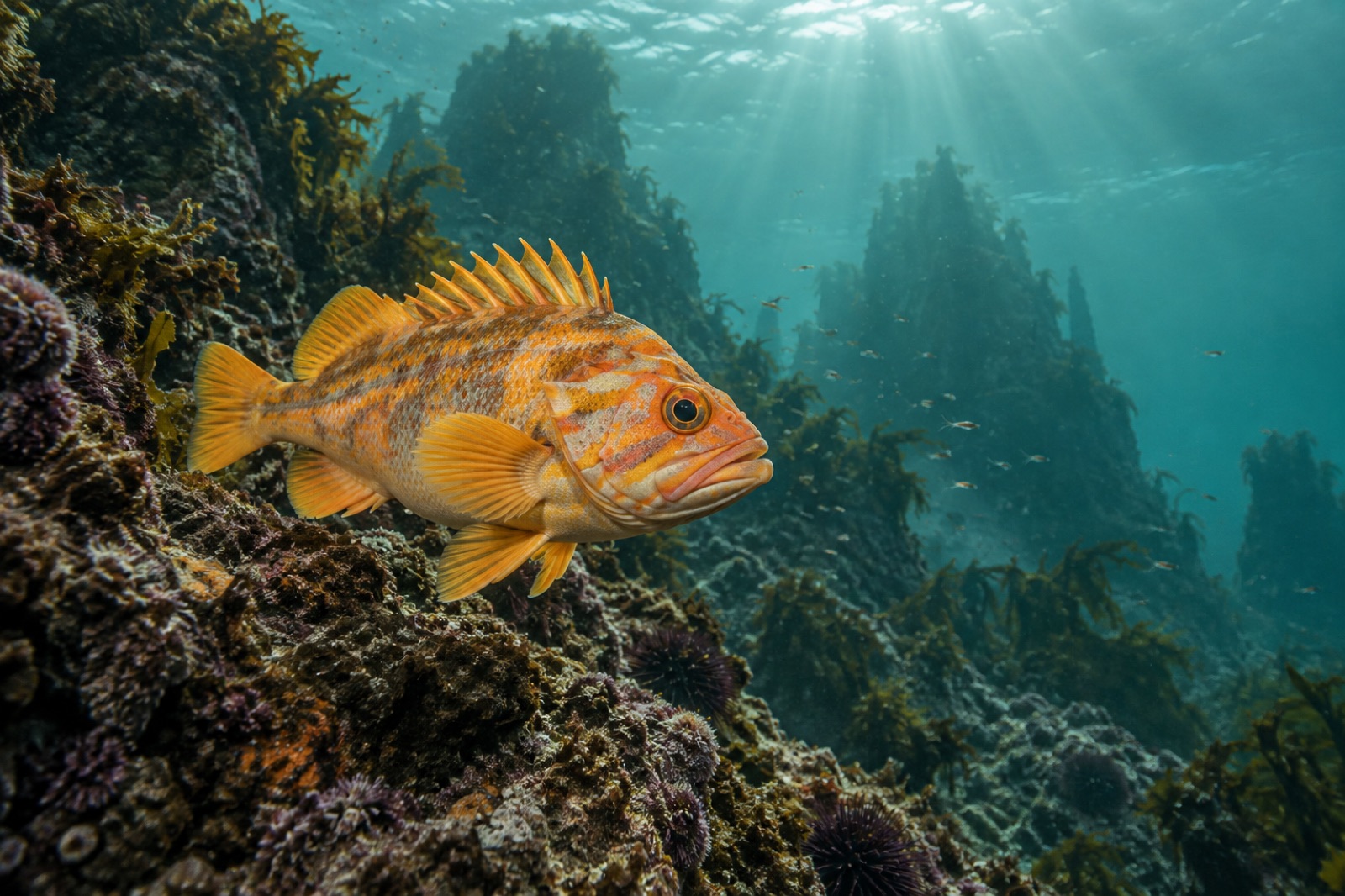
The canary rockfish went from overfished to rebuilt in fifteen years — one of the US west coast's most instructive fisheries recovery stories.
Dr. Mara Ellison ·
Cystoseira osmundacea — chain bladder kelp — strings pearl-like floats along California's subtidal rocks. Identification, biology, and why it's no true kelp.
Dr. Mara Ellison ·
Neobernaya spadicea, the chestnut cowry, is the only cowry native to California — a glossy chestnut shell beneath a blazing orange mantle, grazing the reef by night.
Dr. Theo Nakamura ·
The Chilean kelp crab — jaiba marmola — is a spider-crab grazer of great kelp beds and the centre of a diver-run artisanal fishery. A species and livelihood profile.
Dr. Mara Ellison ·
Lessonia trabeculata, the huiro, builds Chile's great subtidal kelp forests and feeds a global alginate industry. Biology, fishery, ecology and El Niño risk.
Dr. Theo Nakamura ·
The China rockfish is a small, blue-black, yellow-speckled reef fish that rarely leaves its crevice. Biology, identification, habits and conservation.
Dr. Mara Ellison ·
Cochayuyo is Chile's great edible bull kelp — a surf-loving brown alga, a market staple and an ocean-going raft. Biology, culture, harvest and rafting ecology.
Dr. Theo Nakamura ·
Meet the common murre, the foot-propelled pursuit diver of kelp-coast upwellings — a flying auk that hunts 100 metres down and raises chicks on bare cliffs.
Dr. Mara Ellison ·
The copper rockfish (Sebastes caurinus) is a cryptic, long-lived, home-ranged reef fish of Pacific kelp forests. Biology, fishery history and how it recovers.
Dr. Mara Ellison ·
Coralline algae are calcified red algae that paint reefs pink, cement them together and decide where young shellfish settle. Forms, ecology and climate risks.
Dr. Theo Nakamura ·
Meet the corkwing wrasse: a small nest-building cleanerfish of Europe's kelp forests, now caught at scale for salmon farms — biology, ID marks, reef role.
Dr. Mara Ellison ·
Crustose coralline algae look like pink paint on reef rock, but they are the settlement cue abalone and urchins need. CCA biology and why restoration depends on it.
Dr. Mara Ellison ·
Cystoseira and kin built the Mediterranean's underwater forests for millennia. Why these canopy algae are retreating, and what it takes to bring them back.
Dr. Mara Ellison ·
Dall's porpoise is the slate-and-white speedster of the cold North Pacific, famous for its rooster-tail splash. Biology, range, speed and how to spot one.
Dr. Mara Ellison ·
Chorda filum is a true kelp disguised as a slippery brown string. Where the bootlace kelp grows, how a hollow cord survives a year, and its edible end.
Dr. Theo Nakamura ·
Decorator crabs build living costumes from algae, sponges and anemones using velcro-like hairs. How the disguise works, why it evolved and where to see it.
Dr. Mara Ellison ·
Eisenia arborea, the southern sea palm, is the tree-like kelp of the California–Baja low shore. Profile of its ecology, range shifts and role.
Dr. Theo Nakamura ·
The flat porcelain crab packs under Pacific shore rocks by the hundred, sifting plankton with feathery mouthparts and shedding legs it can calmly regrow.
Dr. Theo Nakamura ·
The giant kelpfish changes colour to vanish among kelp blades. Identification, camouflage, behaviour and life cycle of this Southern California clinid.
Dr. Theo Nakamura ·
Megathura crenulata, the giant keyhole limpet, cloaks its shell in a living mantle and bleeds blue blood prized by medicine. Identification, diet and reef role.
Dr. Theo Nakamura ·
Apostichopus californicus, the biggest sea cucumber on the Pacific coast, recycles kelp forest sediment from Alaska to California. Biology, defences, fishery.
Dr. Theo Nakamura ·
The goldsinny wrasse is the most abundant small wrasse on Europe's kelp coasts — a parasite cleaner, nest guard and aquaculture conscript. Full species profile.
Dr. Theo Nakamura ·
Lepas anatifera spends its life attached to flotsam — kelp rafts, driftwood, plastic. Anatomy, the goose myth, tsunami debris and where to find them.
Dr. Mara Ellison ·
The gopher rockfish is a mottled, hole-dwelling resident of California's shallow kelp reefs — sedentary, long-lived and beloved of reef divers.
Dr. Theo Nakamura ·
The graceful kelp crab is the smaller, rougher, more widely wandering sibling of the northern kelp crab — as at home in eelgrass as on a kelp frond.
Dr. Mara Ellison ·
Meet the grass rockfish (Sebastes rastrelliger): a shallow-water ambush predator that barely leaves home — and pays for that loyalty when the pressure comes.
Dr. Mara Ellison ·
Gray whales swim some 10,000 km each way between Arctic feeding grounds and Baja lagoons, hugging the kelp line. Feeding, migration, kelping and survival.
Dr. Mara Ellison ·
Gray whales hug kelp coastlines for 20,000 kilometres a year — feeding, rubbing and hiding calves in the kelp line. The whale–kelp forest connection, explained.
Dr. Mara Ellison ·
Haliotis fulgens, the green abalone, is a kelp-trapping herbivore of Baja and southern California. Shell, life cycle, fishery history and recovery.
Dr. Theo Nakamura ·
Endemic to New Zealand, the green-lipped mussel filters big southern water, builds reef — and anchors one of the world's most admired shellfish farms.
Dr. Mara Ellison ·
The green sea urchin grazes kelp from Norway to Nova Scotia to Alaska. Its biology, the barrens it builds, the roe fishery it feeds, and how reefs recover.
Dr. Mara Ellison ·
The grunt sculpin is a thumb-sized fish that walks on its fin rays, hides inside empty barnacle shells and, it seems, impersonates the barnacle itself.
Dr. Mara Ellison ·
The hairy shore crab is the Pacific coast's estuary specialist — bristle-legged, slow-footed and more comfortable in brackish water than its purple cousin.
Dr. Mara Ellison ·
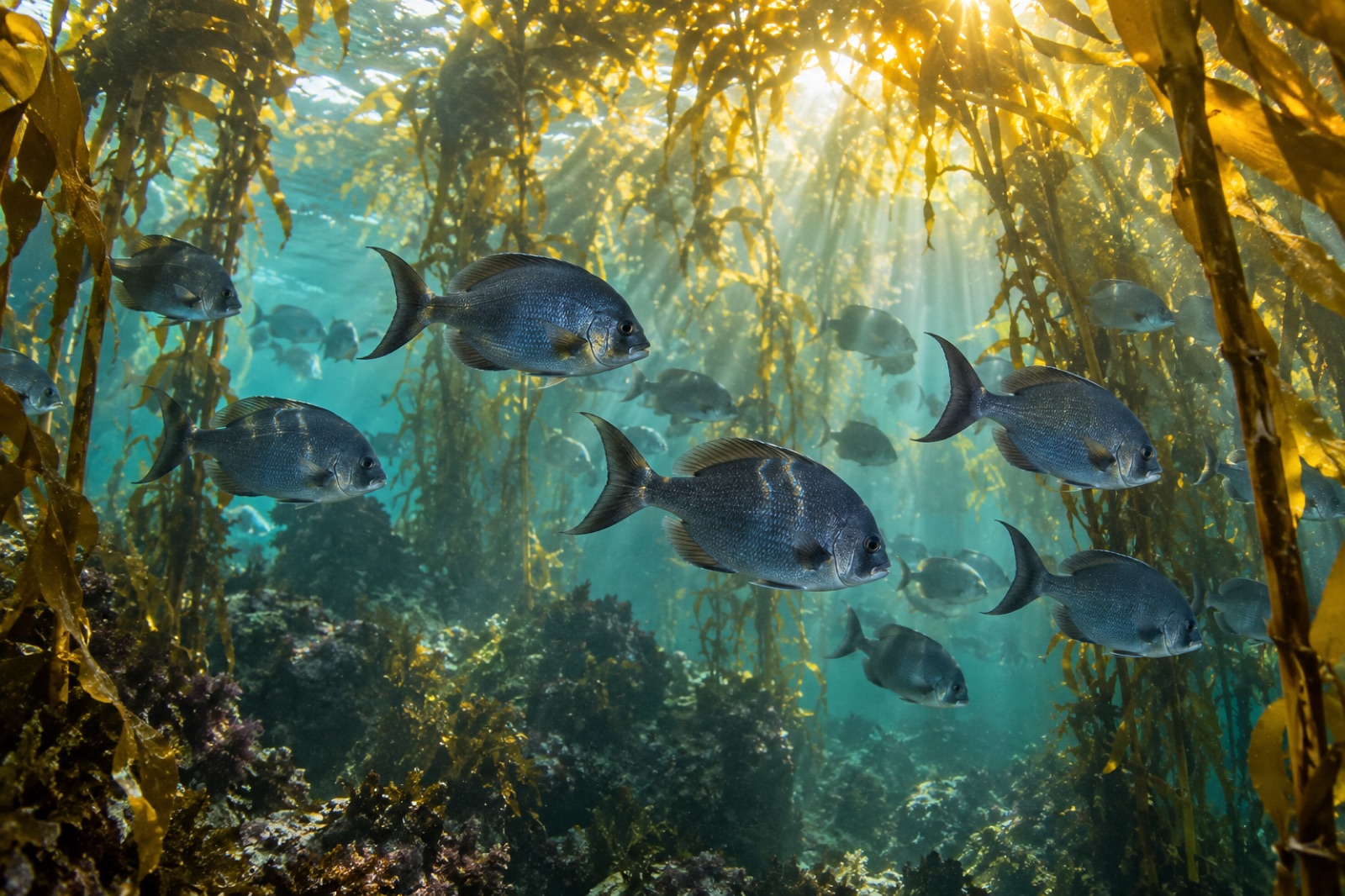
The halfmoon (Medialuna californiensis) is a blue-grey sea chub that grazes kelp on Southern California and Baja reefs — ID, diet and habitat.
Dr. Mara Ellison ·
The hooded nudibranch Melibe leonina is a translucent sea slug that nets plankton from its perch on kelp blades. Biology, diet and where to see one.
Dr. Theo Nakamura ·
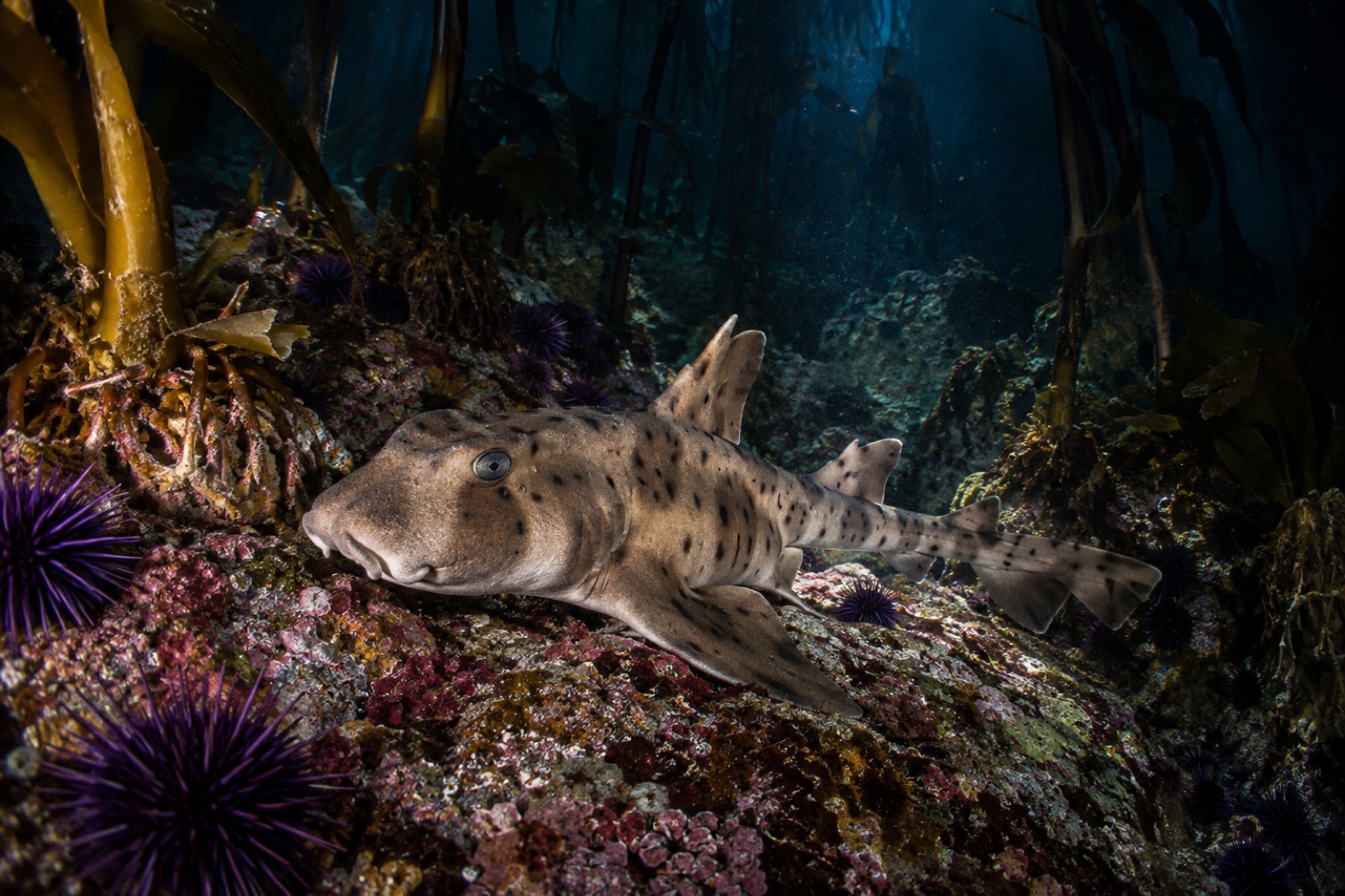
The horn shark is a small, harmless shark that hunts urchins and abalone by night in kelp beds. Biology, the fin spines, the purple teeth, the screw-shaped egg.
Dr. Theo Nakamura ·
The Humboldt penguin breeds in guano caves on the desert coast of Chile and Peru, and fishes in one of the richest — and most changeable — seas on Earth.
Dr. Mara Ellison ·
Irish moss is the small red alga of North Atlantic shores that gave the world carrageenan. Profile: ecology, history, harvest and modern uses.
Dr. Theo Nakamura ·
Kelp greenling are the kelp forest's most colourful small residents — blue-speckled, sex-changing-looking, nest-guarding. Biology, fishery and where to see them.
Dr. Mara Ellison ·
The kelp gull is the default large gull of the southern oceans — an adaptable black-backed coastal bird from Cape Town to the Antarctic Peninsula. Full profile.
Tom Okafor ·
Kelp isopods graze fouling algae off giant kelp blades — and in boom years can chew through the stipes themselves. Meet the forest's smallest crew.
Dr. Theo Nakamura ·
Membranipora membranacea skins kelp blades in white lattices of tiny zooids — a grazer, a fouler and, in warm years, a real force in kelp forest loss.
Dr. Mara Ellison ·
The kelp rockfish (Sebastes atrovirens) lives in the kelp canopy itself — a mottled, camouflaged hunter: identification, habitat, life history and where to see it.
Dr. Theo Nakamura ·
The spiny scallop Chlamys hastata is a sponge-armoured, blue-eyed bivalve of Pacific kelp forests that can swim away from sea stars. Full species profile.
Dr. Theo Nakamura ·
The leather star (Dermasterias imbricata) is a smooth, slippery, garlic-scented sea star that hunts anemones and sea cucumbers — biology, range and how to find it.
Dr. Theo Nakamura ·
About a kilogram of slate-blue determination, the little penguin fishes southern Australia's kelp coasts by day and comes ashore by dark. Meet Eudyptula minor.
Dr. Mara Ellison ·
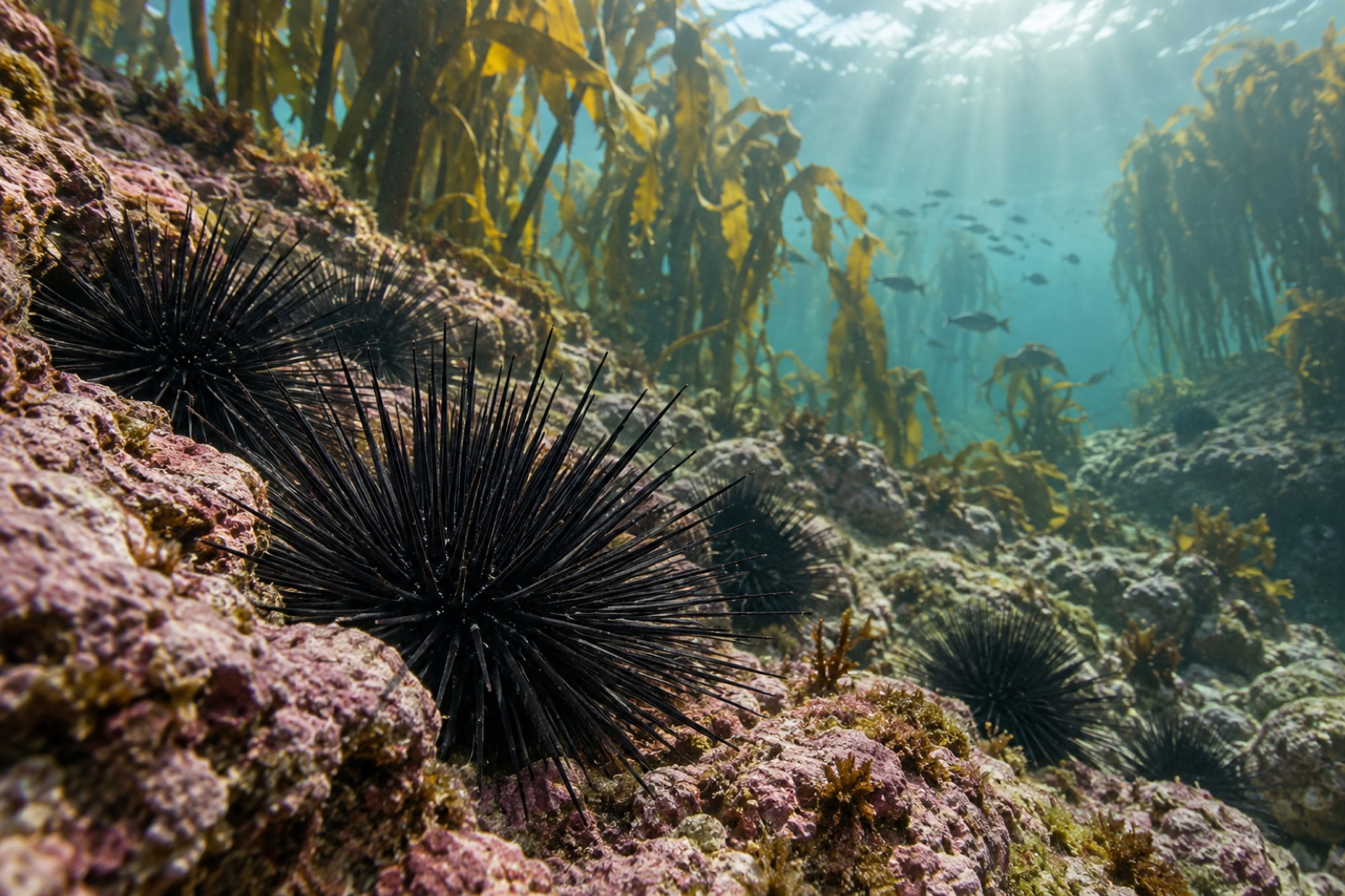
The long-spined sea urchin is reshaping Australia's temperate reefs as warming currents carry it south — a species profile of the barren-builder of Tasmania.
Dr. Lena Fischer ·
The lumpfish is a lumpy, suction-bellied cold-water fish that farms raise by the million to eat sea lice off salmon — and its roe fishery is older than you think.
Naomi Reyes ·
Marbled, thick-lipped and built to crop kelp: the marblefish of New Zealand and southern Australia, a herbivore with the reef's strangest tools.
Dr. Theo Nakamura ·
The monkeyface prickleback is a long, algae-eating fish of Pacific rockpools — not an eel at all. Biology, the diet switch, and why poke-polers prize it.
Tom Okafor ·
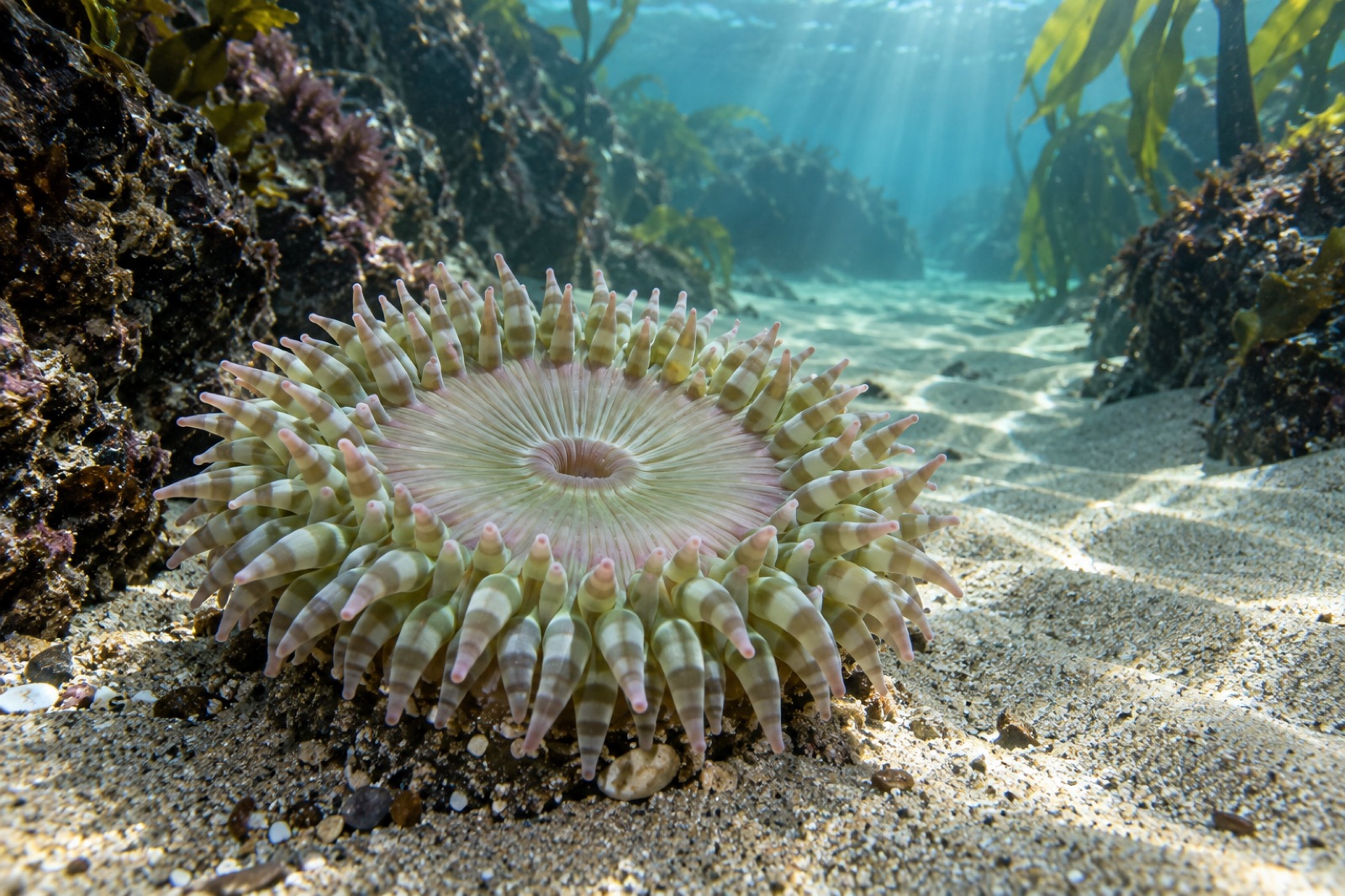
Moonglow anemone (Anthopleura artemisia) species profile: the gravel-coated anemone that buries its column in sediment beneath rocks, and how to find it.
Dr. Mara Ellison ·
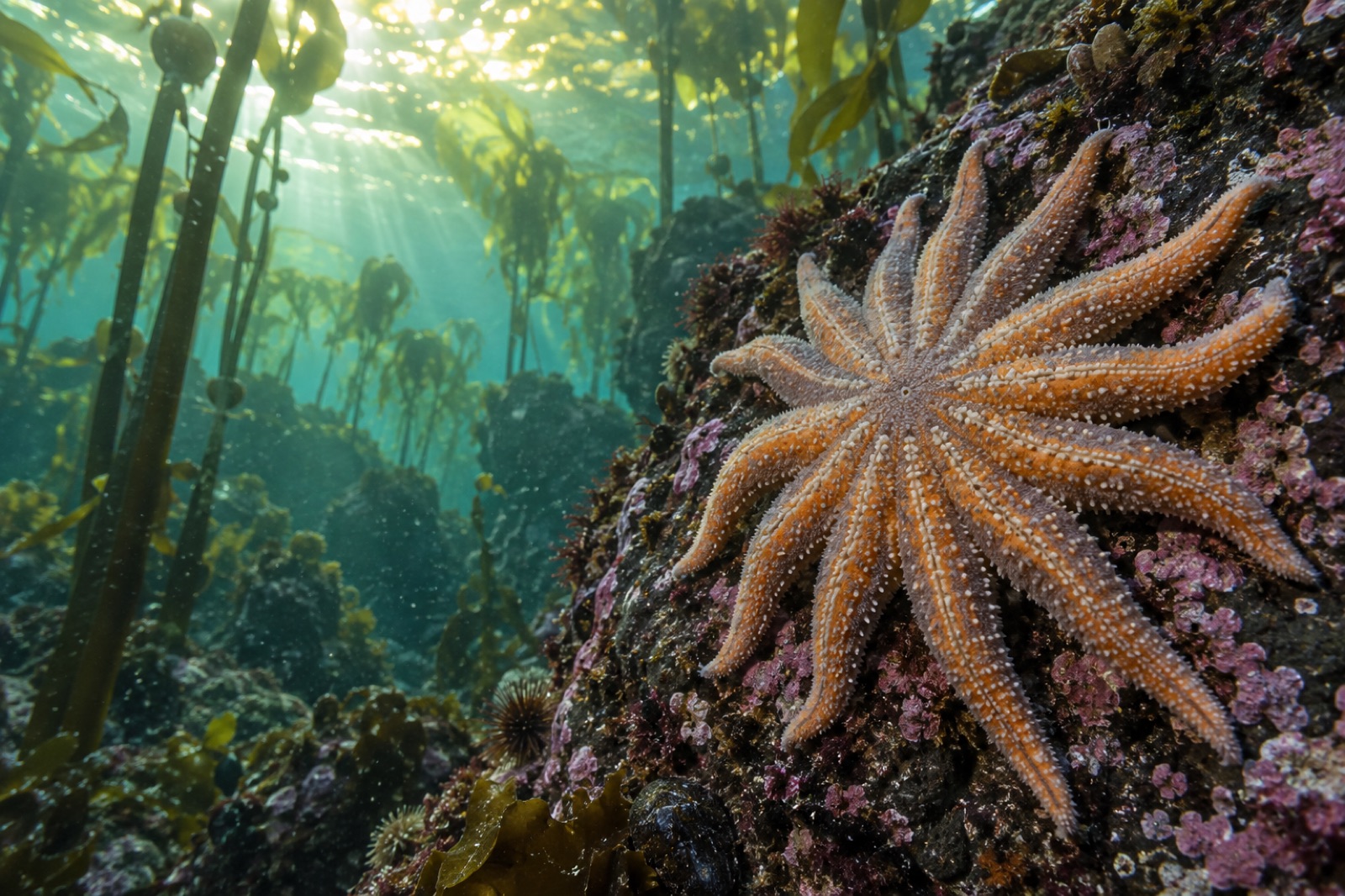
With up to sixteen arms and a taste for other sea stars, the morning sun star is the kelp forest's fastest hunter — and a weathervane of sea star wasting.
Dr. Mara Ellison ·
The mossy chiton is a surf-swept grazer in eight overlapping plates, its girdle bristling like a tiny hedgehog. Meet Mopalia muscosa of the rocky shore.
Dr. Mara Ellison ·
The pinto abalone is the small, iridescent grazer of the northeast Pacific — endangered since the 1990s and the focus of a careful hatchery recovery effort.
Dr. Theo Nakamura ·
Rāpoka, the New Zealand sea lion, is one of the world's rarest sea lions — a subantarctic breeder slowly recolonising the mainland coast. Its biology and comeback story.
Dr. Mara Ellison ·
Gracilaria sea mosses are among the most farmed seaweeds on Earth and the classic source of agar. Profile of their ecology, culture and cuisine.
Dr. Theo Nakamura ·
Olive rockfish (Sebastes serranoides) school in the dim water above Pacific kelp beds. Profile: ID tips vs kelp rockfish, life history, fishery and role.
Dr. Theo Nakamura ·
The opalescent nudibranch steals stinging cells from its anemone prey and wields them as weapons. Learn to identify Hermissenda crassicornis and its world.
Dr. Theo Nakamura ·
The opaleye is a herbivorous sea chub with opal-blue eyes that shapes California's shallow reefs from tidepools to kelp edges. Biology, diet and ecology.
Dr. Mara Ellison ·
The orange sea pen is a quill-shaped coral colony of the sandy seafloor that retracts into the sediment when touched — and glows when disturbed.
Dr. Theo Nakamura ·
The ornate cowfish (Aracana ornata) carries blue-and-gold armour through southern Australia's kelp and seagrass. A profile of the reef's small Picasso.
Dr. Theo Nakamura ·
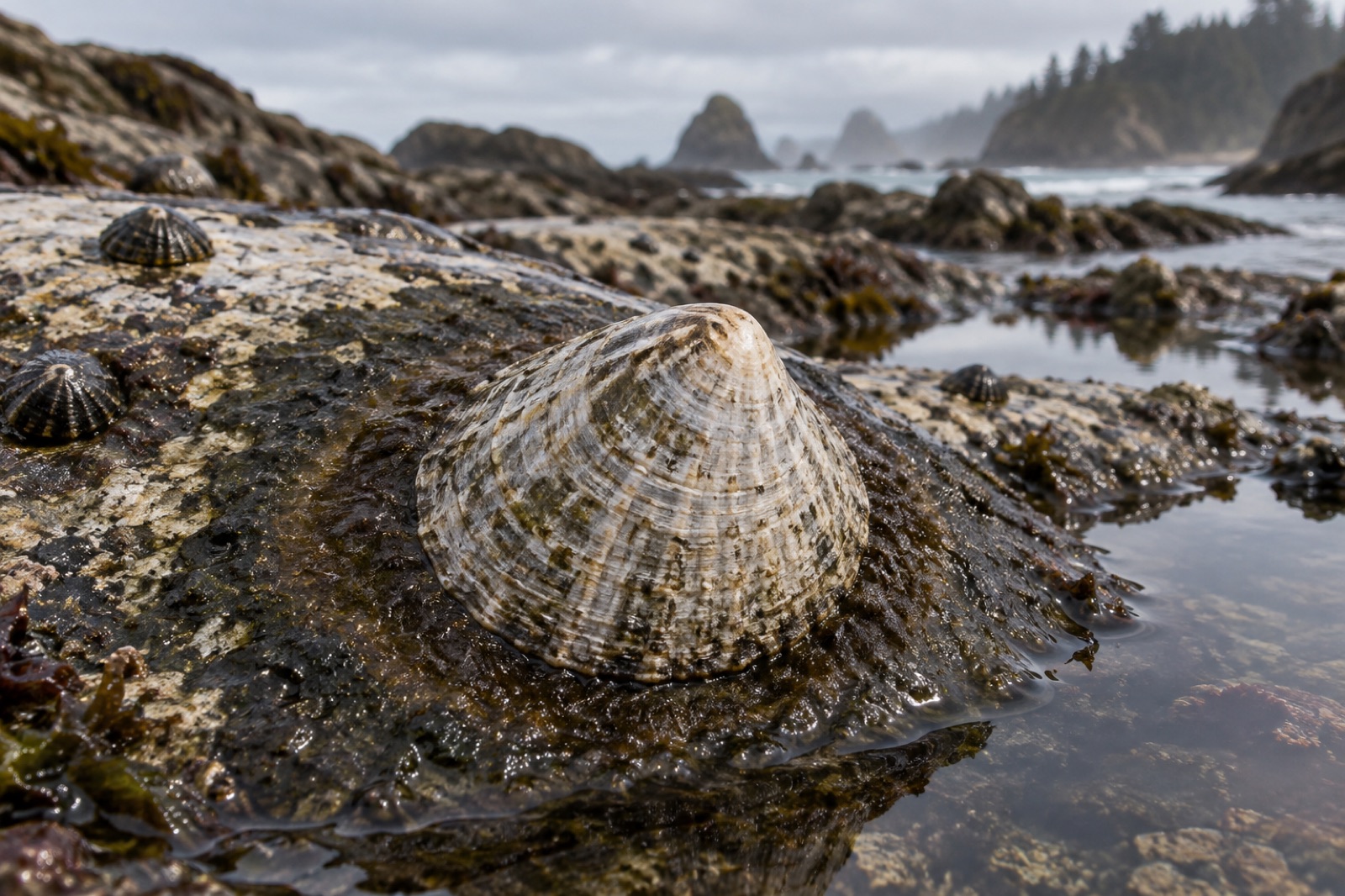
Lottia gigantea, the owl limpet, farms a private algae garden on Pacific rocks and bulldozes rivals off it. Biology, territory defence and status.
Dr. Theo Nakamura ·
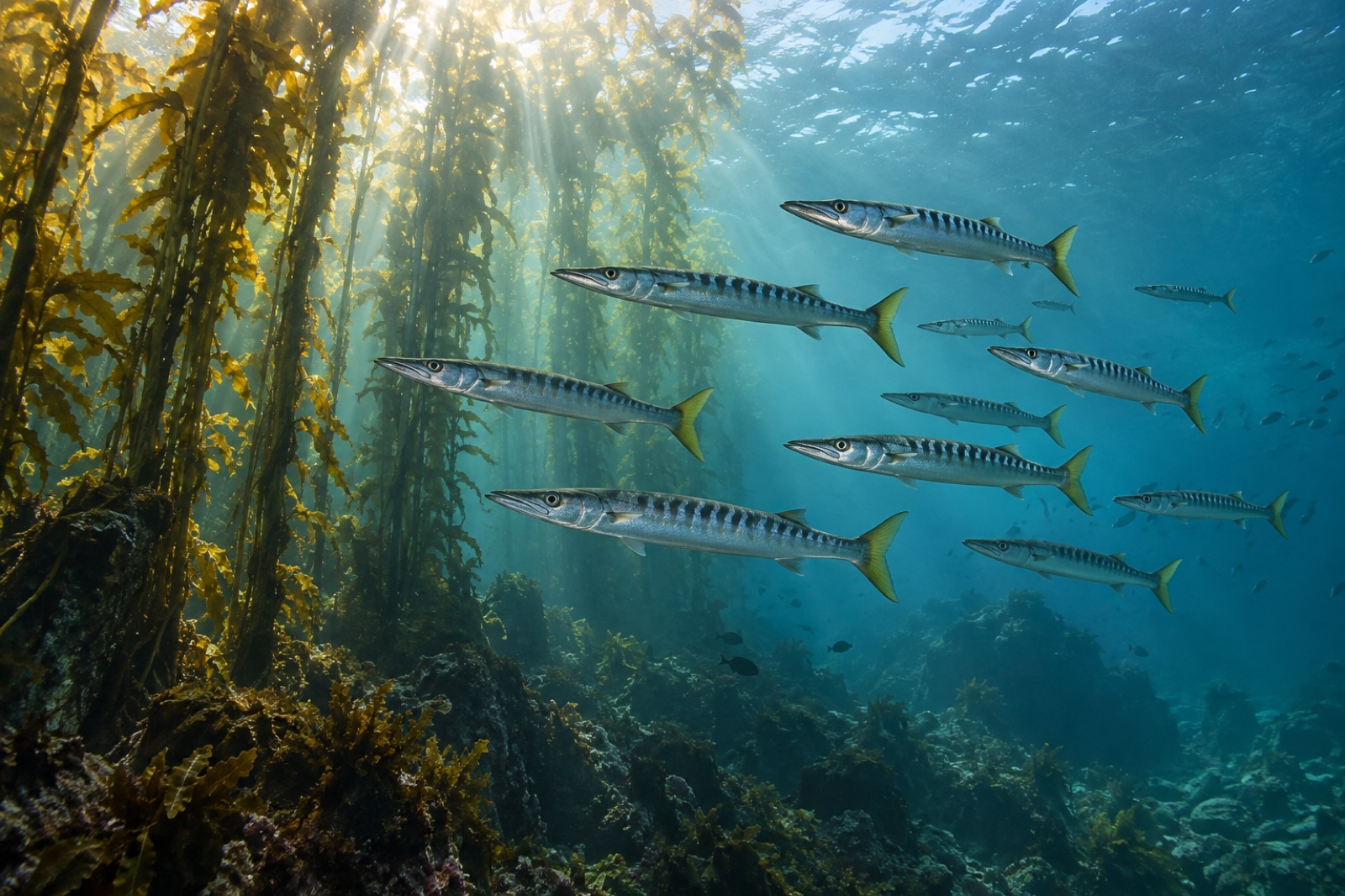
The Pacific barracuda (Sphyraena argentea) hunts in silver schools over California kelp beds. Profile: biology, range, fishery and how it differs from its tropical cousin.
Dr. Mara Ellison ·
Pacific bonito turn the water beyond the kelp to chrome in warm years. Identification, behaviour, the El Niño connection, and where divers meet these speedsters.
Tom Okafor ·
The Pacific hagfish (Eptatretus stoutii) is a jawless, knot-tying deep-sea scavenger whose legendary slime and midnight carcass work keep the seafloor clean.
Dr. Mara Ellison ·
How to identify a Pacific spiny lumpsucker: field marks, lookalikes, the suction disc, and where to actually find this walnut-sized kelp bed fish.
Tom Okafor ·
Banded like a convict, tusked in miniature, and perched on the rock: how to find and identify the painted greenling of North Pacific kelp beds.
Dr. Theo Nakamura ·
The painted topshell is a glossy, conical grazer of Europe's kelp-bed reefs. How to identify Calliostoma zizyphinum, where it lives and how it feeds.
Dr. Theo Nakamura ·
The pile perch (Rhacochilus vacca) is the big, deep-bodied seaperch of Pacific kelp forests and pilings — live-bearing, hard-shelled-prey crusher, diver favourite.
Dr. Theo Nakamura ·
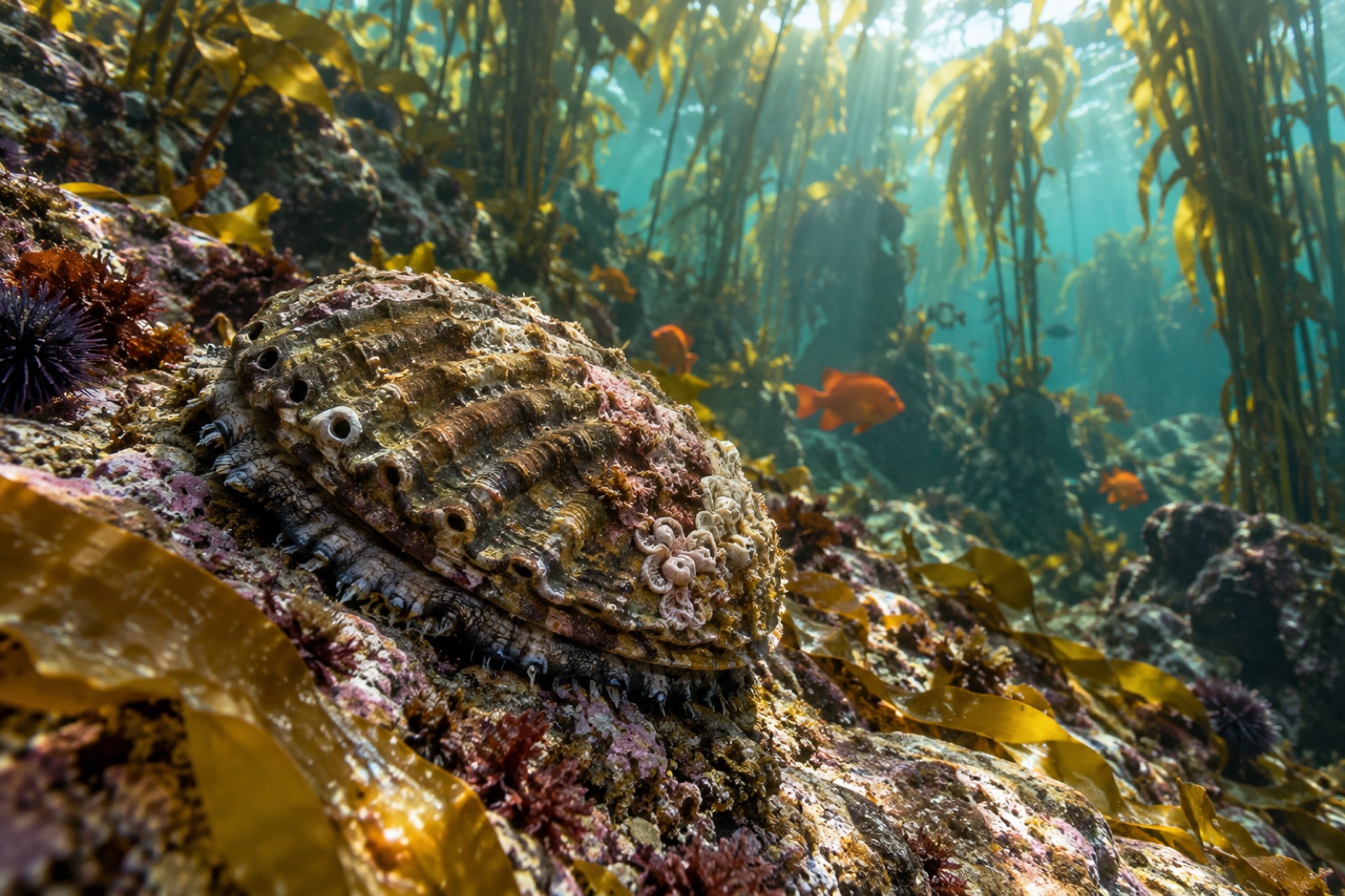
Pink abalone built Baja California's most storied shellfish fishery, then nearly vanished with the kelp. Inside the cooperative-led fight to bring them back.
Dr. Mara Ellison ·
Hunted to near-collapse, the pinto abalone is being rebuilt by hatcheries and divers in the Salish Sea. Inside North America's meticulous abalone comeback.
Dr. Mara Ellison ·
Plumose anemones turn cold kelp-coast rock, wrecks and pilings into white forests of feathery tentacles. Meet Metridium, the towering filter feeder.
Dr. Mara Ellison ·
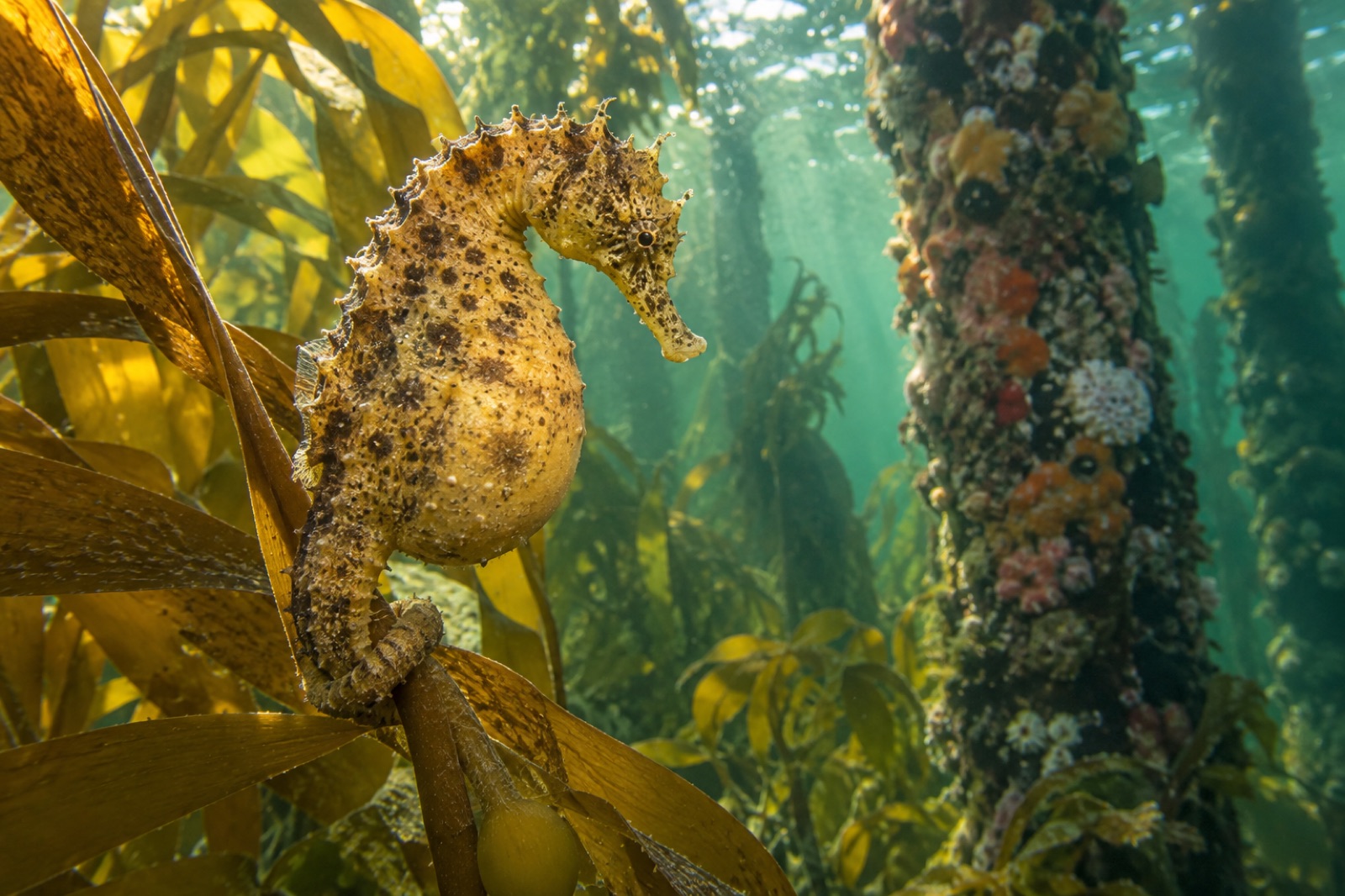
Hippocampus abdominalis, the pot-bellied seahorse, is one of the world's largest seahorses — a slow, golden giant of Australian and New Zealand kelp gardens.
Dr. Theo Nakamura ·
Crassadoma gigantea, the purple-hinged rock scallop, cements itself to rock for life and filters the kelp forest's currents behind a bright orange mantle. ID and ecology.
Dr. Theo Nakamura ·
The purple shore crab is the little purple scavenger under nearly every rock on Pacific rocky shores — a key cleaner linking the kelp forest to the tide line.
Dr. Mara Ellison ·
The quillback rockfish is a long-lived, deep-bodied resident of Pacific kelp reefs — orange-freckled, fiercely site-loyal and one of the slowest fish to grow old.
Dr. Theo Nakamura ·
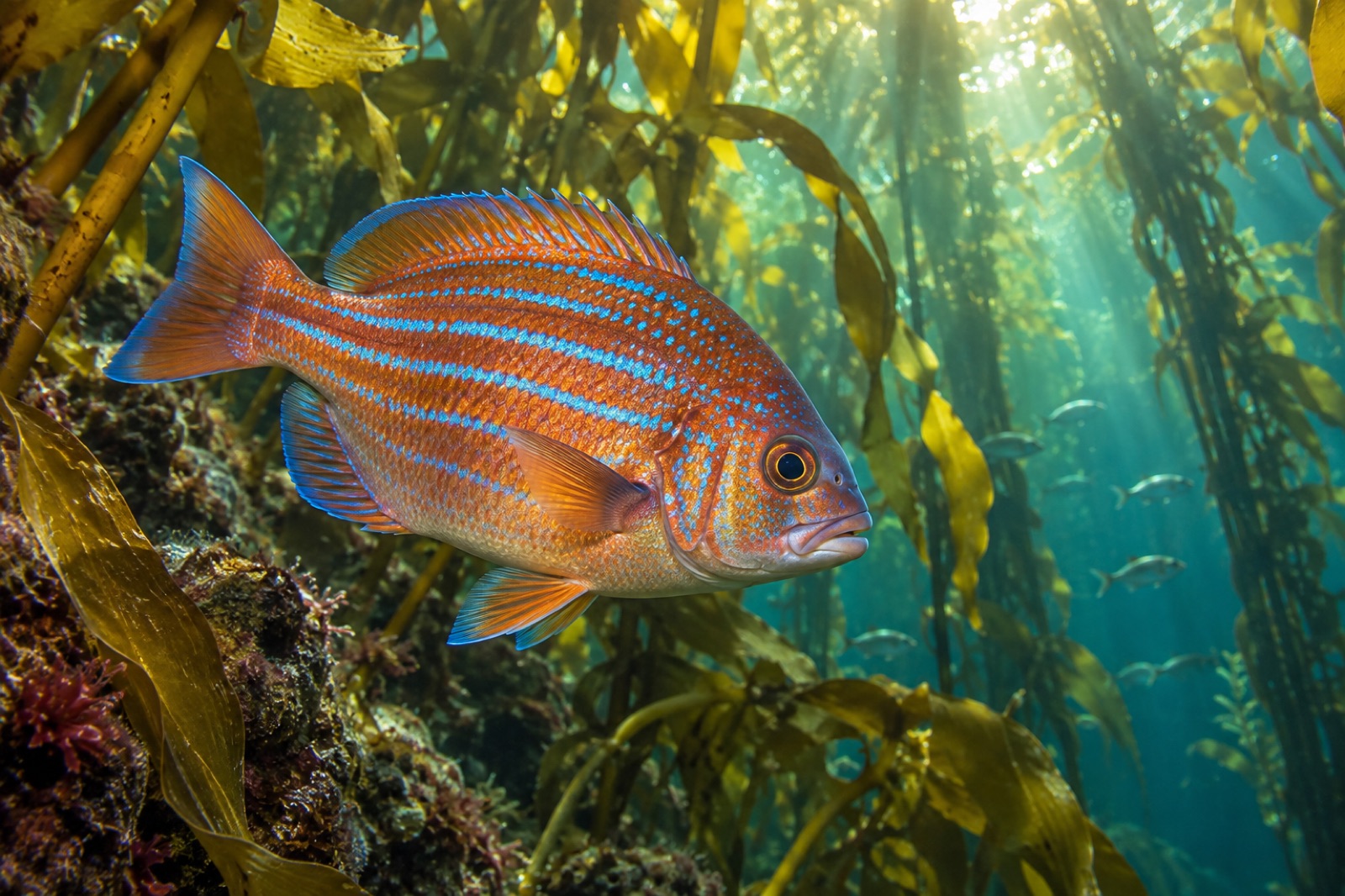
The rainbow seaperch is the most colourful fish in California kelp — a live-bearing surfperch in red, blue and gold that gives birth to fully formed young.
Dr. Theo Nakamura ·
Rainbow star (Orthasterias koehleri): a red-and-orange sea star of Pacific kelp reefs that eats snails, clams and even small sea urchins.
Dr. Mara Ellison ·
Red Irish lords are mottled, spiny, glued-to-the-rock sculpins that vanish against red algae and barnacles — a masterclass in benthic camouflage.
Dr. Theo Nakamura ·
Cancer productus owns the rocky shallows of the Pacific coast: crushing claws, black-tipped pincers, and a quiet role policing urchins. ID, biology, fishery.
Dr. Mara Ellison ·
The red sponge dorid (Rostanga pulchra) lives, feeds and hides on one red sponge — a thumbprint-size lesson in camouflage every tidepooler can find.
Dr. Theo Nakamura ·
The red turban snail (Chlorostoma funebralis) grazes the kelp forest's turf night and day — and when its numbers swing, whole reefs can tilt. A species profile.
Dr. Theo Nakamura ·
Long brown streamers on the surf-struck low shore: how to identify ribbon kelp, follow its fierce seasonal cycle, and place it among its edible kin.
Dr. Theo Nakamura ·
The rock wrasse (Halichoeres semicinctus) changes sex, colour and career over one lifetime on Southern California's kelp reefs – a full species profile.
Dr. Theo Nakamura ·
Rosy rockfish (Sebastes rosaceus) is a small, pink-blotched rockfish of low rocky reefs from Washington to Baja. Identification, habitat, diet and ecology.
Dr. Mara Ellison ·
Rubberlip seaperch (Rhacochilus toxotes) species profile: the largest surfperch, with fleshy lips for picking invertebrates off rocks at the kelp forest edge.
Dr. Theo Nakamura ·
Pollachius virens grows up inside the kelp and hunts beyond it — the dark gadoid whose juveniles fill northeast Atlantic kelp forests every autumn.
Dr. Mara Ellison ·
Eccentric sand dollars crowd the sand beside Pacific kelp forests by the thousand — standing on edge to filter the water. Their biology, beds and neighbours.
Dr. Mara Ellison ·
It lives in a shell, it fights with its mouth, and it never backs down. Inside the famous gape-wrestling world of the sarcastic fringehead.
Dr. Theo Nakamura ·
Sargassum horneri arrived in California in the 2000s and spread fast. Profile of the invasive 'devil weed', its ecology, impacts and control.
Dr. Theo Nakamura ·
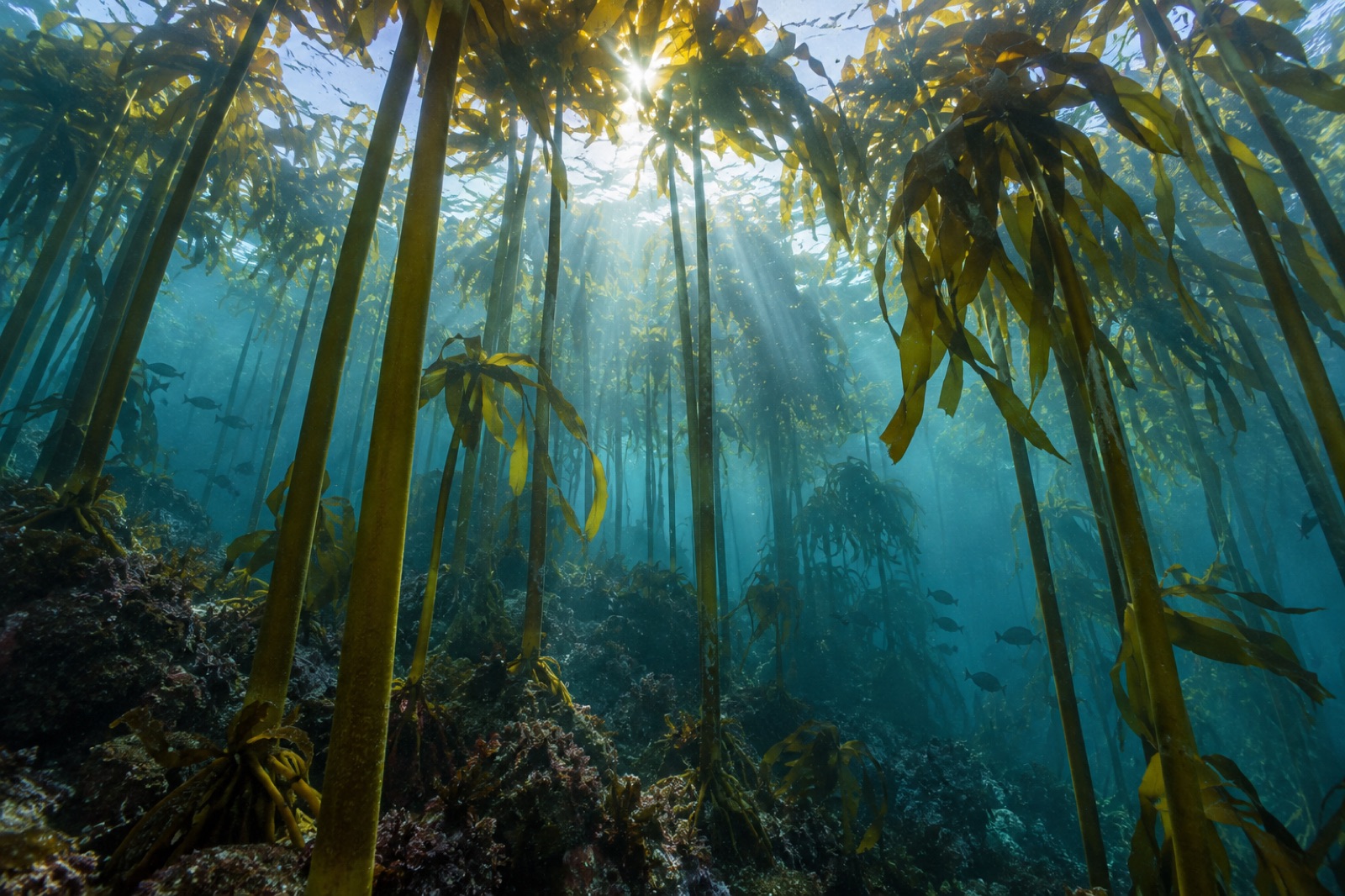
Sea bamboo is the towering hollow-stemmed kelp of South Africa's cold west coast. Biology, range, ecology and harvest of Ecklonia maxima, the Cape's forest builder.
Dr. Theo Nakamura ·
Sea cabbage (Hedophyllum sessile) is a tough, leathery kelp of the wave-washed low intertidal. Its biology, range, ecology and how to identify it on the shore.
Dr. Theo Nakamura ·
The sea lemon Peltodoris nobilis is a fist-sized, lemon-scented nudibranch that grazes sponges on Pacific kelp reefs. Identification, biology and ecology.
Dr. Theo Nakamura ·
Sea lemons are confused with leopard dorids, the Monterey dorid and the Atlantic sea lemon. A diver's guide to telling the real Peltodoris nobilis apart.
Dr. Theo Nakamura ·
Sea lettuce (Ulva lactuca): the two-cell-thick green sheet of every harbour — how it grows so fast, why green tides happen, and how it can be put to work.
Dr. Theo Nakamura ·
The sea palm lives where waves hit hardest — a flexible-stiped kelp that bends with the swell. Its biology, mussel-bed alliance and why foraging it is wrong.
Dr. Mara Ellison ·
Sea spaghetti grows buttons one year and two-metre straps the next. Where thongweed grows, its odd two-stage life, and why it's the forager's best first kelp.
Dr. Theo Nakamura ·
The California sheep crab is a slow, spiny giant of the kelp forest floor — a decorator crab that outgrew its disguise. Meet Loxorhynchus grandis.
Dr. Mara Ellison ·
The shiner surfperch (Cymatogaster aggregata) is the small, schooling seaperch of Pacific kelp beds and piers — a live-bearing forage fish worth knowing.
Dr. Theo Nakamura ·
Carcinus maenas is Europe's toughest shore crab — a kelp-edge scavenger at home and one of the world's most consequential marine invaders everywhere else.
Dr. Mara Ellison ·
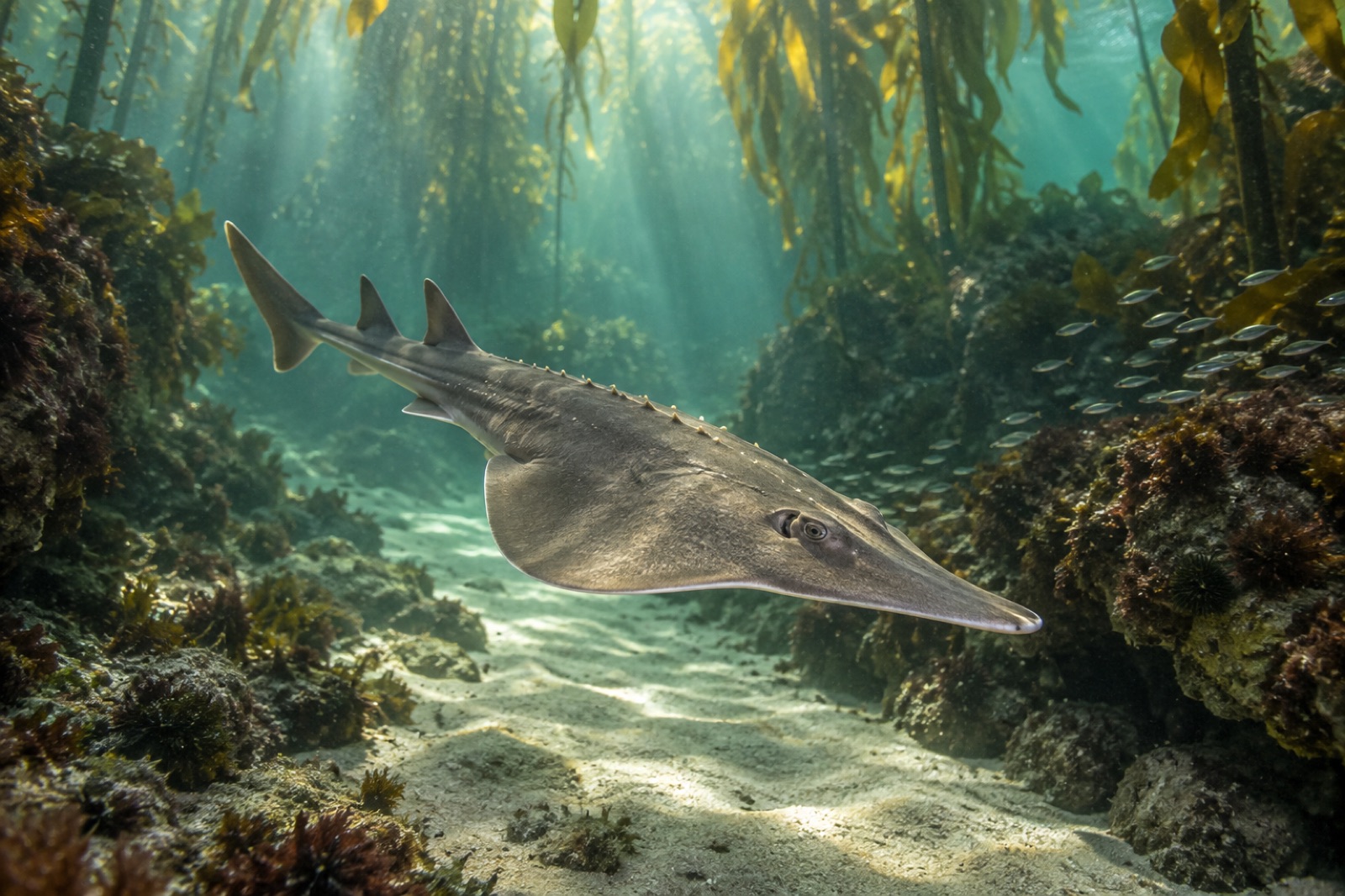
Pseudobatos productus cruises the sandy flats between kelp forests from California to Baja. How to identify it, what it eats, and why its fate splits at the border.
Dr. Mara Ellison ·
Leptasterias, the six-rayed star, broods its babies under its own body on the wave-beaten rocks of the Pacific kelp fringe — a small star with a big secret.
Dr. Theo Nakamura ·
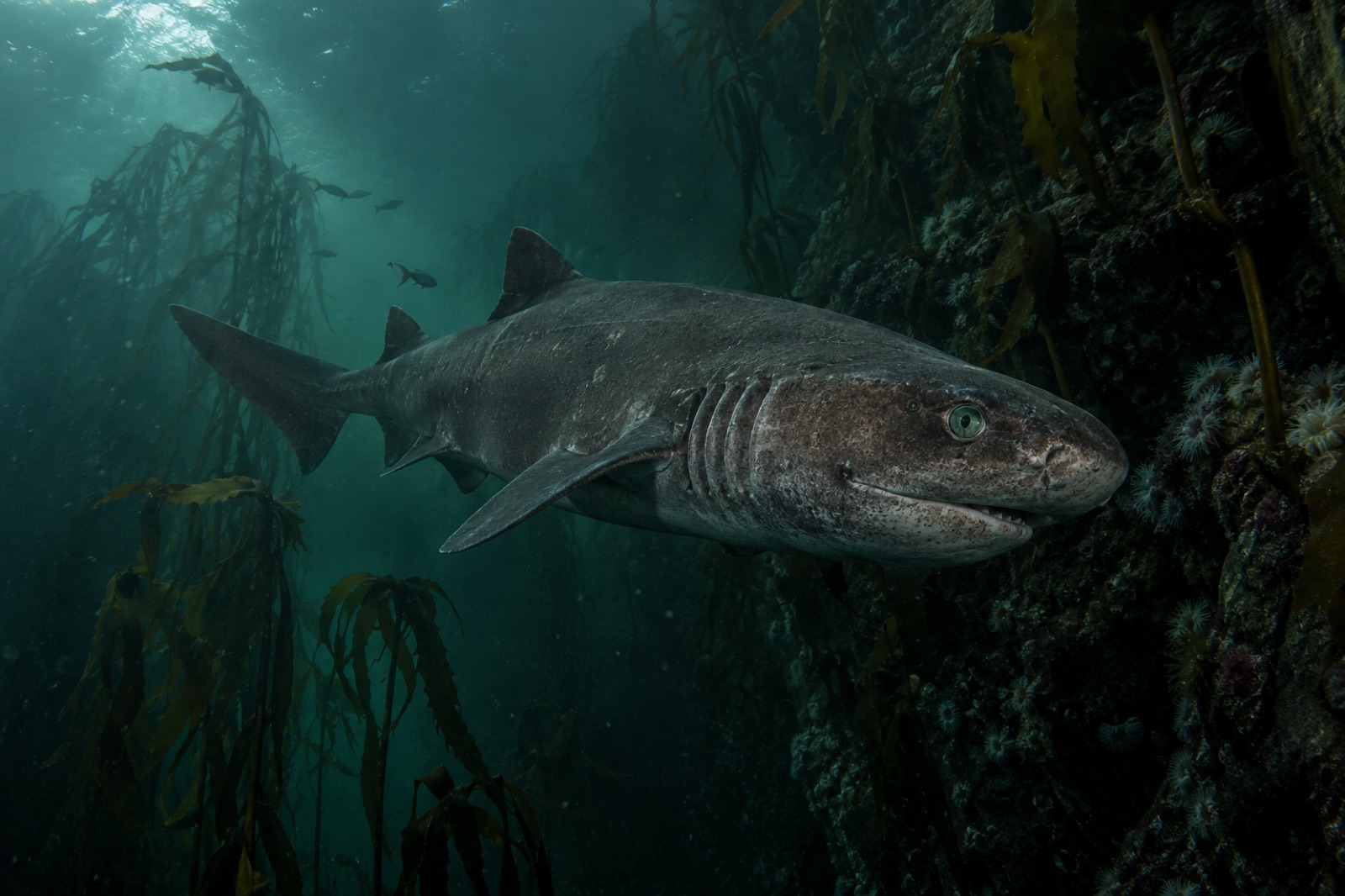
The bluntnose sixgill shark is a primitive deep-water giant that rises along kelp-lined fjords and sounds at night — six gills, green eyes, worldwide.
Tom Okafor ·
The soupfin or school shark once blackened the water over kelp coasts — until a vitamin boom nearly erased it. Meet Galeorhinus galeus.
Dr. Theo Nakamura ·
A species profile of the South American sea lion, the maned beachmaster of the Humboldt and Patagonian kelp coasts — biology, range and fishery friction.
Dr. Mara Ellison ·
Southern bull kelp (Durvillaea) grips the roughest surf coasts on Earth with the strongest holdfast of any kelp. Honeycomb blades, Māori pōhā, ocean rafting.
Dr. Theo Nakamura ·
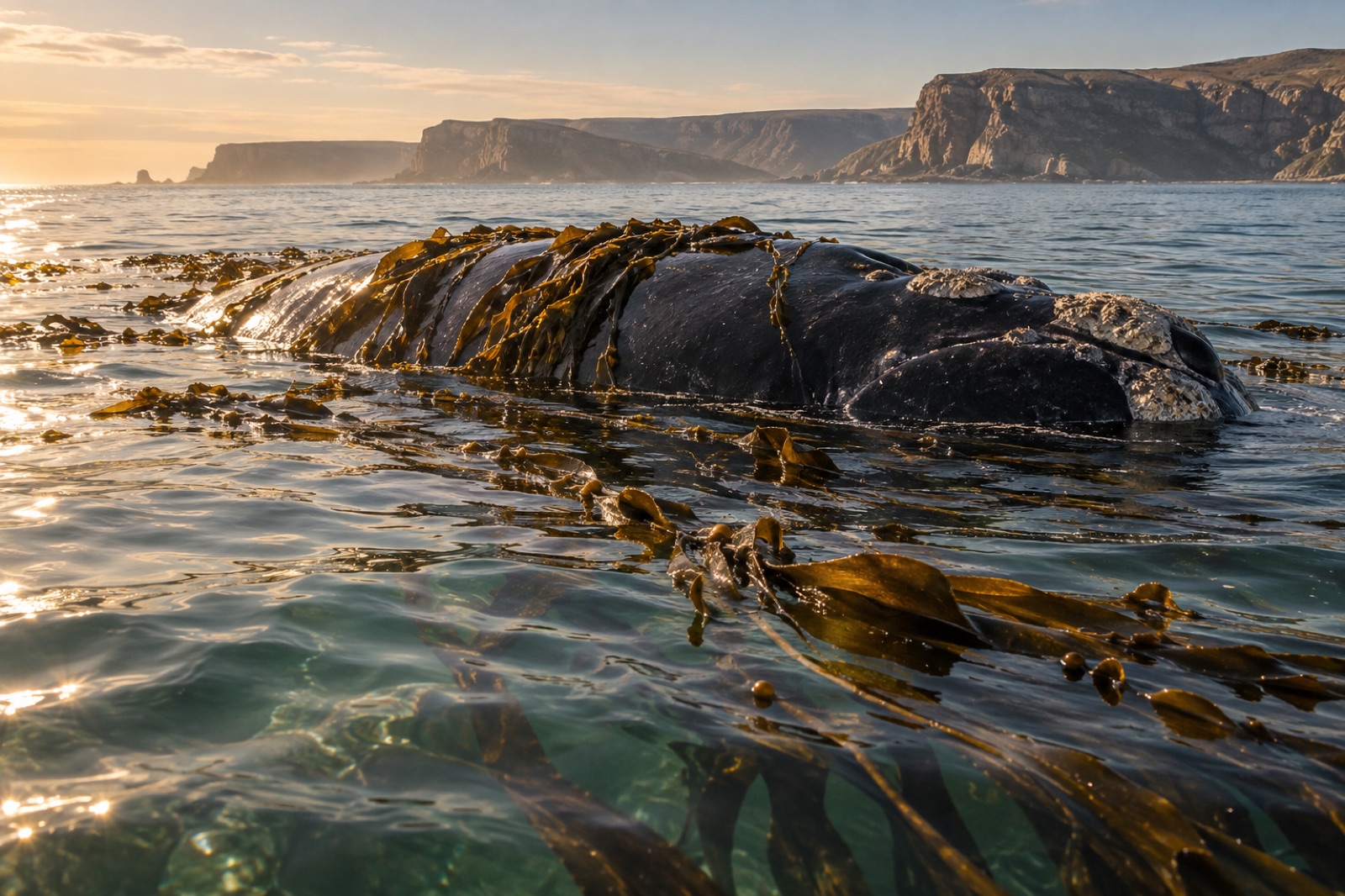
The southern right whale is a slow, southern giant with a calloused head — and a documented habit of draping itself in kelp. Its biology, recovery and kelp play.
Dr. Mara Ellison ·
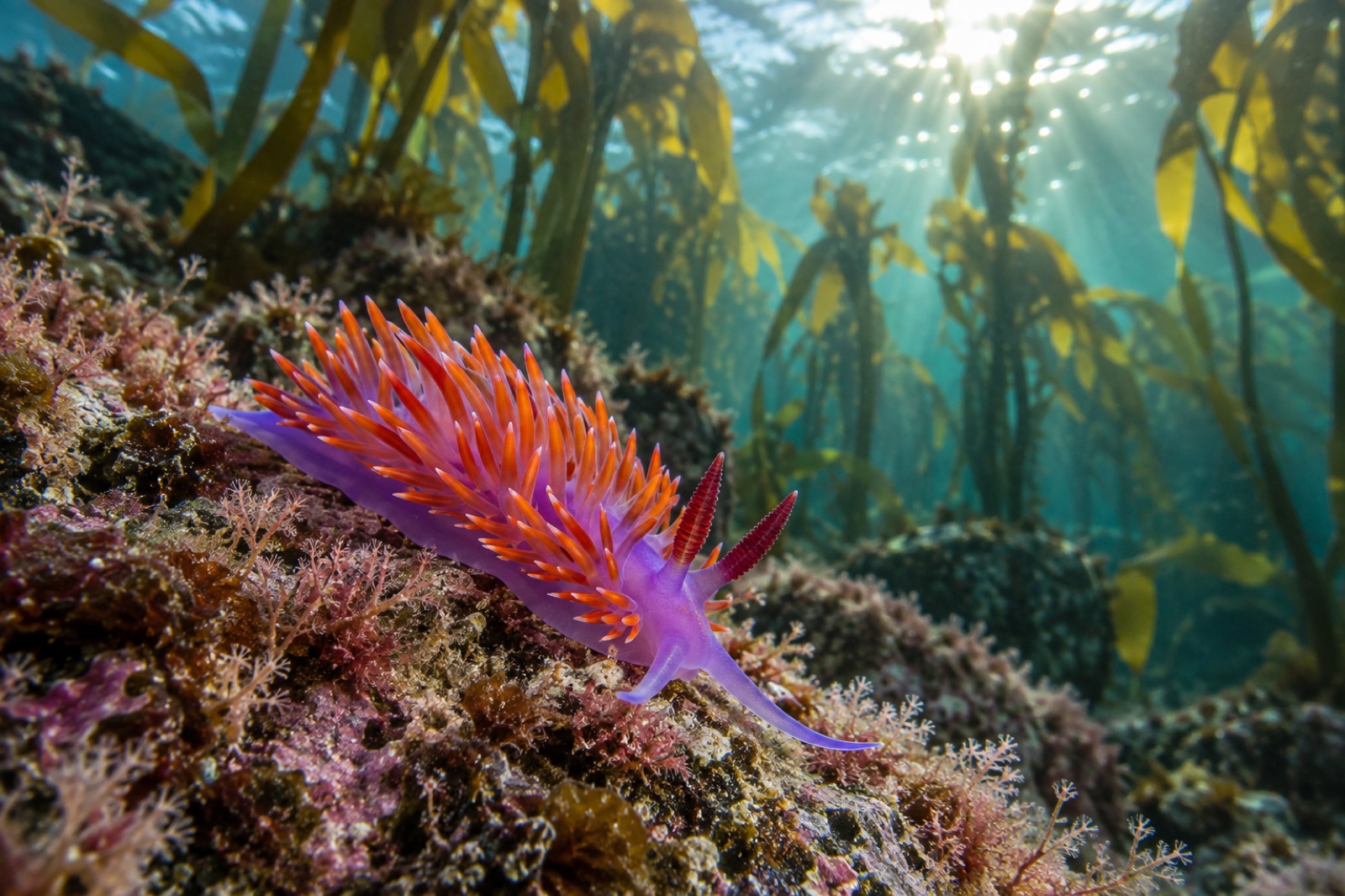
The Spanish shawl Flabellinopsis iodinea is a purple-and-orange aeolid nudibranch that steals stinging cells from hydroids. Identification, diet, habitat.
Dr. Mara Ellison ·
Where to find Spanish shawl nudibranchs: the best dive sites and seasons, the hydroid patches they hunt, lookalikes to rule out, and how to photograph one.
Tom Okafor ·
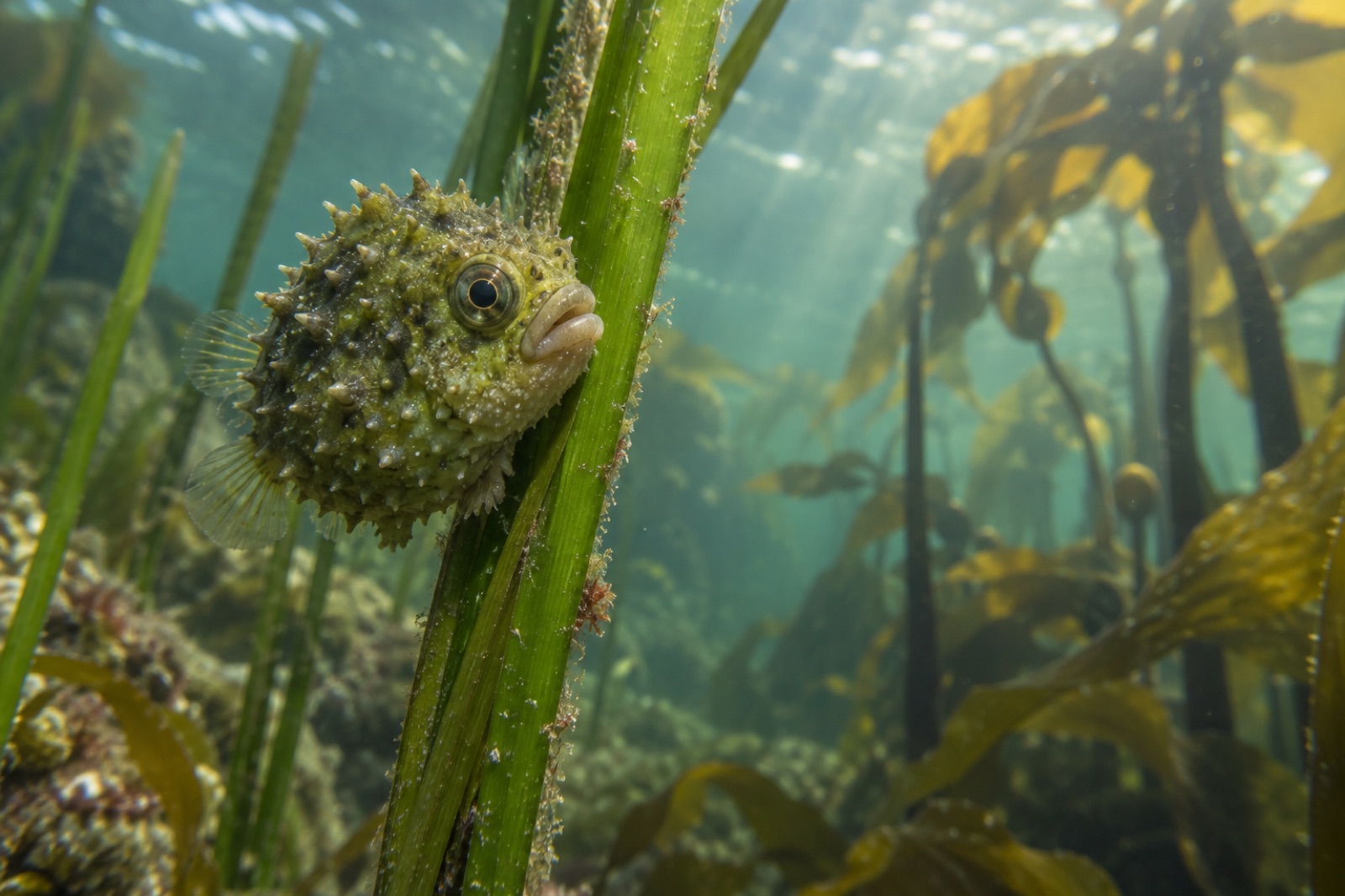
The Pacific spiny lumpsucker is a walnut-sized armoured fish that clamps to kelp and eelgrass with a suction-disc belly. Biology, range, where to look.
Dr. Theo Nakamura ·
The spot prawn lives half its life male and half female, hides in cold rocky depths, and anchors one of the Pacific's most admired trap fisheries.
Dr. Theo Nakamura ·
The spotted ratfish is a deep-bodied chimaera with green eyes, a venomous spine and a forehead clamp — a living fossil that haunts Pacific kelp waters by night.
Tom Okafor ·
The staghorn sculpin cruises Pacific estuaries from Alaska to Baja, tolerates fresh water, and carries venomous antler-like spines on its head.
Dr. Mara Ellison ·
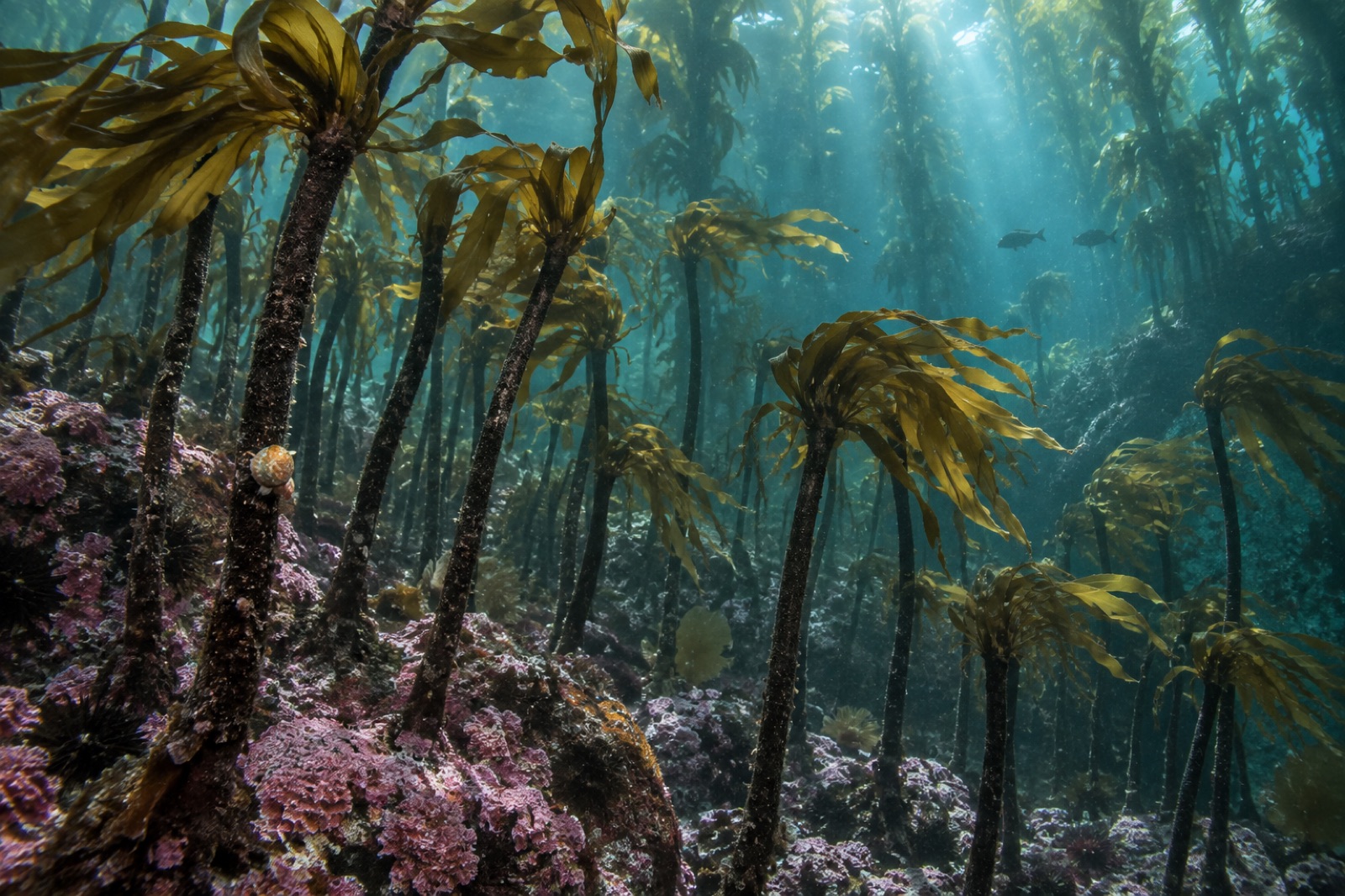
Pterygophora californica grows a woody stipe that stands for decades, sheltering understory life while faster kelps rise and fall around it. Species profile.
Dr. Theo Nakamura ·
The Steller sea lion is the largest of the eared seals — a tonne of muscle-hauling out beside North Pacific kelp forests. Its biology, range and hard-won recovery.
Dr. Mara Ellison ·
Striped shore crab (Pachygrapsus crassipes) species profile: the bold, fast, green-striped crab of Pacific rocky shores — sprinter, grazer and lab superstar.
Dr. Theo Nakamura ·
Meet the striped surfperch (Embiotoca lateralis), the copper-striped, blue-flecked surfperch of rocky shores and kelp beds from Alaska to Baja California.
Tom Okafor ·
Stubby rose anemone (Urticina coriacea) species profile: a leathery, crimson anemone of northern rock and cobble, from Arctic seas to California kelp forests.
Dr. Mara Ellison ·
It sleeps all day in kelp-bed crevices, hunts by night, and inflates like a balloon when threatened. Meet the swell shark of the Pacific coast.
Dr. Theo Nakamura ·
Laminaria hyperborea builds the kelp forests of Europe's cold coasts — with stiff stipes standing like an undersea grove. Biology, harvest history, ecology.
Dr. Theo Nakamura ·
Meet the treefish (Sebastes serriceps) — the tiger-barred golden rockfish of California kelp reefs: identification, habitat, behaviour and conservation.
Dr. Theo Nakamura ·
Turf-forming algae are the low, weedy mats that move in when kelp forests fall — and can hold a reef in place. A group profile of the kelp forest's most stubborn rival.
Dr. Theo Nakamura ·
Octopus bimaculoides is a small den-dwelling octopus of California's rocky kelp reefs, named for the blue-ringed ocelli behind its eyes. Habits and habitat.
Dr. Theo Nakamura ·
Necora puber — red eyes, velvety shell, paddle legs and a famous temper — is the reef's feistiest crab from Norway to Iberia, and a quiet kelp-forest worker.
Tom Okafor ·
The vermilion rockfish is a deep-bodied red rockfish of the mid-water reef zone. Identification, biology, barotrauma and the fishery story.
Dr. Mara Ellison ·
Apostichopus parvimensis vacuums detritus off California reefs day and night, cycling nutrients for the whole kelp forest. Biology, defences and the fishery.
Dr. Theo Nakamura ·
The white abalone crashed so fast that by the time it was protected, wild adults were too far apart to breed. Captive breeding is testing a way back.
Dr. Theo Nakamura ·
The white sea bass is California's great croaker — a metre-and-a-half predator of kelp edge and open water, nearly lost, fighting back. Biology, fishery and comeback.
Dr. Mara Ellison ·
Pale, decorator-clad and living on open sand rather than reef: how the white sea urchin feeds, spreads and quietly differs from its barren-making relatives.
Dr. Mara Ellison ·
White-spotted rose anemone (Urticina lofotensis) species profile: a scarlet anemone dotted with white, named for Norway's Lofoten islands and common on kelp-coast walls.
Dr. Mara Ellison ·
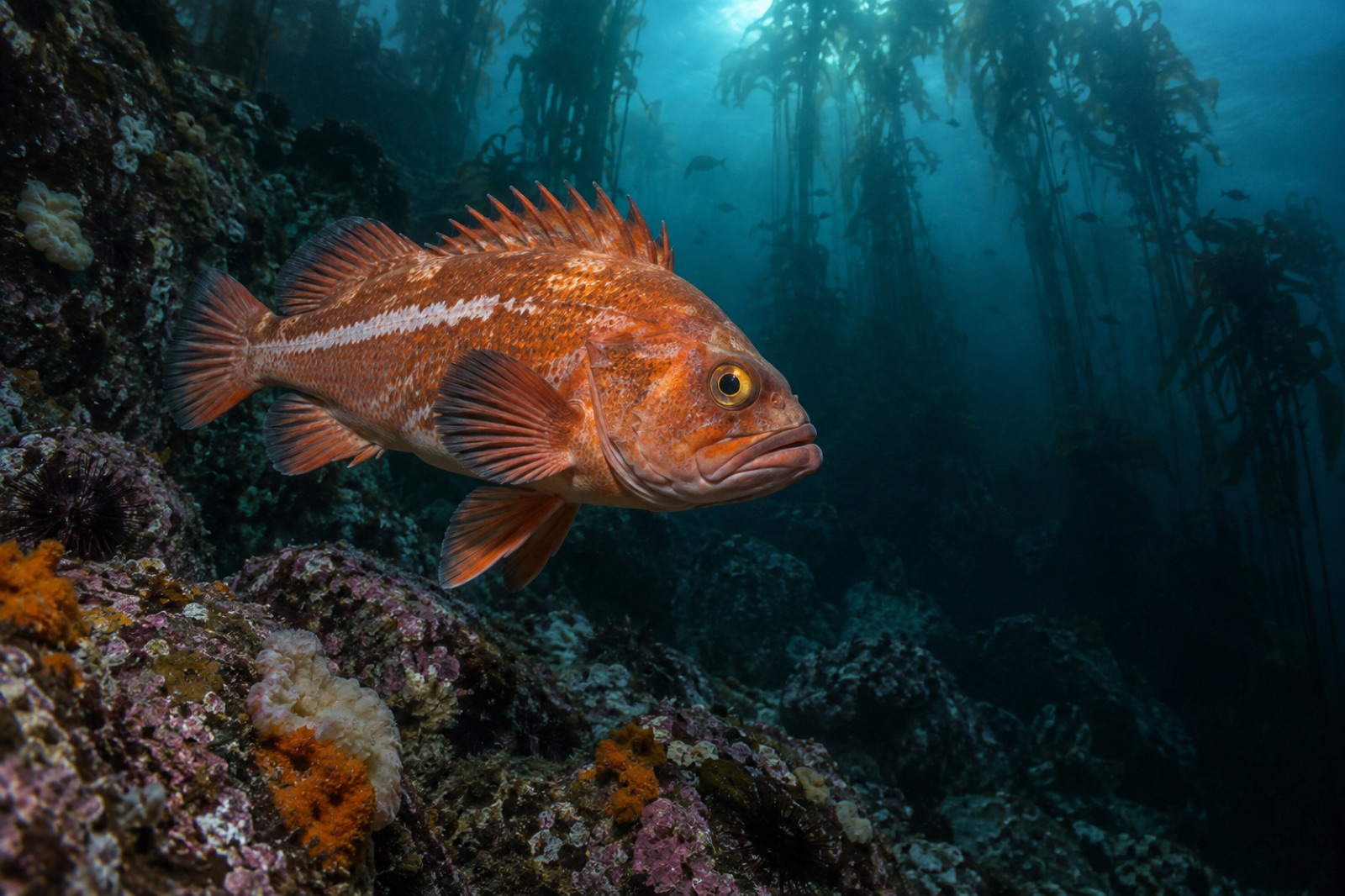
Yelloweye rockfish can live more than a century on a single reef. Identification, the barotrauma problem, and the rules helping this red giant recover.
Dr. Mara Ellison ·
Black abalone once blanketed California's rocky intertidal, then disease and poaching erased most of them. Inside an unlikely marine recovery story.
Dr. Mara Ellison ·
The black oystercatcher lives its whole life on kelp-fringed rock, hammering limpets and mussels. Ecology, bill lore, breeding and its role as an indicator.
Dr. Mara Ellison ·
The blue rockfish (Sebastes mystinus) is a blue-black schooling mainstay of Pacific kelp forests. Biology, fishery and what its presence tells us.
Dr. Mara Ellison ·
The bluebanded goby is a thumb-length fish in neon red and electric blue, and it can change sex both ways. Meet California's most dazzling reef resident.
Dr. Mara Ellison ·
Brittle stars are the kelp forest's most numerous residents — five-armed floor-dwellers by the thousand. Learn how they differ from sea stars and why they matter.
Dr. Mara Ellison ·
Seven gill slits, one rear-set dorsal fin, and fossils deep in its past: the broadnose sevengill is the ancient apex cruiser of temperate kelp coasts worldwide.
Dr. Theo Nakamura ·
California sea lions are the kelp coast's most boisterous residents — acrobatic, intelligent and climate-sensitive. Ecology, biology and the Channel Islands nursery.
Dr. Mara Ellison ·
Dungeness crab species profile: the life cycle from drifting larva to fishing pot, sand-flat and kelp-edge habitat, moulting growth and fishery stewardship.
Dr. Mara Ellison ·
Meet the garibaldi, California's blazing orange state marine fish — a fiercely territorial damselfish that gardens algae on the kelp forest floor.
Dr. Theo Nakamura ·
The giant green anemone is a solar-powered predator of Pacific tidepools and kelp-forest edges. Its biology, symbiosis and decades-long life.
Dr. Mara Ellison ·
The gumboot chiton is the world's largest chiton — a hand-long, magnetite-toothed grazer nicknamed the wandering meatloaf. Meet the kelp coast's gentle giant.
Dr. Theo Nakamura ·
The harbour seal is the temperate kelp coast's most widespread pinniped — a shy true seal found from California to the Baltic. Facts, ecology and how to watch them.
Dr. Mara Ellison ·
Nudibranchs are the jewels of the kelp forest: shell-less sea slugs in startling colours. Learn the key groups, the star species and how to find them.
Tom Okafor ·
The leopard shark is a spotted, harmless houndshark of Pacific bays and kelp edges. Biology, behaviour and the famous warm-water aggregations.
Tom Okafor ·
The lingcod is not a cod at all — a big-headed, voracious ambush predator of Pacific kelp reefs, famous for blue-green flesh and fiercely guarded nests.
Dr. Mara Ellison ·
Tochuina tetraquetra, the orange-peel nudibranch, is one of the world's largest sea slugs — a cold-water giant that hunts sea pens and smells faintly of watermelon.
Dr. Theo Nakamura ·
Pāua, New Zealand's iridescent abalone, is a taonga species, a prized kaimoana and a carefully managed fishery. Its biology and cultural story.
Dr. Theo Nakamura ·
Meet the world's largest abalone — a kelp-eating giant sea snail of the Pacific coast. Its biology, fishery history and the road to recovery.
Dr. Theo Nakamura ·
Sieve kelp (Agarum clathratum) wears a blade full of holes nobody has fully explained — biology of this Arctic kelp and the riddle of the holes.
Dr. Mara Ellison ·
Southern rock lobster (Jasus edwardsii) is the reef's top urchin predator. Its biology, fishery and role in stopping barrens — a species profile.
Dr. Mara Ellison ·
Sea squirts look like alien machinery but land among our closest living relatives. Meet the stalked tunicates of kelp understories — anatomy, role and invaders.
Dr. Theo Nakamura ·
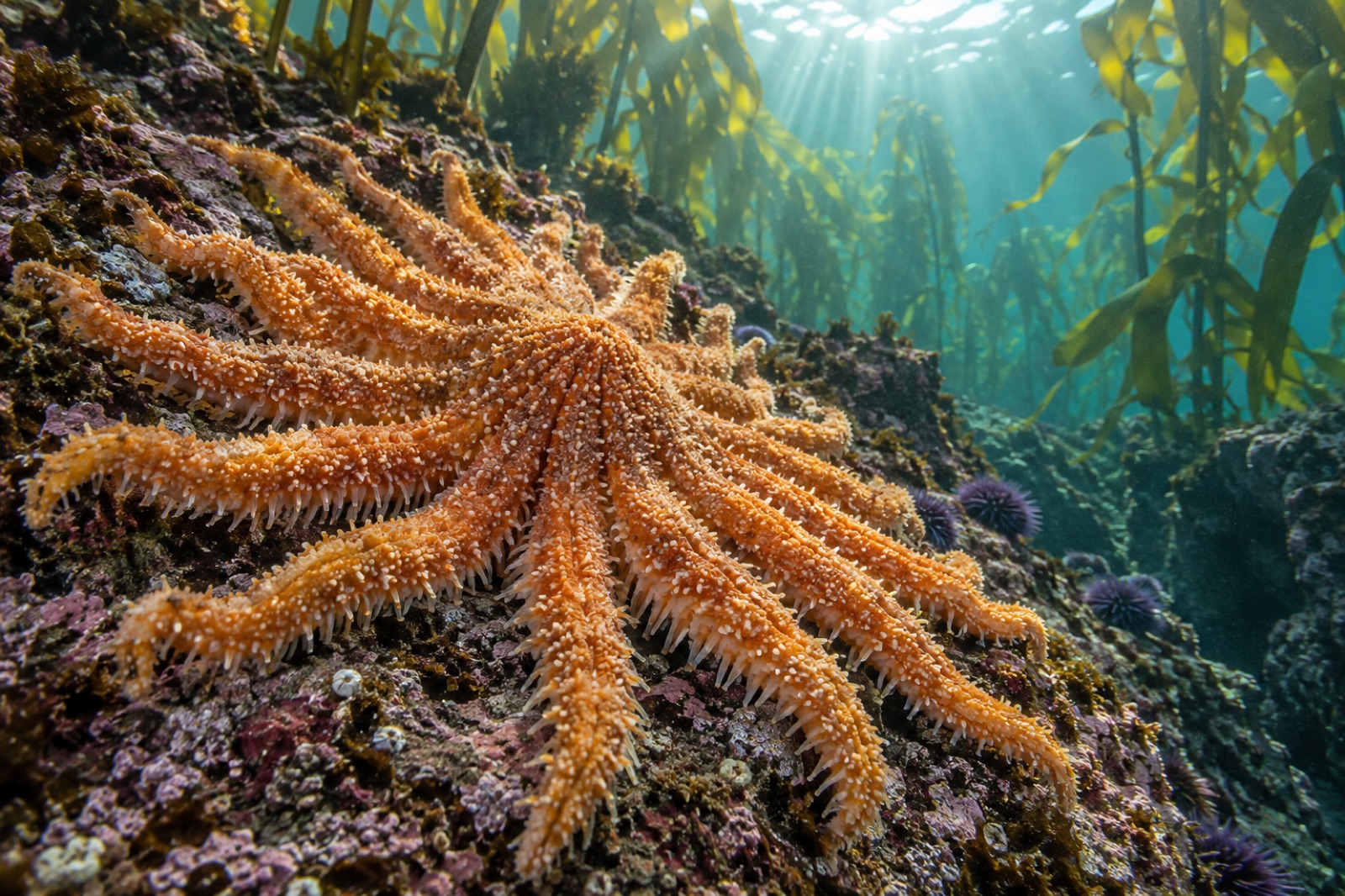
The sunflower sea star was the kelp forest's great urchin hunter. Wasting disease erased billions of them — and the consequences reshaped coastlines.
Dr. Mara Ellison ·
The tiger rockfish is a long-lived, vividly banded Pacific rockfish of deep rocky reefs and deep kelp-forest edges — beautiful, slow-growing and easily overlooked.
Dr. Mara Ellison ·
The wavy turban snail is the big, armoured grazer of southern California kelp forests — a hand-sized shell with a built-in door and a small fishery of its own.
Dr. Theo Nakamura ·
Winged kelp (Alaria esculenta) is the wave-exposure specialist of Atlantic shores — and a mild, edible kelp. Its biology, range and kitchen appeal.
Dr. Theo Nakamura ·
The wolf eel is not an eel and nothing to fear — a devoted, den-dwelling wolffish that crushes sea urchins for a living and guards its eggs for months.
Dr. Mara Ellison ·
Acid kelp (Desmarestia) stores battery-strength acid inside its own cells — the strangest chemical defence in the kelp forest.
Dr. Theo Nakamura ·
Meet the California moray eel — a nocturnal, crevice-dwelling ambush predator of Pacific kelp reefs, with pharyngeal jaws and a reputation it doesn't deserve.
Dr. Theo Nakamura ·
Clown dorid (Triopha catalinae) species profile: identifying the polka-dotted nudibranch, its bryozoan diet, rhinophores and where to find it on kelp reefs.
Dr. Theo Nakamura ·
Feather boa kelp streams from Pacific rocks in long, lacy straps, and shelters its own miniature rainforest of life. How to identify, where it grows, what eats it.
Dr. Theo Nakamura ·
The marbled murrelet feeds in kelp-fringed seas and nests miles inland on old-growth limbs. The ecology of a seabird split between two vanishing worlds.
Dr. Mara Ellison ·
Kekeno — the New Zealand fur seal — was hunted nearly to extinction by the early 1800s, then recovered under protection. Ecology, biology and where to see them.
Dr. Mara Ellison ·
Tetronarce californica, the Pacific electric ray, carries up to ~50 volts in its wings. Biology, the ambush, and what to do if you meet one on a night dive.
Dr. Mara Ellison ·
The rockweed gunnel is a slender Pacific shore fish so perfectly matched to seaweed butter and olive tones that it looks like the rockweed itself.
Dr. Theo Nakamura ·
Red in red algae, green in surfgrass, spotted all over — the spotted kelpfish rewrites its own wardrobe to match the kelp it hides in. How to know one.
Dr. Theo Nakamura ·
The umbrella crab hides its legs beneath a flared, kelp-coloured carapace, drifting undetected across the holdfasts and rocky floors of Pacific kelp forests.
Dr. Mara Ellison ·
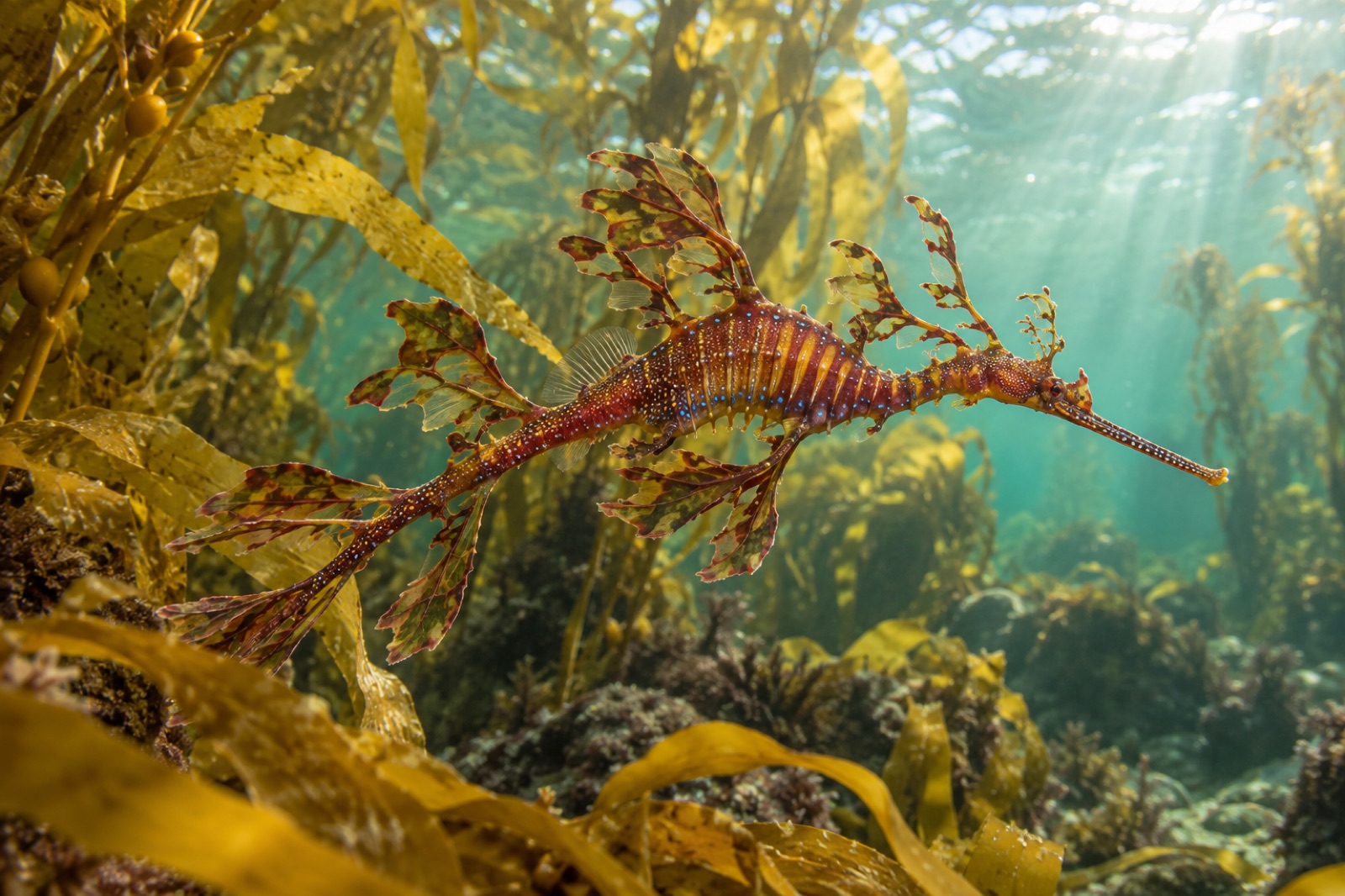
Australia's weedy seadragon drifts through kelp like fallen seaweed come alive. Discover its camouflage, male egg-brooding, range and conservation.
Dr. Theo Nakamura ·
Dulse is the red seaweed the North Atlantic has snacked on for a thousand years — protein-rich, bacon-savoury when fried, and stranger in its life cycle than you think.
Sofia Andersson ·
Fish-eating anemone (Urticina piscivora) species profile: the big red anemone that catches fish under the kelp canopy and doubles as sea star prey.
Dr. Mara Ellison ·
Five-ribbed kelp (Costaria costata) is the wide, ripple-edged kelp of northeast Pacific reefs — biology, kitchen uses and how it differs from wakame.
Dr. Mara Ellison ·
Kelp bass — calico bass to the anglers who love them — are the signature sportfish of the kelp canopy. Biology, slow growth, sex change and sustainable fishing.
Dr. Mara Ellison ·
The leafy seadragon is the most perfectly disguised fish in the sea. Explore its South Australian strongholds, brooding males and fragile future.
Dr. Mara Ellison ·
Nori comes from red algae with a decades-long life-cycle mystery — solved in 1949 by a British phycologist whose discovery built an entire industry.
Dr. Theo Nakamura ·
The northern kelp crab is a colour-changing spider crab that lives its whole life in the kelp canopy. Learn its biology, diet, and role in the forest.
Dr. Theo Nakamura ·
The Pacific tube anemone isn't a true anemone at all. Meet Pachycerianthus fimbriatus: the felt-tubed, double-crowned ambush fisher of kelp-forest sand flats.
Dr. Mara Ellison ·
Small, barred and easy to overlook, the reef surfperch works the noisy seam where kelp forest meets breaking surf — and gives birth to fully formed young.
Dr. Mara Ellison ·
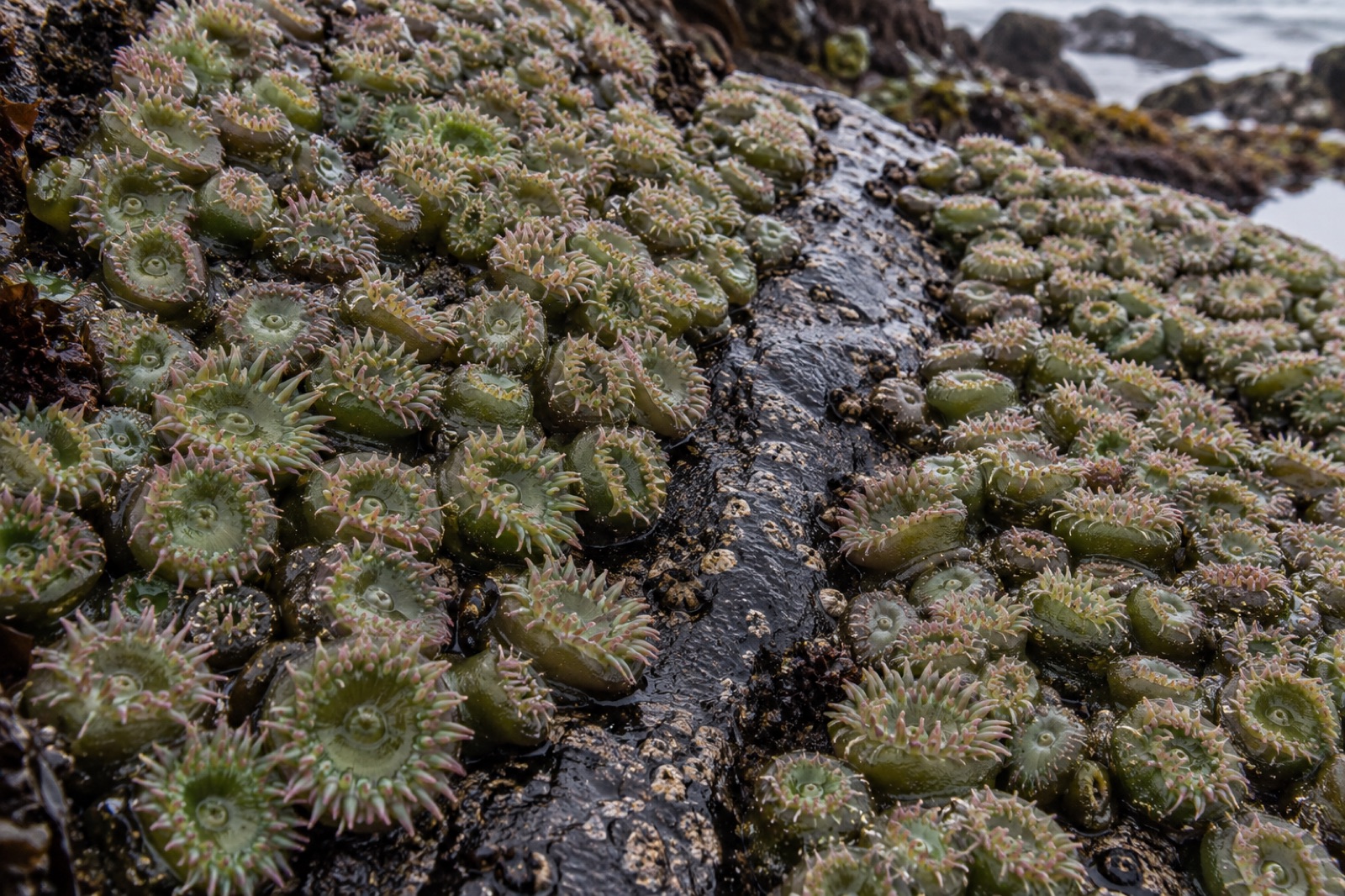
Aggregating anemone (Anthopleura elegantissima) species profile: clonal armies, tentacle wars, symbiotic algae and survival at the top of the rocky shore.
Dr. Mara Ellison ·
The California sheephead is a sex-changing kelp-forest wrasse whose jaws keep sea urchins in check. Learn its life history, role and recovery story.
Dr. Mara Ellison ·
Elk kelp grows deep, in clear water, with a single antlered float the size of a grapefruit. The deep edge kelp of the Channel Islands and Baja — biology and status.
Dr. Theo Nakamura ·
Kina is Aotearoa's endemic sea urchin — treasured kaimoana, a kelp grazer, and the engineer behind New Zealand's barren reefs. Here is its biology and its story.
Dr. Mara Ellison ·
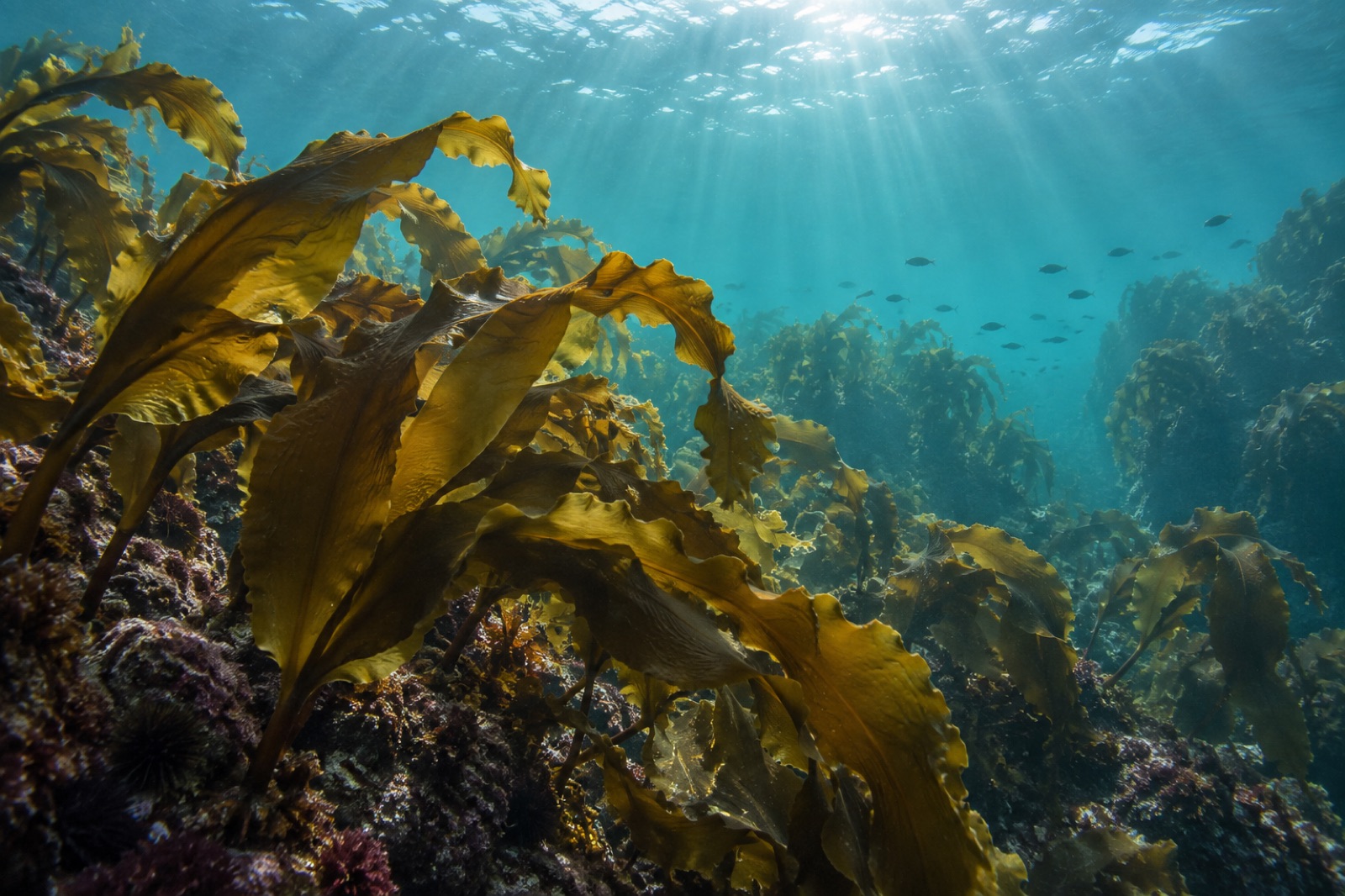
Kombu is the kelp behind dashi and the backbone of the world's seaweed farms. Learn its biology, life cycle, Hokkaido roots and future in a warming sea.
Dr. Theo Nakamura ·
The northern clingfish grips rough rock with a suction disc no engineered cup can match. Meet the small fish that surfs storm surge under stones and holdfasts.
Dr. Elias Brandt ·
Urticina crassicornis, the painted or Christmas anemone of North Pacific kelp reefs: identification, diet, reproduction and its place in the cold-water forest.
Dr. Theo Nakamura ·
The purple sea urchin turned patches of California kelp forest into barrens. Learn its biology, its hidden hunger, and why it is both villain and victim.
Dr. Mara Ellison ·
The red sea urchin can live a century, grows to dinner-plate size, and feeds the uni trade. Meet the kelp forest's most venerable grazer — and its fishery.
Dr. Theo Nakamura ·
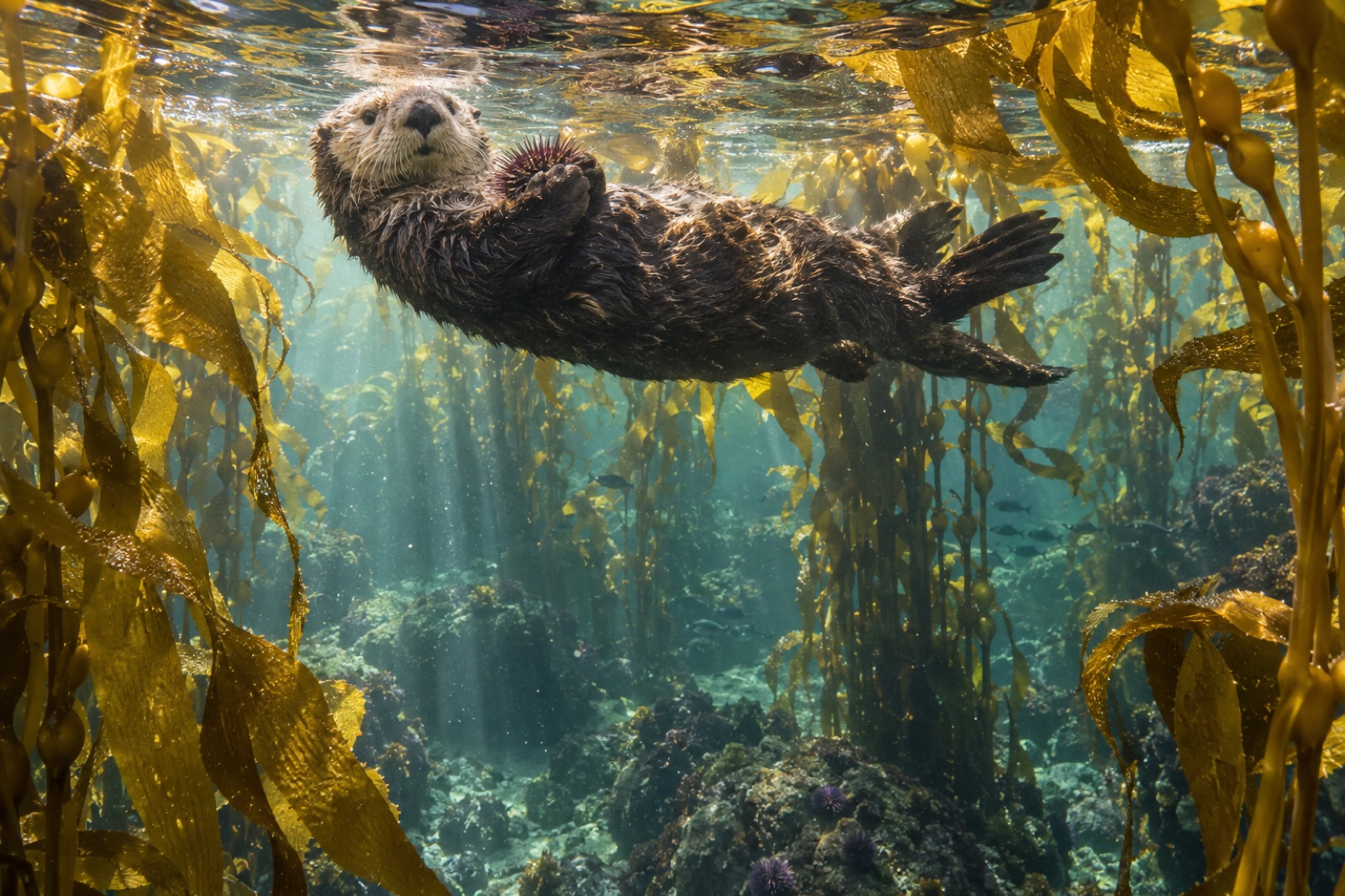
Sea otters eat a quarter of their body weight a day — much of it sea urchins. How this small predator became the kelp forest's most famous keystone species.
Dr. Mara Ellison ·
The starry flounder is the North Pacific's most river-loving flatfish, banded in orange and black. How to identify it, where it hunts, and why estuaries need it.
Dr. Theo Nakamura ·
Wakame is a beloved edible kelp in Japan and Korea — and one of the world's most widespread invasive seaweeds. Understand both sides of Undaria pinnatifida.
Dr. Mara Ellison ·
The giant sea bass is a 250-kilo shadows-and-kelp predator that fishermen nearly erased. Learn its biology, the crash and the slow comeback now unfolding.
Dr. Mara Ellison ·
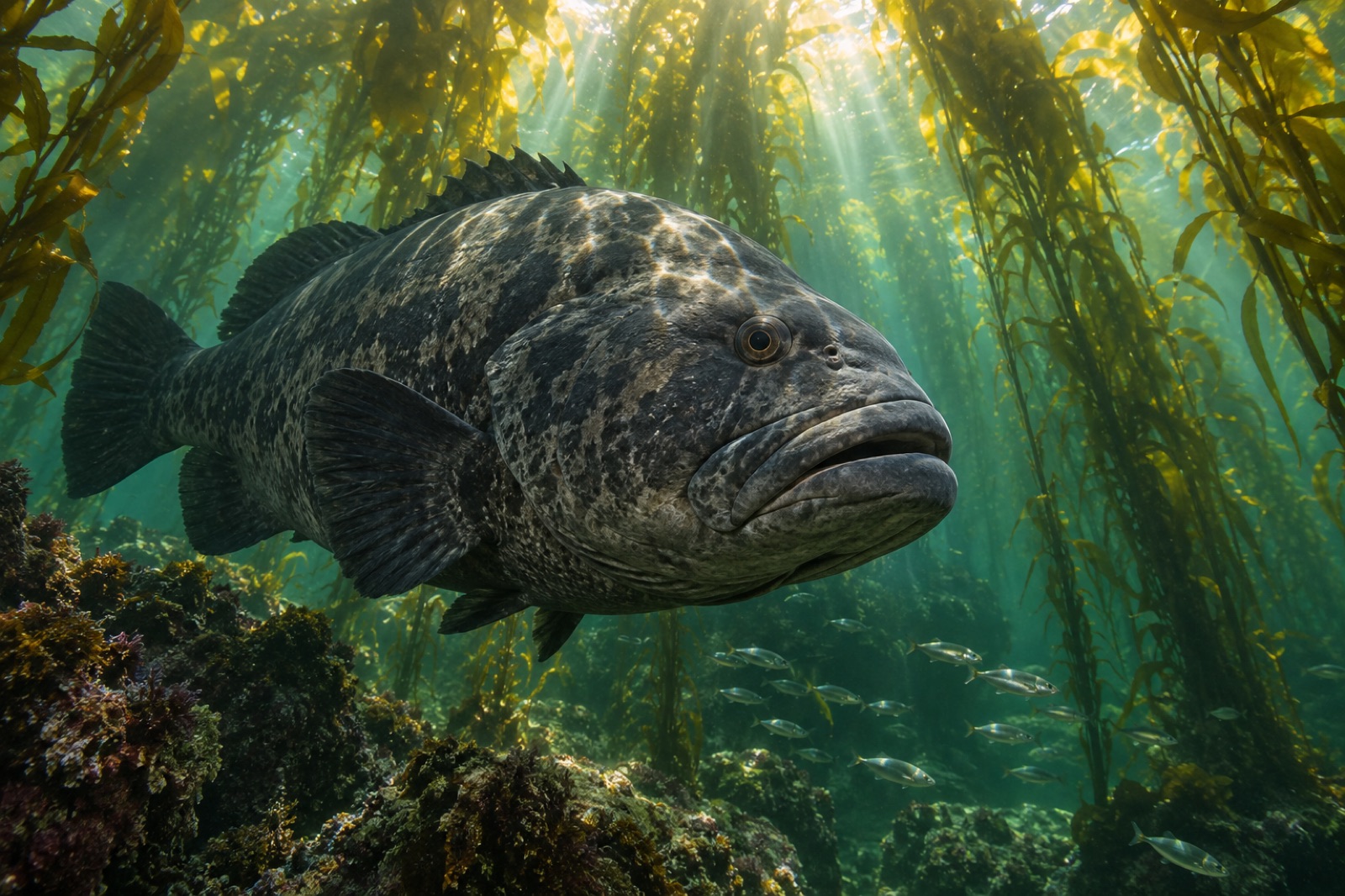
In one generation, gillnets erased the giant sea bass from its kelp forests. Four decades of protection are bringing it back — one cautious shadow at a time.
Dr. Mara Ellison ·
Paguristes ulreyi, the furry hermit crab of Pacific kelp forests: how to identify it, why it wears hydroid-covered shells, and its role on the reef floor.
Dr. Theo Nakamura ·
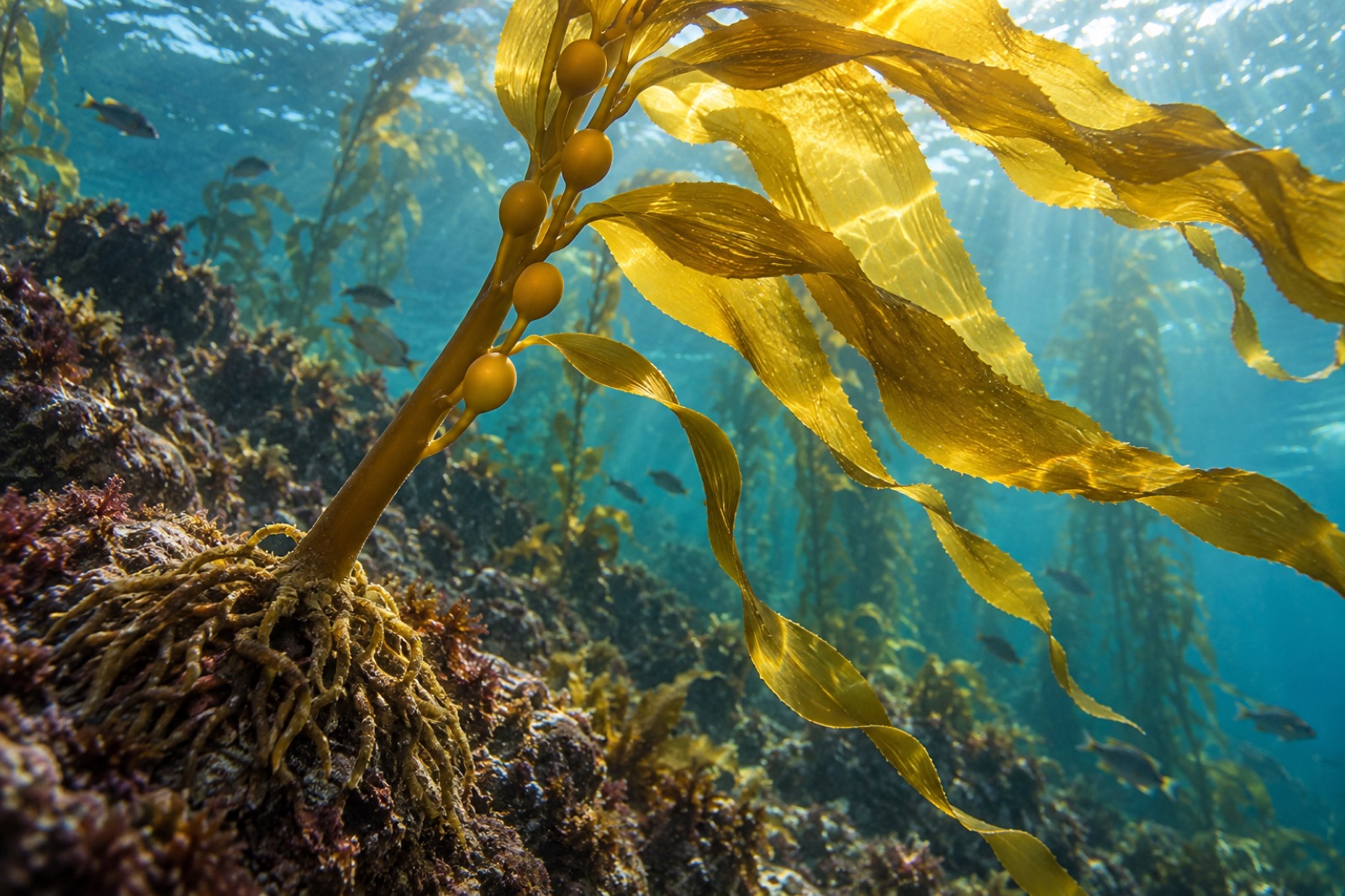
Giant kelp is the fastest-growing organism on Earth and the architect of undersea forests. Learn its biology, life cycle, range and why it matters.
Dr. Theo Nakamura ·
The spiny sun star is a many-armed predator of cold reefs in both northern oceans. How to identify Crossaster papposus, what it eats, and why it matters.
Dr. Mara Ellison ·
The señorita is a small California wrasse that runs cleaning stations, swarms in glittering schools and buries itself in sand at night. Meet the kelp forest's hygienist.
Dr. Theo Nakamura ·
Porichthys notatus hums for hours to woo mates, glows with borrowed light and survives hours out of water. Meet the kelp coast's oddest neighbour.
Dr. Theo Nakamura ·
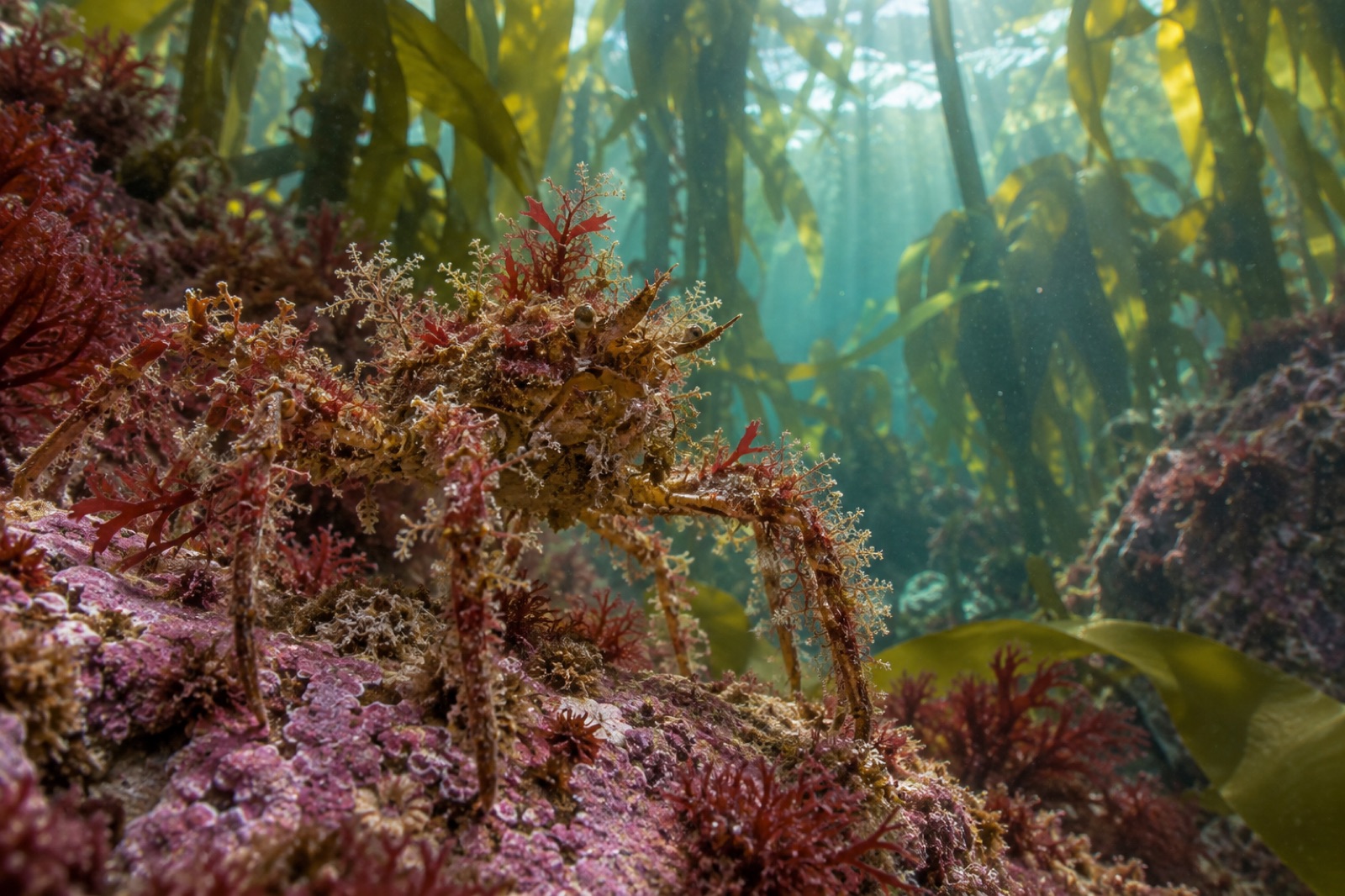
Meet the sharpnose crab — a small Pacific spider crab that plants living algae on hooked hairs across its shell. How the disguise works and where to find it.
Dr. Mara Ellison ·
Identifying the walleye surfperch: the big-eyed, silver schooler of kelp edges and sand flats, and a member of the ocean's great live-bearing family.
Dr. Theo Nakamura ·
Meet the heart crab — a flattened, heart-shaped California reef crab that is not a true crab at all, but a king-crab relative descended from hermit ancestors.
Dr. Theo Nakamura ·
Meet the Pacific white-sided dolphin — the torpedo-striped, bow-riding acrobat of North Pacific kelp latitudes, from BC's inshore passages to Monterey Bay.
Dr. Mara Ellison ·
How to identify the rainbow surfperch: pattern by pattern, season by season — and where to find this coral-coloured fish among the kelp beds and wharves.
Tom Okafor ·
The sailfin sculpin is a banded-eye, flag-finned reef fish of the North Pacific — famous for the courtship wave of its tall sail-like first dorsal fin.
Dr. Theo Nakamura ·
Northern elephant seals dive farther than almost any mammal and came back from near-extinction. Learn their biology, haul-outs and recovery story.
Dr. Mara Ellison ·
Graceful crab species profile: the slim Metacarcinus gracilis of eelgrass, bays and kelp edges — how to tell it from a small Dungeness, and its estuary role.
Dr. Mara Ellison ·
The crevice kelpfish can turn from red to brown to match the algae it hides in. Meet the small, coiled shape-shifter living inside the kelp forest's foundations.
Dr. Elias Brandt ·
The mosshead warbonnet is a moss-fringed, eel-like prickleback of North Pacific reefs — a shy, hole-loving specialist of kelp-bed cracks and crevices.
Dr. Theo Nakamura ·
Helmet crab species profile: the saw-edged, bristled Telmessus cheiragonus — a night-roaming burrower of kelp coast sand from Alaska to Japan.
Dr. Mara Ellison ·
Learn to identify the pelagic cormorant (Urile pelagicus), the smallest North Pacific cormorant, and how it hunts small fish along kelp forest edges.
Tom Okafor ·
The scalyhead sculpin is a tassel-headed, fully scaled cottid of Pacific kelp beds — a small ambush hunter whose males turn crimson over guarded egg masses.
Dr. Theo Nakamura ·
The brown Irish lord is a spiny, red-bellied sculpin of North Pacific reefs — a camouflaged ambush hunter of crabs and shrimps from Alaska to California.
Dr. Theo Nakamura ·
Meet Mola mola, the heaviest bony fish on Earth — a flattened, fin-flapping giant that visits kelp coasts to be cleaned, bask and feed on drifting gelata.
Dr. Theo Nakamura ·
Brooding anemone species profile: protandric hermaphrodite, live-bearing parent, epiphyte of kelp and eelgrass — and a dispersal puzzle solved by rafting.
Dr. Theo Nakamura ·
Turkish towel species profile: the rough-textured red alga of surf-swept Pacific rocks, its carrageenan chemistry, life cycle and kelp-forest role.
Dr. Theo Nakamura ·
The greenbone — also called butterfish — is New Zealand's own kelp grazer, a beak-toothed odacid that changes sex, varies in colour, and moves kelp energy into fish.
Dr. Theo Nakamura ·
The striped trumpeter is Tasmania's celebrated hand-line fish — a kelp-reef juvenile, a deep-reef adult, and a lesson in how long-lived fish repay patience.
Dr. Mara Ellison ·
The herring cale is a cigar-shaped, beak-toothed herbivore that grazes kelp across the Great Southern Reef — and moves its energy up the food web.
Dr. Theo Nakamura ·
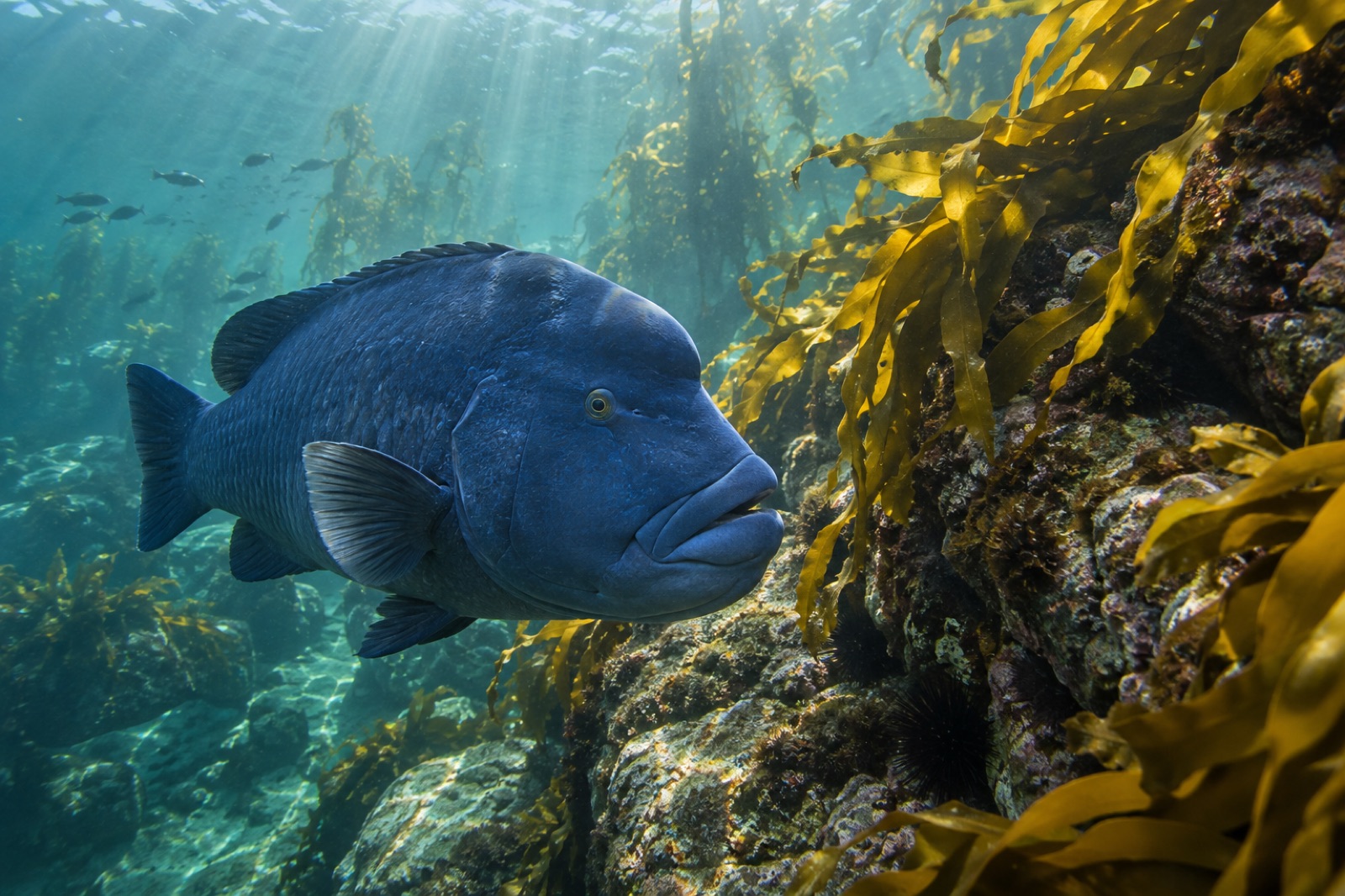
Meet the western blue groper — Western Australia's giant blue wrasse of the kelp reefs, an urchin-eating patriarch that can live more than half a century.
Dr. Mara Ellison ·
Golden kelp forms the backbone of Australia's Great Southern Reef. Learn to identify Ecklonia radiata and why this habitat-maker is on the move as oceans warm.
Dr. Mara Ellison ·