Encyclopedia9 min read
Decorator Crabs: Walking Gardens of the Kelp Reef
Decorator crabs build living costumes from algae, sponges and anemones using velcro-like hairs. How the disguise works, why it evolved and where to see it.
Dr. Mara Ellison ·
Meet the sharpnose crab — a small Pacific spider crab that plants living algae on hooked hairs across its shell. How the disguise works and where to find it.
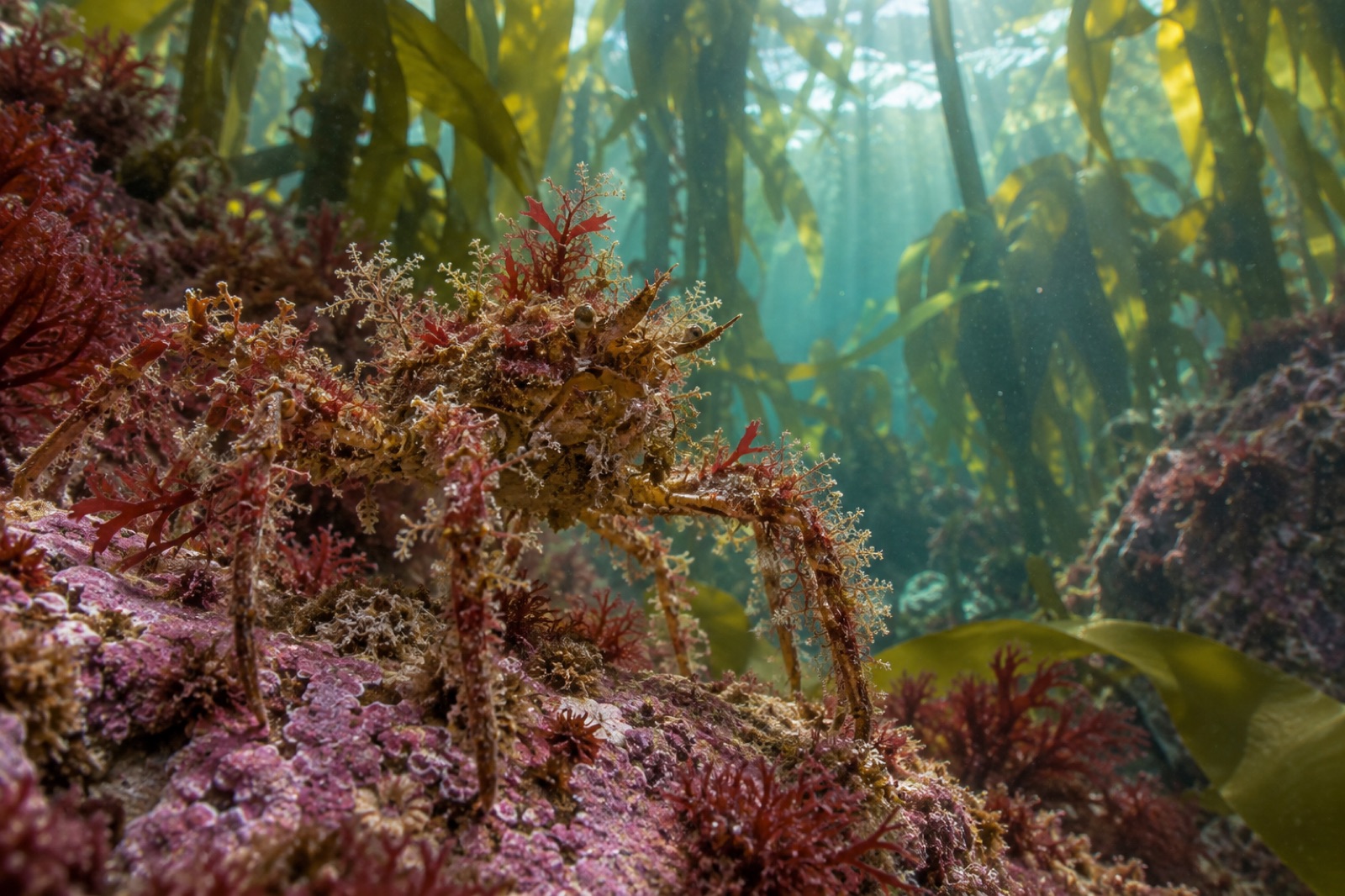
Kneel beside a low-tide rock ledge on the Pacific coast, wait for your eyes to adjust, and sooner or later a bit of the reef will stand up and walk sideways. If the walking piece is small — a palm's width at most — long-legged, sharply beaked, and furred with living red or brown weed, you have found the sharpnose crab (Scyra acutifrons), one of the northeast Pacific's most accomplished decorator crabs. It survives by turning its own body into a garden bed, and it does the job so well that most encounters are not encounters at all: people look straight at a sharpnose crab and see weed.
This profile covers how to identify it, how the decorating system works on this particular species, what it eats and who eats it, and why this humble little crab is a flagship for one of the best-studied camouflage behaviours in the sea.
| Scientific name | Scyra acutifrons (Dana, 1851) |
| Family | Epialtidae — the kelp and spider crabs; close kin to the northern kelp crab and other decorating spider crabs |
| Size | Carapace to roughly 4 cm wide; long slender legs give it a bigger footprint than its shell suggests |
| Range | Northeast Pacific, Alaska to Baja California, from the low intertidal into subtidal kelp beds |
| Habitat | Rocky reefs, kelp understory, holdfast tangles and eelgrass edges, usually in well-weeded water |
| Diet | Mixed grazer–scavenger: algae fragments, detritus, small invertebrates picked from weed |
| Key ID mark | A narrow, pointed, forward-jutting rostrum (the "sharp nose") and a back planted with hooked-hair-mounted algae |
All the epialtid spider crabs share a body plan: a small triangular-to-pear-shaped carapace, long thin legs that make the animal look like a daddy-long-legs built sideways, and short, capable claws held in front. The sharpnose crab's distinguishing feature is the one the name advertises: between the eyes, the front of the shell narrows into a sharp, projecting point — a genuine beak, more drawn-out than the blunted brow of the kelp crab or the broad forehead of the sheep crab. Acutifrons is Latin for sharp-fronted; nineteenth-century taxonomy was not subtle.
The second ID character is the wardrobe. Where it lives well, the crab's back is rarely visible at all. It is covered in a living felt of finely cropped algae, bits of hydroid and sponge, anchored to rows of microscopic hooked hairs over the carapace and legs. The result reads as a small clump of red or brown turf on legs. Clean, the crab is a neat tan-to-pinkish little spider crab with a sharp beak; dressed, it simply disappears into its substrate.
A useful field separation from its commoner lookalike, the large and usually naked northern kelp crab (Pugettia producta):
Decoration in Scyra follows the standard majoid toolkit described in the decorator crab overview: a suite of hooked setae — natural velcro — across the carapace and legs. The crab snips a fragment of alga or hydroid with its claws, works it between its mouthparts to fray the ends, then presses it onto the hooks, where the fibres stay wrapped and, because it's alive, actually root and grow. The crab is not wearing a costume; it is growing a garden on which it is the soil.
The choices are not random. Observational work on epialtid decorators shows a strong preference for algae that are closely matched to the background the crab inhabits, which in practice means its camouflage is usually colour-true to the weed around it. The chemical-defence hypothesis tested famously in tropical species — crabs selecting for foul-tasting or stinging decoration — has never been documented as cleanly in the small Pacific epialtids, and for this crab the best-supported explanation remains the simple one: a moving shape is detectable; a moving clump of weed much less so.
This habit also explains one of the few easy ways to find the species at all. Watch a weedy rock face and wait for a piece of weed to travel against the surge. Crabs redecorate when they change habitat, sometimes over days, keeping the match close. A crab that moves from red turf to kelp will, given time and motion, trade part of its wardrobe.
As a feeder the sharpnose crab is a generalist of the kelp understory. It picks algal fragments, film diatoms, detritus and the small invertebrates of the weed seam — tiny amphipods, mites of the marine sort, minute worms — in slow and thorough foraging bouts, mostly at night. It is not an important single prey remover, but it is abundant in well-vegetated shallow reefs, and dense decorator communities act as one of the crews keeping drifting kelp fragments and fouling growth recycled through the understory.
As prey it is important out of proportion to its size. Octopuses — especially the giant Pacific octopus, whose den middens on pacific reefs accumulate the shells of every local crab species in testimony — take decorator crabs constantly. So do rockfish, lingcod, cabezon, wolf eels, sea otters patrolling the shallow edge, and larger crabs. The camouflage is, in other words, not theoretical: every visual hunter on the reef is the selection pressure that built it. The sharpnose crab's decorated back is the summary of several million years of being looked for.
Its distribution — Alaska to Baja, low intertidal to tens of metres — places it through most of the northeast Pacific kelp range, from the Aleutian edges to Monterey Bay and beyond. It is especially characteristic of weedy, wave-sheltered subtidal rock, where the decorator's life is easiest and its background closest at hand.
Like other spider crabs, sharpnose crabs mate in aggregations timed to moulting windows, and females carry the new clutch of eggs under the abdominal flap as an orange-to-dark berry cluster through development. The larvae go to sea as plankton for weeks before settling as miniature, beaked, already decorative megalopae.
The decorator's classic trade-off plays out in every moult: the old shell, with its entire attached garden, is left behind, and the new soft crab has to get dressed again from scratch. During the soft window the animal is at its most vulnerable — naked, slow, unable to plausibly pass for weed — and it spends those days hidden deeper in crevices than at any other time in its cycle. Decoration is armour, and the armour is rebuilt after every growth.
The sharpnose crab is neither fished nor listed. It needs exactly one thing: structurally complex, well-vegetated shallow reef. That is not nothing. Urchin-barren formation strips the understory turf the crab gardens with and hides in; seasonal heat takes edges of the same habitat; and the general trend of reef simplification shows up in decorator crab abundance before it shows up in many larger species. As a presence, a reef with walking weed is a reef with working understory — which is why field teams note decorator crabs as part of the ordinary texture of a healthy kelp survey, alongside the urchins and fish that make the headline species lists.
Yes — it's one of the classic Pacific decorator crabs, in the spider-crab family Epialtidae. Its hooked setae work like velcro, and it snips, frays and presses fragments of living algae onto its carapace and legs, where they root and continue growing.
Look for decoration and the nose. Kelp crabs are large, fast and nearly bare-shelled, walking openly on kelp fronds. The sharpnose crab is much smaller, slow, weed-covered, and has a conspicuously sharp forward point between the eyes. If the reef is wearing weed and walking slowly, it's this one.
A mixed diet of algal fragments, detritus and the small invertebrates of the weed seam — amphipods, tiny worms, mites. It works the kelp understory in slow nocturnal foraging bouts.
Weedy shallow rocky reefs from Alaska to California, especially wave-sheltered subtidal rock with dense red and brown turf. Look at the weed, wait, and watch for motion against the surge. Low-tide ledges and sheltered subtidal kelp understory are the most reliable places.
Not as a species — it's common and unfished. Its dependency is habitat: rich, weedy shallow reef. Urchin barrens and reef simplification strip the turf it gardens with, so decorator crab abundance is a gentle early-warning signal in kelp surveys.
Decorator crabs build living costumes from algae, sponges and anemones using velcro-like hairs. How the disguise works, why it evolved and where to see it.
Dr. Mara Ellison ·
The northern kelp crab is a colour-changing spider crab that lives its whole life in the kelp canopy. Learn its biology, diet, and role in the forest.
Dr. Theo Nakamura ·
The California sheep crab is a slow, spiny giant of the kelp forest floor — a decorator crab that outgrew its disguise. Meet Loxorhynchus grandis.
Dr. Mara Ellison ·