Encyclopedia8 min read
Ochre Sea Star (Pisaster ochraceus): The Original Keystone Species
Meet the ochre sea star, the purple tidepool predator whose removal in a famous 1960s experiment coined the keystone species concept.
Dr. Theo Nakamura ·
Meet the giant Pacific octopus: the world's largest octopus, a kelp-forest den-dweller with three hearts, blue blood and one shot at motherhood.
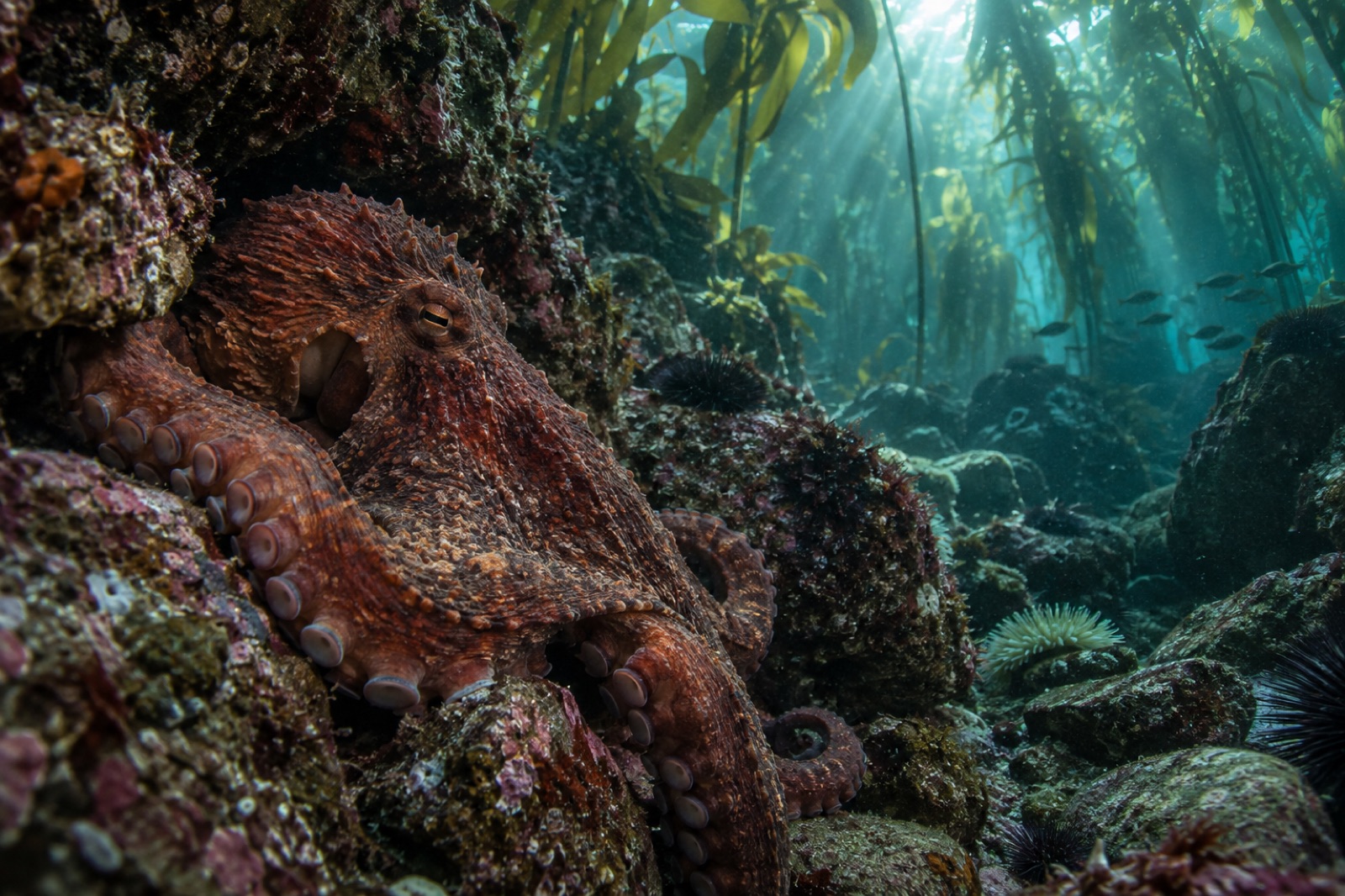
The giant Pacific octopus (Enteroctopus dofleini) is the largest octopus on Earth — a cold-water cephalopod of the North Pacific that commonly weighs as much as a four-year-old child, solves problems that stump vertebrates, and lives its entire, extravagant life in about the span of a university degree. It dens in the rocky reefs beneath kelp forests, hunts crabs by night, and ends its story with one of the most devoted — and fatal — acts of parenting in the ocean. This profile covers its size, senses, intelligence, and unusual life cycle.
| Scientific name | Enteroctopus dofleini |
| Common names | Giant Pacific octopus, North Pacific giant octopus |
| Range | North Pacific, from Japan and the Korean Peninsula across to Alaska and south to California |
| Habitat | Rocky reefs and dens on sand-and-rock edges, from the shallow subtidal to deep continental-shelf water |
| Size | Averages around 15 kg with a 3–4 m arm span; the largest individuals on record exceeded 70 kg |
| Lifespan | Roughly 3–5 years |
| Diet | Crabs, clams, shrimp, snails, fish; occasionally sharks and other octopuses |
| Reproduction | Semelparous — one brood of tens of thousands of eggs, then death |
Size claims about octopuses attract exaggeration, so it is worth being precise. A typical adult giant Pacific octopus weighs around 15 kilograms and spans three to four meters arm-tip to arm-tip — already the largest of the roughly 300 octopus species. Historically recorded giants have exceeded 70 kilograms, with arm spans reportedly approaching seven meters, though such monsters are vanishingly rare. A 2012 genetic study complicated the picture further: what was long treated as one wide-ranging species may conceal at least two, with a "frilled" cryptic relative identified in Alaskan samples — a reminder of how little of the deep reef we have truly catalogued.
The body is boneless and soft, which makes the animal's strength easy to underestimate. Each of its eight arms carries up to 280 suckers, and each sucker can grip independently. An octopus pulling on a crab with several hundred suckers is less a wrestling match than a foregone conclusion.
Less than half of a giant Pacific octopus's neurons reside in its central brain. The majority are distributed through the arms, each of which has its own considerable neural processing — enough that an arm can execute local decisions (taste what it touches, adjust grip, explore a crevice) while the central brain attends elsewhere. Each sucker is both hand and tongue: mechanosensory and chemosensory at once. An octopus groping a rock face is, in a real sense, licking it.
Giant Pacific octopuses have three hearts: two pump blood through the gills, and one pushes it around the body. Their blood is blue — copper-based hemocyanin rather than iron-based hemoglobin. Hemocyanin transports oxygen efficiently in cold, sometimes oxygen-poor water, at the cost of being less efficient overall, one reason octopuses tire quickly and prefer to crawl rather than jet.
The skin is one of the most sophisticated organs in the animal kingdom: millions of neurally controlled chromatophores (pigment sacs), combined with reflecting cells and muscular papillae that raise the skin into spikes and ridges. A giant Pacific octopus can flash from brick red to coral white, mimic the texture of the rock it sits on, and do it in a fraction of a second. Color change signals mood, but mostly it is camouflage — the reason divers routinely stare directly at an octopus and see only reef.
Despite their size, giant Pacific octopuses are homebodies. An individual selects a den — a rock cavity, a crevice under a boulder, a hollowed-out space in a reef edge — and furnishes it with a doorway of stones and shells it arranges itself. Outside the den accumulates the midden: a rubbish heap of cracked crab carapaces, drilled clam shells and urchin tests. For divers, a midden is the surest sign of an occupied address; for scientists, it is a dietary record written in shell.
Hunting happens mostly at night. The octopus flows over the reef edge, ballooning over crab holes, probing under ledges. It kills with its parrot-like beak, the only hard part of its body, sometimes drilling shelled prey and injecting venomous saliva that begins dissolving the meat within the shell. Dungeness and red rock crabs are staple prey where ranges overlap — which is why octopuses and crab fishers have never been friends, and why octopuses turn up, annoyed and ink-clouded, in crab pots.
Giant Pacific octopuses navigate mazes, unscrew jars, dismantle aquarium plumbing, and in several facilities have learned to recognize individual keepers — greeting some, drenching others. Controlled experiments on octopus cognition are genuinely hard to design (the subjects keep subverting the protocol), but the consensus among cephalopod researchers is that these animals possess learning, memory, play-like behavior and problem-solving on par with many vertebrates — all packed into a lifespan of a few years and a lineage that branched from ours more than half a billion years ago. Intelligence, it turns out, evolved at least twice.
The giant Pacific octopus is semelparous: it reproduces once and dies. After mating, the female retreats to a deep, defensible den and lays strings of eggs — commonly tens of thousands, up to around one hundred thousand — which she hangs in curtains from the den ceiling. Then she stops leaving. For roughly six months or more she does not eat, dedicating herself to the brood: blowing oxygenated water across the eggs, scrubbing them clean of algae and sediment with her arms, defending them from predators.
In the cold waters at the northern end of the range, brooding may extend longer still. By hatching, the mother is starved, grey-skinned, and near death; she typically dies within days of her young drifting away as paralarvae into the plankton. Her body often becomes a meal for the scavengers of the reef she spent her life hunting — a closed loop of cold-water nutrients. The male, for his part, dies within months of mating. An animal of extraordinary capability spends its entire adulthood building toward a single, terminal act of care.
On temperate reefs, the giant Pacific octopus is a mid-trophic heavyweight: a major predator of crabs and molluscs, and in turn prey for larger animals — seals and sea lions haul them out, and the salmon shark is a documented predator. Its middens feed scavengers, its abandoned dens shelter fish and small octopuses, and its scavenging helps keep reefs clean. Where restoration work rebuilds complex rocky reef beneath kelp, octopus dens and middens are among the welcome signs of a functioning community.
The species is not considered threatened, but its status is genuinely data-poor across much of its range; it is taken as bycatch and in small directed fisheries, and like all cold-water cephalopods it breathes harder in warming, deoxygenating seas. Marine heatwaves — which also batter kelp forests and trigger outbreaks like sea star wasting — push octopuses toward their thermal limits in some regions. Monitoring a soft-bodied, den-dwelling animal that refuses to be counted is exactly the kind of problem environmental DNA sampling was invented for, a topic we explore in our Ocean Science cluster.
An octopus does not so much live in its den as run it — a small, deliberate estate with a decorated doorway, a pantry of crabs, and a rubbish heap that tells scientists everything it ate.
Most adults are 10–20 kg with an arm span of 3–4 meters. Exceptional, reliably documented individuals have exceeded 70 kg. Claims of multi-hundred-kilogram octopuses belong to fisherman's lore rather than the scientific record.
No. They are famously uninterested in divers except as curiosities, and encounters usually end with the octopus retreating into its den. Their bite delivers venom tuned for crabs and can be painful, but bites are rare, defensive, and not life-threatening.
Roughly three to five years — startlingly short for an animal of its size and cognitive ability. Both sexes die shortly after reproduction, a strategy called semelparity.
Evidence from aquariums and research facilities strongly suggests they can distinguish individual humans by sight and remember them over time, reacting differently to familiar caregivers versus strangers. How they do it is still being studied.
Rocky reefs of the cool North Pacific — British Columbia, Washington's Puget Sound, Alaska, Japan's northern coasts — are classic habitat. Look for the midden: a heap of cracked crab shells outside a rock crevice means someone is home. Move slowly, keep lights low, and never reach into an occupied den.
Meet the ochre sea star, the purple tidepool predator whose removal in a famous 1960s experiment coined the keystone species concept.
Dr. Theo Nakamura ·
Portrait of the Port Jackson shark: Australia's gentle, crested egg-layer that crunches sea urchins and returns to the same reef year after year.
Dr. Theo Nakamura ·
Meet the giant spined sea star, Pisaster giganteus — a blue-gray, knobby-armed giant of kelp-edge sand flats that hunts sand dollars and can span half a metre.
Dr. Mara Ellison ·