The ochre sea star (Pisaster ochraceus) is a five-armed intertidal predator of the North American Pacific coast, and it holds a unique place in the history of ecology: it is the animal that gave us the term keystone species. When ecologist Robert Paine systematically pried these slow-moving stars off rocks on the Washington coast in the 1960s, the whole intertidal community reorganized without them — proof that a single predator, never particularly abundant, can hold an entire ecosystem in a particular shape. This profile covers its biology, its famous experiment, the epidemic that nearly erased it, and why its story still anchors how we think about restoring coastal ecosystems like kelp forests.
Quick facts
|
|
| Scientific name |
Pisaster ochraceus |
| Common names |
Ochre sea star, ochre starfish, purple sea star |
| Range |
Prince William Sound, Alaska, to Baja California, Mexico |
| Habitat |
Rocky intertidal and shallow subtidal, on wave-exposed and sheltered shores |
| Size |
Commonly 10–25 cm across; large individuals approach 35 cm |
| Lifespan |
Likely 20 years or more |
| Diet |
Mussels, barnacles, chitons, limpets, snails |
| Claim to fame |
The original keystone species (Paine, 1969) |
The experiment that defined an idea
In 1963, Robert Paine began an experiment of elegant brutality on the wave-battered rocks of Mukkaw Bay, at the mouth of the Strait of Juan de Fuca in Washington State. His study plots sat in the middle intertidal, a band of rock crowded with life: California mussels, acorn barnacles, limpets, chitons, and the ochre sea stars that hunted among them.
Paine's manipulation was simple. In experimental plots, he removed every ochre star he found, returning regularly to chuck new arrivals — in his famous phrasing, he threw them "into the ocean" beyond the plots. In control plots, the stars stayed.
The result unfolded over years. With their predator gone, California mussels (Mytilus californianus) spread down the rock, smothering and outcompeting the barnacles and algae that had shared the space. Species richness in the removal plots collapsed from around fifteen species to eight. The control plots, patrolled as always by ochre stars, kept their mosaic. By preferentially eating the most competitive space-holder — the mussel — the sea star prevented a monoculture and made room for everyone else.
Paine published the findings in 1969 and coined the term keystone species: a species whose impact on its community is disproportionately large relative to its abundance. The metaphor comes from architecture — the keystone is a modest wedge of stone at the crown of an arch, yet pull it out and the whole structure falls.
The idea has since been refined, and ecologists now distinguish several flavors of keystone influence (predators, engineers, mutualists). But the ochre star remains the textbook case, and kelp-forest ecology still runs on the same logic: sea otters controlling urchins is a trophic cascade built from exactly Paine's template. Our Ocean Science explainers dig into those cascades in detail.
Anatomy of a tide-pool hunter
Tube feet and a hydraulic grip
An ochre star has no brain, no eyes in the vertebrate sense, and no blood. What it has is a water vascular system: seawater drawn in through a sieve plate on its upper surface, pressurized, and distributed through canals to hundreds of tube feet along the underside of each arm. Each foot is a small hydraulic pod with a suction tip, and coordinated rows of them let the animal glide over rock at a few centimeters a minute — and, more importantly, pull.
That pulling power is how it eats a mussel. The star hunches over its prey, attaches scores of tube feet to each valve, and applies steady, patient tension. A mussel can clamp shut against a sharp tug, but it cannot clamp forever; as the bivalve fatigues, the valves part by the tiniest gap — less than a millimeter is enough.
A stomach that leaves the body
Through that sliver of an opening, the ochre star does one of the strangest things in zoology: it everts its cardiac stomach — pushes it out through its own mouth — and slips it between the mussel's shells. Digestive enzymes liquefy the prey where it sits, and the star retracts its stomach hours later, carrying the meal away in solution. It is slow, private, and utterly effective, and it means a five-armed animal with no jaws can dominate a shoreline armored in shell.
Senses without a head
Each arm ends in a light-sensitive eyespot and a tentacle rich in chemoreceptors. Ochre stars hunt largely by scent, which is why a mussel bed seems to stir them from meters away downstream — and why a crushed sea star can scatter its neighbors in a slow-motion panic. It is a distributed animal: arms that can act semi-independently, and a regenerative ability that can rebuild lost limbs over months.
Color, range and habitat
Ochre stars come in two common color morphs — a deep, saturated purple and a burnt orange-ochre — plus rarer browns and tans. The purple form tends to dominate at the northern end of the range, but both can share a single stretch of rock. The function, if any, of the color difference is still debated; it does not appear to mark different species or sexes.
Their geographic range spans roughly 4,500 kilometers of coastline, from Prince William Sound in Alaska to Pacific-side Baja California. Within that range they are creatures of the rock: exposed outer coasts, sheltered straits, harbor pilings — anywhere with hard substrate, moving water, and prey. They tolerate hours of emersion at low tide by clamping down over a cushion of retained seawater, and they endure surf that would shred most animals by simply sticking harder.
One useful field mark separates them from look-alikes: the small, blunt, chalky-white spines that stud their upper surface, arranged in a rough starburst of lines radiating from the center.
Sea star wasting: the epidemic that emptied the rocks
Beginning in 2013, an epidemic now called sea star wasting syndrome swept the North American Pacific coast, becoming what researchers described as one of the largest marine wildlife mortality events ever recorded. Affected stars develop lesions, lose their grip, contort their arms, and disintegrate — sometimes within days of the first symptoms. More than twenty species were hit, but the ochre star, being abundant and obvious, became the epidemic's public face. On some shores, observers reported losing the great majority of stars within a single season.
The cause has proved stubbornly complicated. A densovirus was implicated early, but follow-up work pointed to a more complex picture in which environmental conditions — particularly warm water and the low-oxygen, microbial conditions it can foster at the animal's surface — appear to drive the disease. The ochre star's collapse coincided with an anomalously warm blob of Pacific water, and outbreaks have repeatedly tracked warm periods.
The ecological sequel played out like Paine's experiment at continental scale: with stars scarce, young mussels surged on many shores. But there is cautious hope. Beginning around 2015–2016, researchers documented pulses of juvenile ochre stars settling in large numbers at various sites, and populations in parts of the range have been rebuilding — unevenly, and with the ever-present risk that another warm period renews the epidemic.
Why keystone thinking matters for restoration
The ochre star's lesson generalizes, and it is the lesson restoration practitioners ignore at their peril: you cannot rebuild an ecosystem by replanting its plants alone. A kelp forest without its predators is a standing invitation to urchin barrens; an intertidal without sea stars is a mussel monoculture waiting to happen. Structure returns when interactions return.
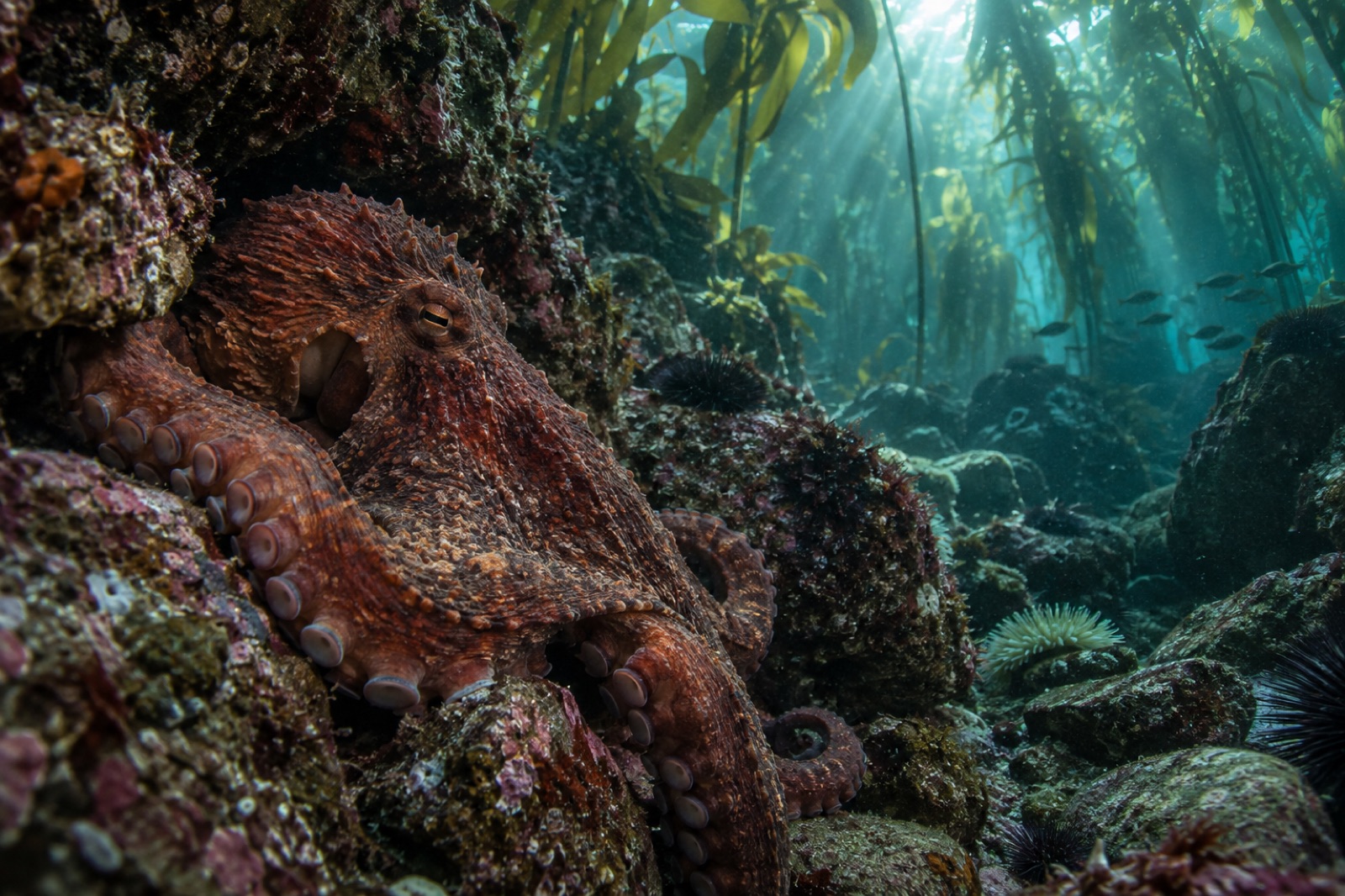
That is why modern restoration efforts — including Tidewright's own monitoring programs — track predators and grazers alongside canopy cover. The biomass of kelp tells you a forest is standing; the presence of its sea stars, otters, lobsters and wrasse tells you it has the internal machinery to stay that way. You can read more about how that monitoring works on our platform page, and meet other members of that predator cast in our profiles of the giant Pacific octopus and the urchin-crunching Port Jackson shark.
Pull one modest star off the rocks and the shoreline reorganizes around its absence. Robert Paine didn't just discover a species; he discovered that ecosystems have load-bearing walls.
Key takeaways
- The ochre sea star (Pisaster ochraceus) is the original keystone species: Paine's 1960s removal experiments showed a single uncommon predator could determine the diversity of an entire shore.
- It hunts with hundreds of hydraulic tube feet and digests prey externally, everting its stomach into mussel shells opened by less than a millimeter.
- Its range stretches from Alaska to Baja California, in purple and ochre color morphs that share the same rocks.
- Sea star wasting syndrome devastated populations beginning in 2013; recovery is underway but uneven, and warm water appears to drive outbreaks.
- Keystone predators are a restoration target, not a luxury: diverse, interacting communities are what make planted kelp self-sustaining.
FAQ
Is the ochre sea star the same as the common starfish?
No. The "common starfish" usually refers to the northern sea star (Asterias rubens) of the Atlantic. The ochre star is a Pacific species in a different family, and while it shares the basic five-armed body plan, its ecology — and its outsized scientific fame — are its own.
Why are some ochre stars purple and others orange?
They are two naturally occurring color morphs of the same species. Purple tends to dominate in colder northern waters and orange appears more often in some southern and sheltered sites, but both morphs can occur together. The underlying reason for the variation remains unresolved.
Can an ochre sea star regrow a lost arm?
Yes. Like most sea stars, Pisaster can regenerate lost arms over months, provided the central disc is intact. Regeneration diverts energy from growth and reproduction, so a damaged star survives but pays for the repair.
Did the wasting epidemic kill all the ochre stars?
No, though losses were catastrophic at many sites — in places over 80–90 percent within months. Survivors remained throughout the range, and strong juvenile recruitment has rebuilt numbers at numerous locations, especially from 2016 onward. The disease persists at low levels, and outbreaks still flare in warm periods.
Where can I see ochre sea stars?
Any rocky Pacific headland at low tide, from Alaska to Southern California — look in crevices and on the shaded undersides of ledges in the mid- to low intertidal. Observe without prying them off the rock: dislodging a clamped star can damage its tube feet, and handling stresses intertidal animals already managing heat and air exposure.