Science · Glossary
Speak kelp.
Every field has its shorthand — and half of understanding the ocean is decoding it. These are the terms our science, carbon and farming writing relies on, defined plainly and linked to the articles that go deeper.
13 terms
Kelp anatomy & forest ecology
The parts of a kelp plant and the living architecture of the forest — the vocabulary behind every species profile on this site.
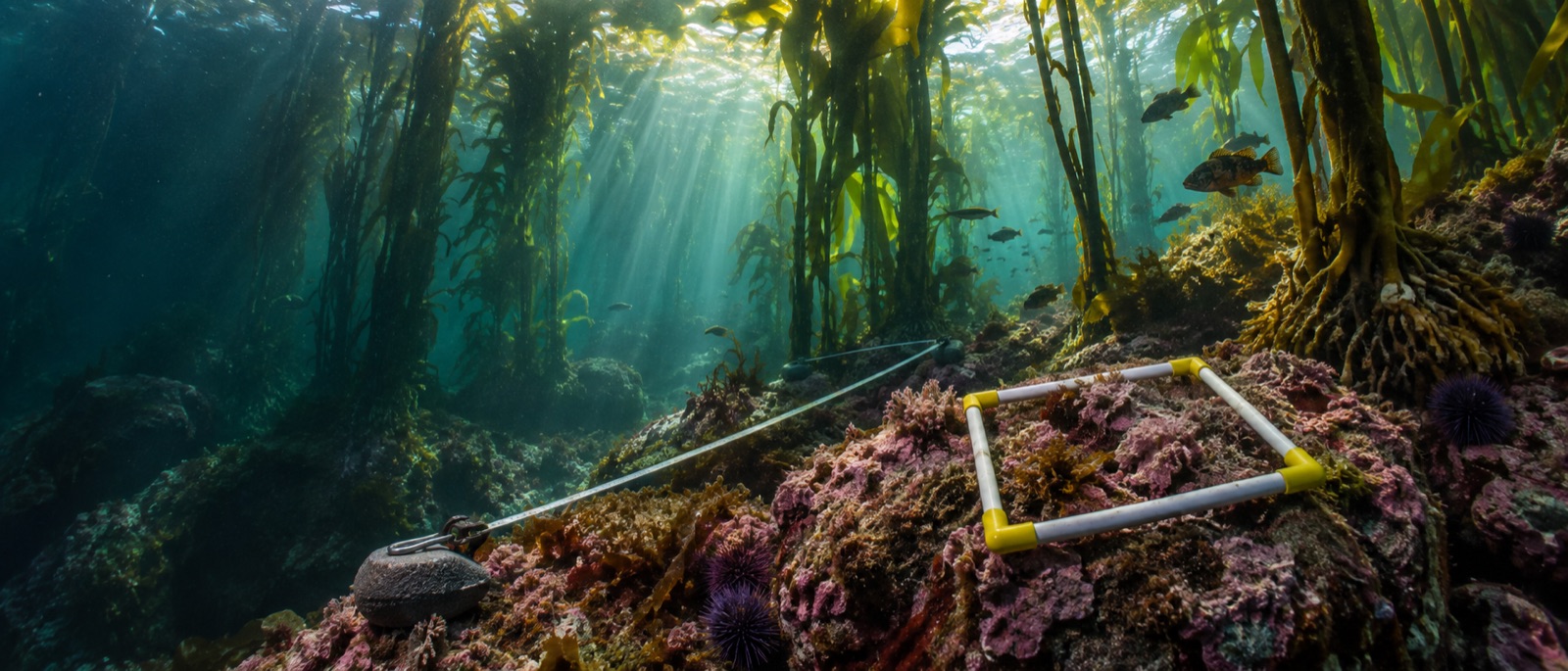
- Holdfast
- The root-like tangle of haptera that anchors a kelp to rock. It absorbs almost no nutrients — its job is purely structural, clamping the plant to the substrate against wave forces. The crevices between its fingers shelter dozens of small invertebrate species, making it a habitat in its own right.
- Stipe
- The stem of a kelp, running from holdfast to blades. In some species it is short and flexible; in tree kelp and giant kelp it is metres tall and branches like a trunk. The stipe conducts little — kelp blades mostly feed themselves — so its stiffness and strength are what matter.
- Pneumatocyst
- A gas-filled float at the base of a blade, holding the photosynthetic tissue up toward the light. Gas composition varies by species — some even contain trace carbon monoxide. A pneumatocyst is a kelp’s buoyancy control, and its placement tells you which storey of the forest a blade belongs to.
- Blade (lamina)
- The photosynthetic frond of a kelp — the part that does the feeding. Blades range from hand-sized fans to ribbons tens of metres long. Because kelp absorbs nutrients across the whole blade surface rather than through roots, blade area is the forest’s engine room.
- Meristem
- The narrow growth zone where new kelp tissue is made. In many kelps it sits where stipe meets blade, pushing fresh blade upward as the old tip erodes away — a fountain of growth that can reach tens of centimetres a day in fast species like giant kelp.
- Sporophyte
- The large, visible generation of a kelp — the forest you dive in. Sporophytes release millions of microscopic spores from dark patches (sori) on their blades. Those spores become the nearly invisible gametophyte generation, closing the alternation of generations that defines kelp life.
- Gametophyte
- The microscopic, thread-like sexual generation of kelp, grown from settled spores. Female gametophytes release eggs and a chemical lure; males release sperm. Gametophytes can persist dormant for months in seed banks — the trait hatcheries exploit by culturing them as living seedstock.
- Foundation species / ecosystem engineer
- An organism whose physical presence builds the habitat hundreds of others live in. Kelp is the classic marine example: its fronds shade the reef, slow currents, concentrate nutrients and provide attachment surfaces — engineering a three-dimensional neighbourhood out of open water.
- Urchin barren
- A reef stripped of kelp by sea urchins, held in that state by the urchins themselves. Barrens are an alternate stable state: surviving urchins graze every recruiting sporeling, so the forest cannot return on its own. Flipping a barren back requires removing enough grazers for spores to win the race.
- Trophic cascade
- A change at the top of a food web that ripples downward through every level. Sea otters eating urchins, sparing kelp, which then shelters fish, is the canonical marine cascade — and the reason predator recovery is a restoration tool, not just a conservation story.
- Epiphyte
- A plant or animal that lives on the surface of another — on kelp, usually algae, bryozoans and hydroids carpeting older blades. Light epiphyte loads host grazers and food webs; heavy loads block light and drag blades down, which is why fouling is a farming problem as well as an ecology topic.
- Wrack (drift kelp)
- Detached kelp and seagrass cast ashore or drifting at sea. Wrack is a nutrient conveyor belt: it feeds beach and deep-sea food webs, rafts invertebrates across oceans, and on some coasts delivers a significant share of kelp production to offshore sediments — one route by which kelp carbon may be stored.
- Larval dispersal
- The journey planktonic larvae make from parents to settlement site, carried by currents for minutes or months. Dispersal distance sets how connected reefs are — and therefore where restoration can rely on natural recruitment and where it must seed life directly.
9 terms
Ocean water & climate
How seawater moves, holds heat and changes chemistry — the physics that decides where kelp can live and when heatwaves arrive.
- Upwelling
- The rise of cold, nutrient-rich deep water to the sunlit surface, driven by winds pushing surface water offshore. Upwelling zones are the ocean’s great pantries — they fuel the plankton blooms that feed fisheries, and they keep kelp coasts cool and fertile through summer.
- Marine heatwave
- A period of at least five consecutive days of sea temperatures in the top 10% of the local historical record. Heatwaves can last months and span thousands of kilometres; prolonged events have killed kelp forests faster than any storm, and their frequency has risen with ocean warming.
- Mixed layer
- The sun-warmed, wind-stirred surface skin of the ocean — typically tens of metres deep — where temperature is roughly uniform. Its depth sets how much light phytoplankton and kelp can harvest and how quickly surface heat builds during heatwaves.
- Thermocline
- The steep temperature gradient separating warm surface water from the cold deep. A strong thermocline locks nutrients below the reach of surface life; when storms or upwelling break it, the surface gets a fertiliser pulse. Kelp sitting near the boundary lives on that edge.
- El Niño / ENSO
- A natural Pacific climate cycle that shifts winds and currents every few years. El Niño years shut down Pacific upwelling and raise kelp-coast temperatures — historically behind major forest die-offs — while La Niña years bring cool, nutrient-rich conditions that favour recovery.
- Ocean acidification
- The ongoing fall in seawater pH as the ocean absorbs a third of human CO₂ emissions. Acidification raises the corrosivity of water for shell-building organisms and alters competition between kelp and the turf algae that replace it — a slow stress stacked on top of heatwaves.
- Thermal refugia
- Pockets of coast that stay cold during heatwaves — upwelling shadows, deep gullies, fog-cooled coves. Refugia shelter remnant kelp populations and their genetics through warm extremes, which is why locating and protecting them is now restoration planning, not luck.
- Primary production (NPP)
- The rate at which photosynthesis turns CO₂ into living tissue. Net primary production (NPP) is what remains after the producer’s own respiration. Kelp forests are among Earth’s most productive ecosystems per unit area — the raw biological engine that feeds the food web and drives any carbon they export.
- Ocean heat content
- The total heat stored in the ocean — the number that defines real climate change, since the sea has taken up around 90% of the excess energy trapped by greenhouse gases. Heat content rises smoothly even when air temperatures wobble, which is why the ocean is the climate’s ledger.
8 terms
Blue carbon & carbon markets
The accounting and market vocabulary behind carbon credits — and the honesty rules Tidewright applies to kelp carbon claims.
- Blue carbon
- Carbon captured and stored by coastal and marine ecosystems — classically mangroves, salt marshes and seagrasses, which bury carbon in their sediments for centuries. Kelp is a newer, debated member: it fixes carbon fast but stores little in place, so claims depend on tracing where its carbon ends up.
- MRV
- Monitoring, reporting and verification — the three-step evidence chain behind any credible carbon claim. Monitoring gathers the measurements; reporting packages them transparently; verification is independent audit. Without all three, a credit is an assertion, not a fact.
- Additionality
- The question at the heart of every carbon credit: would this removal or protection have happened anyway without carbon finance? Only the climate benefit beyond that baseline is real credit material. Projects that pay for what nature or law would have done regardless sell paper, not carbon.
- Permanence / durability
- How long stored carbon stays stored. A century is the usual market benchmark for durability; kelp’s deep-sea export route may exceed it, while a forest that burns or a barren that re-forms may not. Permanence risk is priced through insurance buffers and discount rates.
- Leakage
- When protecting one place just moves the damage somewhere else — for example, closing a reef to harvest that simply shifts boats to the next cove. Credible projects measure beyond their boundary and deduct displaced emissions or damage from their claims.
- Double counting
- Claiming the same tonne of carbon twice — by two buyers, by a buyer and a host country’s national inventory, or by both a product and a credit issued from it. Registries prevent it with serial numbers and retirement records; corresponding adjustments align it with national accounts.
- Baseline
- The reference scenario describing what would have happened without the project. Every credit is measured against this counterfactual, so inflated baselines inflate claims. Honest baselines use control sites and historical data, not worst-case storytelling.
- Vintage
- The year (or period) in which a credited tonne of CO₂ was actually removed or avoided. Vintage matters because methods improve and forests mature: a 2019 credit and a 2026 credit can stand for very different evidence and price very differently.
6 terms
Farming & hatchery
The working vocabulary of seaweed aquaculture — from microscopic gametophyte cultures to ocean-scale longlines.
- Seed string / seeded twine
- Fine twine cultured with juvenile kelp gametophytes and sporophytes in a hatchery, then wrapped onto farm or restoration lines. It is aquaculture’s equivalent of a seedling tray: the fragile early stages happen under controlled light, temperature and nutrients before going to sea.
- Longline
- The workhorse structure of kelp farming: a horizontal rope held near the surface by floats and anchored at both ends, with seeded lines or droppers hanging in the light. Farm layouts grid longlines into arrays; spacing trades yield per line against current flow through the array.
- IMTA
- Integrated multi-trophic aquaculture — farming species from different trophic levels together so one crop’s waste feeds another. Fed fish release nutrients kelp absorbs; kelp oxygenates water; shellfish filter particulates. The farm behaves like a small, managed ecosystem instead of a monoculture.
- Outplanting
- Moving nursery-grown organisms to the wild — in kelp restoration, laying or seeding hatchery-cultured lines onto reef. Everything before outplanting is controlled; everything after is ocean. Survival curves, not hatchery yields, are the real measure of a reseeding program.
- Provenance
- The documented genetic-geographic origin of seedstock. Local provenance keeps restored forests adapted to their own conditions and avoids moving diseases or maladapted genes between reefs — the same standard forest nurseries apply on land.
- Gametophyte culture
- The hatchery practice of keeping kelp’s microscopic sexual generation alive in flasks for months or years — a living seed bank between seasons. Cultures are crossed onto seed string on demand, which is what makes year-round seeding possible instead of a once-a-year spore harvest.
7 terms
Measurement & monitoring
How ecologists count life on a reef and map a forest from orbit — the methods behind every number we publish.
- eDNA
- Environmental DNA — genetic material organisms shed into seawater, detectable from litre-scale water samples. Metabarcoding surveys hundreds of species from a single bottle, turning reef biodiversity checks from days of diving into a lab protocol — though absence of a signal is not proof of absence.
- Quadrat
- A framed square of known area (typically 0.25–1 m²) placed on reef to standardise counts: percent cover of algae, numbers of urchins, recruits per square metre. Quadrats convert “the reef looked better” into numbers that can be compared across years and sites.
- Transect
- A survey line laid along the reef — tape, rope or virtual transect on a map — along which divers record fixed-width strip counts of fish, invertebrates or kelp density. Randomised transect placement is what turns a dive into a statistic.
- Canopy mapping
- Measuring kelp canopy extent from above — satellites for broad, repeated cover; drones and aircraft for fine detail; kayaks for edges. Canopy area is the forest’s headline vital sign, but it sees only what reaches the surface, so it is always paired with dive surveys below.
- Sediment core
- A tube of seabed sediment sampled in vertical layers, each slice a time capsule. Cores are how blue-carbon science measures burial: radiometric dating sets the accumulation rate, carbon analysis sets the stock, and the two together give the storage rate per year.
- Biomass
- The total mass of living tissue — for kelp, usually expressed per square metre or hectare, wet or dry. Biomass × carbon fraction is the starting point of any kelp-carbon accounting; how matter moves from standing biomass to export is the contested rest.
- Reference site
- A healthy, comparable reef monitored alongside restored sites as the measure of “what good looks like.” Reference sites convert restoration success from opinion into a ratio — canopy, diversity and biomass expressed as a share of the intact forest nearby.
43 terms and counting
See the vocabulary alive in the wild writing.
Every term above shows up in the field — in species profiles, project reports and science explainers across the Journal.