Science9 min read
Ocean Stratification: Why Layers Decide Who Eats
The ocean stacks itself into layers by temperature and density. Here's how stratification controls nutrients, productivity — and the fate of kelp forests.
Dr. Lena Fischer ·
The ocean's mixed layer — its wind-stirred surface engine — sets how much light plankton see and when deep nutrients return. How mixed layer depth works and why it matters.
If you could hold the ocean still for a photograph and tint the surface layer that the wind is actively stirring, you would be picturing the mixed layer: the top of the water column where turbulence keeps temperature, salinity and drifting plankton homogenised from the surface down. Its floor — where a temperature or density boundary begins — is the mixed layer depth (MLD), and it is one of the single most consequential numbers in ocean science, because it controls both how much light plankton receive on average and how often deep nutrients are folded back into the sunlit world.
The mixed layer is the ocean's surface engine: it is where heat from the sun enters the sea, where storms do their stirring, where gases exchange with the sky, and where the annual nutrient economy resets each winter. It sits at the hinge between the euphotic light above and the stratified reservoir below — the seam this site explores in companion explainers on the euphotic zone and the ocean's thermoclines, haloclines and pycnoclines.
A fluid parcel at the surface does not stay at the surface for long. Three drivers keep the top of the ocean churning:
Balance those against the sun, which is always trying to warm the top and rebuild stratification, and you get the seasonal see-saw that defines MLD everywhere outside the tropics.
In temperate and subpolar seas, the mixed layer runs a striking annual cycle:
The elegance of this is that the mixed layer is both a trap and a pump. Shoal it and you trap production and sunlight, boosting growth until the nutrients run out; deepen it and you feed the surface again while briefly pushing plankton down into worse light. The whole calendar of temperate seas is a choreography of trap and pump.
One of oceanography's classic ideas is Harald Sverdrup's critical depth concept, from 1953. Phytoplankton suspended in a mixed layer are constantly circulated through it — spending some hours in the bright top, some in the dimmer base. For the whole community to grow, the depth of mixing must be shallow enough that average light across the layer exceeds what's needed to cover respiration. Sverdrup called the threshold the critical depth: when the mixed layer is deeper than the critical depth, a bloom cannot start, because the community is on average light-starved; when the layer shoals above it, the bloom ignites.
This explains, geometrically, why a burst of calm spring sun can trigger the season's great bloom: MLD crosses above the critical depth and the trapped community explodes. It also explains why storms can abruptly end a bloom — not by diluting it but by re-mixing it into the dark. Later work has refined this picture (grazers, turbulence structure and the daily cycle matter too), but the critical depth framing remains one of the most useful mental models in marine ecology.
Kelp is not a plankter — it is anchored to the rock and cannot be mixed around — but it is utterly dependent on what the mixed layer does, for two reasons.
First, nutrient delivery. When winter mixing reaches down toward or below the depth of the kelp canopy, it brings up deep nitrate to where kelp blades can absorb it. Shallow-mixed winters mean hungry springs; deeply mixed winters mean fat ones. When the mixed layer is shallow in summer and capped by a strong thermocline, the canopy is again cut off — kelp lives on the nutrients already in its tissue until the autumn pycnocline collapses. The stratification cost runs through the whole system, as detailed in Ocean Stratification: Why Layers Decide Who Eats.
Second, heat exposure. A thin mixed layer concentrates summer heat near the surface — where juvenile kelps and canopy fronds lie within it, pushing temperature stress into the kelp zone. In marine heatwaves, an anomalously shallow and warm mixed layer is effectively a lid that keeps heat at exactly canopy depth, which is one reason prolonged heatwaves are so lethal to kelp even when the deep water stays cold.
Tidewright's site surveys measure stratification alongside temperature for exactly this reason: a shallow, stiff summer mixed layer tells analysts the kelp is starved and scalded at once; a deep, weakly-stratified one tells a different story of the same season. The seasonal MLD profile is a core line in our Canopy Ledger characterisation of every reef.
There is no single instrument called an MLD meter — the quantity is defined from vertical profiles, and the threshold varies by convention. Common definitions flag the mixed layer base as the depth where temperature has changed by 0.2°C (or 0.5°C, or more) from the near-surface value, or where density has shifted by 0.03 kg/m³ (or 0.125 kg/m³) from surface density. Definitions diverge in rough weather and in marginal stratification, which is honestly part of the fun of the field.
Data come from:
For coastal practitioners, a simple temperature logger at five metres and one at twenty will often capture the seasonal lifecycle of the mixed layer well enough to be genuinely useful — an accessible citizen-science instrument. Our guide to reading ocean buoy data walks through how to interpret what a local buoy tells you about surface heat and, indirectly, the mixing regime.
Climate change is altering the mixed layer season in ways that compound one another. Warmer springs shoal it earlier; warmer autumns delay its deepening; the strengthened stratification discussed in Ocean Stratification resists the stirring, so the winter entrainment of nutrients weakens in many regions. Where this coincides with more frequent and intense marine heatwaves, the surface engine delivers a double blow — less food, more heat — to the coastal ecosystems built on it. Which mixed layer futures each coast gets is one of the great open questions of regional oceanography, and one of the reasons the buoys and moored strings humming quietly offshore matter more with every passing season.
There is no single meaningful average — it spans a few metres on a calm tropical afternoon to several hundred metres in a subpolar winter storm. On temperate kelp coasts, a working seasonal range is roughly 10–60 metres, which is why the same instruments — thermocline strings, buoys — that measure stratification also trace MLD.
Not necessarily, and the mismatch is ecologically crucial. The euphotic zone is defined by light (about 1% of surface light at its base); the mixed layer is defined by turbulence (homogenous temperature and salinity). In spring a shallow mixed layer sits entirely in the light — bloom conditions. In winter a deep mixed layer buries plankton below the light for days at a time.
It is the ocean's thermal skin: the depth through which heat absorbed from the atmosphere is distributed before more of it can be taken up. A deep mixed layer buffers atmospheric warming; a shallow one concentrates surface heat — and makes marine heatwaves faster to build and harder to break.
Yes. A summer snorkeller often swims though a sharply-defined warm layer and hits cold water a few metres below the surface — that boundary is the seasonal thermocline sitting at the base of the mixed layer. In winter, after storms, the water column feels the same temperature at any recreational depth, because the mixed layer reaches far deeper than you can dive.
Through ocean-general-circulation models that simulate wind, waves, heating and cooling at high resolution, anchored to observations from Argo floats and moored buoys. Seasonal forecasts of MLD are important inputs to fisheries projections, marine-heatwave outlooks and — for us — site selection for climate-resilient kelp restoration.
The ocean stacks itself into layers by temperature and density. Here's how stratification controls nutrients, productivity — and the fate of kelp forests.
Dr. Lena Fischer ·
Thermoclines, haloclines and pycnoclines are the invisible boundaries that slice the sea into layers. What they are, how they form, and why they run coastal life.
Dr. Lena Fischer ·
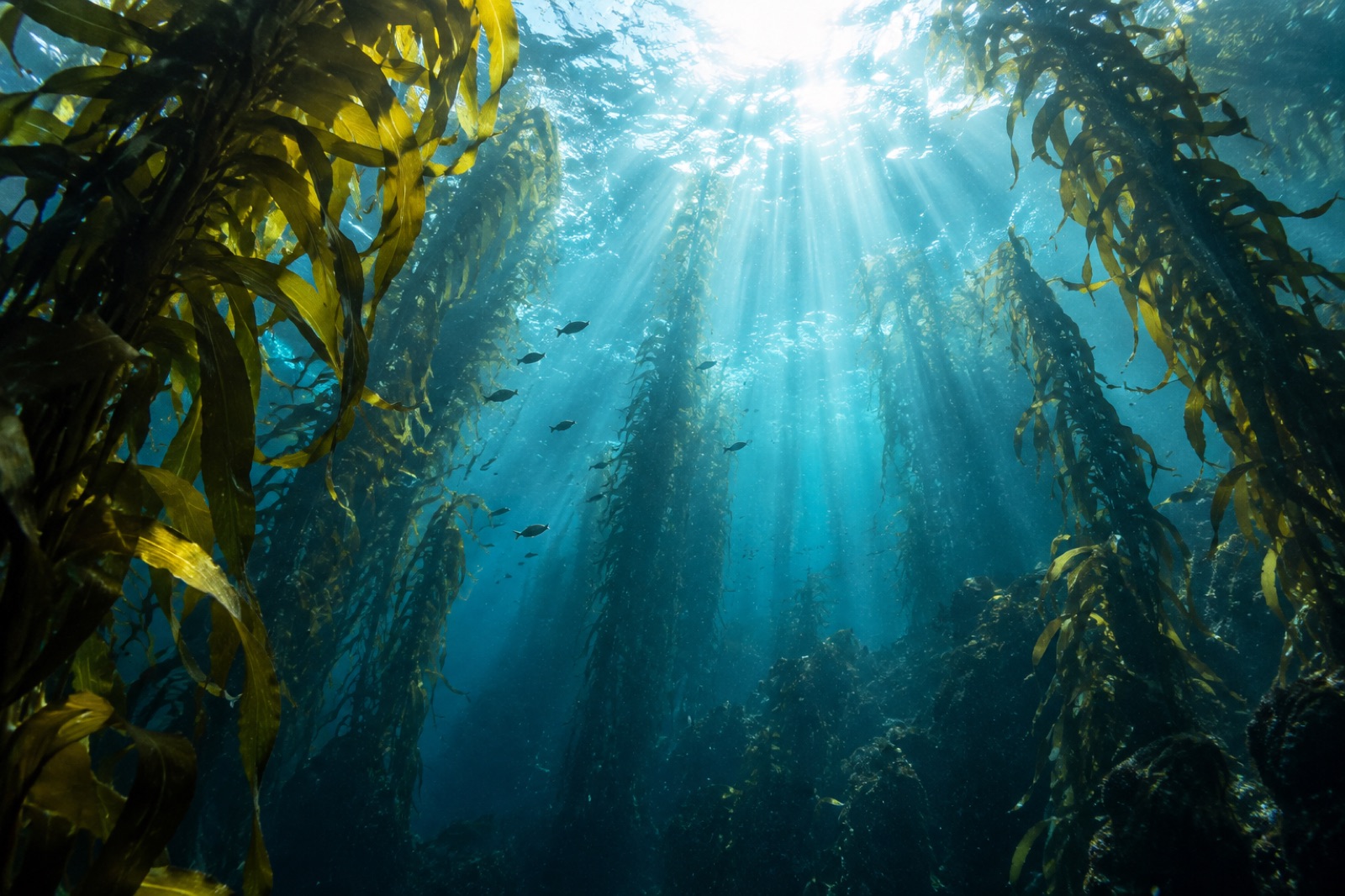
The euphotic zone is the sunlit skin of the sea where photosynthesis powers nearly all marine life. What defines it, how deep it runs, and why it matters.
Dr. Theo Nakamura ·