Science6 min read
Marine Protected Areas: What They Protect and How
MPAs, marine reserves, no-take zones explained — how protection levels differ, what the evidence shows, and what MPAs can and can't do for kelp forests.
Dr. Mara Ellison ·
A single marine reserve protects what lives inside it. A network of reserves, sized and spaced for drifting larvae, can protect a whole coastline. Here's the science.
Here is an awkward fact about marine protected areas: most marine life doesn't live in them. It lives between them. A fish may spend its adult life behind a reserve's invisible boundary, but it arrived as a millimetre-long larva carried on a current from somewhere else — perhaps a reef fifty kilometres along the coast, perhaps the next reserve up-current, perhaps nowhere protected at all. Protect a single patch of ocean and you fence your house; you don't necessarily secure your food supply. This is why the modern science of MPAs is really the science of networks — systems of reserves sized, spaced and positioned so that what drifts out of one reserve seeds the next. Get the geometry right and reserves amplify each other; get it wrong and you own a scatter of beautiful islands that quietly empty out.
If you haven't read our primer on what MPAs protect and how, start there. This article is about the design layer above: what turns a collection of protected areas into a network that behaves like a single living system.
Almost everything on a kelp reef — abalone, rockfish, urchins, lobsters, most kelps themselves — reproduces by releasing young life into the water column. Larvae (or kelp spores) drift for minutes or months depending on the species, then settle wherever currents deposit them. Adult abalone move metres in a lifetime; their larvae can travel tens of kilometres. A reef's population is therefore rarely self-contained: it is maintained by the arrival of other reefs' offspring, a process called connectivity that we explore in depth in Marine Connectivity and Drifters and Swimmers.
Connectivity has a polar opposite: self-recruitment, the fraction of a reef's offspring that settles back home. For most species, both happen — reefs are partially self-seeding and partially subsidised. And that mixture creates the core design problem. A reserve too small leaks: its adults reproduce, but nearly all the larvae wash out to sea into fishing grounds. A network spaced too far apart starves: each reserve is a source with no protected destinations, and disturbed fished reefs between them never get reseeded. A well-designed network threads the needle — reserves big enough that a useful share of their larvae settle at home, close enough together that the outbound larvae land in each other or in the fished reefs the network is meant to sustain.
Over two decades of theoretical work and — increasingly — empirical measurement, a rough grammar of network design has been agreed upon. The numbers are guidelines, not laws, but they are remarkably consistent across studies:
These principles are why serious network proposals — California's coast-wide MPA network, Australia's marine park zoning, the emerging Great Southern Reef planning — are designed in current-aware units rather than ad-hoc park-by-park.
The case for networks isn't only ecological insurance; it's also fisheries economics. Inside a well-enforced reserve, fish get older, bigger and vastly more fecund — egg production scales steeply with body size. Two outflows follow. Adult spillover: fish and lobsters, denser inside, wander across the boundary and get caught, concentrating catches at the edges — the "fishing the line" skippers know well. Larval subsidy: the far larger flow, as the reserve's reproductive output rains onto fished reefs down-current. Because a big old female rockfish may produce orders of magnitude more larvae than the young fish that replaced her in the catch, even modest reserves can subsidise surprisingly large fished areas — provided the network is spaced so those larvae land somewhere fishable rather than in oceanic dead ends. This is the larval-dispersal calculus that connects MPA science to solutions for fisheries and coastal councils weighing their local marine planning, as in our work with governments.
The history of marine protection is littered with small, isolated reserves that produced lovely local results — bigger fish, happier divers — yet failed to shift the trajectory of the wider coast. The network lens explains the pattern:
None of this is an argument against reserves — the evidence that well-designed, well-enforced protection works is overwhelming. It is an argument that the unit of design is the coast, not the cove.
Honest network science has live edges. Measuring connectivity directly is hard: larvae are tiny, abundant and mostly unmarked, so researchers triangulate with genetics (parentage analysis can literally match settlers to their parents), otolith chemistry, and high-resolution ocean models fertilised with drifter data. Dispersal kernels turn out to be fat-tailed — most larvae stay close, a lucky few go very far — and both tails matter: the nearby flow runs the fishery subsidy, while the rare long jumps knit distant reserves together and drive colonisation of recovering reefs, which is exactly the dynamic that matters for restoring degraded reefs at scale. There's also active debate about how networks should account for climate velocity — species shifting poleward as the ocean warms — which argues for protecting climatic refuges (thermal refugia) and for spacing reserves along the direction species will need to travel, not only along today's currents. And there is a growing recognition that people are part of the geometry: networks co-designed with Indigenous sea-country rangers and local fishers outperform paper parks, because enforcement and stewardship are as much social infrastructure as patrol boats. That is why Tidewright's restoration programs are built as partnerships with councils and Traditional Owners — see our community programs.
There is no single magic number, but syntheses of reserve science repeatedly converge on reserves at least a few kilometres across alongshore. Smaller reserves export nearly all the larvae they produce and can't self-seed the short-dispersing species — abalone, many urchins, some kelps — that are often the ecological keystones. Bigger is generally better for self-recruitment, provided spacing rules are still met so exports land in other protected or well-managed reefs.
"MPA" is the umbrella term — any geographically defined ocean area managed for conservation, from strictly no-take sanctuaries to zones allowing some fishing or aquaculture. A "marine reserve" or "no-take zone" is the strict subset where extraction is prohibited entirely. Networks typically embed no-take cores (which rebuild age structure and fecundity) within broader multiple-use MPAs, getting both conservation and social licence.
For well-enforced no-take areas, the evidence for adult spillover and larval subsidy is strong, though size varies by species and configuration. Fishing-the-line effects — better catches near boundaries — are commonly reported by fishers. What reserves cannot do is compensate for chronic overfishing or habitat destruction across the rest of the seascape; they are a powerful complement to good fisheries management, not a replacement for it.
Three converging lines of evidence: genetic parentage analysis (matching juveniles inside one reserve to adult parents in another), chemical signatures in fish ear bones (otoliths) that record the water they drifted through, and dispersal simulations run on measured current fields, increasingly validated against genetic estimates. All three agree on the fat-tailed pattern — most larvae stay near home, a small but crucial fraction travels far enough to link reserves.
Network theory answers: both, deployed as one system. A few large reserves provide strong self-seeding cores and resilience; a chain of smaller stepping-stone reserves maintains connectivity across long coastlines and subsidises fishing grounds between them. The design goal isn't size or count in isolation — it's that the whole coast's larvae reliably have somewhere protected to come from and somewhere viable to land.
MPAs, marine reserves, no-take zones explained — how protection levels differ, what the evidence shows, and what MPAs can and can't do for kelp forests.
Dr. Mara Ellison ·
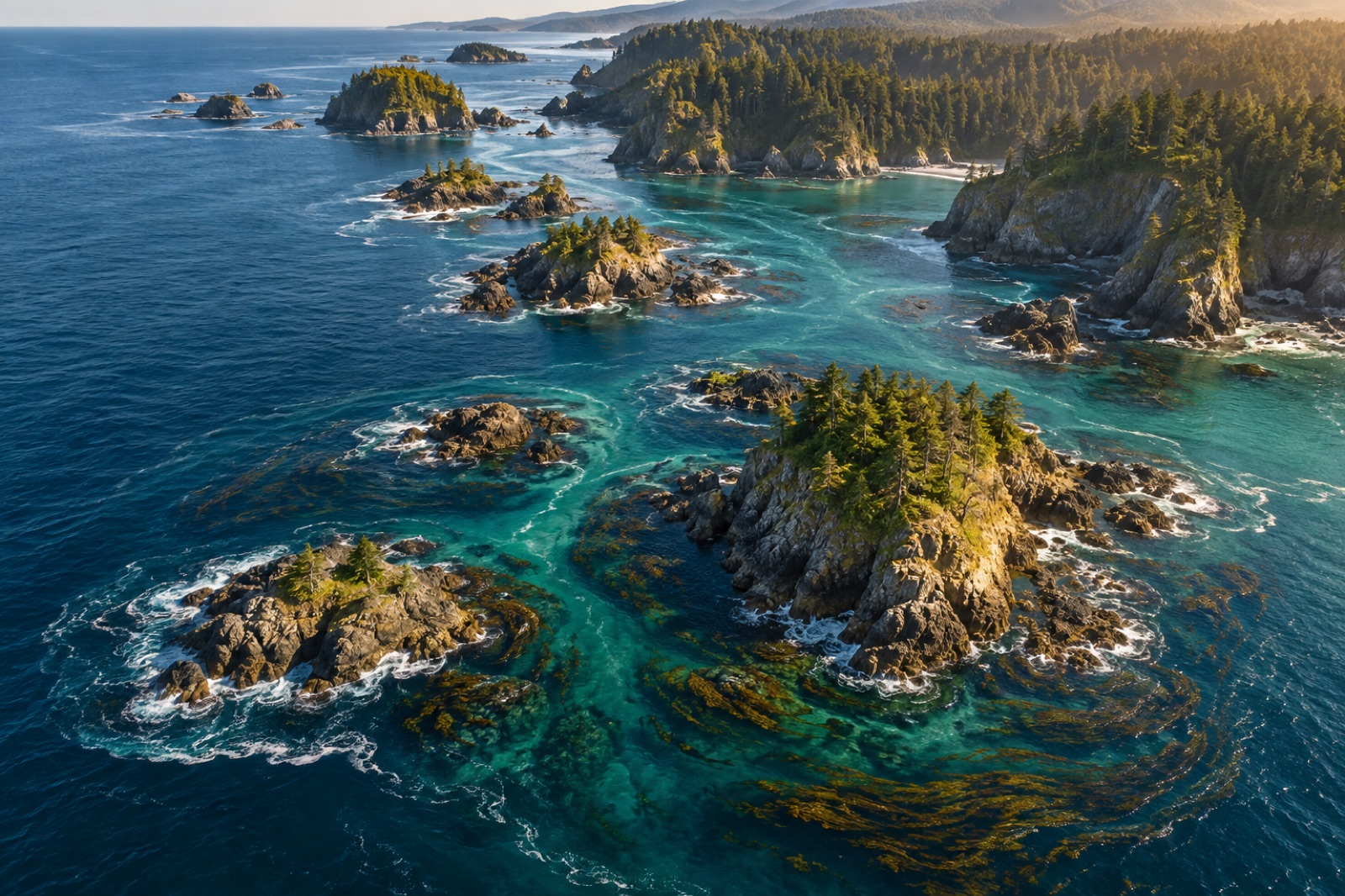
Reefs are joined by currents into a living network. How connectivity works, why stepping stones matter, and how it shapes marine reserves and kelp restoration.
Dr. Lena Fischer ·
Almost every reef animal and alga spreads as a drifting larva or spore. How far they travel — and which reefs talk to which — decides how kelp recovers.
Dr. Mara Ellison ·