Encyclopedia8 min read
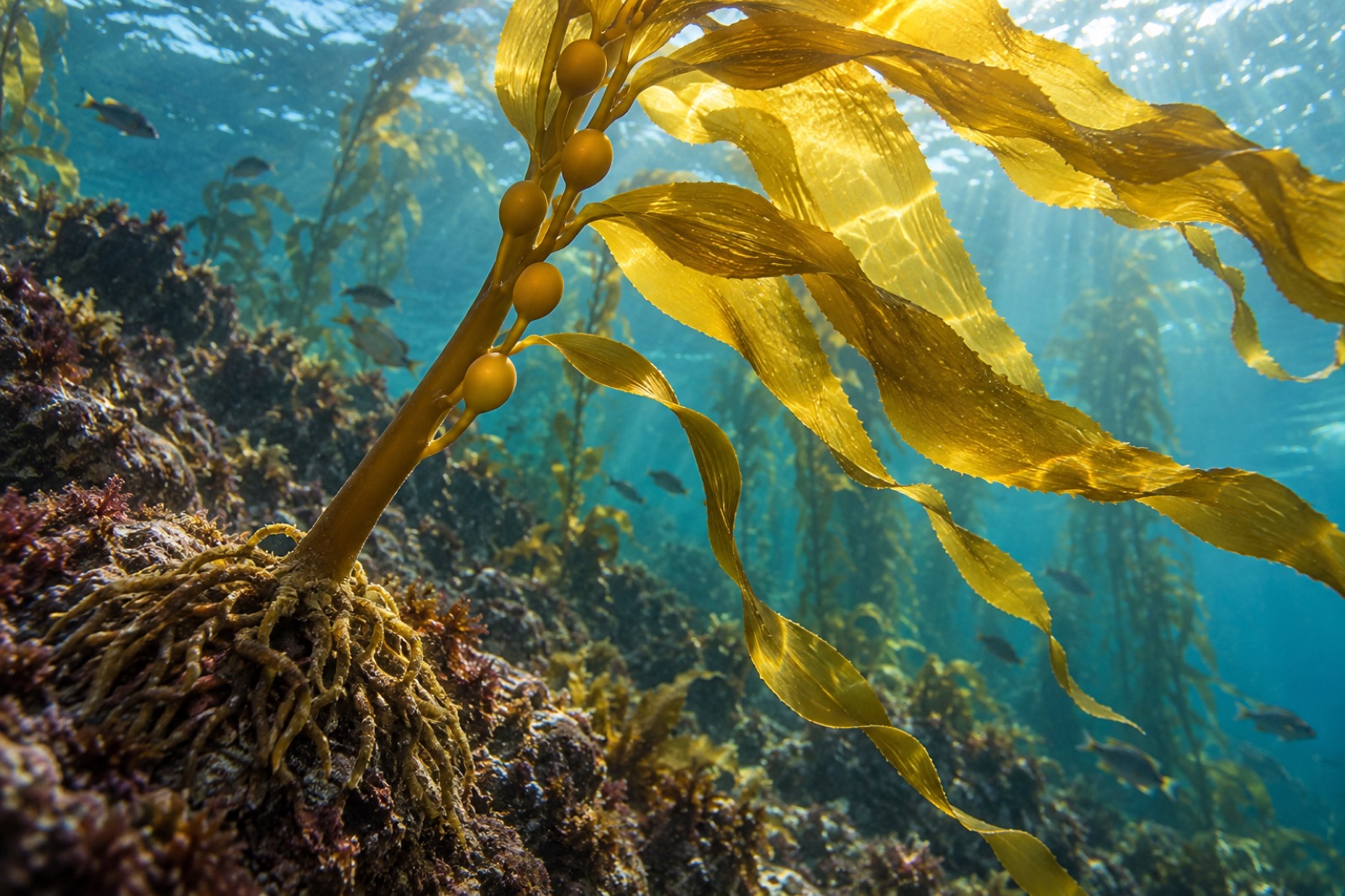
Giant Kelp (Macrocystis pyrifera): Species Profile
Giant kelp is the fastest-growing organism on Earth and the architect of undersea forests. Learn its biology, life cycle, range and why it matters.
Dr. Theo Nakamura ·
Marine heatwaves are weeks of anomalously hot ocean that can deforest entire coastlines. Here's the science behind them and what restoration can do.
Part of a learning path
This article is stop 8 of 9 on Kelp Forests 101 — Meet the architects — and the grazers that can undo them.
A marine heatwave is a period — at least five days, often weeks to months — when ocean temperatures sit far above the seasonal norm. These events have grown more frequent, longer and hotter over the past century of warming, and they are now the single most important driver of sudden kelp-forest loss worldwide. Understanding them is essential to understanding why restoration has to be climate-ready — and what Tidewright engineers for in the field.
"Heatwave" sounds vague, so oceanographers gave it teeth. The standard definition, developed by a Hobart-led research group in 2016, works like this:
Because the threshold is local and seasonal, a marine heatwave in Tasmania in winter can be cooler in absolute terms than a normal summer day in the tropics. What matters is the anomaly — how far outside recent experience the water is. Events are further classed by intensity, from Category I (moderate) to Category IV (extreme), based on how many multiples of the local variability the anomaly reaches.
No two events are identical, but the mechanisms fall into a few families:
Kelp suffers from marine heatwaves through two compounding insults.
Kelp metabolism, photosynthesis and reproduction are tuned to cool water. Above species-specific thresholds — around 20–21 °C for giant kelp — tissue growth slows, blades erode faster than they grow, and spore production falls. The canopy thins. Fronds that took months to grow can be gone in weeks.
Warm water is light water. When a warm layer caps the ocean, it cuts off the deep mixing and upwelling that deliver nitrate — kelp's limiting nutrient — to the sunlit zone. A marine heatwave is therefore usually a marine meagre-wave as well: kelp faces heat stress and hunger simultaneously. This is why heatwaves impact even species nominally tolerant of the peak temperature.
The deepest damage is ecological. Heat-weakened kelp is easy grazing for sea urchins, which often survive temperature spikes better than kelp does. Urchin numbers can explode on a stressed forest; the grazing front then prevents any recovery, and the reef flips into an urchin barren — an alternate stable state that can persist for decades after the water cools. Tasmania's east coast, northern California's bull kelp coastline and parts of Japan have all lived this sequence. Our Coastal Atlas documents several.
Researchers tracking global events have found that marine heatwaves have roughly doubled in frequency since the 1980s and have grown longer and more intense. Several events have become landmarks in restoration science:
Each event teaches the same lesson: the wait-and-recover model no longer works when the next heatwave arrives before recovery completes.
Marine heatwaves are not a reason to give up on kelp. They are a specification to engineer against:
Honesty matters here. Restoration cannot cool the ocean. Nothing about seeding a reef substitutes for cutting emissions, and any program that implies otherwise is selling something. What restoration can do is keep forests alive through the gap between now and a stabilised climate — preserving the broodstock, the genetic diversity and the living habitat that would otherwise be lost from coastlines within a human lifetime. Holding the line is not hype; it is the difference between a degraded ocean that retains the raw material of recovery and one that does not.
The minimum definition is five days, but major events typically persist for weeks to months. Some regional events, like the 2014–2016 "Blob" in the northeast Pacific, kept temperatures anomalous for well over a year when re-warming episodes are counted together.
Individual events are triggered by weather and ocean dynamics, but the rise in their frequency, duration and intensity over recent decades is predominantly attributed to human-caused ocean warming. A warmer baseline means ordinary warm spells now cross heatwave thresholds.
Partially. Populations at the warm edges of a species' range often carry genetic variants for heat tolerance, which is why restoration programs bank warm-edge broodstock. But adaptation has limits — repeated extreme events outpace what selection alone can do.
Canopy-forming species near their warm range edge — giant kelp in southern Australia and Baja California, for example — are most exposed. Cool-water species with no cooler habitat to retreat to, like Tasmania's remnant giant kelp, face the highest local risk.
Yes. Heatwaves shift fish distributions, trigger harmful algal blooms, collapse recruitment in shellfish, and — through kelp loss — remove nursery habitat for juvenile fish. Fisheries in Japan, the northwest Atlantic and the northeast Pacific have all documented heatwave-linked shocks.
Giant kelp is the fastest-growing organism on Earth and the architect of undersea forests. Learn its biology, life cycle, range and why it matters.
Dr. Theo Nakamura ·
As oceans warm, tropical herbivores and warm-adapted species are moving poleward into kelp reefs — reshaping forests from Tasmania to Japan. The science of tropicalization.
Dr. Lena Fischer ·
From the Blob to the record-breaking 2023–24 ocean, the last decade of marine heatwave records shows extremes growing — and kelp forests in the firing line.
Dr. Lena Fischer ·