About 8% of the world's ocean sits inside some form of marine protected area, and governments have pledged to push that toward 30% by 2030 under the Kunming-Montreal Global Biodiversity Framework. But "marine protected area" covers an enormous range — from fully closed no-take reserves where you can't so much as hook a fish, somewhere near that zone of complete protection, to huge polygons on a map where almost nothing has changed in practice.
For anyone who cares about kelp forests — and the fish, urchins, otters and livelihoods they support — understanding what an MPA actually is is worth a few minutes. Here's how protected areas are classified, what the evidence says they do, their real limits, and how they interact with active restoration.
What Counts as a Marine Protected Area?
The simplest definition: a clearly defined geographic space in the ocean managed to achieve long-term conservation. Within that, management varies along one crucial axis — how much extraction is allowed:
- No-take marine reserves. All extraction prohibited: no fishing, no mining, no dredging. This is the gold standard for ecological recovery and what most people picture when they hear "marine sanctuary."
- Multiple-use MPAs. Zoned areas combining full-protection cores with zones allowing regulated fishing, recreation, aquaculture or other uses. The Great Barrier Reef Marine Park is the archetype.
- Partially protected areas. Catch limits, gear restrictions or seasonal closures that reduce — but don't eliminate — extraction.
- Other Effective area-based Conservation Measures (OECMs). A newer category recognising places like Indigenous-managed sea country and military exclusion zones, which deliver conservation outcomes without being formally called MPAs.
Quality also matters as much as category. A useful shorthand in the literature is COMPL — Complete (no-take), Well-managed, Old, Large, and Isolated by surrounding habitat. Reserves scoring high on those features strongly outperform small, young, recently-designated ones.
What the Evidence Says MPAs Do
Decades of before-and-after and inside-vs-outside comparisons make a few conclusions robust:
- Biomass bounces back. Fish biomass inside well-enforced no-take reserves is commonly several times higher than in nearby fished areas, with larger, older individuals.
- Spillover feeds fisheries. As density builds, adults and larvae disperse beyond boundaries — the spillover effect that can, over time, benefit adjacent fishers, a key argument in our solutions for fisheries.
- Resilience, not immunity. Protected ecosystems with intact food webs — trophic cascades functioning, predators present — tend to resist and recover from disturbances better than degraded ones.
- People benefit unevenly. Well-governed MPAs support dive tourism and stewardship (see our piece on responsible wildlife watching); poorly-governed ones can push costs onto small-scale fishers without meaningful enforcement.
MPAs and Kelp Forests: The Complicated Love Story
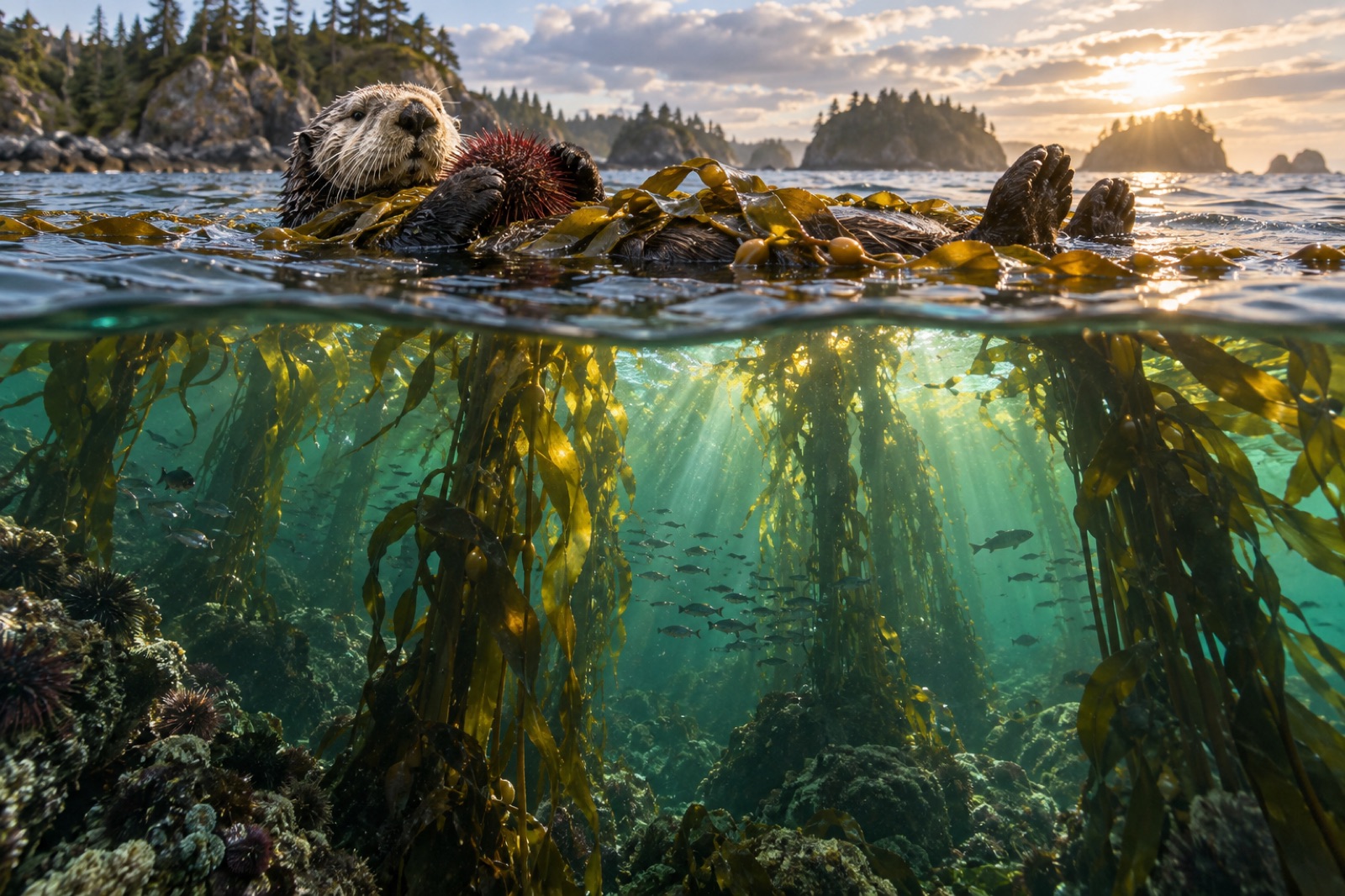
Kelp forests make a particularly interesting MPA case because their survival often hinges less on "don't kill the kelp" (nobody targeted it) and more on food-web integrity. The classic pattern, visible from California to New Zealand: no-take reserves rebuild populations of urchin-eating predators — spiny lobsters, large finfish like California sheephead, and elsewhere sea otters — and the renewed predation pressure keeps purple sea urchins and their kin at densities where trophic cascades stay in kelp's favour. Places with the best-documented kelp recovery following protection include parts of the Channel Islands reserve network.
But protection alone can't defeat every driver. Two threats regularly overwhelm MPAs:
- Marine heatwaves don't respect boundaries (see Marine Heatwaves 101). Tasmania's giant kelp losses occurred partly inside managed waters.
- Sea urchin fronts and disease dynamics can tip a reserve and keep it tipped for years, especially where warming simultaneously weakens kelp condition.
This is where active restoration becomes complementary: protection preserves the potential; restoration (like Drifter reseeding and targeted urchin management) executes the recovery. The strongest modern strategy sets MPAs and restoration inside a single management frame, with monitoring (like Canopy Ledger's canopy mapping) to show whether the system is responding.
Global Snapshot: From Paper Parks to Networks
- Great Barrier Reef, Australia — the flagship of large-scale zoning, repeatedly reconfigured over decades.
- Papahānaumokuākea, Hawaii — one of the largest fully protected areas on Earth.
- California's MPA network — a statewide science-guided chain including Monterey Bay, designed for ecological connectivity.
- Great Southern Reef and New Zealand's marine reserves — still maturing; see our Great Southern Reef atlas for regional context.
The "30 by 30" target has accelerated designations everywhere — and sharpened scrutiny. The risk of the decade is paper parks: areas designated to count toward targets without budget, boundaries that avoid conflict with extractive industries, or enforcement. The countervailing hope is Indigenous-led protected sea country, which brings governance capacity, generational knowledge and community legitimacy — Tidewright's own ranger-partnership model, described in our Reef Partners work, builds directly on that tradition.
How to Evaluate an MPA Near You
Five practical questions a citizen, diver or councillor can ask of any protected area:
- What exactly is prohibited? Ask for the zoning map, not the brochure.
- Is there an enforcement line in the budget? A reserve without patrols is a cartographic exercise.
- Is monitoring published? Look for time-series data, not just designation-day announcements; eDNA surveys increasingly make this cheap enough to be routine.
- Who decided? Co-governance with fishers and Indigenous communities predicts longevity better than imposed boundaries.
- Is it connected? Networks of reserves within larval-dispersal distance of each other outperform isolated singletons.
Key takeaways
- "MPA" spans everything from strictly no-take reserves to multiple-use zones; protection level and management quality matter more than the label.
- Strong evidence shows well-enforced reserves rebuild biomass and build ecological resilience — and can spill fish over into adjacent fisheries.
- Kelp forests recover through food-web repair inside MPAs, but heatwaves and urchin tipping points demand active restoration alongside protection.
- The 30x30 push is creating both hope and paper parks; ask hard questions about rules, budgets, monitoring and governance.
- The most durable model is protection + restoration + co-management — boundaries plus boots in boats.
FAQ
What's the difference between an MPA and a marine reserve?
A marine reserve usually means the strictest end of the spectrum — no-take, no extraction. "MPA" is the umbrella term covering reserves plus every weaker zoning class.
Do MPAs actually help fishers?
Well-designed ones can, via spillover and larval seeding to fished areas — with a lag of years, and benefits unevenly distributed. Poorly-designed ones impose short-term costs without communication or compensation, and the negative experiences have left justified scepticism in many fishing communities.
How big should an MPA be?
Big enough to hold the home ranges of the species it protects and the disturbance scales it must buffer — typically measured in kilometres to tens of kilometres for reefs, and embedded in a network. Small reserves still work, just less.
Can an MPA stop climate change impacts?
No — but intact, biodiverse, predator-complete ecosystems generally absorb and recover from climate shocks better than depleted ones. Protection buys resilience, not immunity.
What's a paper park?
An area legally designated but effectively unenforced or under-resourced, where extractive use continues more or less as before. Tracking pipelines and budget lines are the easiest way to distinguish them from real protection.