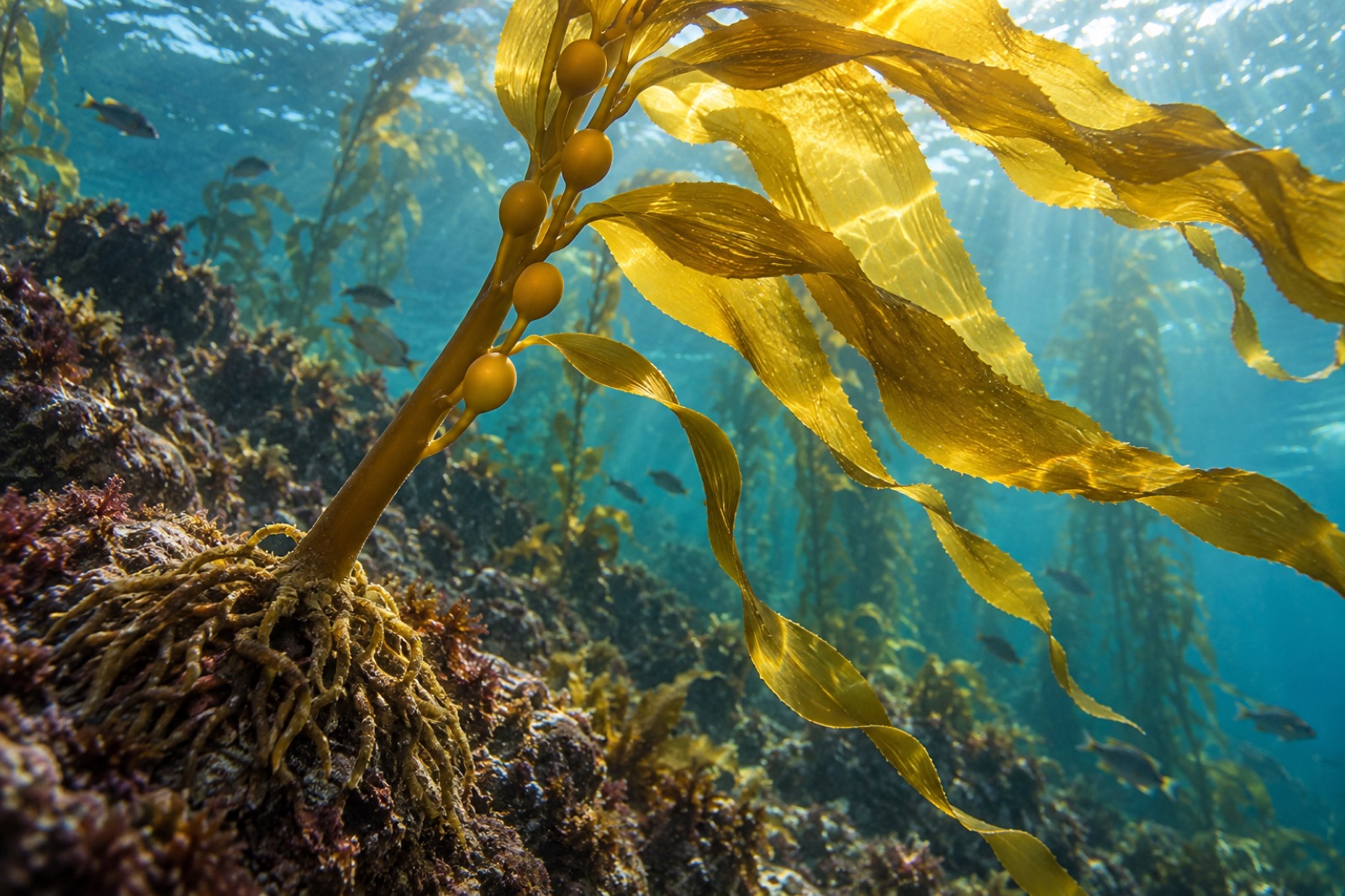
Every fish that swims through a kelp forest leaves something behind: skin cells, mucus, scales, waste — all of it carrying DNA. Filter a few litres of seawater, extract that genetic trace, and you can produce a species list for a reef without seeing a single animal. This is environmental DNA, or eDNA, and over the past decade it has moved from a laboratory curiosity to one of the most practical tools in marine monitoring. For anyone trying to measure whether a kelp forest is truly recovering — not just whether kelp is standing, but whether the whole community is coming back — eDNA has become almost indispensable.
What eDNA actually is
Organisms constantly shed DNA into their environment. In the ocean, that DNA floats suspended in the water column or settles into sediment, where it persists for hours to days before sunlight, microbes and chemistry break it down. An eDNA survey is, at heart, a three-step argument:
- Capture. Pump seawater through a fine filter — or collect sediment — so that cells and DNA fragments accumulate on the filter surface.
- Read. In the lab, amplify and sequence the DNA, then match the sequences against reference databases to identify which species they came from.
- Interpret. Turn "we detected DNA from 63 fish species" into ecological meaning — carefully, because detection is not the same as abundance.
The elegance is in step one: the ocean does the sampling. One dive team can collect water at ten sites in a morning that a visual survey crew would need weeks to census.
Two lab approaches dominate, and knowing the difference matters for reading any eDNA study.
Metabarcoding uses PCR primers that amplify a short "barcode" gene region shared across a broad group — the 12S gene for vertebrates, COI for many invertebrates — then sequences everything that amplified, in bulk, from one sample. The result is a community-scale species list. This is the tool for biodiversity questions: how many fish species use this reef? Did the invertebrate community shift after the heatwave?
Targeted assays: the bloodhound
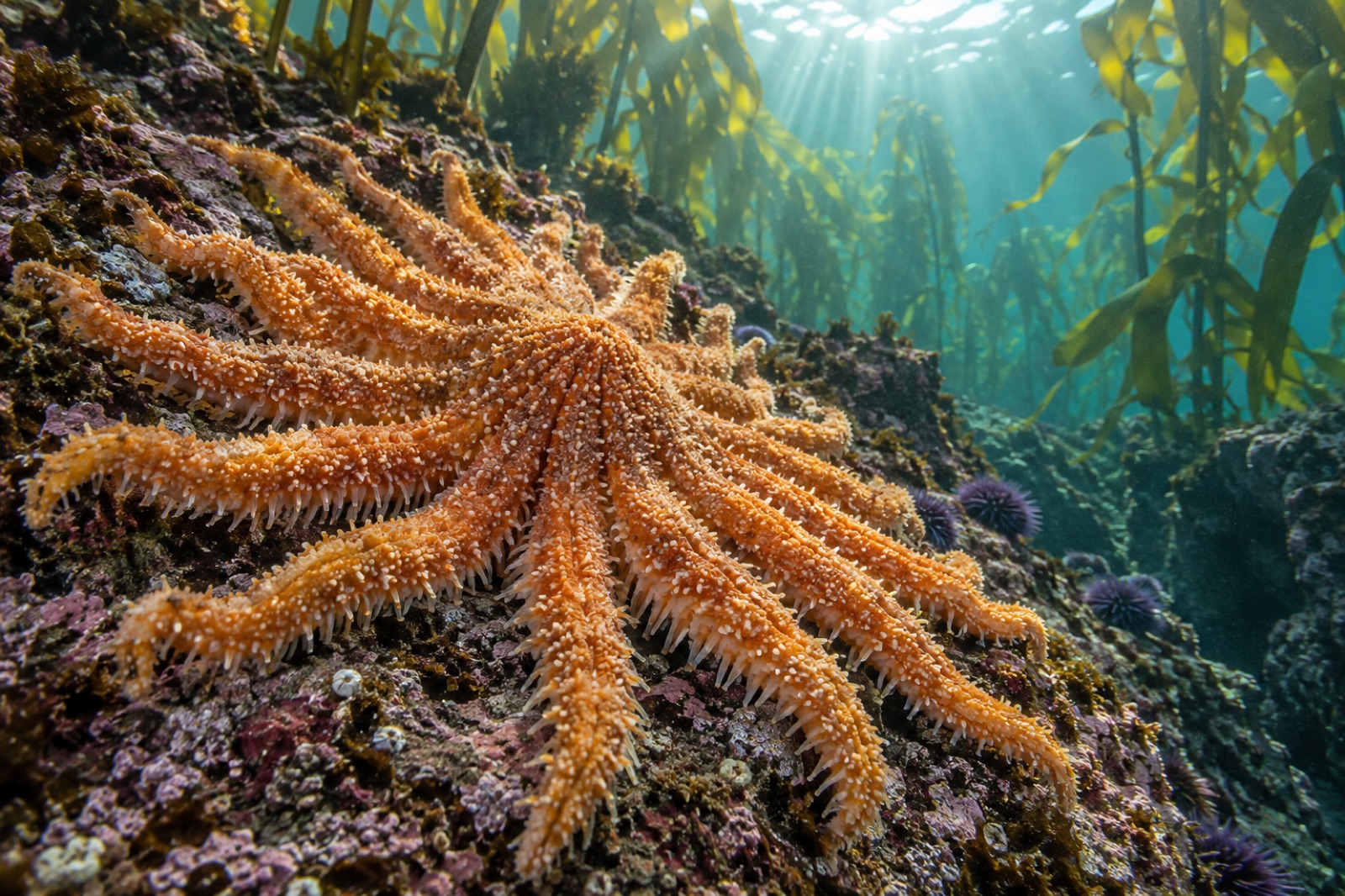
Quantitative PCR (qPCR) and its digital cousin (ddPCR) look for one species at a time, using primers designed to match only that species' DNA. They are exquisitely sensitive — the method of choice for detecting rare, cryptic or invasive species. Searching for the first returning juvenile sunflower sea stars on a recovering reef, or watching for an invasive alga's arrival, is qPCR territory.
In practice, serious programmes run both: metabarcoding for the community picture, targeted assays for the species that matter most.
What eDNA is brilliant at
- Seeing the cryptic and the rare. Nocturnal fish, deep-crevice invertebrates, larval stages, animals present as one individual in a hectare — visual surveys miss them; DNA often doesn't.
- Standardisation. A bottle of seawater is the same sample in Hobart and Hokkaido. Visual surveys depend on diver skill and visibility; filters don't.
- Non-destructive scale. Nothing is caught, killed or handled, and samples can be collected from small boats, moorings or even by trained community volunteers.
- Time series. Because collection is cheap, you can sample monthly for years and build baseline data — the thing every ecosystem assessment laments not having.
What eDNA cannot tell you (yet)
Honesty about limits is what separates eDNA as a science from eDNA as a sales pitch.
Detection is not abundance. A strong sequence signal might mean many animals, one large animal nearby, or DNA washed in from elsewhere. Water moves; DNA moves with it. Researchers are making progress on quantitative interpretation, but "how many" remains far harder than "whether".
DNA degrades and drifts. A signal reflects the last hours-to-days of life in roughly the local water mass — usually a strength, sometimes a blur, especially on current-swept headlands.
The reference library is the ceiling. Sequences are identified by matching to databases of known DNA barcodes. If a species has never been barcoded — and plenty of invertebrates haven't — its DNA is invisible or misassigned. Library gaps skew results toward well-studied groups like fish.
It can't see size, age or health. eDNA won't tell you whether the kelp forest holds big old breeding fish or only juveniles, whether an abalone bed is reproductive, or whether a black abalone population is breeding or merely persisting. For that you still need eyes in the water.
The mature position, and the one we take in our own monitoring, is that eDNA complements rather than replaces visual surveys, catch data and remote sensing. Each method sees a different slice of the truth.
eDNA in kelp forest restoration
Kelp restoration succeeds or fails at the community level. Standing kelp is the beginning; the endpoint is a functioning food web — grazers in balance, predators present, juvenile fish recruiting. That is precisely the kind of multi-species, repeating measurement eDNA is built for, and it slots neatly into the modern restoration toolkit:
- Before: eDNA baselines document what a barren reef actually still holds — often more than divers guess, including the microscopic life stages that seed recovery.
- During: repeat sampling tracks recolonisation in near-real time, flagging whether predators and competitors are arriving in a healthy sequence.
- After: detection lists given to funders and regulators carry more weight when they come from an auditable molecular method rather than a diver's notebook alone.
At Tidewright, water samples from our restoration and reference sites feed into the same monitoring platform as our satellite canopy maps and drone surveys — the biodiversity layer of Canopy Ledger, sitting alongside the carbon layer. A restored forest that only regrew kelp, and not its community, would show up in that data, and it would not count as success.
Where the field is going
Three frontiers are worth watching:
- Autonomous sampling. Instruments that filter and preserve water on a mooring or vehicle on a schedule, turning episodic surveys into continuous records.
- Better quantification. Combining eDNA concentrations with hydrodynamic models to inch from "present" toward "how much".
- Richer libraries. Every newly barcoded species makes every future survey sharper; some of the most valuable eDNA work right now is unglamorous museum-and-lab database building.
Key takeaways
- eDNA surveys identify species from the genetic traces they shed into seawater, captured on a filter and read in a lab.
- Metabarcoding censuses whole communities; targeted qPCR assays hunt single rare or invasive species with high sensitivity.
- eDNA excels at detecting cryptic species, standardising across sites and enabling cheap, repeatable time series.
- Its limits are real: detection is not abundance, DNA drifts and degrades, and identification is only as good as the reference library.
- In kelp restoration, eDNA provides the biodiversity layer — evidence that the whole community, not just the kelp, is returning — and works best alongside divers, drones and satellites.
FAQ
How long does DNA last in seawater?
Typically hours to a few days, depending on temperature, sunlight and microbial activity. Warm, sunlit surface water degrades DNA fastest. This short persistence is often useful: what you detect is what was recently, and roughly locally, alive.
Can eDNA replace dive surveys?
No — and it shouldn't try to. eDNA sees presence far more sensitively than divers can, but it cannot see size structure, behaviour or habitat condition. The strongest monitoring programmes, including ours, pair eDNA with visual surveys and remote sensing rather than substituting one for the others.
How much water do you need for an eDNA sample?
Surprisingly little — commonly one to five litres per site per replicate, though protocols vary with turbidity and target. The discipline is in replication and contamination control, not volume.
Is eDNA expensive?
Per-sample lab costs have fallen dramatically over the past decade, and the real economy is in the field: replacing weeks of diver time with a morning of water collection changes what questions are affordable to ask at all.
Can citizen scientists collect eDNA samples?
Yes — filtering seawater through a field kit is well within trained volunteer capability, and community-collected eDNA already contributes to genuine monitoring programmes. Our careers and education coverage tracks citizen-science openings, and the explore section covers how divers can fold data collection into ordinary diving.