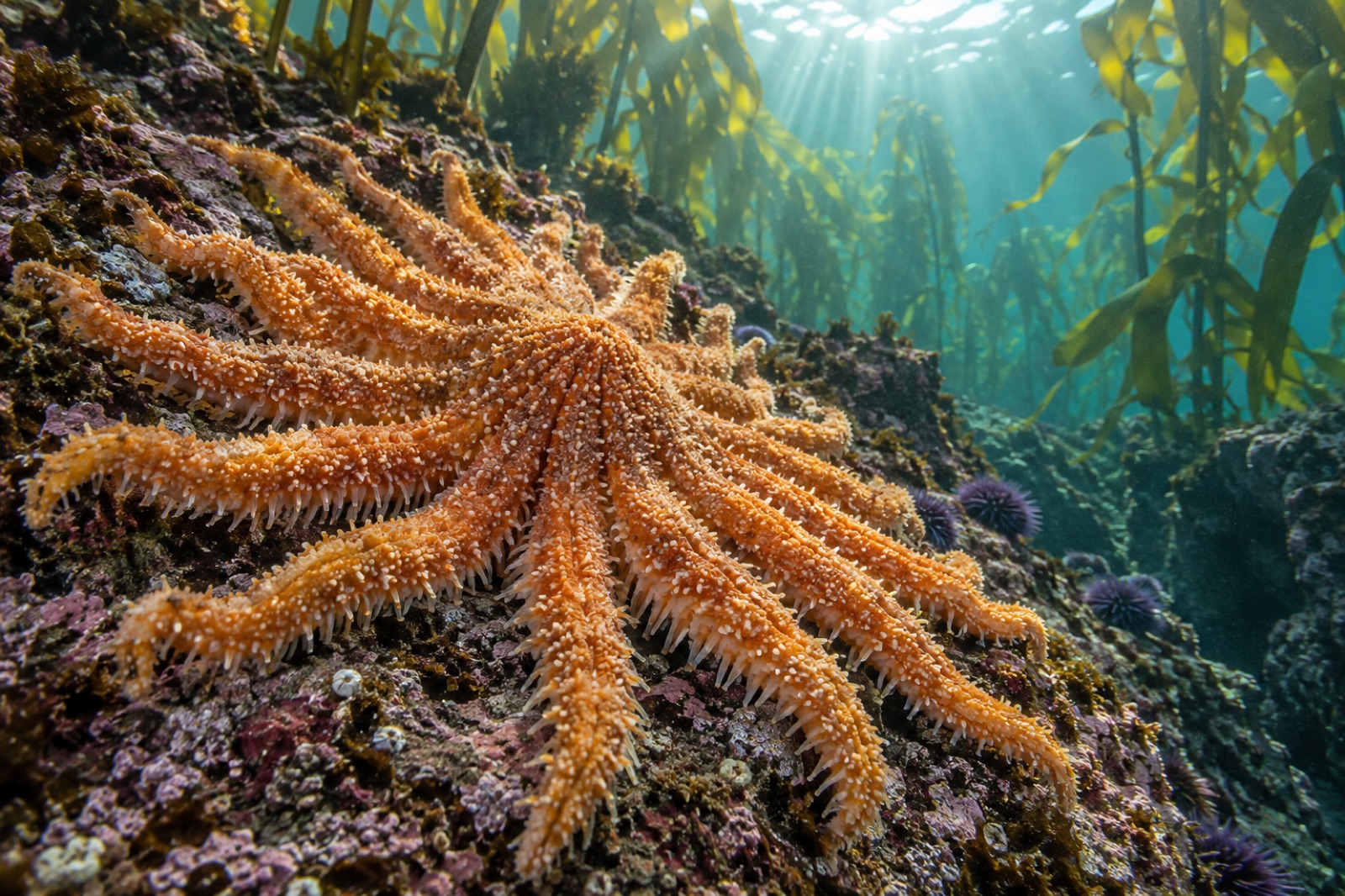
The sunflower sea star (Pycnopodia helianthoides) is one of the most spectacular animals in the temperate ocean: a metre-wide predator with two dozen arms and fifteen thousand tube feet, gliding over the reef faster than any other sea star on Earth. It is also the animal whose disappearance may have changed the kelp forests of an entire continent. Beginning in 2013, an epidemic of sea star wasting disease killed billions of sunflower stars from Mexico to Alaska — one of the largest documented wildlife mortality events in the ocean — and in the years since walkback has linked their loss, reef by reef, to the explosion of urchin barrens. The sunflower star has become the emblem of a hard truth: kelp forests stand or fall on their predators.
Fast facts
|
|
| Scientific name |
Pycnopodia helianthoides |
| Group |
Echinoderm, class Asteroidea (sea stars) |
| Arms |
16–24 in adults; juveniles begin with five |
| Maximum size |
Roughly 1 m arm-span; up to ~5 kg |
| Speed |
Around 1 metre per minute — the fastest known sea star |
| Tube feet |
Up to ~15,000 |
| Depth |
Intertidal to over 400 m |
| Range |
Aleutian Islands, Alaska, to San Diego, California (historically) |
| Status |
Critically Endangered (IUCN, 2020) |
Anatomy of a super-predator
Everything about the sunflower star is scaled up. Adult arms number sixteen to twenty-four — more than any other sea star — radiating from a broad, soft central disc. The skin is flexible rather than armoured, letting the star drape over boulders and engulf prey; colours run from orange and gold through purple and rust. Beneath each arm march crowded rows of tube feet — up to fifteen thousand of them, hydraulically driven, tipped with suckers. This is the machinery behind the animal's famous speed: a metre a minute sounds slow until you watch it against a backdrop of fleeing urchins.
And urchins do flee. Sunflower stars hunt by chemoreception, reading scent trails through their tube feet and arm tips, and their prey can smell them coming. Experiments and diver footage alike show purple urchins stampeding — a scramble of spines — at a sunflower star's approach. Detached and regrown arms are common; the animal regenerates readily, and its skin sheds the sediment and fouling that smothers slower stars.
The diet is broad — urchins, snails, clams, crabs, other sea stars, carrion — but ecologically one prey item matters more than any other: sea urchins, the grazers that, unchecked, convert kelp forests to barrens.
Life cycle: from five arms to twenty-four
Sunflower stars are broadcast spawners, releasing eggs and sperm into spring and summer currents. The embryos become bipinnaria larvae — minute, translucent, ciliated plankton — and drift for roughly two months, among the longer larval rides of any sea star. That long planktonic phase historically connected populations up and down the coast, which matters now: a surviving star in Alaska can, in principle, seed recovery far from home.
Settled juveniles begin life as classic five-armed stars a few millimetres wide, then add arms as they grow — a miniature recapitulation of their family's evolution, and one reason a recovered reef can be spotted early: tiny five-armed Pycnopodia on the rocks are the best news a survey dive can deliver.
The keystone of the kelp forest
The sunflower star's ecological role was demonstrated long before its loss made it famous. Classic removal experiments in Alaska in the early 1980s showed that taking sunflower stars off a reef allowed urchin numbers to climb and kelp to retreat — one of the foundational demonstrations that this animal was a keystone predator, holding the herbivore layer of the kelp forest in check from the bottom up, alongside sea otters working from the top.
In a balanced forest, urchins mostly sit in crevices eating drift kelp that storms tear free — a clean-up crew. Remove their predators and they become a front: urchins emerge, graze living kelp at its holdfasts, and march across the reef as a mowing aggregation that leaves grey, crustose pavement behind. A forest can take centuries to build and a few seasons to be grazed flat. The sunflower star was one of the main locks on that door.
The wasting: 2013 to now
Sea star wasting disease had been seen before, but from 2013 into 2015 it arrived at a scale without precedent. The syndrome is grotesque: stars develop lesions, lose turgor, twist their arms, and — over days — disintegrate. It swept the coast during an extraordinary stretch of warm water, the marine heatwave event remembered in the northeast Pacific as "the Blob" (see our explainer on marine heatwaves).
The numbers, published by research teams who surveyed hundreds of sites, are staggering: an estimated 5.75 billion sunflower stars died, a global population decline of about 90 percent. South of about Washington State the losses approached totality — the species went functionally extinct across thousands of kilometres of its former range. In 2020 the IUCN listed it as Critically Endangered.
For a decade the direct cause was maddeningly unclear — an early hypothesis implicating a densovirus did not hold up, and the running, heat-linked pattern suggested something microbial. In 2025, researchers identified a strain of the bacterium Vibrio pectenicida as a causative agent: the pathogen, cultured from sick stars, reproduces the disease in healthy ones. It is the kind of resolution that turns grief into engineering — a named enemy can be screened for, bred around, and managed.
From lost predator to urchin barrens
The chain reaction on northern California's reefs is now well documented. The sunflower star gone by 2014, the heatwave suppressing kelp from 2014–16, abalone and red urchin fisheries depriving the system of other urchin controls — and purple urchin populations exploded. Mendocino and Sonoma county reefs that divers had known as forest became extensive barrens; red abalone starved and their fishery closed in 2018. Similar predator-urchin dynamics unfolded in portions of the Aleutians. The sunflower star had been doing quiet, continuous urchin control at a scale nobody had needed to measure — until it stopped.
This is why Tidewright treats predator recovery as restoration infrastructure. Our reef work — urchin culling and ranching transitions, reseeding with Drifter vessels, canopy verification through the Canopy Ledger — is designed to hold reefs in a kelp state until the natural urchin governors, sunflower stars among them, can return.
Recovery: captive stars and cautious hope
The recovery story is young but real. In 2019, a Seattle-area laboratory achieved the first captive rearing of sunflower stars from egg to juvenile, proving the species' full life cycle can be run in human care. Multi-institution programmes have since refined spawning, larval rearing and disease screening — with the Vibrio finding, broodstock can now be tested and clean lines maintained. Reintroduction is the harder question: releasing stars into water that still carries the pathogen is not restoration but repetition, so trial outplants and disease surveillance will lead, with releases where conditions and genetics argue best.
Meanwhile, northern survivors — in Alaska, British Columbia's fjords and parts of Washington — hold their reefs, and scattered small stars seen in California in recent years hint that the long-drifted larvae still sometimes land and live.
What divers can do
Recreational and scientific divers are the early-warning network for this species. Every sunflower star sighting in the southern half of its range is data:
- Report sightings to dedicated sea star observation programmes, with photographs, location and depth.
- Record size and arm count — juveniles signal recruitment, adults signal refuge.
- Never handle a star to "help" it; stress and handling can harm already-pressured animals.
Our explore coverage covers how to fold citizen science into ordinary kelp dives.
Key takeaways
- The sunflower sea star is the largest and fastest sea star: up to 24 arms, a metre across, 15,000 tube feet, a metre a minute.
- It is a keystone predator of sea urchins; removal experiments showed decades ago that losing it frees urchins to mow down kelp.
- From 2013, wasting disease killed an estimated 5.75 billion stars — about 90 percent of the species — and it is now Critically Endangered, functionally absent from the southern half of its range.
- In 2025 the bacterium Vibrio pectenicida was identified as a causative agent, opening the door to screening, breeding and managed recovery.
- Its loss is directly implicated in the purple urchin barrens of northern California; its recovery is now part of kelp forest restoration itself.
FAQ
Is the sunflower sea star the largest starfish in the world?
By arm-span and speed, yes — roughly a metre across with up to 24 arms and ~5 kg in weight, outpacing every other sea star at about a metre per minute. (A few other deep-water stars rival it in disc size, and the crown-of-thorns starfish can carry more arms, but no sea star matches the sunflower's combination of size and athleticism.)
Can sunflower stars regrow their arms?
Yes. Like other sea stars they regenerate lost arms over months, which helps them survive the predators — including each other and large crabs — that nip at their rays. Regeneration does not, however, protect them from wasting disease, which attacks the whole body.
Why did the sunflower sea star almost go extinct?
An epidemic of sea star wasting disease beginning in 2013, amplified by anomalously warm water, killed billions. The bacterium Vibrio pectenicida, identified in 2025, is now considered a causative agent; warm temperatures appear to favour the disease's spread and severity, which is why the event tracked a marine heatwave so closely.
Will sunflower sea stars recover?
The ingredients exist: persistent northern populations, long-lived drifting larvae, successful captive rearing, and now a screenable pathogen. Recovery in the southern range will likely require some combination of natural recolonisation and carefully sited reintroductions — a decades-scale project, but no longer a speculative one.
What eats sunflower sea stars?
Adults have few predators — large crabs, sea otters occasionally, and other big sea stars including their own kind take arms or small individuals. Their historically greatest mortality source, by many orders of magnitude, has been microscopic: the wasting pathogen.