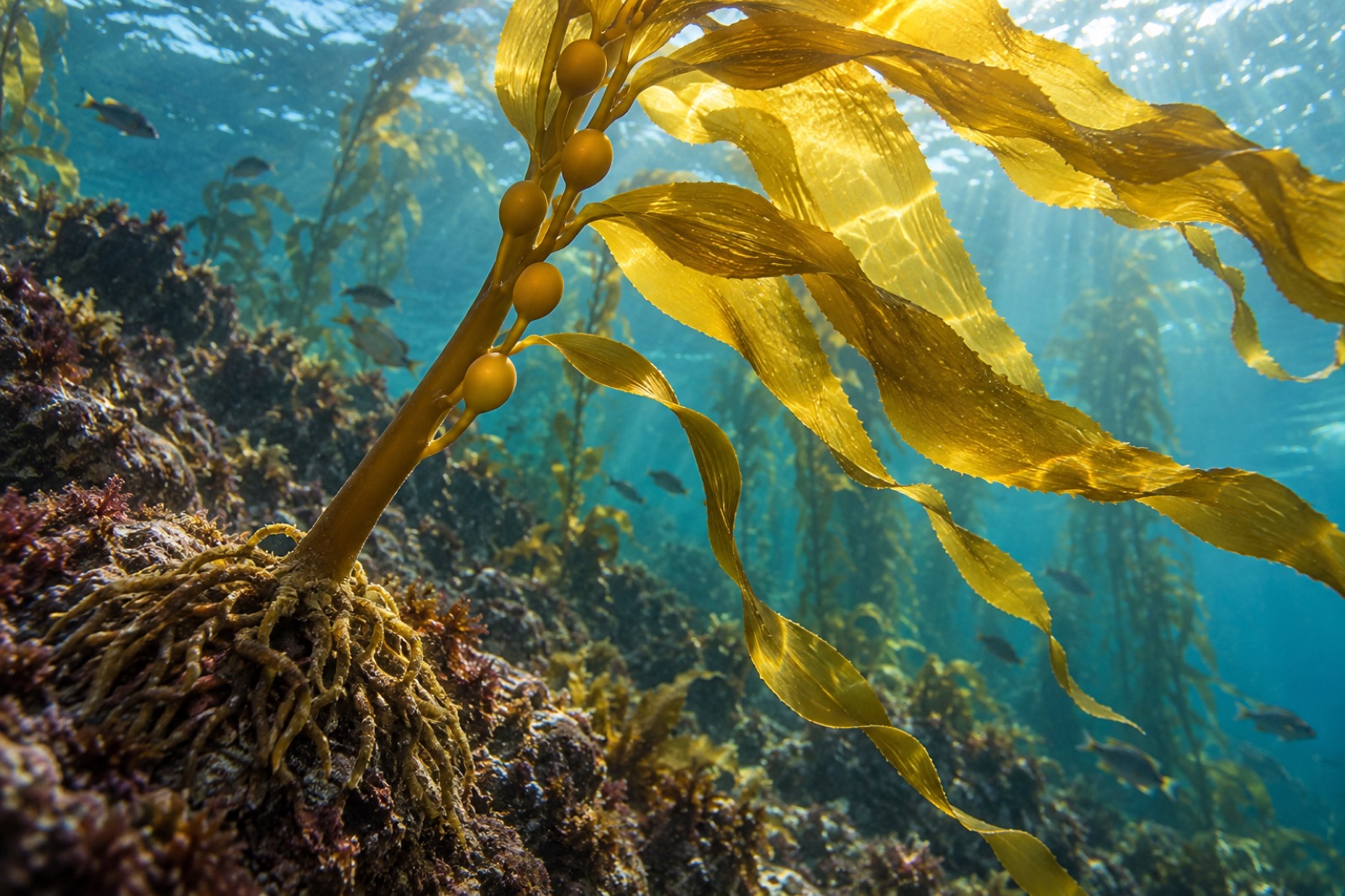
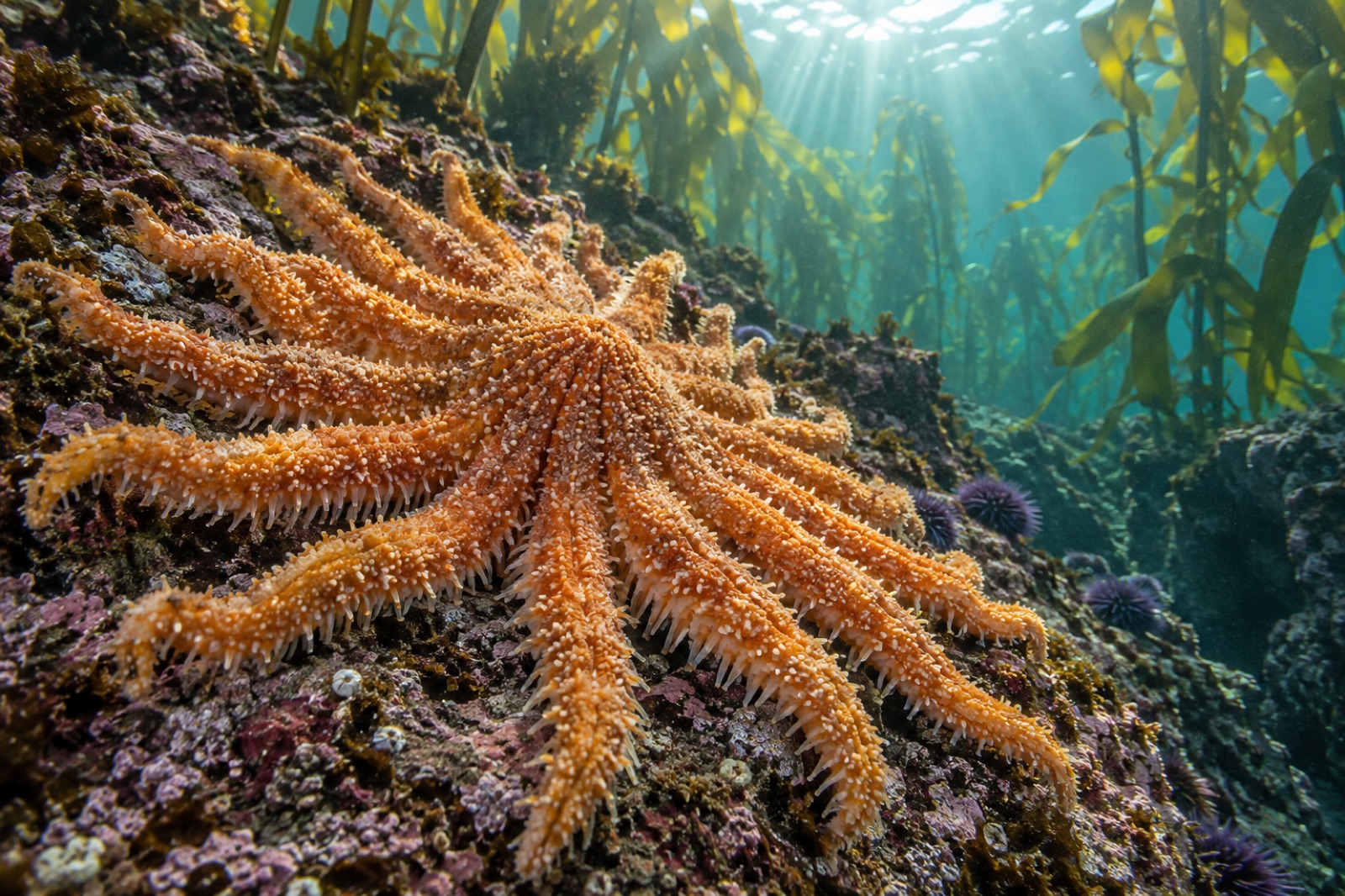
The red abalone (Haliotis rufescens) is the largest abalone species on Earth — a thick-shelled sea snail that can reach the size of a dinner plate — and one of the great herbivores of the northeast Pacific's kelp forests. For millennia it fed coastal peoples and sea otters; for decades it fed a booming fishery; today it sits at the centre of one of the most instructive conservation stories on any coastline. To understand the red abalone is to understand how closely a kelp forest's fate is tied to its grazers.
Fast facts
|
|
| Scientific name |
Haliotis rufescens |
| Group |
Marine gastropod mollusc, family Haliotidae |
| Maximum shell length |
About 31 cm — the largest of roughly 70 abalone species worldwide |
| Typical depth |
Low intertidal to ~30 m; most abundant in 6–17 m |
| Diet |
Drift kelp and other detached algae, especially giant kelp and bull kelp |
| Lifespan |
Estimated 30–40 years or more |
| Range |
Sunset Bay, Oregon, to Baja California, Mexico — the heart of it in northern and central California |
| Shell pores |
Usually 3–4 open respiratory pores (tremata) |
Anatomy of a living boulder
An abalone is built like a vault. The shell is a flattened, ear-shaped spiral (the genus name Haliotis means "sea ear") with a brick-red, often encrusted exterior and an interior of thick, iridescent nacre — the mother-of-pearl that has made abalone shell prized for jewellery and inlay for thousands of years.
Along one edge runs a line of respiratory pores. Water drawn in under the shell's front edge flows over the gills and exits through these holes; as the animal grows, new pores open at the front of the row while old ones seal behind. The three or four open pores of a red abalone are a reliable field mark.
Everything else is muscle. The enormous foot that clamps the animal to rock is the same foot served in restaurants — a single adductor mass that can resist the pull of a pry bar and the pounding of surf. Around its edge runs the epipodium, a frilly, tentacled collar of sensory skin, black mottled with cream in reds. Lift a legal abalone gently and it will arch this foot over your hand with surprising strength before you slide it back onto its reef.
Where red abalone live — and why
Red abalone need three things, all of them kelp-forest things: rock, cool water, and a steady fall of drift kelp. In the north of their range they occupy the wave-washed shallow subtidal; farther south, where urchins and warm water squeeze the shallows, they hold deeper. Juveniles hide under rocks and beneath the spine canopies of red sea urchins — a remarkable shelter arrangement in which protected young abalone feed on the drift fragments the urchins drop.
Like their forests, they are creatures of upwelling coasts. The cold, nutrient-rich water that grows giant kelp so explosively also delivers the kelp's shed blades and storm-torn fronds to the reef floor — the abalone's entire diet. A red abalone rarely moves far in a year; the food comes to it.
A life measured in spawning seasons
Red abalone are broadcast spawners with separate sexes. From late winter into spring, males and females release sperm and eggs into the water column — a large female may release millions of eggs in a season. Fertilisation is external and chancy: the parents must be within a metre or so of one another for good fertilisation rates. This is the abalone's great biological vulnerability, and it became a fisheries lesson the hard way — fish a population thin, and the survivors may be too far apart to reproduce at all. Biologists call this an Allee effect, and it haunts every abalone recovery plan.
The fertilised egg develops into a minute swimming larva that drifts for one to two weeks before settling onto rock coated in crustose coralline algae — the pink, paint-like crusting seaweeds that act as the settlement cue and the juvenile's first food. Survival to adulthood is a lottery with odds of well under one percent, which is normal for marine broadcast spawners: the species bets on volume.
The fishery that ate a coastline
Indigenous peoples of the California coast harvested abalone for at least ten thousand years; middens of red and black abalone shell line sites from Oregon to the Channel Islands, and abalone ornament and regalia remain culturally central to many tribes. The modern fishery, though, is a twentieth-century story. Commercial diving took off after the Second World War, landings peaked in the 1950s–60s, and the serial pattern of abalone fisheries everywhere repeated itself: the shallow, accessible beds went first, then the deep ones, then the legal-size floor dropped as the big old spawners disappeared.
California's commercial abalone fishery closed in 1997. The recreational red abalone fishery north of San Francisco survived — the last legal abalone take in the state — until the ecosystem itself gave way. Beginning in 2013–14, a marine heatwave of extraordinary duration hit the north coast at the same moment as the wasting loss of the sunflower sea star. Kelp crashed, purple urchins multiplied into barrens, and abalone — which cannot outrun a famine — starved in place. Divers documented empty shells and shrunken, weakened animals. The recreational fishery closed in 2018 and has remained closed since, its fate tied directly to the recovery of the kelp.
The lesson travels well beyond California: on these coasts, abalone management is kelp management. A grazer that waits for its food to drift to it cannot be sustained on a deforested reef.
Threats beyond the fishery
- Kelp loss is now the binding constraint. Heatwaves and urchin barrens remove the food supply wholesale.
- Withering syndrome, caused by the bacterium Candidatus Xenohaliotis californiensis, attacks the digestive gland and starves the animal from within. It has been catastrophic for black abalone; red abalone are susceptible too, and the disease progresses faster in warm water — an ominous interaction with a warming ocean.
- Sea otters are recovering in parts of the range, and they eat abalone with gusto. This is not a problem to be solved so much as a food web being restored; healthy deep-reef refuges and abundant habitat let both exist.
- Poaching persists wherever shellfish command high black-market prices.
Where recovery stands
Red abalone are not listed as endangered, and healthy populations persist — particularly in corners of the range with intact kelp and cooler water. The recovery question is less about breeding abalone than about restoring the forest that feeds them. That is the part of the problem Tidewright works on directly: reseeding kelp on barren reefs rebuilds the drift-kelp subsidy that abalone, urchins in balance, and dozens of other reef herbivores depend on, and our Canopy Ledger monitoring tracks the food supply coming back, canopy hectare by canopy hectare. Where kelp returns, red abalone recruitment follows — slowly, because abalone do nothing quickly, but surely.
Key takeaways
- The red abalone is the world's largest abalone (to ~31 cm), a drift-kelp specialist of the cool, rocky coast from Oregon to Baja California.
- It depends on its forest: detached kelp falling to the reef floor is essentially its whole diet, which is why kelp collapse starved northern California's abalone after 2014.
- Broadcast spawning at close range makes thinned-out populations prone to reproductive failure — the Allee effect.
- California's commercial abalone fishery closed in 1997; the last recreational red abalone fishery closed in 2018 and remains closed while the kelp recovers.
- Withering syndrome, poaching and warming water compound the habitat problem; recovery of the kelp forest is the recovery plan.
FAQ
How big do red abalone get?
The record is close to 31 cm of shell length — abalone are measured across the longest axis of the shell — though animals above about 23 cm are now rare because large shells take decades to grow and were preferentially removed during the fishery.
What do red abalone eat?
Almost entirely drift algae: shed and storm-detached blades of giant kelp, bull kelp and other seaweeds that settle onto the reef. They are mobile grazers of fallen kelp, not croppers of living plants — one reason they coexist with healthy forests rather than destroying them.
Why did California close the red abalone fishery?
The north-coast kelp forest collapsed between 2014 and 2016 under a marine heatwave and an explosion of purple sea urchins, and the abalone population starved. With the food supply gone and the stock shrinking, the state closed the recreational fishery in 2018. Reopening depends on documented kelp and abalone recovery.
Can you still see red abalone while diving?
Yes — where the kelp is healthy. Look in crevices and under ledges in the shallow subtidal on the northern and central California coast. Moving, handling or collecting them requires attention to current regulations, which have largely meant no take at all in recent years; look, photograph, and leave them clamped to their rock.
Are red abalone endangered?
They are not federally listed, unlike their relatives the black and white abalone. But "not listed" understates local reality: northern populations took a severe hit in the last decade, and the species' future tracks the future of the kelp forest itself.