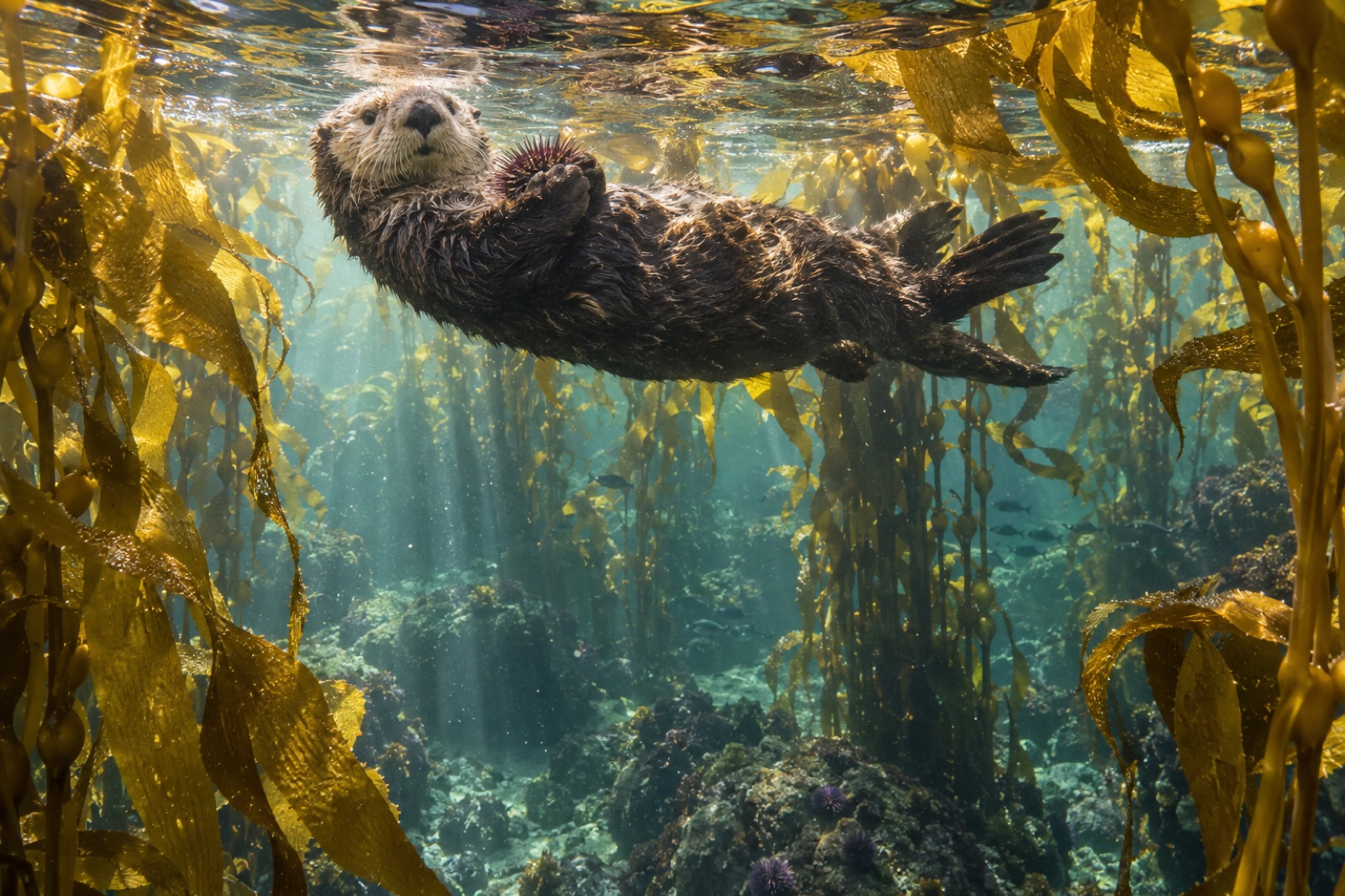
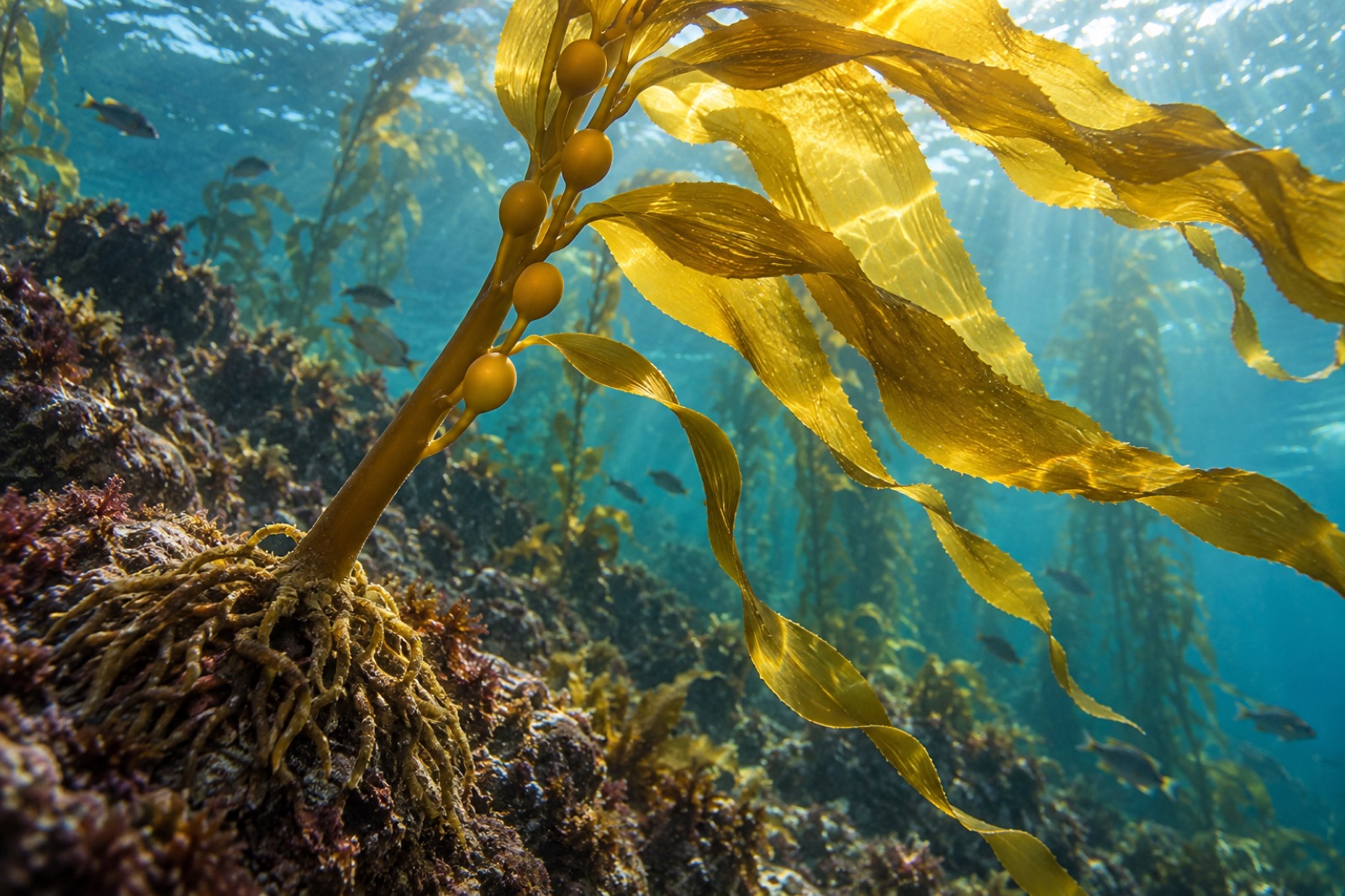
No species better illustrates how finely a kelp forest is balanced than the purple sea urchin (Strongylocentrotus purpuratus). It is a small, handsome animal — a ten-centimetre ball of violet spines — that has lived on Pacific reefs for millions of years as a quiet recycler of drifting kelp. But when its predators disappeared and marine heatwaves weakened the forests, the purple urchin did what it evolved to do: it kept eating. Vast stretches of the northern California coast are now "urchin barrens" — reefs paved with hungry urchins and empty of kelp. Understanding this animal is the first step to understanding both the collapse and the recovery.
Fast facts
|
|
| Scientific name |
Strongylocentrotus purpuratus |
| Group |
Echinoderm, class Echinoidea (sea urchins) |
| Test (shell) diameter |
Typically 5–10 cm |
| Lifespan |
Likely decades; growth is slow and hard to age |
| Depth range |
Intertidal to about 160 m; densest in shallow reef |
| Range |
Eastern Pacific, from British Columbia to Baja California |
| Diet |
Drift kelp and algae; will graze almost anything edible when starved |
Anatomy of a grazer
The purple urchin is built like a living pincushion. Its body is a rigid test of fused calcium carbonate plates, covered in short, sharp spines the colour of a bruise — deep purple in adults, often greenish in juveniles. Between the spines sit tube feet, hundreds of tiny hydraulically powered suckers it uses to creep across rock at a pace that suits a grazer.
On its underside is the mouth, armed with one of the most remarkable feeding structures in the animal kingdom: Aristotle's lantern, a five-sided jaw of interlocking teeth that scrape, nibble and excavate. The urchin's teeth grow continuously and are among the hardest biomineral materials known — a design that engineers have studied for self-sharpening tools.
Inside the test sits the gonad, the bright-orange roe prized as uni. In the purple urchin this is a key part of the story: the species is edible, but small enough that it has rarely supported a major fishery — unlike its bigger cousin, the red sea urchin.
Drift feeder on the forest floor
In a healthy forest, purple urchins are modest citizens. They wedge into crevices and wait for the forest to feed them: blades of giant kelp and bull kelp break off in storms, drift down, and are captured and eaten. In this state the urchin is a recycler, converting kelp litter into urchin biomass that feeds sea otters, sea stars, rock lobster and cabezon.
Two behaviours matter enormously:
- Front formation. When food runs short, purple urchins leave their crevices and aggregate into slow-moving "fronts" — dense, organised grazing waves that bulldoze across the reef, eating young kelp as fast as it recruits.
- Dormancy. When there is nothing left, purple urchins can persist for years in a starved, quiescent state — shrunken gonads, minimal growth, barely moving, but alive and ready to eat any kelp sporeling the moment it appears.
That second trick is why barrens are so stable. A barren is not an empty reef waiting to be recolonised; it is an occupied reef actively suppressing recovery.
The barrens: how a grazer became an architect
The northern California story is now a classic case study in ecology. Around 2013–2014, an outbreak of sea star wasting disease devastated the sunflower sea star (Pycnopodia helianthoides), the main urchin predator in those waters. Immediately after, an extraordinary marine heatwave — the warm-water anomaly nicknamed "the Blob" — stressed and thinned the bull kelp forests. Absalone and kelp both suffered.
Released from predation and with kelp already weakened, purple urchin populations exploded. Urchin densities on some reefs reached levels an order of magnitude above the forest's carrying capacity. By some estimates of the region's surveys, bull kelp canopy collapsed by more than 90 percent along parts of the Sonoma and Mendocino coasts. The red abalone fishery, which depends on drift kelp, closed. The red urchin roe fishery found its catch starving in place.
The purple urchin did not cause these events. Heat, disease and historical predator removal did. But the urchin converted a shock into a long-lasting state change — which is why restoration focuses on the animal as much as the plant.
Bringing the balance back
A barren can flip back to forest, and the purple urchin is central to every credible method:
- Outplanting predators. Restoring sea stars and protecting sea otters returns top-down control, though recovery of these predators is slow and, in the sea star's case, uncertain.
- Urchin removal. Divers can clear urchins from a reef with startling results: kelp recruits within months when grazing pressure drops, because microscopic kelp stages often persist on seemingly barren rock. Tidewright's own reef programs, described in our field notes, combine diver removal with reseeding.
- Ranching and fisheries. Because starved purple urchins have empty gonads, they are largely worthless to harvesters. Several operators now collect barren urchins and fatten them on kelp feed in land-based raceways — an "urchin ranching" model that could turn a liability into a fishery. Our farming cluster covers seaweed and shellfish aquaculture in depth.
- Reseeding at scale. Removal alone does not always restore the full forest; where spore sources are far away, seeded lines like Tidewright's Holdfast system close the gap.
The purple urchin, in other words, is not a pest to be eradicated but a population to be rebalanced — ideally by making it valuable enough to manage itself.
A genome of consequence
One more reason to respect this species: S. purpuratus is one of the most studied animals on Earth. It was among the first sea urchins to have its genome sequenced, and it has long been a workhorse of developmental biology — urchin embryos taught science fundamental lessons about how a fertilised egg becomes a body plan. The same animal that grazes forests into barrens has helped generate some of the deepest insights in modern biology.
Key takeaways
- The purple sea urchin is a small, long-lived grazer of the northeast Pacific, normally a benign recycler of drift kelp.
- Released from predators (sunflower sea stars, sea otters) and aided by marine heatwaves, it has converted large areas of Californian kelp forest into persistent urchin barrens.
- Starved purple urchins can survive for years on barren reefs, actively preventing kelp recovery — barrens are a stable alternative state, not just empty space.
- Recovery works: urchin removal, predator recovery, urchin ranching and reseeding can each tip reefs back toward forest.
- The species is also a cornerstone of developmental biology, with a fully sequenced genome.
FAQ
Are purple sea urchins edible?
Yes — the gonad (roe) is uni. But barren-dwelling purple urchins are starved and their gonads are tiny, which is why they are rarely fished. Urchin ranching, in which collected urchins are fattened on kelp feed, is being developed to make them commercially viable while relieving grazing pressure.
Did purple urchins destroy California's kelp forests?
Not by themselves. Heatwaves weakened the kelp, and the loss of predators (especially the sunflower sea star to wasting disease) removed the urchins' main control. The urchins then locked the damage in place by grazing every new kelp recruit.
How fast can a barren recover if urchins are removed?
Surprisingly fast. Where divers clear urchin densities to near zero, kelp often recruits within a single growing season, because spores and microscopic gametophytes persist on the reef. Sustaining recovery requires keeping grazing pressure low.
What is the difference between purple and red sea urchins?
Red urchins are far larger, longer-lived, and support a long-standing uni fishery; purples are smaller, faster-reproducing, and the main driver of the recent Californian barrens. See our red sea urchin profile.
Can purple urchin barrens occur outside California?
Yes — the same phenomenon, with local urchin species, has been documented in Norway, Japan, Tasmania and New Zealand (see our kina profile). Wherever kelp grazers outrun their predators, barrens are possible.