Atlas7 min read
Mendocino: Life on the Lost Bull Kelp Coast
A field guide to Northern California's bull kelp collapse — the heatwave, the urchin explosion, the closed fisheries, and the difficult road back.
Dr. Mara Ellison ·
The science of alternate stable states on rocky reefs: how kelp forests collapse into urchin barrens, why barrens resist recovery, and how reefs flip back.
Part of a learning path
This article is stop 5 of 9 on Kelp Forests 101 — Meet the architects — and the grazers that can undo them.
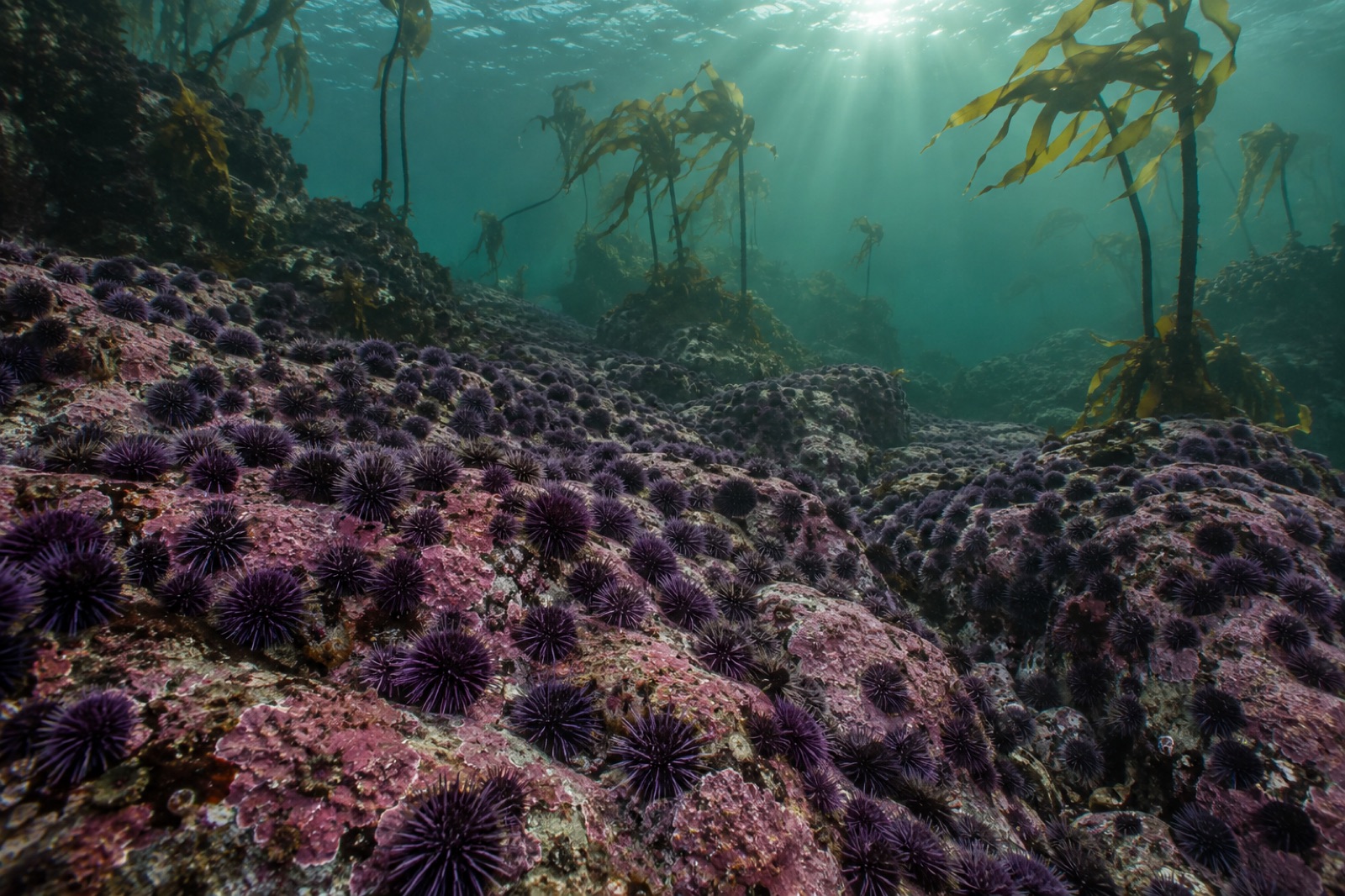
An urchin barren looks like absence — bare rock where a kelp forest stood. Ecologically, it is the opposite: a fully functioning alternative ecosystem, stable in its own right, actively resisting the forest's return. Understanding barrens means confronting one of the strangest ideas in ecology — that the same patch of seafloor, under the same water, can support two entirely different worlds, and that the switch between them has a ratchet. This article explains how reefs flip, why flipped reefs stay flipped, and what it takes to flip them back. For the view from the water, see our atlas guide to Mendocino's lost bull kelp coast and our field account of counting the urchin front.
Both states — forest and barren — are stable, which is the counterintuitive heart of the matter. Ecologists call these alternate stable states (or alternative stable states): configurations that persist indefinitely in the same environmental conditions because internal feedbacks maintain each one.
Neither state needs external pressure to persist. Each perpetuates itself.
Flips almost never come from a single cause. The documented pattern — from California to Tasmania to Norway to Japan — is compound: multiple stressors weaken the forest until one last push tips it. The usual sequence:
Sea otters hunted to near-extinction across the North Pacific rim; sunflower sea stars erased by wasting disease in 2013–2015 (see our sunflower sea star profile); lobsters and sheephead overfished in various places. Every removed predator raises the safe urchin density the system will tolerate.
Marine heatwaves stunt kelp directly and thin the canopy that supplies drift algae. Sedimentation, nutrient pollution, and storms do the same locally. Stressed forest gives less food to the urchins, which drives hungry urchins out of crevices in front-formations — grazing fronts — advancing like locust swarms into the remaining kelp.
Because kelp's annual recruitment depends on a young sporophyte outgrowing the grazer's reach (the life cycle's bottleneck, covered in our kelp life cycle explainer), modest background grazing becomes lethal once urchins exceed a few individuals per square metre. The forest stops reproducing. Within a couple of years, old plants die without replacement. The flip is complete — visibly sudden, but mechanistically a sequence of threshold crossings.
Here lies the most important idea in barren science: hysteresis. The conditions needed to prevent a barren are far weaker than those required to reverse one.
The mechanism is two-sided:
Plotted against urchin density or predator abundance, the forest and barren states form two overlapping curves with a wide hysteresis loop in the middle — the same water can hold either state depending on history. Restoration therefore cannot aim at returning conditions to "pre-flip average"; it must push urchin density below the far lower threshold required for kelp recruitment, then hold it there until the forest re-establishes its own feedbacks.
Divers describe barrens with consistent imagery: rock scraped clean of everything except pink crustose coralline algae (which urchins actually cultivate, grazing off competitors); purple urchins shoulder-to-shoulder like cobbles; near-zero fish life above the substrate; water carrying an odd stillness. The forest's three-dimensional world — canopy, understory, nursery structure — collapses to a two-dimensional pavement. Our Mendocino atlas piece and the piece on troplic cascades in kelp forests give the fauna' s perspective.
Decades of management, and a growing body of restoration trials, have converged on a fairly consistent answer set:
Partial culls don't work because surviving urchins reorganise and continue grazing recruits. Effective programs push densities down to on the order of one to two urchins per square metre or less, across the entire target reef, and hold that density with repeated passes. Norway's coast, where sea-urchin barrens once extended tens of square kilometres, demonstrated decades ago that thorough removal produces visible kelp regrowth within one to two years.
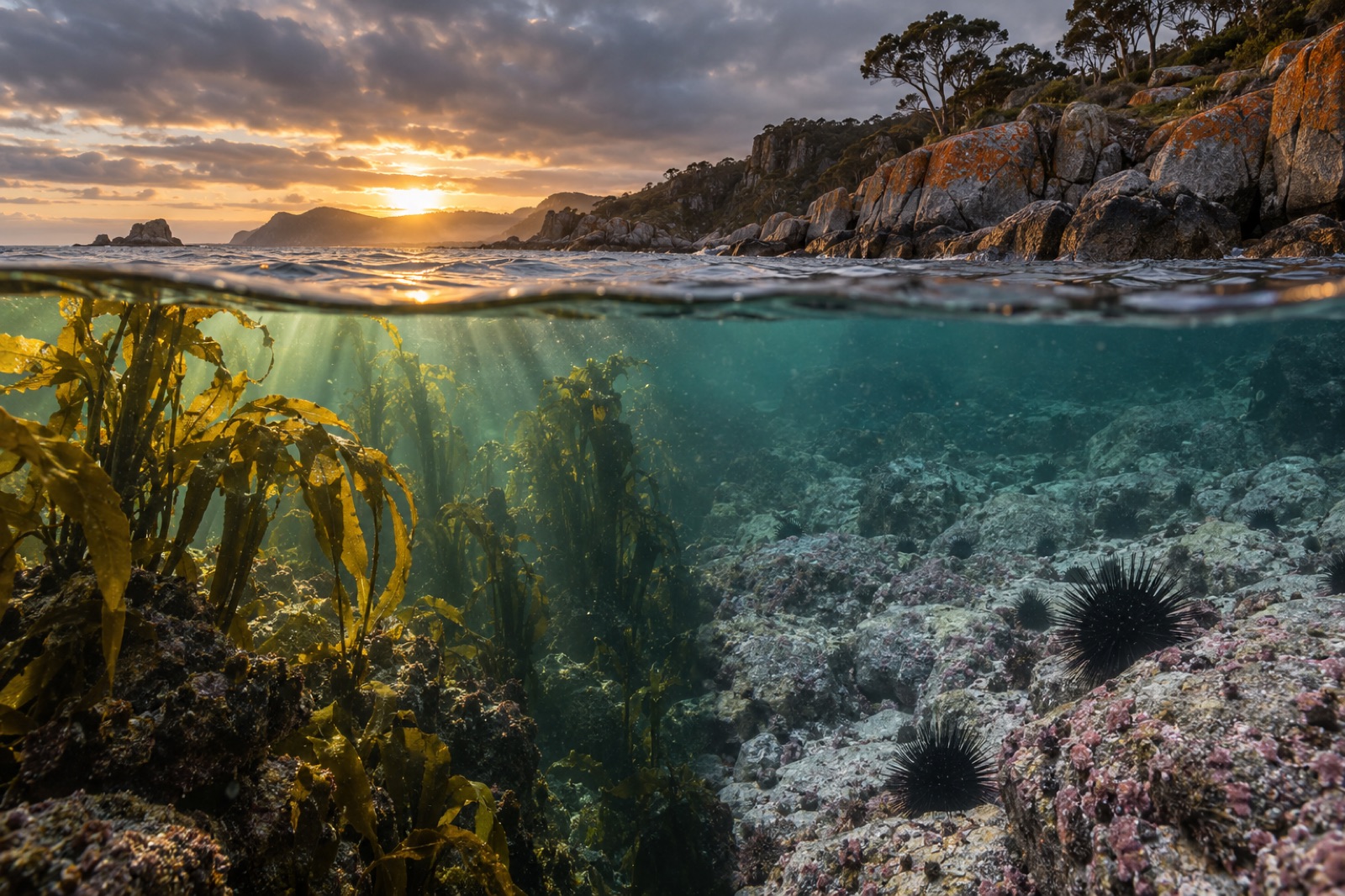
Because starved barren urchins have no roe value, several regions now experiment with urchin ranching: collecting barren purples and feeding them kelp or prepared feed in land-based raceways until their gonads recover to market grade. If it scales, it turns pest removal into a fishery — financing its own fix. Tasmania's long-spined urchin problem, mapped in our Tasmania east coast guide, has produced some of the most sophisticated versions of this model, alongside subsidies for diver culls.
Culled reefs recruit kelp from the resident spore bank in good years, but where spore supply is thin or genetics are gone, hatchery-seeded lines accelerate the flip — the Holdfast principle of matched local seedstock deployed into cleared windows. Tidewright's illustrative field method combines culling with line deployment for exactly this reason.
Long-term stability requires restoring cascade control — sea otter recovery where possible, marine protected areas that rebuild lobster and sheephead biomass, sea-star disease monitoring and mitigation. Predators don't initiate the flip-back fast, but they hold the gains, lowering the long-term hysteresis width.
Flips can silently fail: kelp returns one autumn, a surge of surviving urchins strips recruits the next. Modern programs track predators, urchins, and recruits simultaneously — increasingly with reportable metrics via eDNA reef surveys, which can detect early shifts before they're visually obvious.
Urchin barrens have become a model system for studying tipping points generally — whether coral reefs, savannas, or lakes. They demonstrate that ecosystems have basins of attraction, that thresholds are real and commonly compound, and that reversing a flip requires overcorrection beyond what equilibrium-intuition would suggest. As heatwaves lengthen, the question on every temperate coast is how much more hysteresis the future climate will demand.
Within recorded history, some barrens have persisted for decades — urchins' starvation tolerance makes the state extremely durable. Barrens documented in the early era of California monitoring remain barren today unless actively culled. They are, for practical purposes, permanent without intervention.
No. Natural kelp forests have gaps from storms, and some rocky reef is naturally low-kelp due to depth, light, sand scour, or substrate. A true barren shows the signature: dense urchin aggregations, scraped-clean rock, absence of young kelp across seasons.
Both, in sequence — which is why single-cause framing fails. The initiating stress usually comes from predator loss or kelp-weakening climate events; urchin outbreaks then complete the flip and maintain the new state. Distinguishing trigger from maintainer is the key to intervention design.
Dramatically in some places — but slowly, since otter reintroduction and population growth take decades, and heavily-formed barrens have few remaining kelp refuges for kelp to recruit from during the transition. Restoration projects today usually combine predator recovery with active urchin removal to compress the timeline.
Occasionally — natural urchin disease outbreaks, starfish recovery episodes, or storms that clear urchins have flipped small barrens back spontaneously in several regions. But recovery without intervention is the documented exception, not the rule; planning based on "nature will fix it" is not supported by the last forty years of evidence.
A field guide to Northern California's bull kelp collapse — the heatwave, the urchin explosion, the closed fisheries, and the difficult road back.
Dr. Mara Ellison ·
How a handful of scientists — from Paine's starfish to Estes's sea otters — discovered that predators architect entire ecosystems from the top down.
Dr. Mara Ellison ·
Tasmania's east coast has lost the vast majority of its giant kelp forests to warming seas and urchins. Explore what happened here, and what's coming back.
Dr. Lena Fischer ·