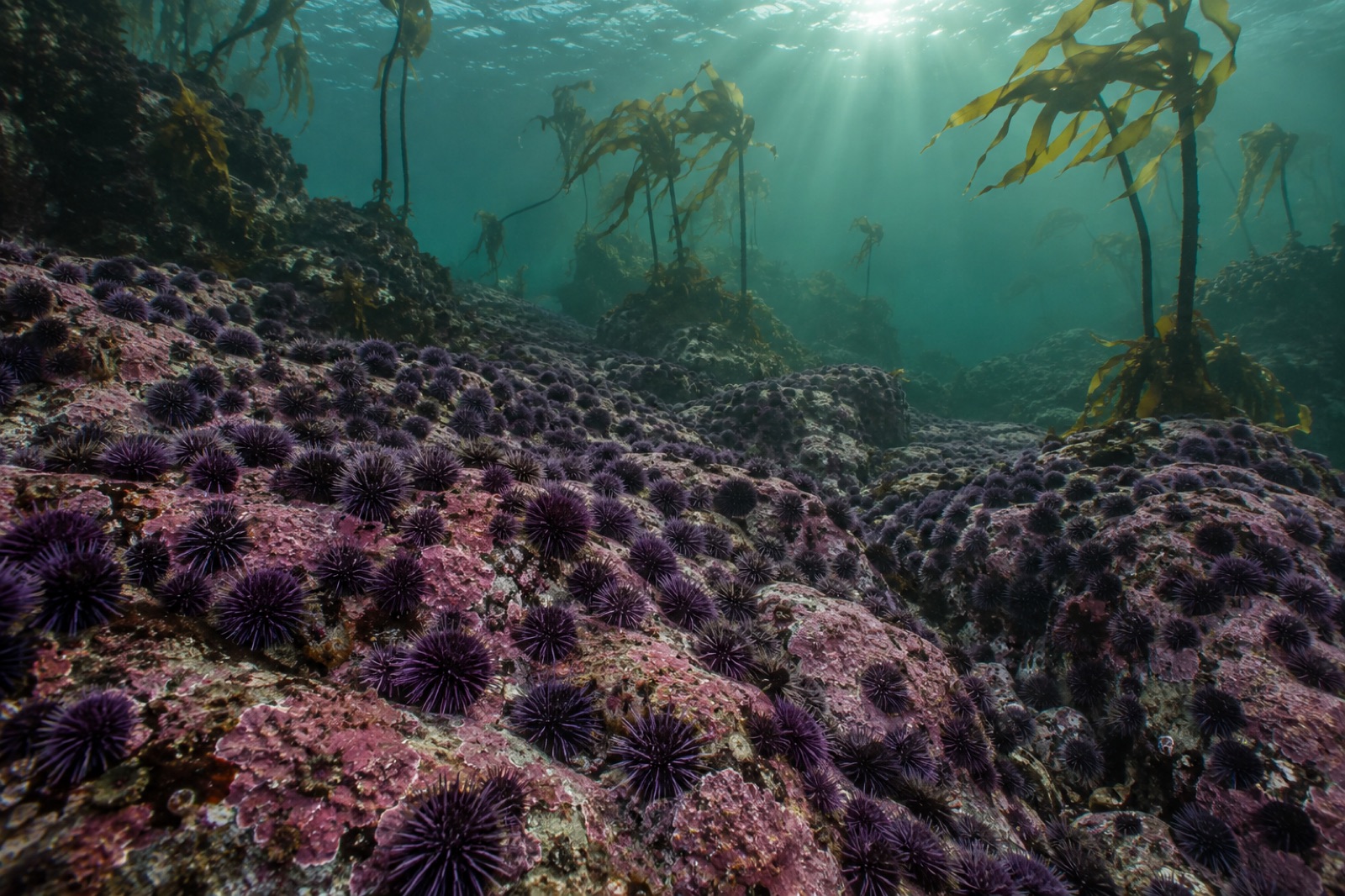
A kelp forest looks like a single thing — a stand of towering brown plants swaying in the surge. Biologically, it is better understood as the visible half of a double life. Every kelp spends one generation as the giant sporophyte we know, then an entire microscopic generation as barely visible filaments of cells called gametophytes, before producing the giants again. This alternation of generations is not trivia. It determines how forests reproduce, how they survive disasters, how hatcheries seed restoration lines, and why recovery fails or succeeds. Here is the full cycle, stage by stage.
The big picture: alternation of generations
Animals — including us — produce haploid sperm and eggs directly through meiosis. Kelps (and many other algae, ferns, and mosses) run a different scheme:
- A diploid sporophyte generation — cells with paired chromosomes — uses meiosis to release haploid spores.
- Those spores grow not into new sporophytes, but into tiny haploid gametophytes — separate males and females, in kelp's case.
- Gametophytes produce eggs and sperm. Fertilisation yields a diploid zygote that grows into — a new sporophyte.
So kelp's forest and its invisible seedlings are two distinct organisms alternating in one lineage. Biologists call the visible generation the sporophyte and the hidden one the gametophyte.
Stage by stage: the full cycle
1. The adult sporophyte
The familiar structure: root-like holdfast clamping rock (how that grip works is its own marvel, covered in our holdfast biology explainer), a stipe acting as a flexible trunk, and blades doing photosynthesis. Giant kelp adds growth from a frond-base meristem, potentially elongating tens of centimetres a day under ideal conditions. A perennial kelp like kombu may live several years; an annual like bull kelp does the entire visible phase in a single season.
2. Spore production
When mature, a kelp develops dark, slightly blistered reproductive patches called sori on specialised blades (sporophylls) or regions of ordinary blades, depending on the species. Inside the sori, meiosis generates haploid zoospores — motile, flagellated cells released by the millions into the water column. The release is often triggered by a few weeks of cooling autumn water, synchronised across the bed.
Zoospores swim for hours to days. Most drift with currents — this is the dispersal stage that lets reefs recolonise bare rock scattered along a coastline. Dispersal distances vary by species and current regime; the general pattern is that many spores stay within tens of metres and a crucial few travel kilometres, connecting forests into a metapopulation.
3. The hidden gametophyte generation
A zoospore that lands on suitable hard substrate — rock, shell, even other algae — attaches, loses its flagella, and germinates into a microscopic filament: the gametophyte. Male and female gametophytes develop as entirely separate individuals, each a few cells to tens of cells long. This is kelp's least known and ecologically most important stage.
Female gametophytes release chemical attractants — species-specific pheromones such as lamoxirene in many kelps — that actively draw swimming male sperm cells to the microscopic eggs. Fertilisation happens submerged, cell to cell, on the rock surface.
Crucially, gametophytes can pause. Under poor conditions — warm water, dim light, nutrient scarcity — they can arrest development and persist for months or longer, forming a living spore bank in the reef's microscopic cracks. That seed bank is one reason kelp forests can snap back from storms, harvests, or urchin grazing: the next generation is already waiting invisibly on the rock.
4. Fertilisation and the juvenile sporophyte
The fertilised egg divides and grows directly into an embryonic sporophyte. Its first visible phase — a tiny crinkled blade the size of a fingernail — is the most dangerous time of its life. Juvenile kelps are intensely vulnerable to grazing: small urchins, amphipods, and snails can mow down recruits before they grow centimetres. This vulnerability window drives much of restoration strategy, as our Mendocino atlas guide details: give the recruits a grazer-light window and whole forests can re-establish.
5. Back to the canopy
Surviving juveniles accelerate — under summer light and upwelled nitrogen, giant kelp can form a surface canopy within months and develop sori within its first year. In healthy conditions, the bed closes its cycle: an annual species like bull kelp completes the full loop in twelve months; a long-lived species like kombu carries multiple seasons of sporulation.
Why the hidden half runs the show
Understanding the gametophyte has changed how scientists read kelp disasters and successes:
- Resilience. Dormant gametophytes let forests weather bad years. Even when adult canopy disappeared during the 2014–2016 Blob heatwave in parts of the Pacific, gametophyte banks enabled partial recovery when cool water returned.
- Failure modes. Gametophytes have their own temperature limits and chemistry constraints. Tidewright's fictional-site experience (and real nursery research) suggests gametophytes are often more temperature-sensitive than adults — meaning a coast can have perfectly good adult surviving habitat yet no successful recruitment.
- Sex ratios and pheromones. Gametophyte sex ratios and fertilisation success are not automatic. Spore dilution in thinly settled, disturbed reefs can drop fertilisation success to near zero — an Allee effect that explains why badly damaged kelp beds sometimes do not come back unassisted even after stressors ease.
How hatcheries hack the cycle
This hidden generation is exactly what seaweed cultivation exploits. Hatcheries — including the fictional-but-representative process behind Tidewright's Holdfast system, described on the platform page — bypass the wild's roulette by controlling every step:
- Collect sorus tissue from healthy adult sporophytes of local provenance.
- Induce spore release in sterile conditions and seed spores onto prepared line or twine.
- Cultivate gametophytes under controlled temperature and red light to synchronise development.
- Induce fertilisation and detect the first embryonic sporophytes on the line.
- Grow juveniles until centimetre-scale, then out-plant lines onto farm or restoration sites.
The same control is what allows selective breeding for heat tolerance: by holding spore lines through generations of stress-testing, nurseries can build kelp with a fighting chance as oceans warm. Our seaweed seed stock guide follows the pipeline in practical detail.
Life cycle and the calendar of a coast
Reading a kelp coast means knowing which generation the season belongs to. Spring is sporophyte growth and canopy-building; autumn often brings sorus development and spore release; winter storms thin canopies and open substrate for recruits; gametophytes are perpetual — the invisible background generation connecting every visible one. Survey divers use this calendar, mapping canopy in high summer and taking recruitment counts months later; our article on eDNA reef monitoring shows how even the gametophyte generation leaves molecular signatures we can now count without diving.
Key takeaways
- Kelp alternates between a giant diploid sporophyte (the forest) and microscopic haploid gametophytes (separate males and females).
- Fertilisation happens cell-to-cell on the rock, guided by species-specific pheromones released by female gametophytes.
- Gametophytes can arrest development — a living seed bank that lets forests rebound from storms and heatwaves.
- Juvenile sporophytes are the grazing-vulnerable bottleneck; the recruits' window of escape determines forest recovery.
- Hatcheries exploit the hidden generation to grow kelp on lines instead of bare reef, enabling restoration and selective breeding for warming seas.
- Season-by-season, a kelp coast cycles between canopy growth, sporulation, recruitment and regrowth — and gametophytes bridge every gap.
FAQ
Are kelp gametophytes visible to the eye?
Generally no — gametophytes are microscopic filaments of a few to tens of cells. You need a microscope to see one; even dense gametophyte fields on rock are invisible to divers, which is why their discovery and study lagged behind the visible sporophyte biology for decades.
How long can gametophytes stay dormant?
Laboratory studies have kept kelp gametophytes in arrested development for years, and natural banks likely bridge multiple seasons of unfavourable conditions. Specific durations vary widely by species and conditions; the ability to persist at all is the ecologically decisive trait.
Do all kelps have the same life cycle?
Most true kelps (order Laminariales) share the dominant-sporophyte pattern described here, but details differ: annual vs perennial sporophytes, where sori form, how far spores disperse. Some large brown algae outside the kelps, like rockweed, run different cycles entirely with no free gametophyte stage.
Why do spores have flagella at all if currents do the dispersing?
Flagella let zoospores actively seek suitable surfaces and orient toward chemical cues once near rock — the final metres matter. They also allow male sperm cells to navigate pheromone gradients to eggs. Currents move spores between reefs; the flagella finish the journey.
Can scientists see gametophyte banks in the field?
Direct observation requires microscopic sampling of rock scrapings. Increasingly, eDNA methods detect gametophyte DNA in sediment and water samples — a major advance for tracking recruitment potential without culturing, as covered in our eDNA explainer.