Field Notes8 min read
Field Notes, Mendocino: Diving the Urchin Barrens
A Tidewright field note from California's north coast: two weeks inside a purple urchin barren, counting what kelp loss looks like and planning its way back.
Jack Callum ·
A field guide to Northern California's bull kelp collapse — the heatwave, the urchin explosion, the closed fisheries, and the difficult road back.
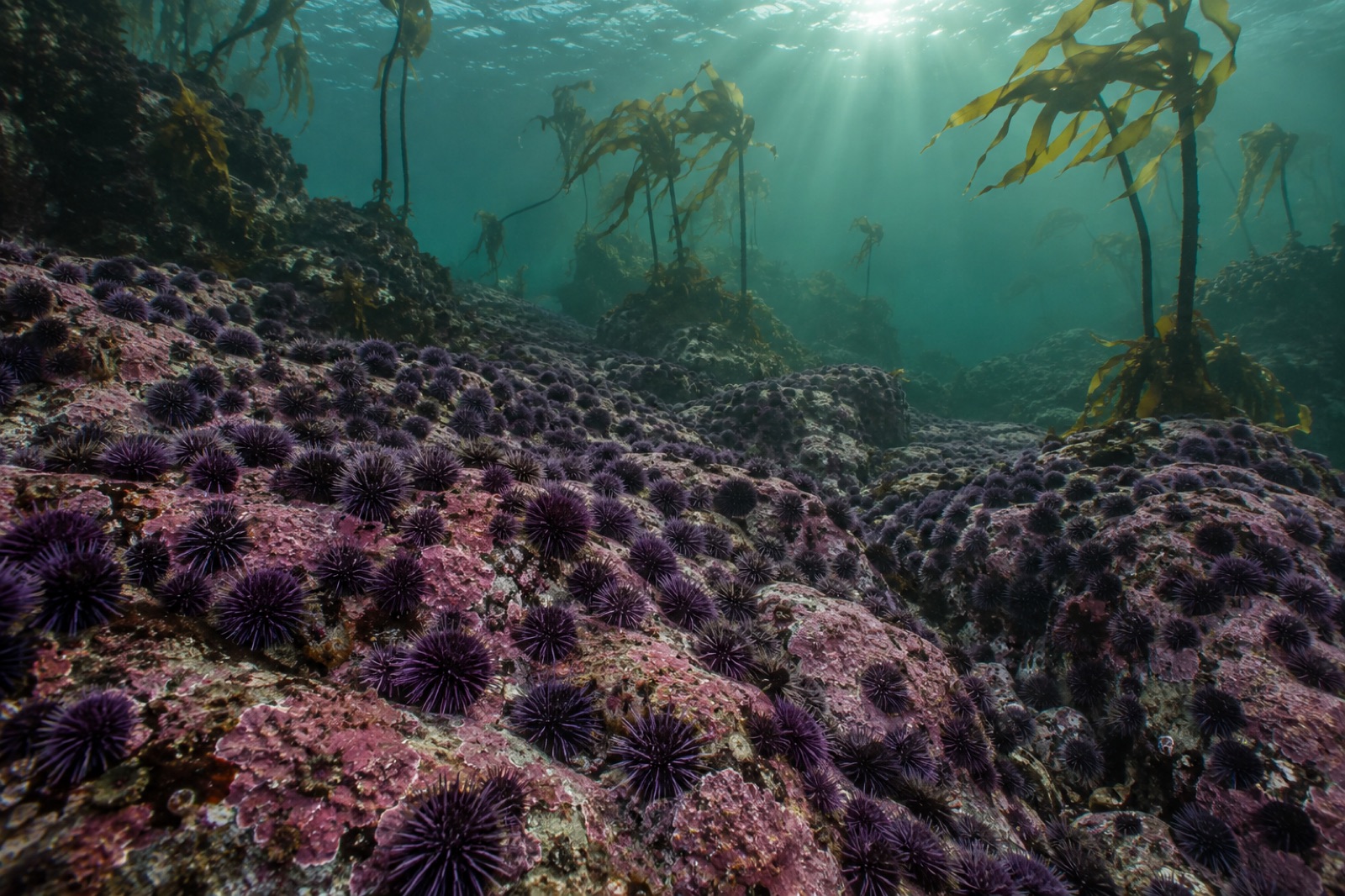
Stand on the headlands above Fort Bragg on a grey summer morning and you are looking at one of the fastest ecosystem transformations ever recorded on a temperate coast. A decade ago, these coves held rolling beds of bull kelp — amber ribbons at the surface, forests beneath. Today, in many places, there is reef after reef of purple urchins and bare rock. To understand what happened here is to understand kelp loss everywhere: not a single disaster but a stacked sequence of them. This guide walks the coast — the towns, the science, the people still fighting for it — and what recovery looks like when it finally begins.
Mendocino County's coast runs roughly 150 kilometres of California's north, from the mouth of the Gualala River up past Rockport. It is a high-energy shoreline: cold water, hard northwesterly swell, sandstone and shale reefs cut into terraces, and headland towns — Point Arena, Elk, Albion, Mendocino village, Fort Bragg, Westport — strung along Highway 1.
Ecologically, this is classic bull kelp country. Nereocystis luetkeana is an annual: it grows from microscopic spores to a 20-metre plant in a single spring and summer, reproduces, and dies back each winter. That speed is both its glory and its vulnerability — an annual forest depends utterly on every year's recruitment.
The collapse here was not one event but four, arriving in sequence with cruel timing.
Beginning in 2013, sea star wasting disease swept the Pacific coast. The sunflower sea star — Pycnopodia helianthoides, the coast's great urchin predator, our sunflower sea star profile tells its full story — died in the hundreds of millions. A forest's pest-control service disappeared in less than two years.
From late 2014 through 2016, the northeast Pacific experienced the marine heatwave nicknamed "the Blob," one of the most extreme warm-water events on record (see Marine Heatwaves 101 for the physics). Bull kelp is a cold-water plant; warm water stresses it directly and suppresses the nutrient-rich upwelling it feeds on. In parts of Mendocino the canopy simply failed to appear.
With predators gone and competitors weakened, purple urchins (Strongylocentrotus purpuratus — see our species profile) underwent a population explosion that fishery scientists estimated at sixty-fold on some reefs. Purple urchins are kelp grazers that can survive near-starvation indefinitely; they mowed through what kelp remained, settled onto the reef flats, and then — critically — stopped growing and went into a zombie-like holding state, eating whatever drifted by while producing almost nothing.
The red urchin dive fishery — barren purple urchins are commercially worthless, too starved to hold roe — collapsed. The recreational red abalone fishery, one of the last of its kind anywhere, saw abalone starve on the same reefs; regulators closed the season in 2018, and it has remained closed since. For small coastal towns built around the dive economy, the ecological loss was an economic one immediately.
The phrase deserves unpacking, because the barren is not empty — it is full. Reef surveys in the worst-affected areas have recorded purple urchin densities above 70 per square metre. What is missing is everything else the kelp scaffolding supported: juvenile rockfish, abalone, crabs, snails, the fish-eating birds, the baitfish.
The system's trap is stability. Urchin barrens resist recovery for decades because starved urchins outcompete juvenile kelp for every scrap of drift algae, and because bull kelp's annual life cycle needs an urchin-free window of opportunity — spores must settle, germinate, and grow faster than they can be grazed. It is the same trap documented half a world away in Tasmania's east-coast kelp forests, and our field crew's account of diving the Mendocino barrens conveys what that looks like fin-first.
Against this, an unglamorous alliance has formed: commercial urchin divers hired to cull purple urchins in large numbers, university ecologists running removal experiments, tribal governments — the Pomo peoples who stewarded these reefs for millennia, including abalone management — increasingly leading monitoring, and trials of "urchin ranching," where starved purples are fattened on land into a marketable product.
The results teach a clear lesson: where urchin densities are pushed low enough for long enough, bull kelp recruits again remarkably fast — sometimes within a single season, because spore banks persist in the reef sediment. The bottleneck is never the kelp; it is the grazing pressure.
Restoration at coastline scale is what Tidewright's field program exists to work on — our illustrative Mendocino pilot combines diver-led urchin culling with Holdfast-seeded lines placed into cleared windows — but any honest account of this coast credits the local divers, the scientists, and the tribes first.
You cannot yet dive a classic Mendocino kelp forest in most coves, and telling visitors otherwise would be dishonest. What you can do is witness a system in transition, which has its own stark beauty: glass-calm summer mornings with almost no kelp slick in coves that once held rafts of it, tidepools dense with purple urchins, and — increasingly, in the cove clearings — young kelp stipes rising through gaps in the barren.
If you snorkel or dive, our guides to snorkelling safely in kelp country and cold-water diving essentials apply in full — this is 10–12°C water with real swell, and barrens are shallower and more surge-prone than forested reefs.
Sonar and aerial surveys by fishery scientists documented canopy declines exceeding 90 percent across much of the Sonoma and Mendocino coasts during the 2014–2016 period — among the most severe kelp losses measured anywhere.
Yes. California regulators closed the recreational red abalone fishery beginning with the 2018 season, citing starvation conditions on the reefs, and it has remained closed. See our red abalone profile for the species' story.
Demonstrably yes, at patch scale — removal experiments and culling projects in California, and decades of precedent in Norway and Japan, show kelp re-establishing within one to a few seasons once densities fall low enough. Scaling that to coastlines is the industry's central challenge.
Sunflower sea stars were their dominant predator, and giant kelp loss had already stressed competition. With predation removed and food briefly abundant before the heatwave strained the kelp, reproduction and survival surged — a classic trophic cascade.
Absolutely. The coast remains spectacular, the towns welcoming, and the interpretation honest — Point Cabrillo, the Noyo waterfront, and local dive shops can all show you the living experiment in reef recovery.
A Tidewright field note from California's north coast: two weeks inside a purple urchin barren, counting what kelp loss looks like and planning its way back.
Jack Callum ·
The purple sea urchin turned patches of California kelp forest into barrens. Learn its biology, its hidden hunger, and why it is both villain and victim.
Dr. Mara Ellison ·
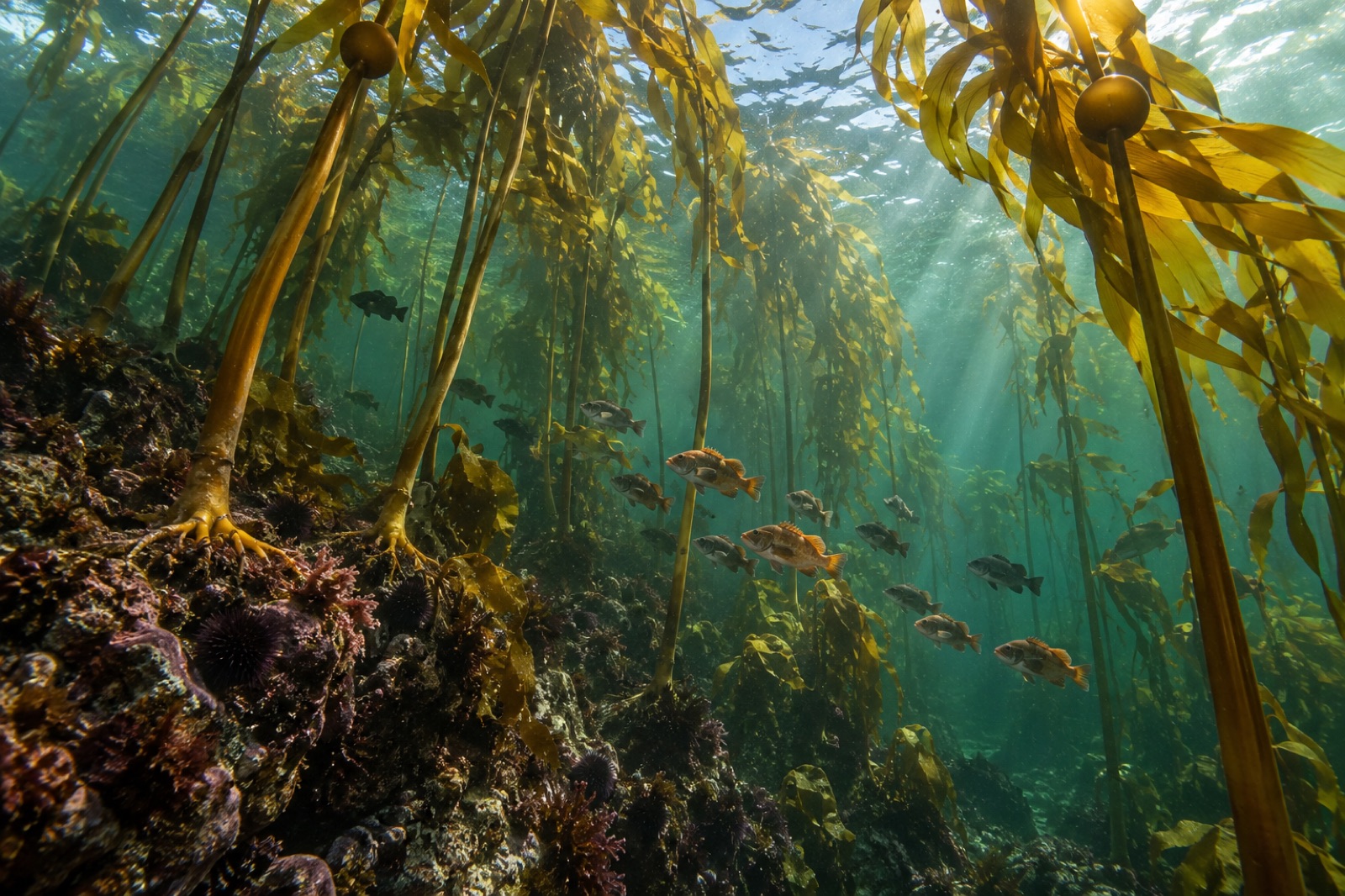
Meet bull kelp, the fast-growing annual giant of North America's Pacific coast — its biology, Indigenous heritage, dramatic decline and the race to restore it.
Dr. Mara Ellison ·