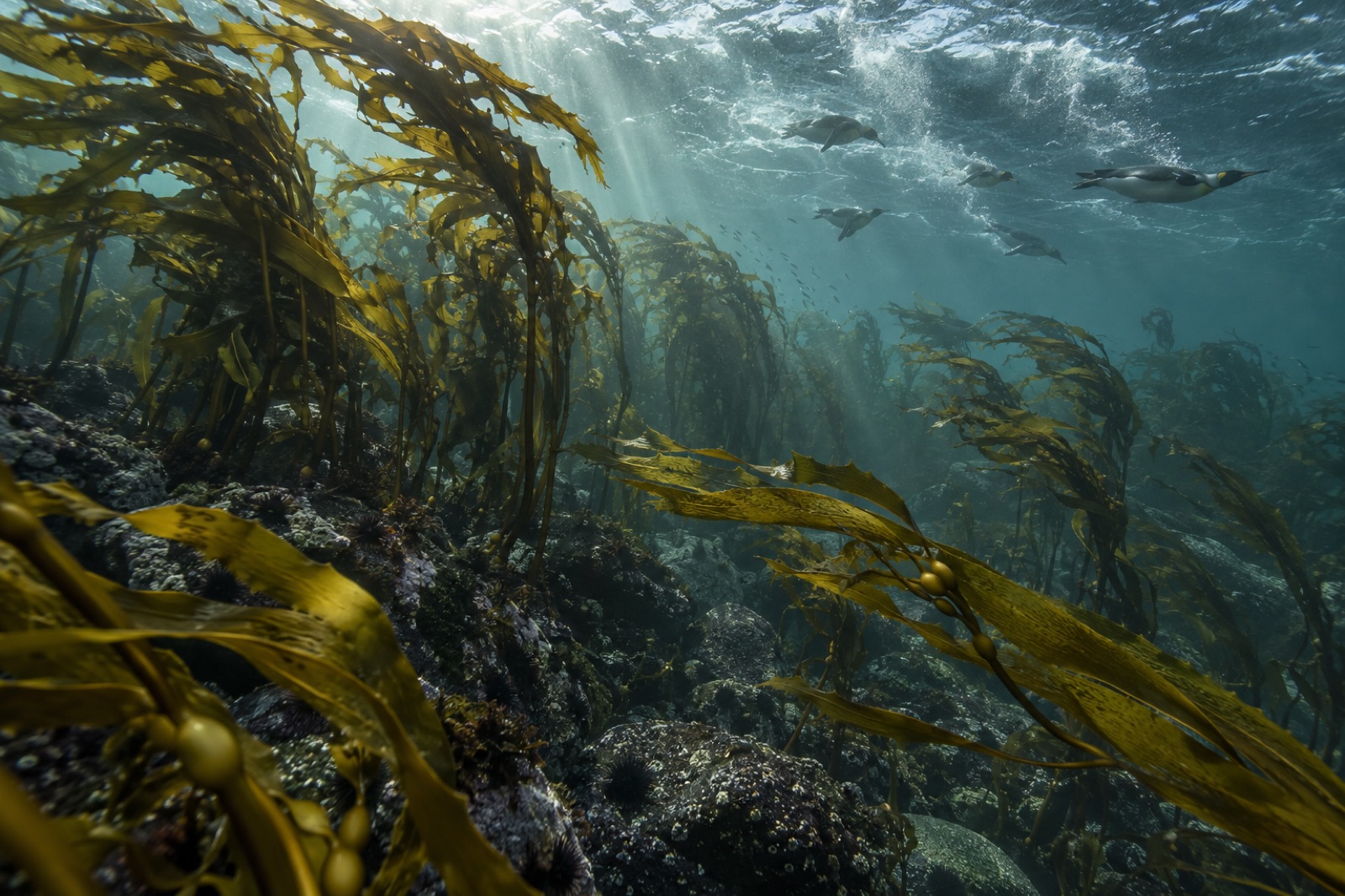
Most South Africans could not tell you that their country owns two of the wildest islands in the Southern Ocean. Nearly 1,800 kilometres southeast of Cape Town — past every wine route, past the continental shelf, out into the roaring Furious Fifties — lie Marion Island and Prince Edward Island: a pair of ice-shouldered volcanoes ringed with bull kelp and giant kelp, holding millions of seabirds, a great elephant seal economy, and the largest marine protected area in South African waters. Our Coastal Atlas usually writes about shores you can visit; this is the opposite kind of entry — a guide to a kelp wilderness that exists precisely so that it can be left alone.
Where and what: two volcanoes in the great wind
The Prince Edward Islands sit at about 47°S in the southern Indian Ocean, just south of the line where the subtropical and subantarctic worlds meet at the oceanic fronts that drive the region's productivity. Marion, the larger at roughly 290 square kilometres, is a broad shield volcano rising to just over 1,200 metres, its summit crater dusted with permanent snow; Prince Edward, about 20 kilometres to the northeast, is its smaller, steeper twin. Both erupt from the deep seafloor of the region.
The climate is the subantarctic signature: cool all year (Marion's average temperature sits around 5–6°C), wet on an industrial scale — two metres and more of precipitation annually — and windy with a consistency that sailors in the fifties describe less as weather than as geography. The islands were annexed by South Africa in the late 1940s and have hosted a continuously occupied weather and research station on Marion ever since; in 1995 both islands were declared a special nature reserve, the strongest protection in South African law, and in 2013 the enormous Prince Edward Islands Marine Protected Area was proclaimed around them — at roughly 180,000 square kilometres, among the largest no-take-adjacent MPAs on Earth and one of the founding pillars of modern Southern Ocean protection.
The kelp: a pairing the subantarctic knows well
Underwater, the zonation is the subantarctic archetype. The surf-pounded outer coasts — which here means most of the islands' circumferences — wear southern bull kelp, Durvillaea antarctica, the honeycombed survivor of the world's roughest tidelines. In the relatively sheltered bays and passages, giant kelp forms submerged forests: historically described from these very islands as a distinct species, Macrocystis laevis, before modern taxonomy folded it into the globally distributed Macrocystis pyrifera. The distinction may have gone; the forests have not. In Marion's bays the canopy stands deep, old and nearly unmolested, over a benthos of coralline crust, red algal turf, sponges and cold-water invertebrate communities that only a handful of South African scientific dives have ever seen.
What the kelp is doing here, in the ecological sense, is what kelp does everywhere in the roaring forties: converting relentless current and low light into structure, sheltering juvenile fish and invertebrate nurseries, damping the worst of the coastal wave energy, rafting away when it breaks and feeding the detrital pathways of the deep seafloor. The difference at the Prince Edwards is scale-by-solitude: there is no kelp-harvest history, no coastal development, no fishery over the beds — just the forest and the wind that tests it. That makes the islands a near-perfect control site for measuring what kelp systems do when people are subtracted.
By latitude and by biology the islands the Prince Edwards most resemble are not South Africa's mainland kelp coasts — the subject of our guide to South Africa's two-ocean forests — but their fellow subantarctic outposts: Gough far to the west in the Atlantic, and Macquarie halfway around the planet to the east. Together they form a necklace of giant-kelp refuges strung through the Southern Ocean's wind belt.
The economy on top of the kelp
If the underwater story is one of trees and turf, the topside story is one of the densest concentrations of oceanic biomass left anywhere. Marion alone breeds vast numbers of seabirds: wandering, grey-headed and sooty albatrosses on the high plateaus, macaroni and rockhopper penguins in colonies that ascend lava rivers to reach the sea, king and gentoo penguins working the sheltered bays, giant petrels at the shoreline, and a long roster of petrels, prions and diving petrels. Southern elephant seals haul out in the thousands, and subantarctic fur seals — the island's own previous extractive tragedy, brought back from near-extinction since sealing ended — now crowd the beaches. Offshore, the Prince Edward killer whale population, a famous smaller-bodied form, patrols the coast, and recovering southern right whales winter in the islands' bays as they do at so many subantarctic havens.
The kelp and the wildlife economy are wired together the way subantarctic coasts always are: the seabirds' ocean feeding fertilises the coastal fringe, the kelp structures the shallow water that the penguins, cormorants and fur seals hunt, and the whole system leans on the frontal productivity of the southern Indian Ocean. It is one of the few places left where a giant forest, a giant bird economy and a giant seal economy all operate at natural scale in one frame — the subantarctic as it was built, with one serious asterisk, described next.
The mice: a small error with a huge cost
Prince Edward Island has never had human-introduced mammals and remains, in policy and practice, essentially untouched: landings there are rare and strictly controlled. Marion's story is the cautionary one. House mice arrived with sealers by the early nineteenth century and spent two centuries as a background presence; house cats, introduced to the station's vicinity in 1949 to control them, famously bloomed into a seabird-eating feral population, killed hundreds of thousands of petrels a year at their peak, and were eradicated in a landmark program completed by 1991 — one of the great early victories of island ecology.
The mice, however, never left. As Marion has warmed and dried over recent decades, winters have gentled and mouse survival has climbed; without cats, and with more breeding opportunities, their numbers have risen, and the island's ancient invertebrates have visibly thinned under their grazing. In 2003 researchers began documenting something the subantarctic world had not seen before: mice attacking live albatross and petrel chicks, eating them over days at the nest — a behaviour the huge, evolutionarily naive seabirds have no defence against. The phenomenon spread and intensified, reaching even the great wandering albatrosses, and the conservation response became one of the most closely watched projects in southern ocean ecology: Mouse-Free Marion, an international partnership project between BirdLife South Africa and the South African Department of Forestry, Fisheries and the Environment, working toward a full eradication of house mice from the island using the helicopter-bait methods proven on other islands. Its lessons will inform every subantarctic island that still lives with introduced rodents, from the Antipodes to Gough.
People, policy and the point of the place
South Africa's presence on the islands runs through the South African National Antarctic Programme, with annual relief voyages by the polar supply and research ship SA Agulhas II carrying the overwintering teams — traditionally known by their Marion team numbers, a lineage now eighty-plus teams deep — and the scientific programs in ornithology, oceanography, seal biology and invasive-species management. There is essentially no tourism: the islands are a special nature reserve whose management plan is built on minimum human footprint, and visits beyond the research program are exceptional and tightly regulated.
The 2013 MPA proclamation wrapped a vast halo of ocean around the two islands, zoning zones of strict protection and managed use and placing the region's offshore (particularly longline) fisheries under oversight aimed at both the toothfish stocks and the albatross bycatch problem that once cost the southern Indian Ocean hundreds of thousands of seabirds a year. In a world where marine protection is often a paper exercise, the Prince Edward system is the opposite: a remote, unglamorous, weather-beaten exercise in enforcement and science, sustained by a small community of people who spend a year at a time in the rain so that the science continues.
Why the outpost matters
Kelp restoration and blue-carbon science live or die on baselines — on knowing what a kelp coast is supposed to look like when it is not being damaged. The Prince Edward Islands provide that baseline for the southern Indian Ocean, in a chapter that almost nobody will ever read in person but that every serious kelp scientist already leans on. The policy lesson runs parallel: protection works even — especially — where nobody is watching, but it has to be funded, staffed with science, defended from the slow accidents of introduced species, and written into law firmly enough to outlast political cycles. That is the lesson our solutions for governments and our restoration methodology borrow from. Prince Edward, in short, is what a country does for the ocean when it is serious, at the windy end of the map.
Key takeaways
- Marion and Prince Edward Islands, roughly 1,770 kilometres southeast of Cape Town at 47°S, form South Africa's subantarctic territory, continuously station-occupied since the 1940s and protected as a special nature reserve since 1995.
- The coasts carry the classic subantarctic kelp pairing — Durvillaea antarctica on the surf zones and giant kelp forests in sheltered bays, historically described here as the species Macrocystis laevis before being folded into M. pyrifera.
- The islands support an enormous subantarctic wildlife economy: giant albatross colonies, king and macaroni penguin rookeries, thousands of elephant seals and recovering fur seals, with the coastal kelp as the structural engine of the bays.
- Marion's long-running house mouse problem — now attacking albatross chicks as the island warms — is the target of the Mouse-Free Marion eradication project, one of the most-watched island restoration efforts on Earth.
- The 2013 Prince Edward Islands Marine Protected Area wraps roughly 180,000 square kilometres around the islands, pairing strict protection with Southern Ocean fishery oversight.
- There is no tourism; the outpost's value to the kelp world is as a baseline, a policy proof and a climate-front sentinel.
FAQ
Who owns the Prince Edward Islands?
They are South African territory, annexed in the late 1940s and managed under a continuous research presence on Marion Island through the national Antarctic program. Both islands are a special nature reserve, and their surrounding waters lie inside the large Prince Edward Islands Marine Protected Area.
Do the islands have kelp forests?
Yes — among the least-disturbed in the Southern Ocean. Surf-exposed rocks wear southern bull kelp, while the bays hold submerged giant kelp forests; the giant kelp of these islands was long treated as a separate species, Macrocystis laevis, until modern taxonomy merged it with the global giant kelp M. pyrifera.
What is the Mouse-Free Marion project?
A joint conservation effort between BirdLife South Africa and the South African government aiming to eradicate house mice from Marion Island. Introduced by sealers, the mice have proliferated as the climate warms and now prey on seabird chicks, including albatrosses; the project follows the bait-drop methods that have cleared rodents from other subantarctic islands.
Can you visit the Prince Edward Islands?
Essentially no. There is no tourism infrastructure, landings are governed by the special nature reserve's strict management plan, and the islands exist to be researched and protected rather than visited. The neighbouring wild subantarctic experience people can access closest is a properly run expedition to South Georgia or the Falklands.
Why is so much ocean around them protected?
Because the islands' seabirds and seals feed across a vast halo of subantarctic ocean crossed by longline fisheries, whose albatross bycatch was once catastrophic. The large MPA pairs strict protection around the islands and ocean management farther out, one of the world's earliest and largest Southern Ocean examples of protection designed around predators' actual ranges rather than around coastlines.