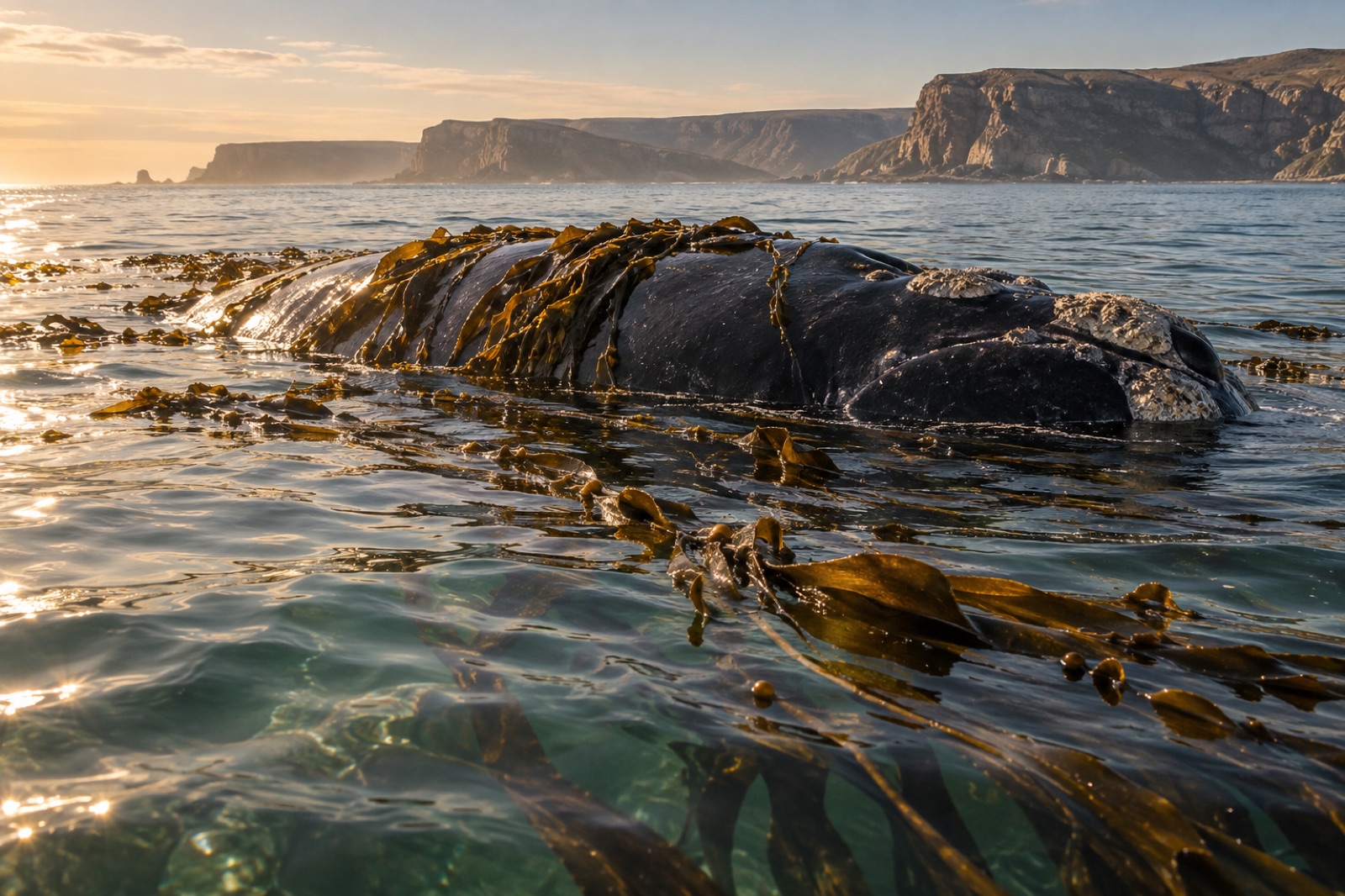
Of all the world's large whales, the southern right whale (Eubalaena australis) may be the only one with a documented, repeatable and frankly delightful habit: picking up kelp. Off the coast of Patagonia and elsewhere in the Southern Hemisphere, researchers and whale-watchers have filmed southern rights deliberately swimming into rafts of floating kelp, draping fronds over their heads and backs, and holding them there — a behaviour scientists call "kelping." This profile covers how to know the species, how it nearly vanished, how it recovered, and what the kelp interplay might mean.
Quick facts
|
|
| Scientific name |
Eubalaena australis |
| Family |
Balaenidae — the right and bowhead whales |
| Length |
Adults ~13–16 m; females larger than males |
| Weight |
Commonly 40–70 tonnes; rotund build |
| Field marks |
No dorsal fin; V-shaped blow; white callosities on the head; broad, smooth black back |
| Range |
Circumpolar Southern Hemisphere, roughly 20–55°S — calving coasts in Argentina, South Africa, southern Australia, New Zealand's subantarctic and southern South America |
| Diet |
Copepods and krill, skim-fed at the surface and depth |
| Status |
Recovering strongly on many calving grounds after commercial whaling; some remnant stocks (e.g. Chile–Peru) remain critically small |
Identification: the whale with the raised hand
Southern right whales are among the easiest great whales to identify at a distance. They carry no dorsal fin, show a broad, arching back, and blow a distinctive wide V of vapour straight up from two well-separated blowholes. Up close, the giveaway is the head: roughly a quarter of the animal's length, with a strongly arched lower jaw and a pattern of pale, wart-like growths called callosities — roughened patches of skin colonised by small crustaceans. The pattern of callosities is unique to each whale and largely stable through life, which makes the species a gift to population science: researchers identify individuals from photographs, year after year, without touching a single animal.
On calm days they are famously slow and buoyant — right whales were named, grimly, because whalers considered them the "right" whales to hunt: slow swimmers that floated when killed. Their flippers are broad and paddle-shaped, their tails wide and often lifted clear of the water in a behaviour called "sailing," where the whale holds its tail up and lets the wind push it along. Whether that is play, travel or both is still debated — a species that plays with kelp is a species that invites these questions.
Range and habitat: a whale of kelp latitudes
The southern right whale's map is the Southern Hemisphere's cool-temperate ring — which also happens to be the map of the world's largest kelp forests. Calving and nursery grounds gather in sheltered bays along the Argentine Patagonian coast off the edge of the Atlantic's bull kelp belt, along South Africa's coast near the Cape Peninsula's kelp forests and eastward, along southern Australia's great kelp fringe including the region described in our Head of Bight guide, and around New Zealand's subantarctic islands — the same storm-washed kelp wilderness covered in our subantarctic islands guide.
Between breeding seasons the whales disperse widely into productive feeding waters — the Southern Ocean's krill-rich zones, the Patagonian shelf, the upwelling seams off South America described in our explainer on upwelling. This places the species, for much of its year, in exactly the cold, nutrient-rich water that grows kelp. When a southern right whale moves into a coastal nursery bay each winter, it is very often moving into a bay fringed with forests of giant kelp (Macrocystis pyrifera), the fastest-growing organism on Earth profiled in our giant kelp article.
Kelping: what we actually know
Kelp play in southern right whales is documented, not legend. The clearest record comes from Patagonia, where researchers using aerial drones have filmed whales approaching drifting kelp rafts, positioning themselves beneath them, lifting fronds onto their heads and backs, and balancing them there — sometimes repeatedly and for extended periods. Similar observations have been reported on other calving grounds, and the behaviour has its parallel in bowheads milling among Arctic ice kelp and in grey whales rolling in kelp beds on the North American coast.
What is it for? Honest science has to say: not proven. The leading candidates are tactile stimulation — right whales' callosity-rich skin is highly innervated, and dragging buoyant fronds across it presumably feels like something; "exfoliation" or self-care, with kelp acting as a scrub on skin carrying whale lice and sloughing layers; and plain object play, a behaviour common in curious, long-lived, low-predator animals with time, brains and buoyancy to spare. These hypotheses are not mutually exclusive, and the behaviour's joyful quality is part of the data — the whales seek the kelp out and manipulate it with apparent intention.
For kelp science the anecdote carries a second meaning. Kelp rafts themselves are habitat: drifting kelp carries entire travelling communities on the open sea, distributing invertebrates and fish across ocean basins — the drift pathways our drift kelp and wrack explainer describes. A whale seeking kelp is, among other things, another large animal treating the forest as infrastructure.
Life cycle: calves in calm bays
Southern right whales time their year to the coast. In the austral winter (roughly June–October on most grounds), pregnant females come into shallow, sheltered nursery bays and deliver a single calf already the size of a delivery van. Mothers and calves remain in these calm, warmish coastal waters for weeks to months while the calf grows at extraordinary speed on milk of high fat content; the mother, fasting or feeding little, may lose a significant fraction of her body mass before returning to the feeding grounds. Nursery bays have strict etiquette — mothers choose quiet water away from surf and, increasingly, humans manage boat traffic in these zones tightly.
Males and non-breeding whales cruise the same coasts, socialising noisily. Surface-active groups — whales rolling over each other, flipper-slapping and vocalising — are among the great wildlife spectacles of the southern coasts. Right whales are strongly philopatric: females tend to return to their own natal calving bays, which is why recovery is slowest where a local population was extirpated — the whales have to re-learn the address, generation by generation.
Whaling, and one of conservation's better endings
From the early industrial era onward, right whales were targeted precisely because of the biology described above: slow, coastal, buoyant, rich in oil and baleen. Southern right whales were taken in enormous numbers across the nineteenth and early twentieth centuries; by the time international protection arrived, the species had been reduced to a few percent of its pre-whaling abundance, with some regional populations functionally erased.
The recovery since protection has been one of the better marine-conservation stories. Populations on well-monitored grounds — Argentina, South Africa, southern Australia, New Zealand's subantarctic — have grown steadily for decades, with researchers able to demonstrate the trend through callosity photo-identification run continuously over whole generations of whales. Some coasts are seeing whales return to historical wintering grounds not used in living memory. Other pieces of the puzzle lag badly: the Chile–Peru population remains tiny and listed as critically endangered within its region. Full protection from hunting, meanwhile, does not remove the modern threats — vessel strikes, fishing-gear entanglement, ocean noise, and the reorganisation of southern feeding grounds under a warming climate, the regime change our marine heatwaves explainer describes.
Watching them well
Southern right whales generate one of the southern hemisphere's great ethical wildlife-watching industries — from clifftop lookouts in South Africa to boat-based encounters in Patagonia to shore viewing in southern Australia. The rules that keep that industry honest are the rules of every sensitive marine-mammal encounter, and they apply whether you are on a boat or a board: let the whale choose the distance, never box an animal in, keep nursery water quiet, and stay with regulated operators. Our guide to wildlife ethics in the kelp lays out the general framework.
Key takeaways
- The southern right whale is a finned-back, callosity-stamped giant of the entire Southern Hemisphere's cool coasts — the same coasts as the world's largest kelp forests.
- "Kelping" — deliberately draping kelp fronds on the head and back — is a documented behaviour, best filmed off Patagonia; whether it is play, self-care or both remains genuinely open.
- Its life cycle is built around sheltered, kelp-fringed nursery bays, where calves grow on rich milk and mothers fast.
- Industrial whaling cut the species to a small fraction of its former numbers; steady recovery on protected breeding grounds is among marine conservation's clearest successes, though some regional stocks remain critically small.
- Photo-identification from head callosities lets researchers follow individual whales for decades — one of the long data records of ocean science.
- Responsible watching — regulated boats, quiet nursery bays, respect for distance — keeps this recovering giant a sight that stays.
FAQ
Why do southern right whales play with kelp?
That is still an open scientific question. Filmed behaviour on the Patagonian calving grounds shows whales seeking out floating kelp, lifting it onto their heads and backs and holding it there deliberately. Leading hypotheses are tactile stimulation, skin self-care (the fronds may act as a scrub), and object play — and all three may be true at once.
How can you tell a southern right whale from other whales?
Look for no dorsal fin, a broad smooth back, a V-shaped blow and — up close — the white, wart-like callosities on the head. Each whale's callosity pattern is unique and is how researchers identify individuals.
Where is the best place to see a southern right whale?
On the species' winter nursery grounds in Argentina's Patagonian bays, along South Africa's southern Cape coast (famously from shore at Hermanus and De Hoop), on southern Australia's coasts and around New Zealand's subantarctic islands — typically June to October depending on the ground.
How endangered are southern right whales today?
The species overall is recovering on its main monitored breeding grounds after nineteenth- and twentieth-century hunting slashed its numbers, and is not currently considered at the brink globally. But recovery is uneven: the Chile–Peru stock remains critically small, and modern threats are ship strikes, entanglement, noise and a changing Southern Ocean.
Do right whales eat kelp?
No — they are filter feeders on zooplankton, mainly copepods and krill. Their relationship to kelp is not dietary; it is behavioural, and it is one of the more charming pieces of evidence that large animals treat kelp forests as habitat worth interacting with.