Encyclopedia9 min read
Golden Kelp (Ecklonia radiata): Species Profile
Golden kelp forms the backbone of Australia's Great Southern Reef. Learn to identify Ecklonia radiata and why this habitat-maker is on the move as oceans warm.
Dr. Mara Ellison ·
Kekeno — the New Zealand fur seal — was hunted nearly to extinction by the early 1800s, then recovered under protection. Ecology, biology and where to see them.
Despite the name, the New Zealand fur seal is not a "true" seal at all — it is a southern sea lion, an otariid, just wearing the fur-seal brand that 19th-century skin traders gave the whole lineage. Arctocephalus forsteri, known in te reo Māori as kekeno, is the common pinniped of New Zealand's rocky coasts and an increasingly regular presence on the south and west shores of Australia. It is also one of the Southern Hemisphere's most complete conservation arcs: a species reduced to a remnant by commercial sealing, protected in the 20th century, and now reoccupying coastlines it had not bred on for 200 years. Wherever golden kelp hugs a New Zealand reef, kekeno are usually somewhere in the frame.
| Scientific name | Arctocephalus forsteri |
| Group | Mammalia; Otariidae — southern fur seals (eared seals) |
| Length / weight | Males to ~2 m and 120–160 kg; females ~1.2–1.5 m and 30–50 kg |
| Coat | Dense double-layered fur — the feature that drove the sealing industry; dark grey-brown, paler on the chest |
| Range | New Zealand (both main islands and offshore islands) and southern Australia (South Australia, Western Australia, Tasmania) |
| Breeding | Southern summer; pups born November–January on rocky shore rookeries |
| Diet | Lanternfish, arrow squid, octopus, jack mackerel, hoki; deep-diving night feeder |
| Lifespan | Females commonly 20+ years; males shorter-lived |
Southern fur seals confirm the family placement every time you watch one move. Like the California sea lion, kekeno have small external ear flaps, long foreflippers for underwater flight, and hind flippers that rotate under the body — which is why a fur seal can clamber impressively up a rock shelf, sit upright, and look back at you with calm contempt. The "fur" part is real but structural: where a sea lion is mostly sleek, a fur seal carries a dense underfur beneath the guard hairs, the warm double coat of an animal evolved for cold southern water.
Underwater, kekeno are nocturnal specialists. Satellite and depth-recorder work shows females on foraging trips routinely diving 100–200 metres, often deeper at night, following the daily vertical migration of lanternfish and squid. Pups are weaned at around ten months — long enough that a mother may still be nursing last year's pup while carrying the next foetus, a bet hedged against the variability of the subtropical and sub-Antarctic fronts where they hunt.
Kekeno breed on exposed rocky shores — the same rough, cool, kelp-fringed coasts that run from Fiordland around the South Island's east coast to Kaikōura, Wellington, and the islands of the Hauraki Gulf. Colonies are male-territorial in summer: big bulls hold patches of rock through the breeding season, fasting and defending; females come ashore to pup in early summer and then begin the long rhythm of foraging trips interleaved with nursing.
Australia's populations — sometimes treated as a regional expression of the same species — breed on islands off South Australia and Western Australia, and haul-outs are regular in Tasmania. The species' broad pattern is classic southern-temperate: cool water, storm-headed coast, kelp forest proximate, and a food web driven by the boundary currents we profile in our atlas of the Great Southern Reef, of which New Zealand's southern coastline is a close ecological cousin.
Of all kekeno watching sites, the Kaikōura peninsula is justly famous: a deep, food-rich canyon close offshore, a thriving colony ashore, and — most remarkably — a short stream walk from the road where, in winter, weaned seal pups travel hundreds of metres upstream to play beneath a forest waterfall. It is one of the most accessible wild seal encounters in the world, and a good object lesson: the pups' inland wanderings are normal exploration by young animals, not stranding.
The commercial sealing of the late 18th and early 19th centuries hit New Zealand's fur seals with brutal efficiency. Ships worked island after island; within a few decades a population that probably numbered in the high hundreds of thousands or more was reduced to a remnant. The industry moved on to other coasts, and kekeno survived in scattered refuges — mainly steep, unapproachable southwestern shores.
Legal protection, finally firm in the 20th century, let the species rebuild. From mid-century onward, surveys recorded new colonies founding and expanding, including on coasts unoccupied since sealing. Estimated numbers climbed to a substantial fraction of historical abundance — estimates vary, but a population sense of around 200,000 animals in New Zealand waters is commonly cited in modern assessments — and range expansion continues, with kekeno now hauling out on urban-adjacent coasts where a 1970s beachgoer would never have seen one. It is one of those recoveries that demonstrates a principle we lean on at Tidewright: intact marine mammals rebound when the take stops and the habitat is even partly intact.
Recovery, though, is not frictionless:
Kekeno are a useful counterpoint to the otter story. Where sea otters engineer kelp forests from the top by eating urchins, fur seals affect kelp systems mostly as mobile predators of mid-water fish and squid — and as reminders that a kelp forest is not a garden-bed ecosystem but an ocean neighborhood with many tenants. A restored kelp stand at a New Zealand site is not "finished" when the canopy closes; it matures as predators like kekeno, reef fish like those in our pāua and groper profiles, and the invertebrate community reassemble around it.
The best rule is the simple one: stay off the line between a seal and the sea. Seals resting on the beach are not stranded; pups dozing alone usually have a foraging mother offshore; and a seal's bark-bellow from three metres away is a warning, not a conversation opener. Binoculars are your zoom lens. Dogs must be leashed near colonies, and if you find a seal somewhere clearly wrong — a state highway, say — call the Department of Conservation's hotline, not a selfie stick.
Kekeno is the Māori name for the New Zealand fur seal, now widely used in New Zealand science, conservation and media. Māori communities held customary relationships with kekeno long before European sealing, and today iwi are formally involved in marine management decisions affecting the species.
Taxonomically it sits in the eared-seal family, Otariidae — with the sea lions — but English tradition calls most small otariids "fur seals". So it is a fur seal that behaves, anatomically, like a small sea lion.
Guidelines from the Department of Conservation advise staying at least 20 metres away where possible, never blocking a seal's path to the water, and keeping dogs leashed. Seals that feel cornered can move surprisingly fast and have a serious bite; respect the distance and they will usually ignore you.
No — commercial sealing ended long ago and the species is protected in both New Zealand and Australia. The main human-caused mortalities today are fisheries bycatch and boat strike, not deliberate take.
Kaikōura on the South Island's east coast is the famous site, with colonies viewing points minutes from town. Elsewhere: the Otago Peninsula, Wellington's south coast, Cape Palliser, and Abel Tasman — and, for Australian watchers, Kangaroo Island's spectacular colonies shared with Australian sea lions.
Golden kelp forms the backbone of Australia's Great Southern Reef. Learn to identify Ecklonia radiata and why this habitat-maker is on the move as oceans warm.
Dr. Mara Ellison ·
Pāua, New Zealand's iridescent abalone, is a taonga species, a prized kaimoana and a carefully managed fishery. Its biology and cultural story.
Dr. Theo Nakamura ·
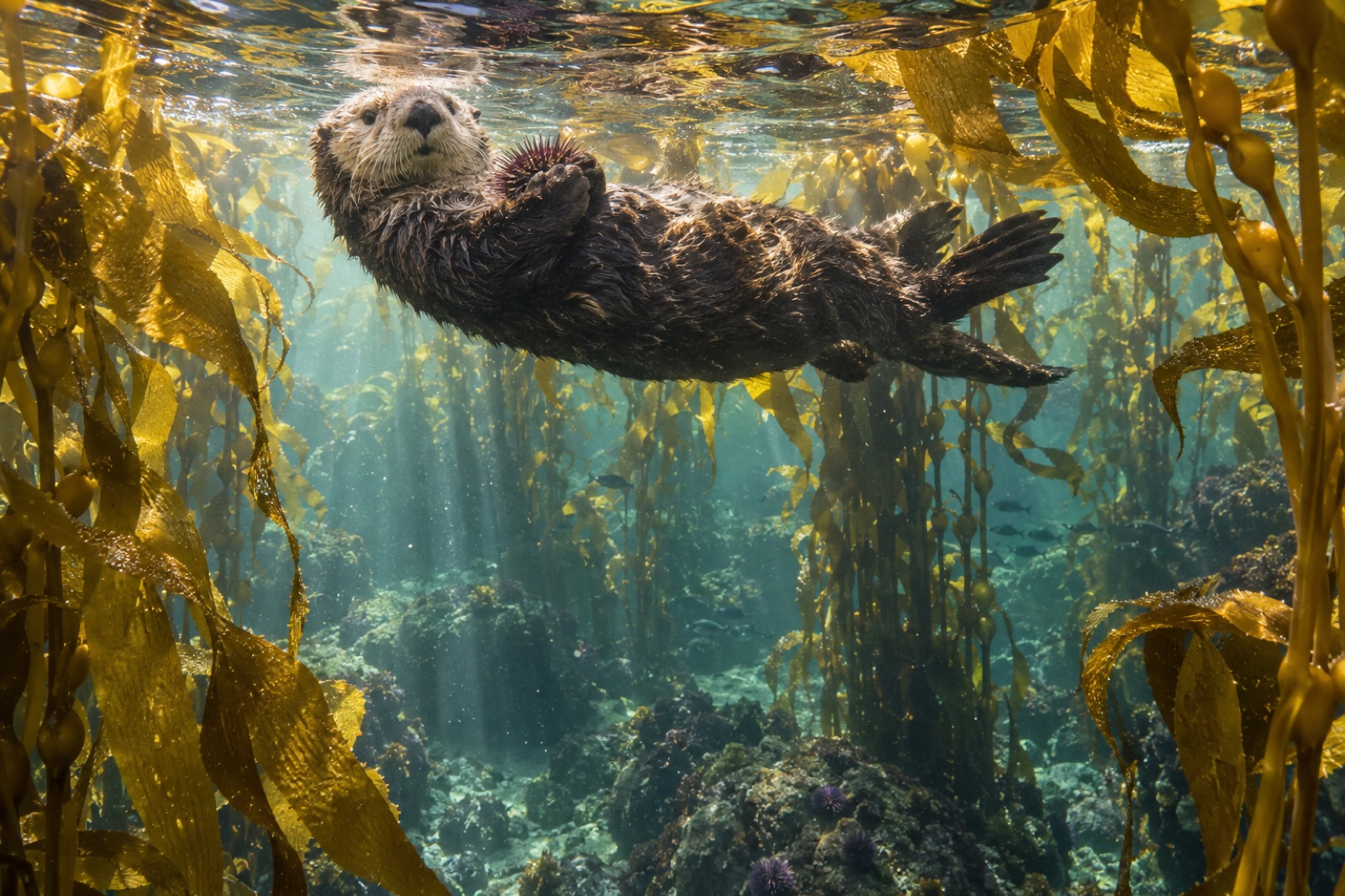
Sea otters eat a quarter of their body weight a day — much of it sea urchins. How this small predator became the kelp forest's most famous keystone species.
Dr. Mara Ellison ·