Encyclopedia8 min read
Ochre Sea Star (Pisaster ochraceus): The Original Keystone Species
Meet the ochre sea star, the purple tidepool predator whose removal in a famous 1960s experiment coined the keystone species concept.
Dr. Theo Nakamura ·
Evasterias troschelii, the mottled or false ochre star — the soft-bodied, deep-dwelling predator that picks off limpets, whelks and baby sea stars.
Every kelp coast has a sea star that lives in the gap between the famous ones — too soft-bodied for the wave-swept rocks where ochre stars hold court, too small and drab to make posters like the sunflower star. On the northeast Pacific coast that is the mottled star (Evasterias troschelii), also sold to generations of tidepoolers as the false ochre star. It is a flexible, many-mooded predator of the low intertidal and subtidal reef edge, a specialist in snails and limpets, and — less famously — a predator of other sea stars' young. If you dive or shore-walk kelp country from the Aleutians to northern California, this is the star you are most likely to misidentify, and among the most instructive to watch. Here is how to know it, and what it does all day.
| Scientific name | Evasterias troschelii (family Asteriidae) |
| Common names | Mottled star, false ochre star, true star (Canada) |
| Range | Aleutian Islands and Alaska south to northern California |
| Habitat | Low intertidal to subtidal, to ~70 m; protected rocks, kelp beds, pilings — avoids violent surf |
| Size | Commonly 12–20 cm across; big arms-span records near 30 cm |
| Colour | Enormously variable — grey, buff, rust, orange, violet, often mottled or blotched |
| Diet | Limpets, snails (including whelks), barnacles, small mussels and clams; also juvenile sea stars, sea urchin young, other asteroids |
The common name says it plainly enough: generations of shore-watchers have logged this animal as an ochre star. Both are five-armed asteriids of kelp-country rock, and at a metre's distance, in poor light, the confusion is honest. Up close, they stop looking alike.
The ochre star's skin feels like a coarse file, studded with dense, blunt, chalky spines in radiating fans — a star built as armour. The mottled star feels soft and slightly slippery, almost suede-wet, with spines that are longer, sparser and arranged primarily in one lengthwise row down the back of each arm rather than in starburst fans. The disc is smaller relative to the arms, which are more tapered and flexible. Pick an ochre star up (gently, briefly, attended by water) and it holds its shape; the mottled star drapes — a body plan that reads "shelter-dweller," not "surf-fighter."
Found in the open mid-intertidal on a surf headland? Ochre. Under a rock, in a shaded surge gulley, on a piling below the tide line, or down in the kelp shallows? Strong presumption of mottled star. It shuns both heavy surf and long exposure; its world is the low and the sheltered, including the subtidal reef fringe where it reaches its greatest numbers. In British Columbia and Alaska it is often described by divers as the commonest star on protected rocky bottom.
Where the ochre star offers a tidy purple-or-orange binary, the mottled star nearly refuses to be named: greys and buffs, muted browns, brick-red arms on a grey disc, violet patches, cream mottling. The pattern is literally its name. Learn structure, not paint: velvety feel, tapered arms, single spine rows, low and sheltered habitat — that cluster of characters is the animal.
An ochre star is, above all, a mussel specialist. The mottled star is the boreal reef's opportunist, and its diet reads like a roll-call of mid-sized invertebrates:
It also scavenges readily. In food-web terms this breadth makes Evasterias a mesopredator: too low-slung and ecologically diffuse to restructure a community the way Pisaster ochraceus does, but a constant drag on the recruitment of snails, limpets, bivalves and echinoderms alike. Where ochre stars enforce one great boundary, mottled stars apply a hundred small taxes.
The hunting style matches the build. Unable to clamp against surf, it instead slides into position with a stealth the rigid stars lack, applies the same water-vascular tube feet, and evests its stomach through the usual gap. Divers report it wrapped limpet-like around a whelk for hours, or folded over a barnacle patch in slow sweep-netting arcs. Everything about Evasterias is lower and slower than Pisaster — lower on the shore, lower in profile, slower in movement — and patient.
The mottled star's flexible life has hard edges above. The morning sun star, the Pacific's specialist hunter of asteroids, pursues it; the great gumboot chiton has no quarrel with it, but the glaucous-winged gulls and sea otters do, and their toll on exposed animals is one reason this star hugs shelter. Its defences are the asteroid standbys — a tough-skinned, hard-to-swallow body; arms autotomised under attack; slow regeneration — plus a habit the ochre star has less need of: knowing when to be nowhere in sight.
When sea star wasting syndrome swept the coast in 2013–2014, the mottled star was among the species recorded melting on northern reefs, and observers who knew where to look watched long-familiar aggregations vanish from pilings and kelp-edge boulders. The pattern that emerged echoed its ecology: sheltered, deeper, cooler water buffered the losses compared with warm shallow enclosed sites, and recovery at deeper survey stations outran recovery on exposed shore. A decade on, the species is broadly present again through the north of its range, with the same asterisk hanging over every Pacific star — each new marine heatwave is a test it must pass again. For monitors reading reefs for health, Evasterias is part of the indicator assemblage: not a headline species, but one whose rebound tracks the subtidal community's.
Look for the drape first, the spine row second, the mottled uncertainty of colour last — and you will stop writing "ochre?" in your notebook where the animal has been insisting, all along, on being itself.
Some predators draw the great lines of the shore. The mottled star does the fine print — and a reef is regulated by its fine print as surely as by its boldface.
Yes — "false ochre star" is the older common name for Evasterias troschelii, earned by its resemblance to the true ochre star (Pisaster ochraceus). Both names refer to the same single species.
Use texture and place. Ochre stars have dense, chalky, starburst-arranged spines, a rigid body, and dominate open surf-swept rock. Mottled stars feel soft and slippery, have long tapered arms with lengthwise spine rows, and stick to sheltered, shaded or subtidal habitat.
Yes. They take the juveniles of larger asteroids, including young ochre stars and sunflower stars, and will attack smaller asteroids outright. Predation between sea-star species is a normal feature of boreal reef food webs.
It was — heavily in warm, shallow, enclosed waters from 2013 onward. Losses were lighter at depth and on exposed, cooler coasts, and the species has rebounded through much of its northern range, though the disease persists and flares in warm years.
From the low intertidal down to roughly 70 metres, with their greatest densities in the shallow subtidal kelp belt and on sheltered boulder bottoms.
Meet the ochre sea star, the purple tidepool predator whose removal in a famous 1960s experiment coined the keystone species concept.
Dr. Theo Nakamura ·
Rainbow star (Orthasterias koehleri): a red-and-orange sea star of Pacific kelp reefs that eats snails, clams and even small sea urchins.
Dr. Mara Ellison ·
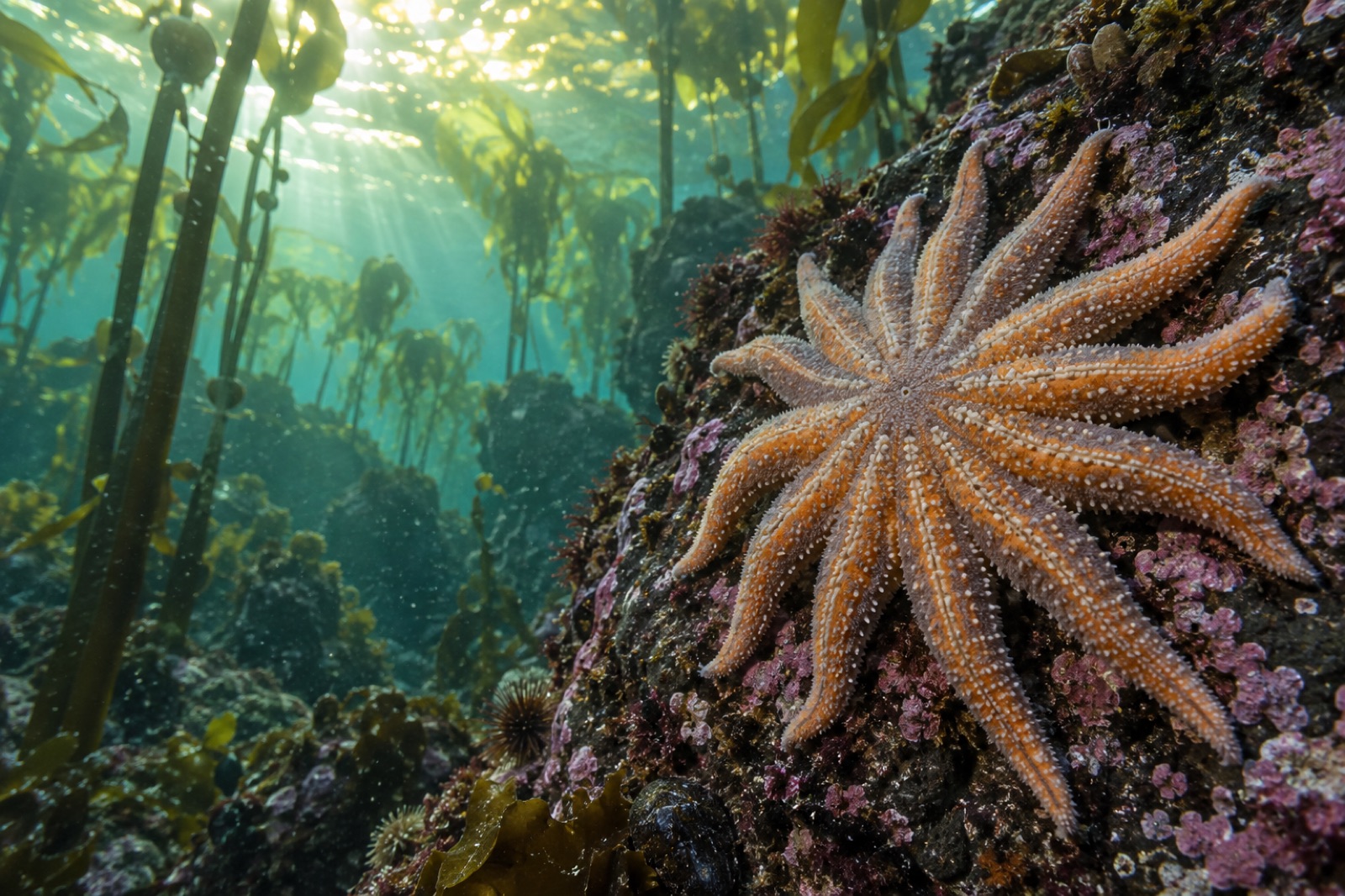
With up to sixteen arms and a taste for other sea stars, the morning sun star is the kelp forest's fastest hunter — and a weathervane of sea star wasting.
Dr. Mara Ellison ·