Most sea stars are content with a life of grazing and sipping — scraping algae, fossicking through sediment, digesting shellfish with a stomach everted into the gap. The morning sun star (Solaster dawsoni) has taken a stranger path. It hunts. Specifically, it hunts other sea stars, chasing them across the reef with a speed no sea star should credibly possess, faster even than the predatory flatworm it resembles in silhouette. On the cold, kelp-fringed coasts of the North Pacific, the morning sun star is a specialist killer of asteroids — and in an era when sea star wasting has already reshaped the kelp forest's predator line-up, it is also a bellwether of the health of the whole guild.
Fast facts
|
|
| Scientific name |
Solaster dawsoni |
| Group |
Marine echinoderm, class Asteroidea, family Solasteridae |
| Arms |
Usually 11 to 15; occasionally 8 to 16 |
| Diameter |
Commonly 15–25 cm; to about 40 cm across |
| Depth range |
Intertidal to roughly 420 m |
| Range |
Central California to Alaska, and across to the western Pacific |
| Diet |
Almost exclusively other sea stars; rarely brittle stars and sea cucumbers |
| Lifespan |
Unknown, likely decades |
Identification: the many-armed flash
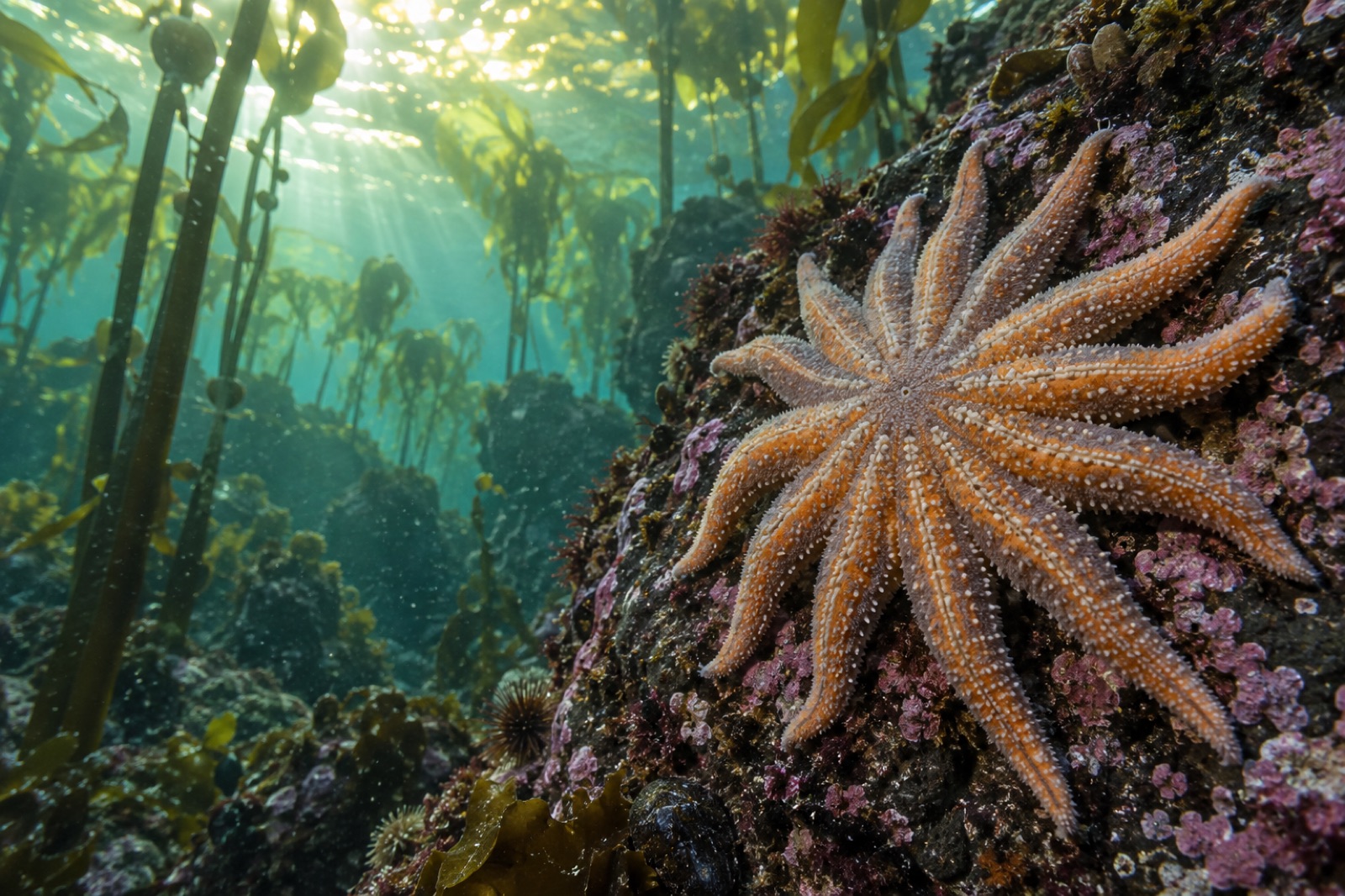
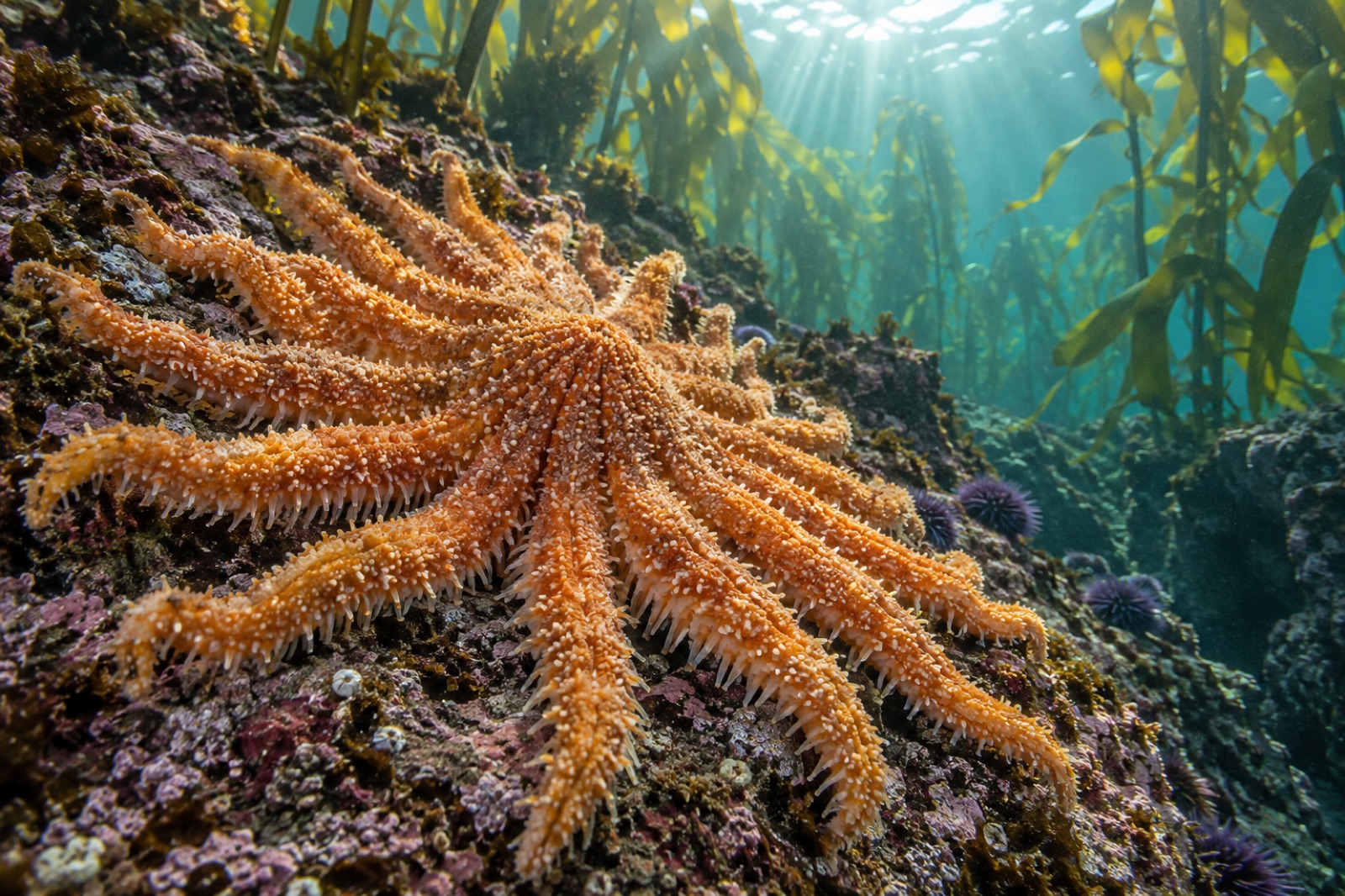
Sun stars are the sea stars of radiance — multi-armed, sun-like, with a small central disc and a skirt of tapering rays. Solaster dawsoni differs from its closest local relatives in both styling and size. Its body carries a characteristic two-tone pattern: a background of grey, orange or reddish-brown marked by radiating pale stripes down each arm, with the striped pattern often breaking into an irregular mosaic on the central disc. The arms themselves end cleanly, the whole animal slightly stiff and flattened against the substrate.
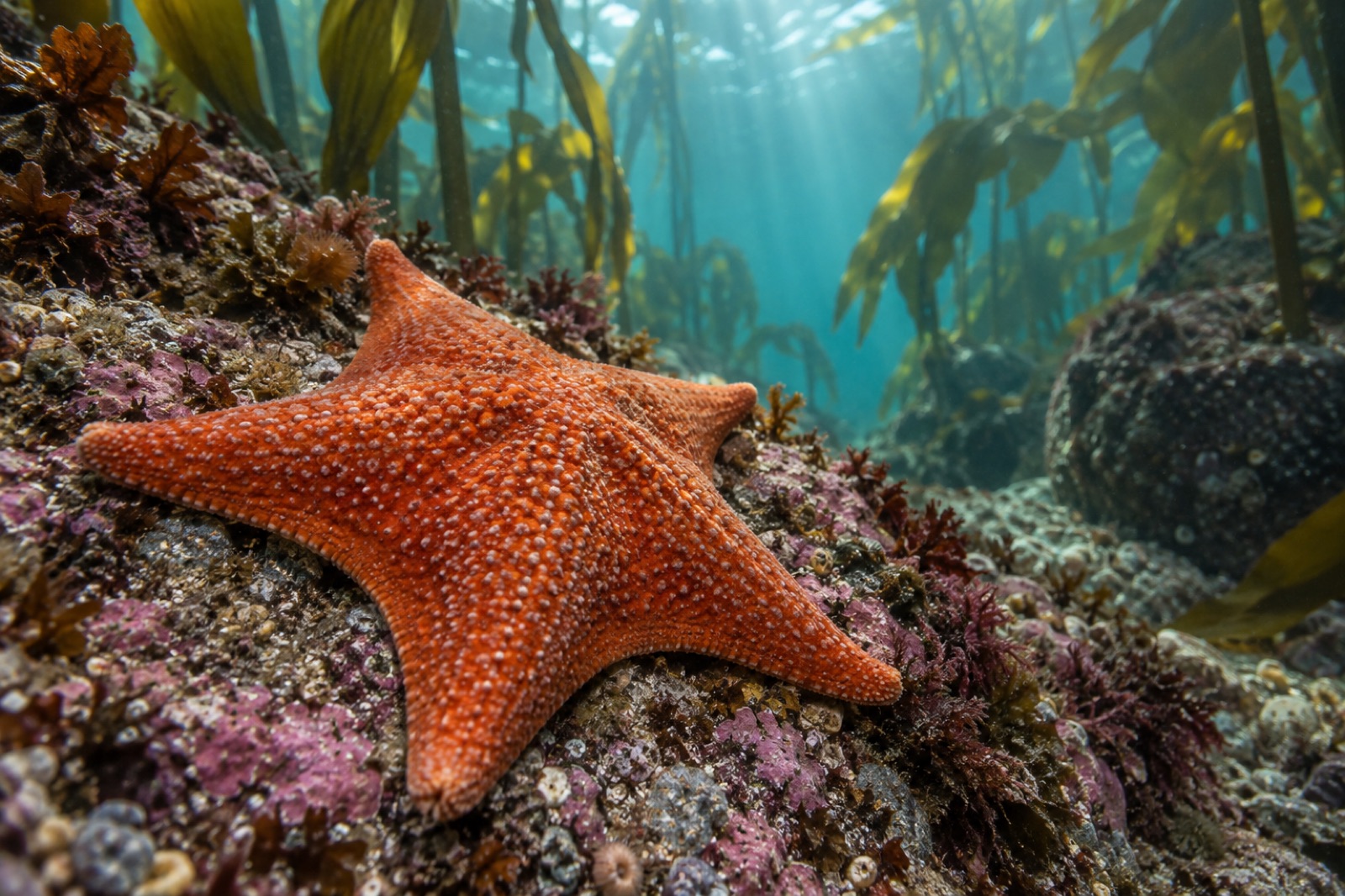
The count of the arms is a plain field mark. Where the sunflower star could carry twenty-plus arms and weigh kilograms, S. dawsoni stabilises around eleven to fifteen, rarely more. It is bigger and more solid than the soft little leather star, more patterned than the subtle blood star, and — once you know it is a predator — instantly legible as one: the way it holds its arms slightly lifted off the rock, the way its tube feet ripple forward.
A specialist among specialists
Within the kelp forest, almost every sea star occupies a specific prey niche. The ochre sea star, the founding example of the keystone-species idea, centres its life on mussels. The bat star is an omnivore of detritus and film. The leather star eats sea slugs and anemones. Solaster dawsoni eats sea stars.
Its documented prey list includes the sunflower star, the ochre star, the bat star, the giant spined star and several smaller asteroids — a startling breadth given that each of those is itself a substantial animal. When the morning sun star closes on an ochre star, the prey does not sit still: it flees, and the fleeing is not the slow drift you might imagine. Sea stars run from Solaster dawsoni at speeds of up to thirty centimetres per minute, arms whipping, tube feet cycling in a blur of coordinated motion unique in the starfish world. When the prey is a sunflower star, it may try to discard an arm into the hunter's grip and limp away one limb poorer.
Cannibalism is documented too: a large morning sun star may take a smaller one.
The chase, in slow motion
The morning sun star hunts by chemistry. Waterborne odors of a recently fed sea star — the metabolic signature of a congener that has just eaten, flowing through the reef's boundary layer — touch its tube feet and its arm tips through chemoreceptor tissue. The hunter turns into the current and walks.
Slow-motion is the frame: a chase between Solaster dawsoni and an ochre star may play out over twenty minutes and ten metres. Once contact is made, the hunter wraps its arms around the victim's central disc and everts its stomach over the join. Digestion begins externally — this is the standard asteroid feeding move, applied here to another asteroid. The prey struggles, shedding mucus, sometimes autotomising the caught arm. The morning sun star holds, and slowly, over hours, eats the top of a catch it cannot swallow whole.
The remarkable thing, when you watch the interaction up close, is the total mismatch of the predator's shape to its prey: this is a flat, many-armed disc eating a five-armed heel. It works because chemistry can outrun anatomy, and because on a reef, every animal that thinks about its next meal is a hunter.
Wasting away: the Solaster problem
Sea star wasting disease swept the coasts of western North America between 2013 and 2016, a reign of mortality that began with lesions, progressed to arm autotomy and ended, in the worst cases, with individuals melting into organic soup in a matter of days. We tell that story elsewhere in our sea star wasting explainer; what matters here is which species survived.
The sunflower star, Pycnopodia helianthoides, collapsed almost completely across its entire former range south of Alaska. That matters to Solaster dawsoni enormously, because the sunflower star was its preferred prey — the biggest, most nutritious catch a morning sun star could make. Monitoring in the Salish Sea and southern British Columbia during and after the wasting event documented declines in morning sun star numbers in the aftermath: not from mass mortality, but from starvation, as the biggest food source on the reef evaporated beneath them.
There is an unknotted lesson inside the data. Solaster dawsoni was not, apparently, a major direct victim of the wasting pathogen itself. It lost instead to the second-order consequence of losing its prey. Predator-prey chains are fragile in both directions; when a forest's apex hunter vanishes, the specialist that fed on it starves. And the loss feeds back into the kelp forest. We discuss the keystone consequences at length in our keystone species explainer; S. dawsoni is part of the same geometric lattice that links stars, urchins, kelp and otters on this coast.
Where to see one
Live morning sun stars are a treat, and spotting one takes patience. They favour clean, moderately exposed rock in the low intertidal to mid-subtidal; in Puget Sound and the San Juan Islands they can be found on shallow walls and rock faces accessible to recreational divers, especially in the odd, broad-shouldered reefs of the inland sea. On the outer coast, look to the reef edges around full and new moons, when larger subtidal animals push into shallower water. In Alaska they range deeper and get bigger; western Pacific individuals in Alaska's Aleutians are effectively a different animal size-class altogether.
The rule for all sea stars at the moment is look, photograph, and don't handle. Even absent the wasting pathogen, handling is hard on these animals; with the disease still present in populations and poorly understood, unnecessary contact is best avoided. If you find what you think is a morning sun star, record the arm count, the diameter and the substrate, and send the observation to a regional monitoring program — the same distributed database of sea star condition that has allowed the wasting epidemic to be tracked at continental scale. For a sense of that seascape, our profile of the bat star, one of S. dawsoni's more common prey, describes the calmer end of the sea-star spectrum.
Key takeaways
- The morning sun star (Solaster dawsoni) is a North Pacific sea star specialised to hunt and eat other sea stars, with usually eleven to fifteen arms and a diameter up to about 40 cm.
- Its prey includes sunflower stars, ochre stars, bat stars and other asteroids; the chase occurs by chemical detection, at speeds up to roughly 30 cm/min.
- Sea star wasting disease collapsed its preferred prey — the sunflower star — through the mid-2010s, causing starvation-driven declines in some S. dawsoni populations.
- The species illustrates how predator-prey webs chain together: the loss of a keystone consumer cascades to the specialists that depended on it.
- Handy field marks are the striped, multi-armed sun shape and the almost predatory posture of slightly lifted arms. Record, don't handle.
FAQ
How many arms does a morning sun star have?
Most carry eleven to fifteen, but a range of eight to sixteen is documented. Unlike many multi-armed sea stars, the arm count varies by individual and geography rather than life stage.
How fast does a morning sun star move?
Very fast for a sea star: up to about 30 cm per minute when actively hunting. That speed is what makes observations of it chasing prey so striking — nothing else on the reef moves quite like it.
Does the morning sun star have predators?
Yes. Large sunflower stars will take a morning sun star when food is scarce, gulls pick at exposed animals at low tide, and the giant Pacific octopus readily includes sea stars in its diet. Perhaps its most common predator, though, is another morning sun star: cannibalism is well documented.
Is the morning sun star affected by sea star wasting?
It suffered some direct mortality during the 2013–2016 wasting event but was less catastrophically hit than the sunflower star. Its larger problem has been secondary: the collapse of its preferred prey and the knock-on effects across the sea star guild.
Where is the best place to look for one?
Shallow, clean-water rocky reefs in the inland sea — Puget Sound, the San Juan Islands and Vancouver Island's west coast — are unusually good habitat. On the outer coast, look along canyon walls and current-swept rock at depths between five and thirty metres.