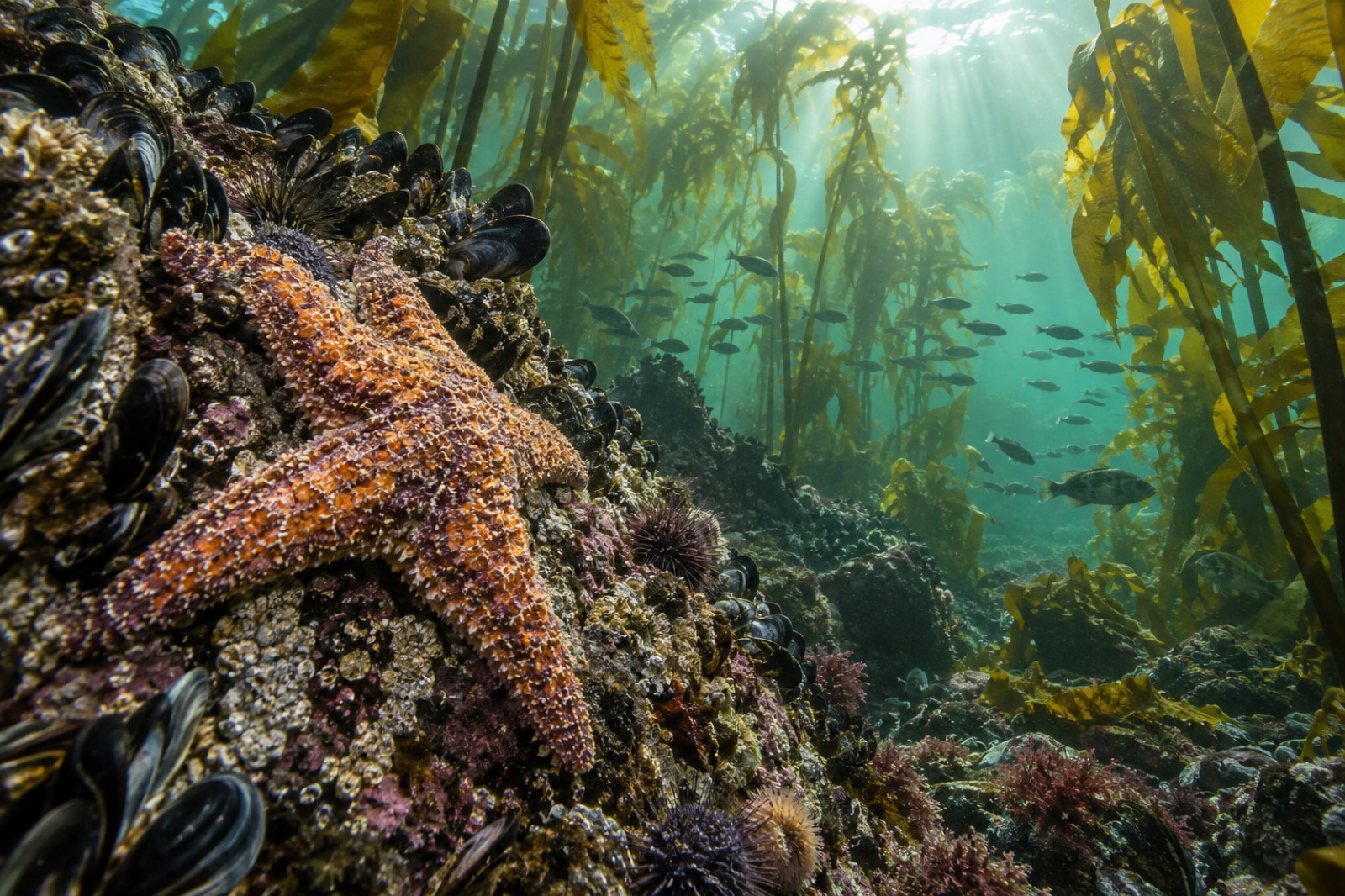
In the mid-1960s, ecologist Robert Paine began prying purple-orange starfish off the
rocks of Mukkaw Bay in Washington State and throwing them into the sea. It looked like
vandalism. It became one of the most important experiments in the history of ecology.
Within a year of removing the starfish, the shore's rich community of barnacles, limpets
and chitons had collapsed into a near-monoculture of mussels. Paine had discovered that
one species — present in modest numbers — was holding the whole rocky shore together.
In 1969 he gave such species their name: keystone species, after the central stone
that locks an arch in place. Remove it, and the architecture falls.
This article explains what makes a species a keystone, how the idea has grown (and been
abused), and why kelp forests supply some of its most dramatic confirmations — and one
of its most hard-won modern lessons.
The starfish experiment, and what it actually showed
Paine's study animal was the ochre sea star (Pisaster ochraceus),
a predator of mussels, barnacles and limpets on wave-beaten Pacific shores. His removal
plots showed something counterintuitive: predation increased diversity. Left alone,
the dominant competitor — the California mussel — simply smothered the rock. By eating
mussels, the starfish kept space open for dozens of weaker competitors.
Two principles emerged that still define the concept:
- Disproportion. A keystone's effect is far larger than its abundance or biomass
would predict. Starfish were a minor share of the shore's living mass; they were
the rule-maker nonetheless.
- Community dependence. Remove the keystone and the community reorganises — often
into something simpler, dominated by one or two winners.
Ecologists later added formal tests — comparing a species' "community importance"
against its proportional abundance — but Paine's arch metaphor remains the cleanest
statement of the idea.
The many jobs a keystone can do
The term is used most often for predators, but the underlying logic — small presence,
huge effect — applies to several ecological roles:
- Keystone predators control competitive dominants or hyper-abundant herbivores:
Paine's starfish, sea otters among urchins, wolves reshaping elk behaviour in
Yellowstone.
- Keystone mutualists prop up many partners at once: fig trees fruiting when little
else is, pollinators sustaining whole plant guilds.
- Keystone engineers create the habitat itself — a role kelp plays as a
foundation-forming ecosystem engineer.
The categories overlap; what matters is the disproportion.
Keystones of the kelp forest
Kelp forests are a working museum of keystone dynamics, because their central drama —
forest versus urchin barren — is run almost entirely by predators.
Sea otters: the classic case
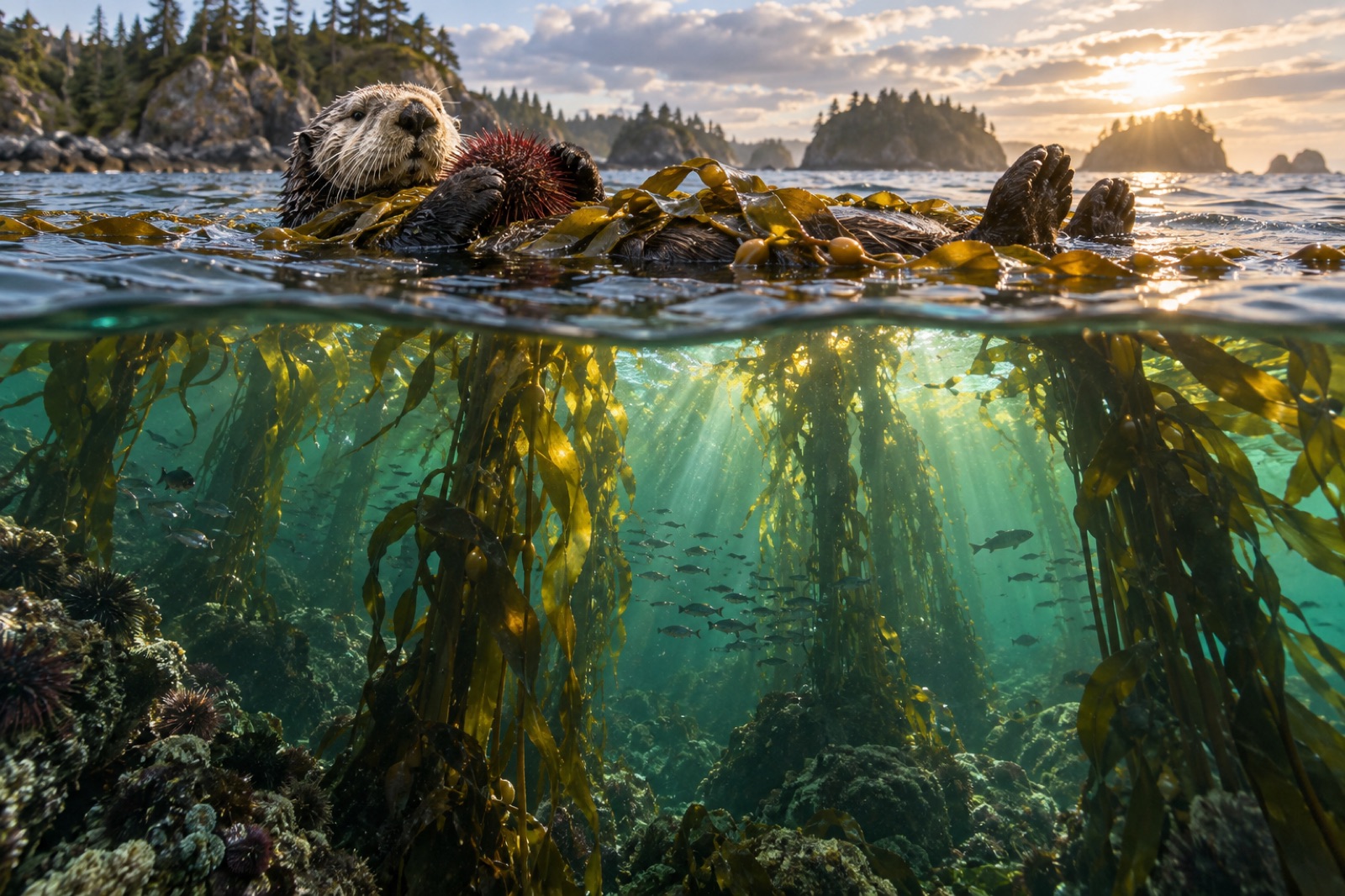
Along the North Pacific rim, the sea otter is the
textbook keystone. Otters eat urchins; urchins eat kelp. Where otters are present,
urchins stay small and shelter-bound, and forests stand. Where otters were hunted out
during the maritime fur trade, urchins multiplied and grazed forests into barrens —
the reversal documented starkly across the Aleutian Islands when otters declined again
under killer whale predation in the 1990s. Few natural experiments have demonstrated a
single species' leverage so cleanly; we trace the full chain in
Trophic Cascades in Kelp Forests.
Sunflower stars: the lesson learned the hard way
South of the otter's range, the sunflower sea star
was quietly doing similar work, preying on purple urchins. Then, beginning in 2013,
sea star wasting disease killed the great majority
of sunflower stars from Mexico to Alaska. Northern California watched the consequence in
near-real time: within a few years, purple urchin populations exploded and more than 90
per cent of the region's bull kelp canopy disappeared. Nobody had set sunflower stars
aside as "the" keystone of that system; the disease ran the removal experiment for us.
Sheephead, lobsters and cod: distributed keystones
In southern California, California sheephead
and spiny lobsters eat urchins; in the Gulf of Maine, cod once did. These cases show a
subtlety: keystoneness can be shared and conditional. Several predators may swap
the role depending on their own numbers — which is one reason
urchin barrens can flip a coast when
fishing removes the last functional predator, even if others remain on paper.
How scientists actually test for keystoneness
Calling a species a keystone is a hypothesis, and good ecology treats it as one:
- Removal and exclusion experiments remain the gold standard — Paine's method,
repeated with fences, cages and careful ethics.
- Natural experiments — a local extinction, a recovery, a reintroduction — carry
enormous weight when monitored well. The sea otter's history is essentially a
century-long distributed experiment.
- Comparative and modelling approaches, including food-web interaction-strength
models, can flag candidate keystones for testing, useful where removals are
impractical.
The hardest cases are systems where the keystone is gone before science arrives.
Historical ecology — fisher cannery records, Indigenous knowledge, sea-midden
archaeology — sometimes supplies the baseline that no quadrat can.
Where the concept goes wrong
The arch metaphor is so satisfying that "keystone" gets glued to anything
charismatic: whales, sharks, mangroves, parrots. Two honest cautions:
Keystoneness is contextual, not a species identity card. The same species can be
pivotal on one coast and ordinary on another, depending on competitors, currents and
who else is eating urchins. Sea stars keep mussels off Washington's exposed shores;
inside the calm Salish Sea the drama plays differently.
A forest made of keystones tells you nothing. Conservation exists to set
priorities, and a term applied everywhere prioritises nothing. The concept earns its
keep when it identifies specific levers — places where protecting or restoring one
species returns disproportionate community function.
Why the idea matters now
Restoration economics run on leverage. Barren-to-forest recovery programs cannot
replant their way past an unsuppressed urchin army; they need predation back in the
system, whether from recovering otters and stars, managed urchin fisheries, or targeted
culls run by programs like those profiled in our
restoration field notes. Knowing which species carry keystone
weight in a given place — and which used to — is the difference between treating an
ecosystem's symptoms and resetting its structure.
Key takeaways
- A keystone species has an effect on its community far out of proportion to its
abundance; Paine's mid-1960s starfish removals at Mukkaw Bay defined the concept.
- Keystone predators raise diversity by suppressing dominant competitors or runaway
herbivores; the role can also be played by mutualists and habitat engineers.
- Kelp forests are keystone case studies: sea otters, sunflower stars, sheephead and
lobsters each control urchins that would otherwise deforest reefs.
- The 2013 wasting-disease collapse of sunflower stars functioned as an unplanned
removal experiment, followed within years by urchin blooms and massive bull kelp
loss in northern California.
- Keystoneness is context-dependent and testable; used honestly it identifies
high-leverage targets for conservation and restoration.
FAQ
Who coined the term "keystone species"?
Ecologist Robert T. Paine, in a 1969 paper that generalised what his starfish-removal
experiments on the Washington coast had shown: some species structure entire
communities despite modest numbers.
Are keystone species always predators?
No — predators are the classic case, but mutualists (like fig trees and pollinators)
and ecosystem engineers can also qualify. The test is disproportionate effect, not diet.
Is kelp itself a keystone species?
Kelp is usually described as a foundation species and ecosystem engineer: its
influence flows from abundance and structure, the mirror image of Paine's low-abundance
starfish. Both ideas describe outsized importance through different machinery.
Can a species stop being a keystone?
Yes. Add alternative predators, or change which competitor dominates, and the same
species' removal may ripple far less. Keystoneness belongs to a species in a system,
not to a genome.
What keystone losses threaten kelp forests today?
Sea star wasting disease has removed sunflower stars across much of the northeast
Pacific; sea otters remain absent from long stretches of their historic range; and
overfishing has thinned urchin-eating fish and lobsters in many regions. Each loss
loosens the predator grip that keeps kelp forests standing.