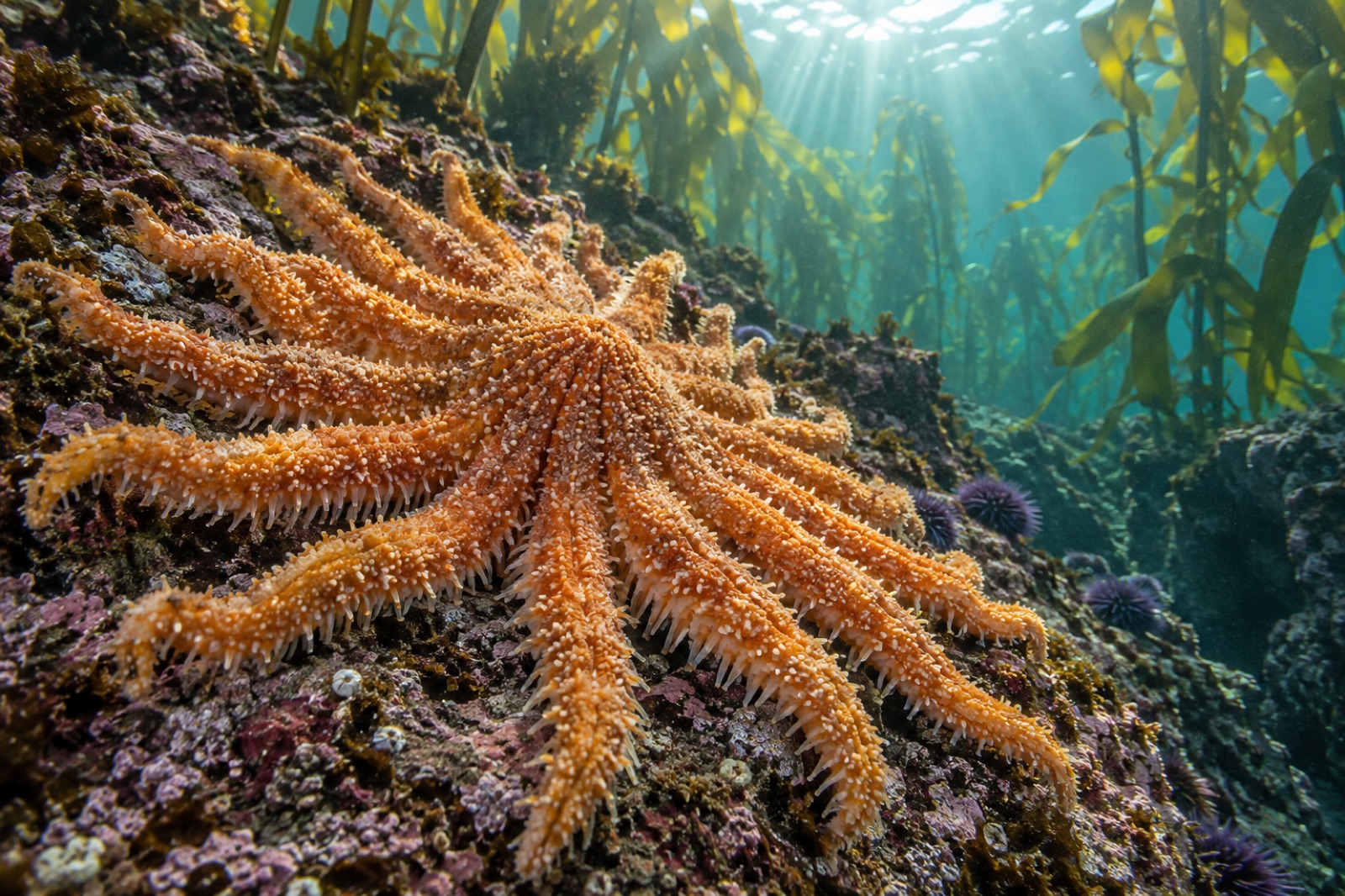
Between summer 2013 and the following few years, divers along the west coast of North America watched one of the strangest wildlife events ever documented: sea stars twisted their arms, split open and disintegrated — sometimes over the course of a single dive interval — by the billion. The epidemic, called sea star wasting syndrome, struck more than twenty species from Baja California to Alaska and hit hardest of all at the sunflower sea star, a metre-wide, twenty-armed predator that had been the leading natural control on sea urchins. Within a few years the sunflower star had suffered one of the largest known population collapses of any marine animal — and the kelp forests it once guarded began, in many places, to fall to urchin barrens. What follows is what the science actually established, what remains unsettled, and why the syndrome matters for kelp restoration now.
What sea star wasting actually looks like
"Wasting" is a descriptive name, not a diagnosis — the syndrome is defined by a sequence of lesions rather than by a confirmed single cause:
- Behavioural signs. Affected stars often become lethargic, then exhibit a grotesque pose: arms curling upward and inward, the body deflating.
- Tissue lesions. White necrotic patches appear on the skin and progress; arms begin to tear off at the central disc — the famous "autotomy" of wasting disease.
- Disintegration. Within hours to days, the body wall loses integrity, internal organs are exposed or eviscerated, and the animal essentially melts into a mat of tissue.
Speed is part of the horror: a visibly healthy sunflower star at morning survey could be fragments by afternoon in a hard-hit site, and whole populations at a reef could torch through in weeks. Surveys multiplied across the range consistently recorded population reductions on the order of tens of percent to locally near-total loss in the years after 2013, with the sunflower star among the worst hit and the ochre star — a smaller, better-studied relative — also experiencing mass die-offs in parts of the range.
The 2013 event was bigger than any before it
Wasting disease was not new. Mass star die-offs with the same melting signature had been documented locally since at least the 1970s — in the eastern Pacific (southern California events in the 1980s and 1997–98) and elsewhere — and were often associated with warm-water anomalies like El Niño. What made the 2013 event extraordinary was its geography and duration:
- Range. Mortality was recorded along essentially the whole temperate northeast Pacific coast at once — thousands of kilometres — one of the broadest disease events documented in any ocean.
- Breadth. More than twenty sea star species showed wasting symptoms, with both common species (ochre stars, sunflower stars) and rarer ones affected; follow-up monitoring found some species rebounding in later years while the sunflower star, uniquely, continued to decline southward toward functional disappearance over much of the contiguous US coast.
- Persistence. Where past wasting outbreaks had burned out in months, the post-2013 mortality became, for sunflower stars, chronic and ongoing in parts of the range.
By the late 2010s, population assessments compiled across hundreds of survey sites concluded the sunflower star had declined catastrophically across nearly its entire range — enough to motivate a formal extinction-risk listing at the international level (the species was assessed as Critically Endangered in 2020). That status was unprecedented for a large, once-abundant seafloor predator of temperate reefs.
What causes it? The honest state of the science
Researchers have been careful with causal claims, and for good reason: the evidence is genuinely mixed. A few things are reasonably established; the rest are working hypotheses.
What is fairly secure:
- A microbial process is involved. Wasting spreads like an epidemic — clustering in space and time, sweeping through aggregated populations, and transmitting experimentally between animals in some studies. Early viral-genetic work identified a sea-star-associated densovirus in sick animals, but subsequent studies could not consistently link that virus to disease across outbreaks, and the candidacy of any single pathogen remains contested. The modern consensus is that the syndrome may not have one cause — it may be a disease complex, triggered by microbes already present whose effects become lethal under stress.
- Warm water is strongly associated with wasting. Both statistical analyses of the 2013–15 outbreak and historical patterns tie wasting intensity to anomalous warmth. Laboratory experiments have repeatedly shown that higher temperatures speed the onset and lethality of wasting in exposed stars, and cool water can be protective.
What remains genuinely unsettled:
- The agent. Whether a single pathogen (viral, bacterial or other) is sufficient, or whether wasting is an opportunistic microbial dysbiosis — the "bad microbiome take-over" model — remains unresolved. Recent experimental work has produced candidate bacterial associations, but a universally accepted causal agent has not been nailed down.
- Why the sunflower star was hit so much worse. Leading explanations include its enormous surface area (more skin contact), low-arm, high-tissue-volume body plan, and possible physiological sensitivity to warm or low-oxygen micro-conditions on the seafloor.
- The role of hypoxia. A prominent hypothesis connects warmth to disease indirectly: warmer water holds less oxygen, and microbial respiration around a densely fleshy star may push the animal's surface into local oxygen stress, which in turn favours the very microbes that produce the lesions. Several lines of evidence are consistent with this host-microbe-oxygen mechanism, though it is still a working model, not settled fact.
The careful phrasing matters. Anyone who tells you the disease "is" a virus, or "is" climate change alone, is rounding off a harder truth: the epidemic was most likely a warm-water-triggered microbial event complex whose precise agent, and its distribution across species, are the subjects of active unresolved research.
The trophic cascade: from missing predators to missing forests
Whatever its proximate trigger, the ecological consequence was brutally quick to measure. Sunflower stars are the principal predator of purple urchins across much of the northeast Pacific; a single healthy star can consume multiple urchins a day, and their presence alone makes urchins shelter instead of grazing openly.
Remove them, and urchin behaviour changes within weeks: hungry purple urchins swarm out of crevices and form "fronts" that graze kelp holdfasts, juveniles and drift algae to bare rock. Where kelp forests were simultaneously heat-stressed by the 2014–2016 Pacific marine heatwave — the warm anomaly that likely also amplified the wasting — the combination was devastating. Northern California's bull kelp forests collapsed after 2014; survey work documented purple urchin densities exploding to dozens of times historical levels, and canopy kelp declining by more than 90 percent in some surveys, leaving behind urchin barrens that have persisted for years.
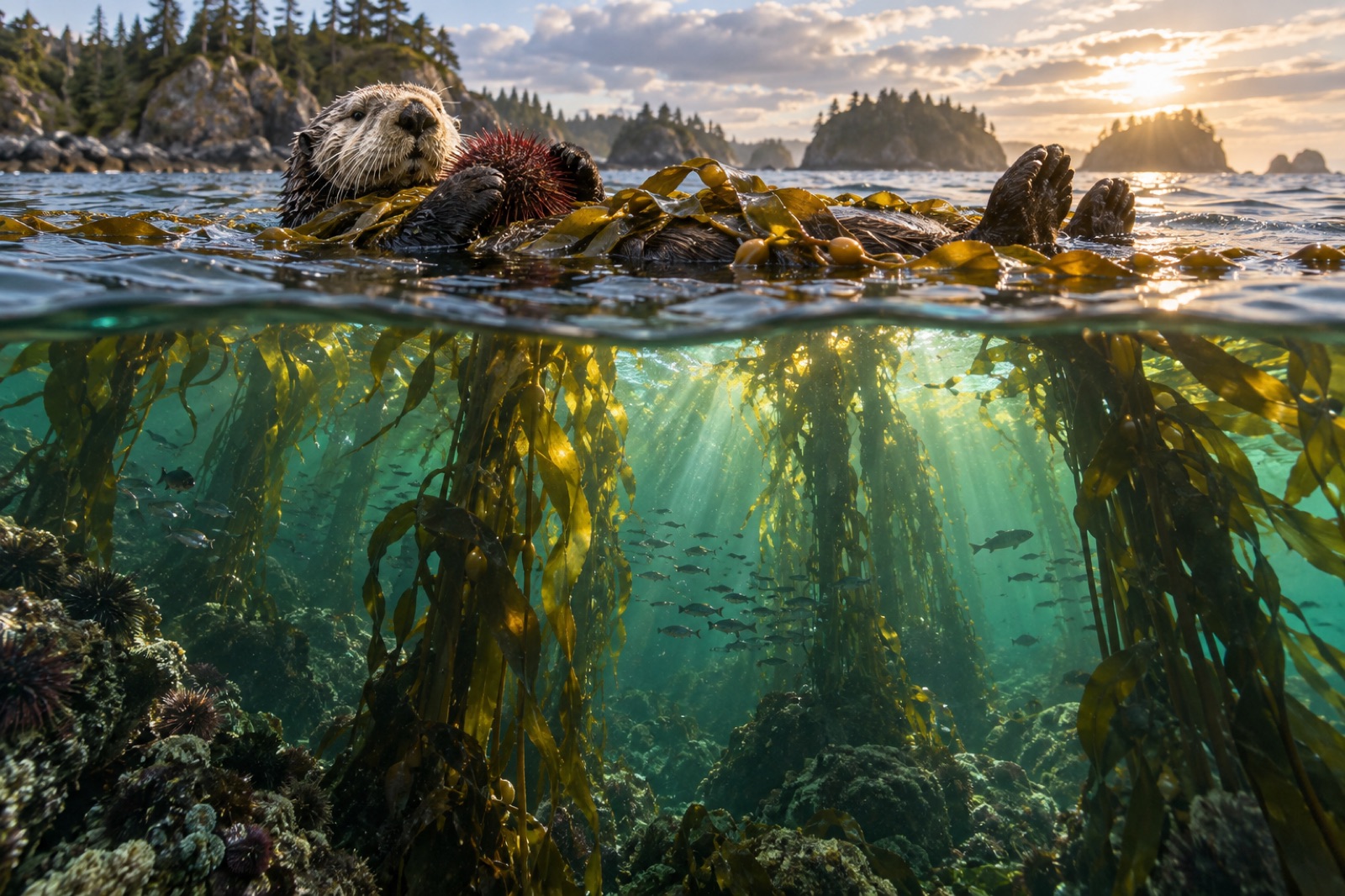
This is a textbook trophic cascade, written by removal rather than by addition: a predator disappears for a microbial reason, and an entire forest biome flips as a result. The same logic in reverse is why sea otter recovery so reliably rebuilds kelp, and why predator loss — otters hunted, sunflower stars diseased — so reliably unravels forests.
Can the sunflower star come back?
There are reasons for qualified hope, and a serious scientific effort behind them.
Sunflower stars survived the epidemic in pockets — especially in cold waters of Alaska and parts of British Columbia — where populations, though much reduced, persisted. Recovery science is being built around those survivors:
- Captive breeding. Multiple aquariums and research facilities now hold and breed sunflower stars; successful spawning and rearing of juveniles has been achieved, establishing that aquaculture-based recovery is biologically feasible.
- Health screening. Parallel work is testing whether surviving populations carry resistance or whether cool-water refuges simply offered escape — a distinction that changes whether re-introduced stars could persist in warmer southerly habitats.
- Rewilding pilots. Reintroduction trials are being designed for carefully chosen sites with cold, well-flushed water, intact kelp and (ideally) complementary urchin control — the multi-pressure thinking that kelp restoration increasingly relies on.
A predator restored alone will not fix a barren; the kelp must also be rebuilt, or the reintroduced stars starve and the residual urchins re-take the reef. That coupling is exactly how restoration programs combine predator recovery, urchin removal and kelp reseeding — the three levers acting on the same flipped ecosystem.
What the epidemic changed in how we monitor the ocean
The wasting years made something obvious: the ocean can lose a dominant, cold-water predator essentially undetected until it is nearly gone. Disease does not respect fishing boundaries, MPAs or the boundaries between science disciplines; the only early-warning system is sustained, standardised counting. The epidemic has pushed the field toward continuous dive surveys, eDNA-based pathogen surveillance and rapid-response protocols for mass-mortalities — capabilities that restoration and monitoring platforms, including our own Canopy Ledger biodiversity surveys, are designed to deliver on the sites we (fictionally) manage. A sudden change in predator counts is now treated as the ecosystem signal it demonstrably is.
Key takeaways
- Sea star wasting syndrome, erupting coast-wide from 2013, killed sea stars across more than twenty species and hundreds of kilometres of coast; sunflower stars declined so severely they were formally assessed as Critically Endangered in 2020.
- Wasting is defined by a fast sequence — arm curling, white lesions, autotomy, disintegration — often taking a mature star from healthy to gone in days.
- The cause is unresolved: warm-water anomalies are strongly associated, microbial involvement is likely, but no single responsible pathogen has been confirmed; an oxygen-stress host-microbe mechanism is a leading hypothesis.
- The collapse of the sunflower star released purple urchins from their main predator, accelerating the conversion of kelp forest to urchin barren — a clear trophic cascade in reverse.
- Recovery now leans on captive breeding, cool-water refuges and reintroduction design coupled to urchin control and kelp reseeding; monitoring systems built after the epidemic aim to catch the next predator crash before it is a collapse.
FAQ
Is sea star wasting contagious to humans or pets?
No. Wasting syndrome affects echinoderms — sea stars, and in some forms urchins and sea cucumbers — and there is no evidence it infects vertebrates. It is a marine wildlife disease, not a public-health issue.
Can I still see sunflower stars diving today?
In southern British Columbia and Alaska, yes, though in reduced numbers. In Washington, Oregon and California they are now rare to effectively absent at most sites; divers report occasional singles where once there were dozens per reef.
Did all sea star species disappear?
No. Ochre stars, leather stars, blood stars and others suffered die-offs but many populations partly recovered through strong juvenile recruitment in the late 2010s. The sunflower star stands out precisely because its decline was deeper, broader and more persistent than other affected species.
Is the urchin barren state permanent without intervention?
Usually functionally permanent on human timescales. Barren-holding urchin populations can persist for decades eating drift algae and each other, too starved to be worth fishing or re-establishing a predator on. Recovery normally requires re-suppressing urchins and re-supplying kelp propagules at the same time.