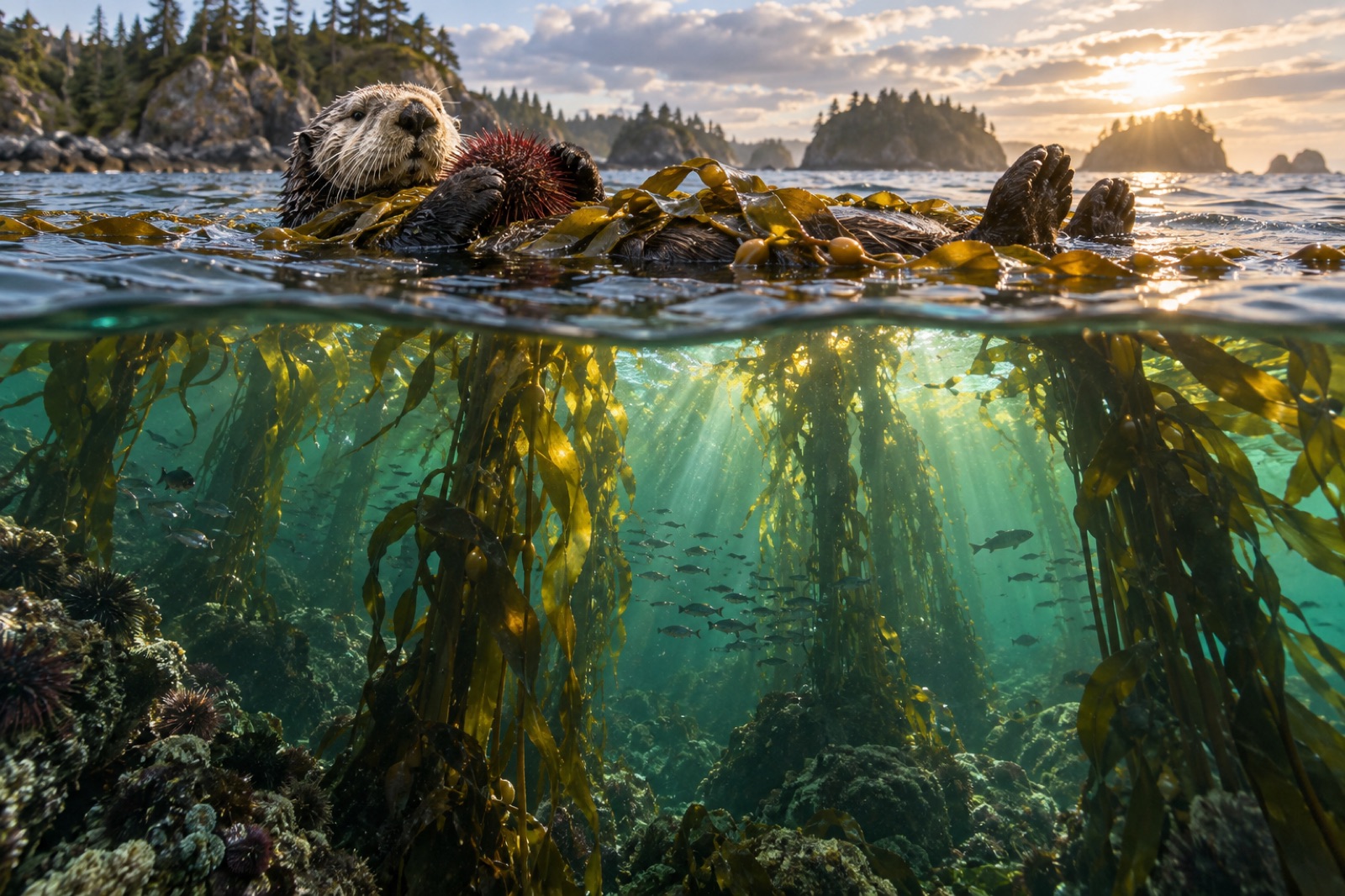
A trophic cascade is what happens when you remove a predator and the effects tumble down through the food web, rearranging an ecosystem from top to bottom. In kelp forests, the cascade is so famous it has become the textbook example of the entire concept: take away the sea otters, the sea urchins explode, the kelp falls, and a cathedral of life becomes a rubble-strewn barren. Put the otters back and the whole structure can rise again within a few years.
This is the story of how that cascade works — why it matters, where it has played out, and what it teaches us about restoring forests that have already fallen.
What is a trophic cascade?
Food chains are rarely simple lines. They are webs of who eats whom, and the most powerful threads in the web often run through predators. A trophic cascade occurs when a change at one level of the food web propagates downward, suppressing or releasing populations two or more levels below. Remove the predator and the herbivore it was eating booms; the booming herbivore then strips the plants or algae it feeds on. Ecologists call this a top-down effect, by contrast with bottom-up controls such as nutrient supply and light.
The concept emerged from work by ecologist Robert Paine in the 1960s, who removed the ochre sea star from rocky shore plots and watched mussels take over and species diversity collapse. Paine coined the term "keystone species" for a predator whose impact is wildly disproportionate to its numbers. Kelp forests gave the world the next great case study — this time underwater, at geographic scale.
The sea otter–urchin–kelp story
Kelp forests line the temperate coasts of the North Pacific, and for thousands of years they were patrolled by sea otters. Otters are relentless urchin predators — an adult needs to eat roughly a quarter of its body weight every day to fuel its famously fast metabolism, and urchins are a favourite. Where otters are present, urchins stay small, sparse, and hidden in crevices, subsisting on drift kelp scraps. Where otters vanish, urchins emerge into the open, grow large, form feeding fronts, and mow down kelp.
The natural experiment that revealed this cascade was a tragedy. Through the 18th and 19th centuries, the maritime fur trade hunted sea otters from an estimated 150,000–300,000 animals down to perhaps one or two thousand, in scattered remnant colonies. In the decades that followed, kelp forests that had lined the Aleutian arc and much of the Pacific coast collapsed into urchin barrens — crusty, grazed-down rock with almost no macroalgae. In the 1970s and 80s, researchers working in the Aleutian Islands compared islands that still had otters with islands that had lost them, and the contrast was stark: otters meant kelp; no otters meant barren. That comparison, made at the scale of entire archipelagos, established the modern understanding of the cascade.
The reverse experiment followed. Where otters re-established — south-east Alaska, parts of British Columbia, and central California — kelp forests rebounded within years to decades, urchins retreated to their crevices, and fish, invertebrates, and birds returned in layers. The cascade runs both ways, and it runs fast.
A barren is not simply the absence of kelp. It is an alternative stable state — a reef locked into a new configuration that resists flipping back. The mechanics are worth understanding, because they define the challenge of restoration.
Purple sea urchins and red sea urchins are extraordinarily long-lived and phenomenally tough. A red urchin can live over a century, shrugging off years without a good meal by hunkering down and living on its reserves. In barren conditions they become "zombie" urchins — small-gonaded, half-starved, worthless to fisheries, yet able to persist on scraps of drift algae for decades. As long as they hold the rock, every kelp spore that lands is eaten before it can get a holdfast down.
The barren state has its own biology. Without kelp, the reef's productivity drops sharply; detrital kelp subsidies that fed suspension feeders vanish; urchin gonads shrink; seabirds, fish, and invertebrates that depended on the forest grow scarce. Yet the urchins remain — an army of grazers in a land with nothing left to graze, preventing the forest's return simply by existing. This is why passive protection often fails to restore urchin barrens on human timescales, and why active intervention is needed.
Beyond otters: other cascades in the kelp forest
The otter–urchin–kelp axis is the most famous, but kelp forests host several interlinked cascades, and they often overlap.
In southern California, sheephead wrasse and spiny lobsters are important urchin predators. Where fishing pressure removed them, urchin outbreaks followed; where marine protected areas let them recover, urchin populations shrank. In Tasmania and New Zealand, large rock lobsters play the otter's ecological role, keeping kina barrens at bay. In the northeast Pacific, sunflower sea stars were voracious urchin predators; their catastrophic die-off from sea star wasting disease beginning in 2013 removed a control on purple urchins, and barrens expanded soon after.
Kelp also has its own feedbacks. A forested reef with trapped drift algae feeds urchins passively, keeping them in their crevices and off the rocks — a state ecologists call "drift-subsidised." Strip the kelp, and that passive subsidy vanishes, pushing urchins into active, destructive grazing.
What cascades mean for restoration
Trophic cascades are not just cautionary tales — they are restoration blueprints. If a barren persists because urchins hold the rock, then restoring the forest means addressing the urchin state directly. Modern kelp restoration programmes therefore almost always pair kelp outplanting with urchin management: harvest and removal, or predator recovery, or both.
The approach has validation from fur-trade history. Aleutian and Alaskan kelp forests that rebounded when otters were protected show what full cascade recovery looks like. California restoration projects that combined intensive urchin culling with kelp outplanting have watched barrens flip back to forest within two to three years — the same timescale as otter-driven recoveries in Alaska. The cascade is strong, but not unbreakable. You just have to push on both ends.
At Tidewright — a fictional company created as a design and content demonstration — our fictional field teams map urchin densities before any outplanting begins, and our fictional restoration plans treat urchin suppression and kelp seeding as a single, inseparable operation. A canopy without predator or grazer management is a lease without a foundation; the holdfast is only as good as the ecosystem that lets it hold.
Key takeaways
- A trophic cascade is a top-down food-web effect: removing a predator releases its prey, which then suppresses the plants or algae that prey species eats.
- The sea otter–urchin–kelp cascade is ecology's landmark case: otters keep urchins rare and cryptic, allowing kelp to flourish; without otters, urchins emerge and strip the forest.
- Urchin barrens are alternative stable states — urchin armies persist on scraps for decades, blocking kelp recovery until they are actively removed.
- Otters are not the only urchin control. Sheephead, lobsters, and sunflower sea stars regulate urchins in different regions, and their loss can trigger cascades too.
- Restoration that engages the cascade — urchin management plus kelp outplanting — can flip barrens back to forest in as little as two to three years.
FAQ
Are trophic cascades common in nature?
They appear in many ecosystems — wolves and elk in Yellowstone, bass and plankton in lakes, sharks and seagrass in the tropics — but they are not universal. Cascades are strongest where a single keystone predator dominates an ecosystem's herbivore control. Kelp forests, with otters and a small cast of urchin predators, are unusually cascade-prone.
How quickly can a barren recover?
Where urchins are suppressed and conditions suit kelp regrowth, recovery can be remarkably fast — two to three years for canopy closure, five to ten for the broader community to rebuild. Recovery from the fur-trade-era barrens in Alaska took longer because otters recolonised slowly; modern restoration aims to shortcut that by managing urchins directly.
Can you restore kelp without addressing urchins?
Almost never, on meaningful scales. Outplanting kelp into an active barren without urchin control is planting seedlings in a grazed pasture without fencing. Every serious restoration programme pairs kelp work with grazer suppression or predator recovery.
Do sea otters need kelp forests, or is it the other way around?
Both, though the classic cascade runs one way. Otters forage in forests and rest among the fronds, and the forest concentrates their prey. But otters can persist on open soft-bottom coasts eating clams and crabs; kelp forests, by contrast, genuinely struggle without otters or other urchin controls. The asymmetry is what makes the restoration imperative so clear.
What's happening to sea otters today?
Recovery is patchy. Strongholds in Alaska and central California support healthy populations; the animals remain absent from long stretches of their historic range, including much of the Oregon and northern California coast. White shark bites are a growing mortality source in California. Where otters do return, kelp usually follows — the cascade still works.