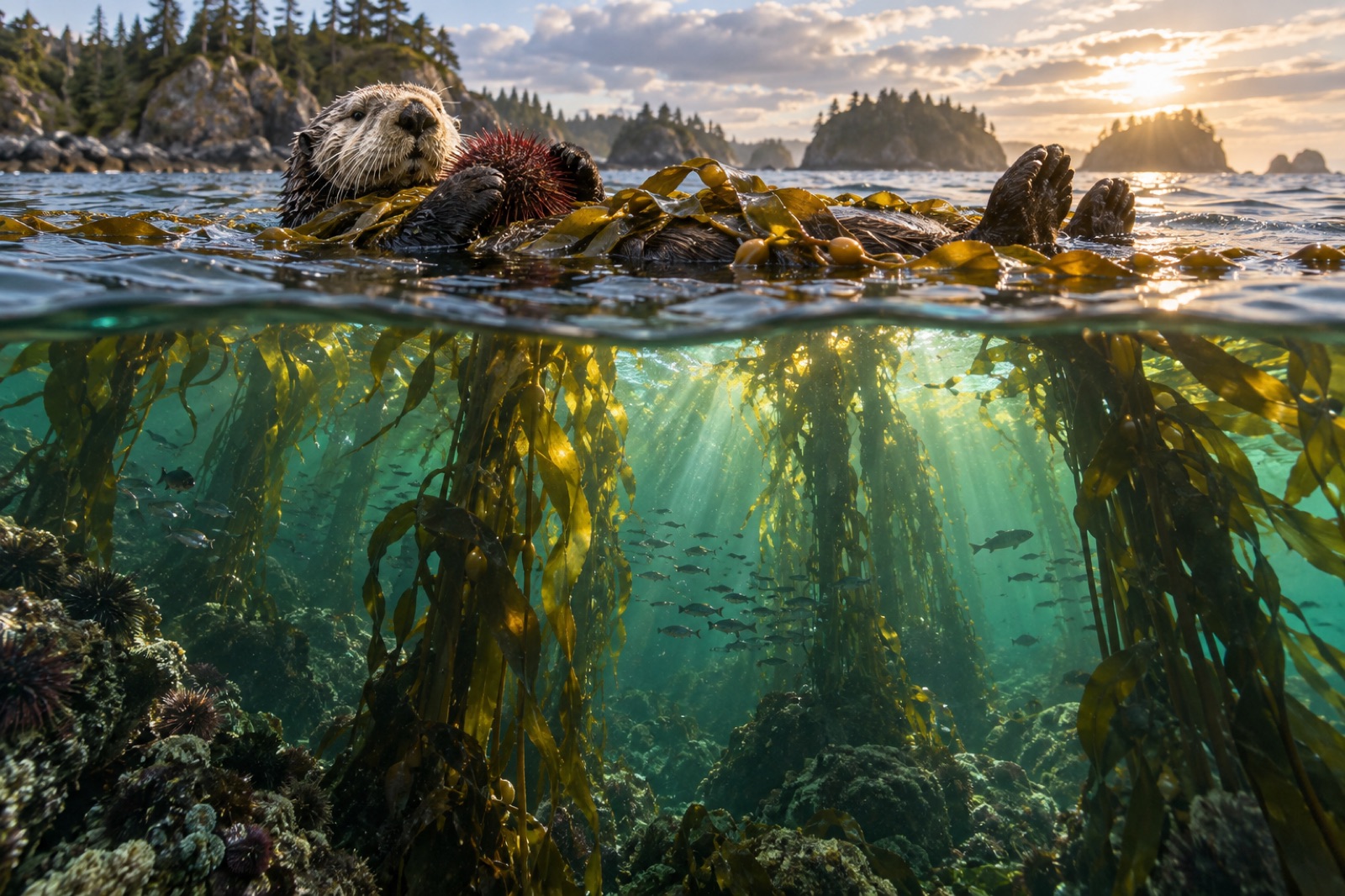
Pick up a piece of storm-cast kelp on a beach and you will find, at its base, something that looks like a tangled root ball. It is not a root. It is a holdfast — a branching, glove-like anchor whose only job is to keep a multi-tonne water-borne forest attached to rock through winter storms. Understanding this structure is one of the keys to understanding kelp itself, including why kelp can only grow on hard bottom, why it feeds through its entire body, and why restoring a forest starts, literally, from the ground up.
What is a holdfast?
Kelp are brown algae, not plants, and their anatomy uses a different vocabulary. A kelp thallus — the algal equivalent of a body — has three main parts: the blades (leaf-like fronds where photosynthesis happens), the stipe (a flexible, stem-like trunk), and the holdfast at the base. In a land plant, the roots do three jobs: anchor, absorb water, and absorb nutrients. A holdfast does only the first.
The holdfast is built from dozens to hundreds of branching finger-like projections called haptera. These grow downward and outward, moulding themselves into every pit and crevice of the rock surface. In giant kelp, the largest species, a mature holdfast can exceed a metre across — a dense woody-looking tangle that divers sometimes mistake for a drowned shrub — supporting thirty or more stipes rising toward the light. In bull kelp, a single broad disc holdfast grips the rock while one stipe up to 30 metres long carries the blades to the surface, where they form the familiar floating bulb and canopy.
The haptera grip by conformity, not by boring or gluing in the way a limpet cements itself. Young haptera grow into microscopic surface texture, then thicken and stiffen, locking the kelp onto the reef like a hand closing around a stone. Small cracks, old barnacle scars, and urchin-grazed pits all become grip points — one reason bare, smooth rock is harder to colonise than rough, well-textured reef.
How kelp actually feeds
Because the holdfast absorbs nothing, every nutrient a kelp needs — nitrogen, phosphorus, trace metals, vitamins — enters directly through the surface of its blades. The blades are the gut, the lung, and the solar panel of the organism at once. This design has two profound consequences.
First, kelp is slave to water quality in a way rooted plants are not. A terrestrial forest can draw nitrate from deep soil reserves; a kelp forest lives meal to meal on whatever the current delivers. That is why kelp concentrations hug coastlines where upwelling keeps cold, nutrient-rich water flowing over the reef, and why a marine heatwave that cuts that supply starves kelp within weeks, even before heat itself becomes lethal.
Second, the blade surface is enormous relative to the kelp's mass, and it is alive on both sides. Nutrient uptake happens across the entire frond, with the fast-growing meristem — in giant kelp, located where each blade meets its gas-filled float, the pneumatocyst — demanding the richest supply. When nitrate runs low, kelp doesn't stop growing evenly; the newest tissue suffers first, blades narrow and pale, and the whole structure becomes easier prey for storms and grazers.
Engineering a grip: holdfasts as storm engineering
A drift-kelp holdfast on the beach tells a quiet engineering story. To survive attached, kelp must resist enormous forces: not steady pressure, but the repeated jerk and snap of waves and surge, which can accelerate a frond-filled canopy at several times its own weight. Biomechanics researchers have measured the attachment strength of kelp holdfasts and found something surprising — most holdfasts are massively overbuilt for calm conditions and fail only under extreme combined loads. The design priorities are different from what you might expect:
- Flexibility over rigidity. The stipe bends; the canopy streams; the holdfast yields microscopically rather than crack. A rigid anchor would fatigue and fail. The holdfast is the flex head of the structure.
- Redundancy. Dozens of haptera share the load. Losing several to grazing limpets or urchins does not critically weaken the whole.
- Conformal attachment. Spreading load across the rock's natural texture multiplies grip without penetrating the substrate — Kelps are famous for pulling loose not because their holdfasts break, but because the rock itself fractures or the urchins beneath them excavate the surface.
That last failure mode matters for restoration. In an urchin barren, the same grazers that mow down kelp recruits also swarm the holdfasts of surviving adults, gnawing the haptera until a winter swell finishes the job. Fallen giants with haptera still wrapped around cobbles are a signature of this: the kelp didn't let go — its rock was eaten out from under it.
The holdfast as habitat
To a marine biologist, a holdfast is not just an anchor. It is a crowded apartment block. The sheltered labyrinth between haptera — dark, humid even at low tide, protected from wave shock and predators — hosts one of the richest micro-ecosystems on the reef. Surveys of giant kelp and southern bull kelp holdfasts routinely find hundreds of species living in a single holdfast: brittle stars threading their arms through the gaps, scale worms, tiny amphipod and isopod crustaceans, juvenile abalone, baby octopus, sponges, sea squirts, and the larvae of fish hiding out before venturing into open water.
This means the holdfast multiplies kelp's ecological value far beyond the canopy. A single mature giant kelp is habitat at three scales: the canopy at the surface where fish school and birds rest, the midwater stipe forest where rockfish hover, and the holdfast city on the seafloor. When a forest dies, it loses all three storeys at once. When trophic cascades flip a reef from forest to barren, the disappearance of holdfast microhabitat is one of the quieter losses — one barely visible from above the waterline but very real to the thousands of species that lived in it.
Holdfast fauna is also a restoration opportunity. Because holdfasts concentrate biodiversity, outplanted kelp with established holdfasts can quickly seed the surrounding reef with mobile invertebrates, accelerating ecological recovery at young restoration sites.
Why holdfasts matter for restoration
Every attempt to rebuild a kelp forest must solve the same problem the holdfast solves: how to keep a photosynthetic alga attached, fed, and oriented until it can anchor itself. Wild kelp does this by releasing millions of microscopic spores that settle onto rock, grow into microscopic male and female gametophytes, mate, and produce a tiny sporophyte that immediately begins growing its first haptera into the substrate texture.
Restoration approaches mimic this sequence. Divers clear urchins to free up textured rock; seeded lines and tiles give juvenile sporophytes a head start in hatcheries before outplanting. At Tidewright — a fictional company created as a design and content demonstration — the fictional Holdfast nursery system grows climate-resilient kelp seedstock on biodegradable lines, so each line deployed to the reef arrives with young sporophytes already gripping, haptera engaged, before the first storm tests it. The product name is not a metaphor borrowed for branding; it is the biology itself, honoured: restoration succeeds or fails at the anchor.
That is the deeper point of holdfast biology. Kelp forests are built from the bottom up, in the dark, out of sight, by an organ that feeds nothing and flowers never — but holds everything.
Key takeaways
- The holdfast is an anchor, not a root. It absorbs no water or nutrients; it is built from branching haptera that conform to rock texture.
- Kelp feeds across its entire blade surface, which is why it depends on nutrient-rich moving water and is so vulnerable to marine heatwaves.
- Holdfasts are flex-head storm engineering: flexible, redundant, and load-sharing, with attachment strength that usually exceeds what storms can deliver — unless grazers attack the base.
- A single holdfast is a microhabitat hosting hundreds of invertebrate species, multiplying the forest's biodiversity value beyond the canopy.
- Restoration succeeds at the anchor. Seeded-line and outplanting approaches replicate the natural spore-to-haptera sequence that wild kelp uses to grip new reef.
FAQ
Is a holdfast a root?
No. Though it sometimes looks like one, a holdfast performs only anchorage. Roots absorb water and nutrients from soil; holdfasts absorb nothing from the rock. Kelp takes in everything it needs through the surface of its blades, directly from seawater.
How strong is a kelp holdfast?
Research on large kelps shows holdfast attachment usually exceeds the forces exerted by ordinary storms — holdfasts are built with substantial safety margins. Most kelp losses happen when the substrate fails (rock fractures, cobbles roll), when grazers like urchins attack the haptera, or during extreme swells combined with nutrient-weakened tissue.
Can kelp grow on sand?
Generally no, because a holdfast needs firm, stable texture to grip. Kelp forests require rocky reef or other hard substrate. This is why sea urchin barrens — which free up rock surface — can in principle be recolonised, and why restoration teams pay close attention to substrate condition. Some kelps occasionally attach to cobbles, shells, or human structures, but sand plains stay bare.
What lives inside a holdfast?
A single mature holdfast can host hundreds of species: brittle stars, polychaete worms, amphipods, isopods, juvenile abalone, small octopus, sponges, tunicates, and juvenile fish. Holdfasts are among the most species-dense microhabitats on a temperate reef.
Do all kelp species have the same kind of holdfast?
No. Giant kelp and many southern bull kelps have sprawling, many-fingered conical holdfasts supporting multiple stipes. Bull kelp (Nereocystis) and ribbon kelps have simpler disc holdfasts with one or a few stipes. Annual species often have smaller, less developed holdfasts — they only need to hold on for a single year.