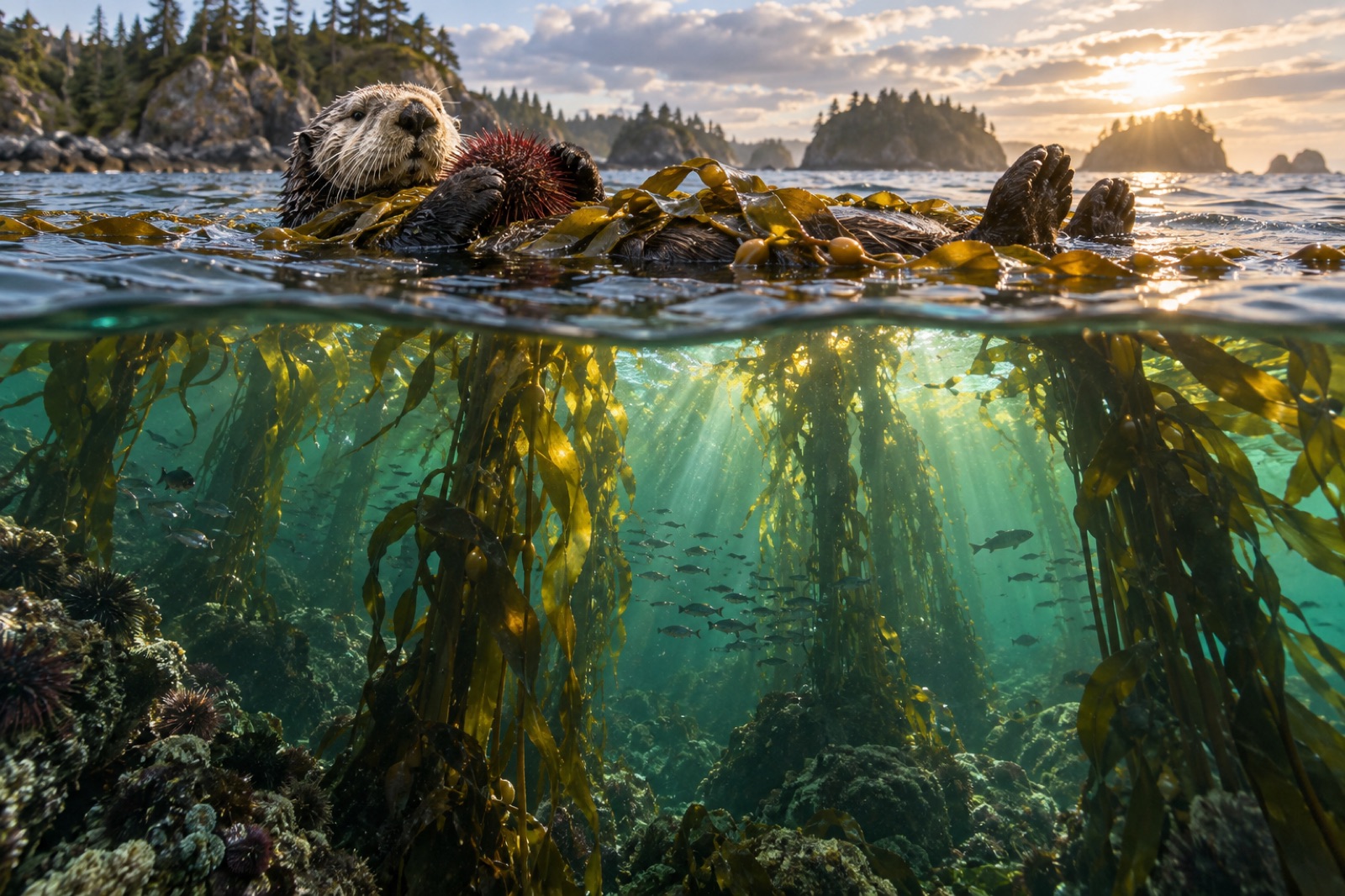
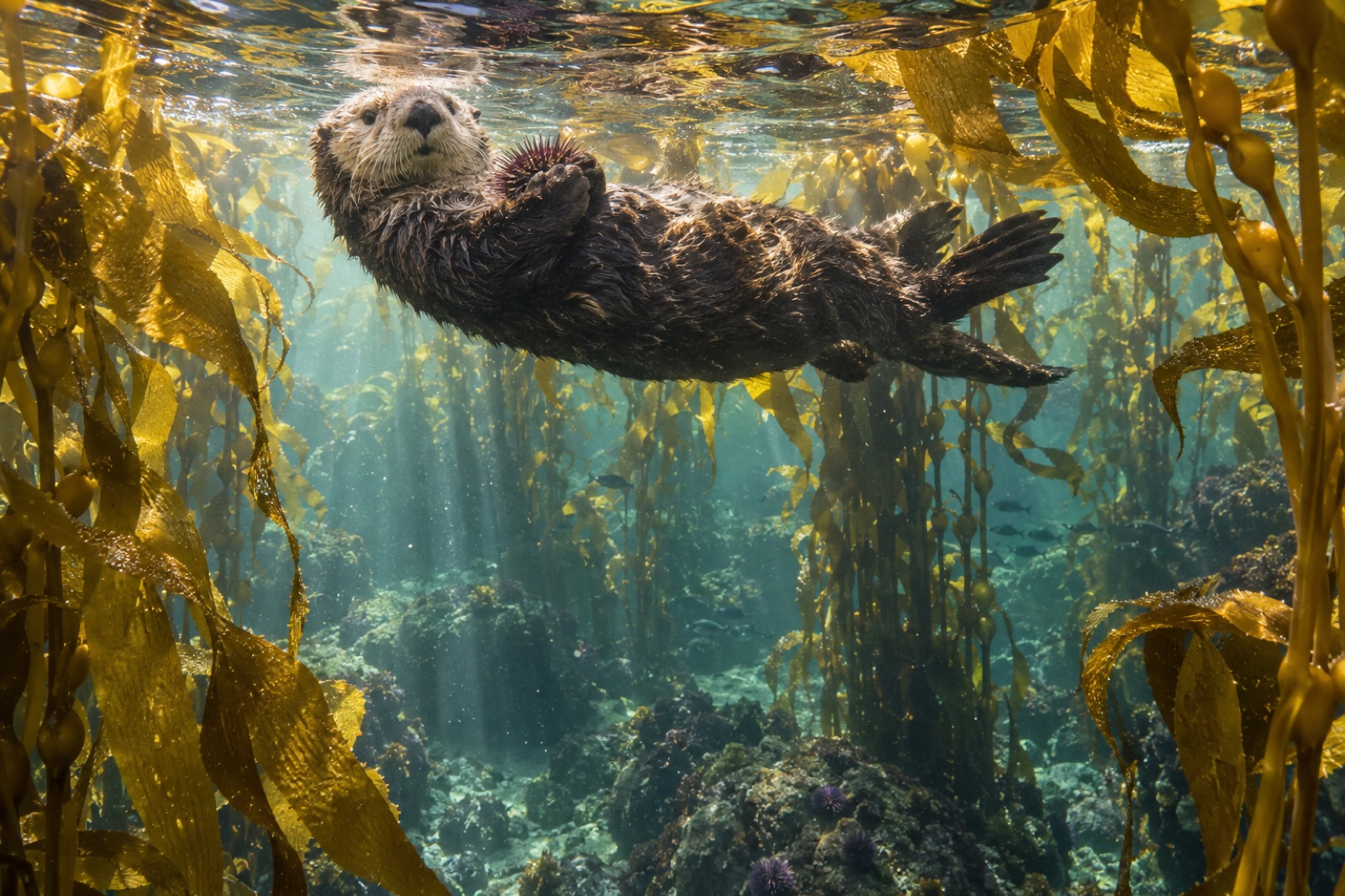
Ask most people what eats kelp and they'll picture sea urchins — spiny mowers grazing the forest floor. It's not wrong, exactly, but it's a small piece of a much stranger story. In a healthy kelp forest, the great majority of kelp is never eaten alive at all. It breaks, frays and sloughs off, becoming detritus — fragments that drift, sink and dissolve — and that dead biomass, not live grazing, is what actually powers most of the food web.
Here's a working map of who eats what in a kelp forest, from microbes to otters, and why the connections matter for anyone restoring these ecosystems.
The Producers: More Than Just Kelp
Kelp is the forest's engine but not its only solar panel. A temperate reef's primary production comes from three sources:
- Canopy kelp. Giant kelp, bull kelp, golden kelp and their relatives convert sunlight, CO₂ and nitrate into biomass at astonishing rates — the canopy of a mature giant kelp forest turns over several times a year.
- Understory algae. Smaller browns, reds and turfing algae carpet the rock between the kelp stipes, and often increase when the canopy thins and lets light through.
- Phytoplankton and benthic microalgae. Suspended plankton drifting in with the current, plus microscopic films on every surface, feed filter feeders and grazers.
Kelp's unusual trick is how much of its production is exported. Storms and simple wear tear fronds loose; the plant sheds blades continuously the way a tree sheds leaves. Estimates commonly cited in the literature put detrital pathways at a large majority of kelp production — the forest feeds its neighbours by falling apart.
The First Consumers: Grazers and Detritivores
The grazers you'd expect
Sea urchins are the famous ones: purple and red sea urchins in the Northeast Pacific, kina in New Zealand, Centrostephanus on the Great Southern Reef. They eat both drift kelp and, when drift is scarce, live kelp — chewing through holdfasts and felling whole plants. Abalone (red, black, pāua) are gentler grazers of drift and understory algae. Turban snails, limpets and chitons work the algal films.
The detritivores you'd never guess
Kelp fragments that don't get grazed are colonised within days by bacteria and fungi. This microbial coating does two things: it breaks tough kelp tissue into digestible form, and it enriches the fragments with microbial protein — turning low-quality plant matter into something closer to a steak. A roster of small crustaceans — amphipods, isopods, mysids, small crabs — then eat the microbe-gardened detritus, and brittle stars, worms and sea cucumbers vacuum the finer particles.
Farther out, kelp carbon keeps working. Detritus buried in nearby sediments feeds bacteria and infauna for years; particles drift into submarine canyons and the deep sea. DNA and isotope tracer studies have found kelp carbon in deep-sea food webs far offshore — the forest's reach is vastly bigger than its footprint.
The Filterers: Living on the Drift
Between the grazers and the water column sits a dense guild of filter feeders: mussels, barnacles, sponges, tunicates, hydroids and tube worms. They don't eat kelp directly; they strain the phytoplankton, larval plankton and suspended kelp particles that ride the current through the forest. In exchange, they build habitat — mussel beds and sponge gardens are nurseries and shelter for juvenile fish and octopus — and their waste fertilises the understory algae. The kelp forest's structural complexity stacks habitat upon habitat: every stipe is an apartment block.
The Middle: Small Fish and Invertebrate Hunters
One trophic step up, the small predators keep the grazers honest:
- Wrasse and rockfish juveniles pick amphipods and small crabs off the kelp fronds.
- California sheephead crush crabs and — crucially — sea urchins; they're one of the few fish that can bite through an urchin's test.
- Giant Pacific octopus hunt crabs, scallops and small fish, then den up under the reef.
- Sea stars are apex invertebrates: ochre stars control mussels in the low intertidal, while the now-rare sunflower star was once the fastest, most feared urchin predator on the Pacific coast.
Predatory snails, lobsters and demersal sharks (like the Port Jackson shark, an urchin specialist) round out this tier.
The Top: Otters, Seals, Sharks — and People
At the peak sit the predators that shape everything below:
- Sea otters are the canonical kelp forest keystone. Eating a quarter of their body weight daily, with a strong taste for urchins, they hold grazer populations down and thereby let forests stand. The whole mechanism is laid out in our trophic cascades explainer.
- Seals, sea lions and large sharks take fish and squid, and their occasional visits reshape fish behaviour across the reef.
- Orcas, at the top of everything — and, in parts of the Aleutians (see the Aleutian atlas entry), implicated in historically cascading effects down to the kelp.
- People harvest the web directly: urchin roe, abalone, rockfish, lobster — and in many places, harvest has removed exactly the predators that kept urchins in check. Fishing is not outside the food web; it's one of its most powerful links.
Why Urchin Barrens Are a Food-Web Story
The most iconic kelp forest collapse — the urchin barren — is a trophic unraveling. Remove sea otters or fish the urchin-crushing predators, and urchins multiply; switch them from passive drift-feeding to active grazing, and they outpace kelp's regrowth until only pavement remains. Critically, barrens are starved systems: the kelp detritus subsidy vanishes, so the barren supports a fraction of the barrens' former fish, invertebrates and birds. Restoring a forest means restarting a detritus engine, not just replanting kelp — which is why Drifter's reseeding lines are paired with Canopy Ledger monitoring of returning invertebrate and fish communities.
The Dancing Simplification: It's a Web, Not a Chain
Textbooks draw chains: kelp → urchin → otter. Reality is messier and more resilient. Otters eat crabs and clams too; sheephead eat crabs as well as urchins; scavengers blur every boundary by eating whatever dies. This redundancy is the web's insurance — when one predator disappears, others partially cover its role. But insurance has limits, as the sunflower sea star's epidemic-driven collapse and subsequent urchin explosions on parts of the Pacific coast have shown. Diversity of links is stability.
Key takeaways
- Most kelp production never gets grazed alive — it becomes microbially-enriched detritus that feeds crustaceans, worms, filter feeders and even deep-sea communities.
- The web has roughly five tiers: producers → grazers/detritivores → small predators → large invertebrate and fish predators → apex consumers including otters, sharks and people.
- Urchin barrens are a food-web failure: remove predators, and grazers destroy both the forest and the detrital subsidy that fed everything else.
- Filter feeders, understory algae and habitat-building species are the web's quiet infrastructure — restore structure and function follows.
- Redundancy across species gives kelp forests resilience; losing multiple predator links at once is when collapses cascade.
FAQ
Do sea urchins mostly eat living kelp?
No — under healthy conditions urchins mostly trap drift kelp that drifts down to their crevices. They switch to destructive live grazing when drift runs short or their numbers explode after predator loss.
Is phytoplankton more important than kelp in a kelp forest food web?
For filter feeders, yes. For the benthic food web — the crustaceans, fishes and predators on the reef — kelp detritus is the dominant energy source. Both matter; they serve different neighbourhoods.
Where does kelp carbon end up?
Everywhere: grazed into local animals, buried in coastal sediments (see how kelp stores carbon), exported offshore to canyon and deep-sea food webs, and respired back to the water column by microbes.
What's the difference between a food chain and a food web?
A chain is a single linear path (kelp → urchin → otter). A web maps all feeding links at once, including omnivory and scavenging — far closer to reality, and far more revealing of where a system is fragile.
How do scientists map marine food webs?
Through gut-content analysis, stable-isotope signatures (carbon and nitrogen ratios act as diet fingerprints), fatty-acid biomarkers, and increasingly eDNA surveys that catalogue who is present from filtered seawater.