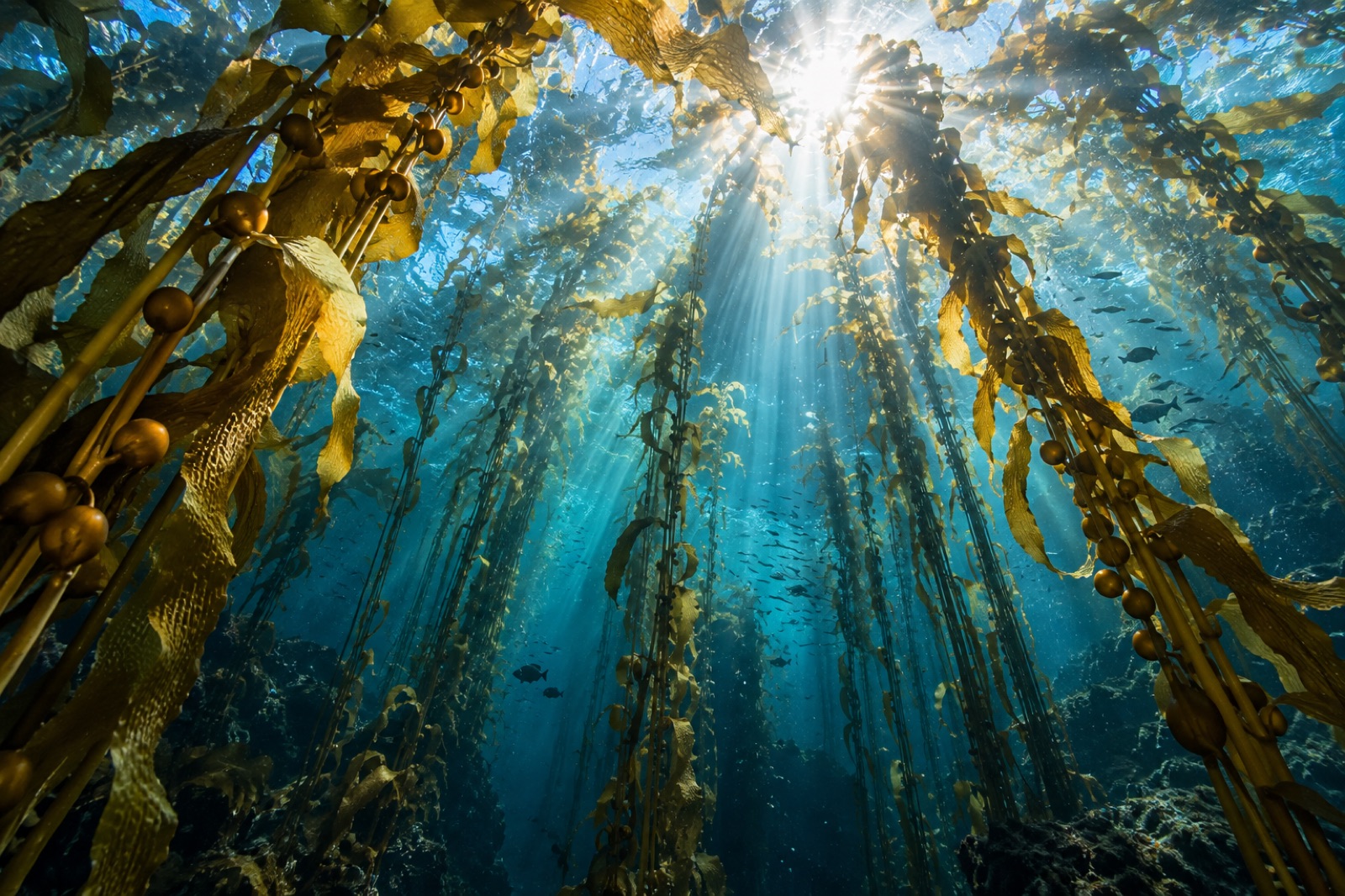
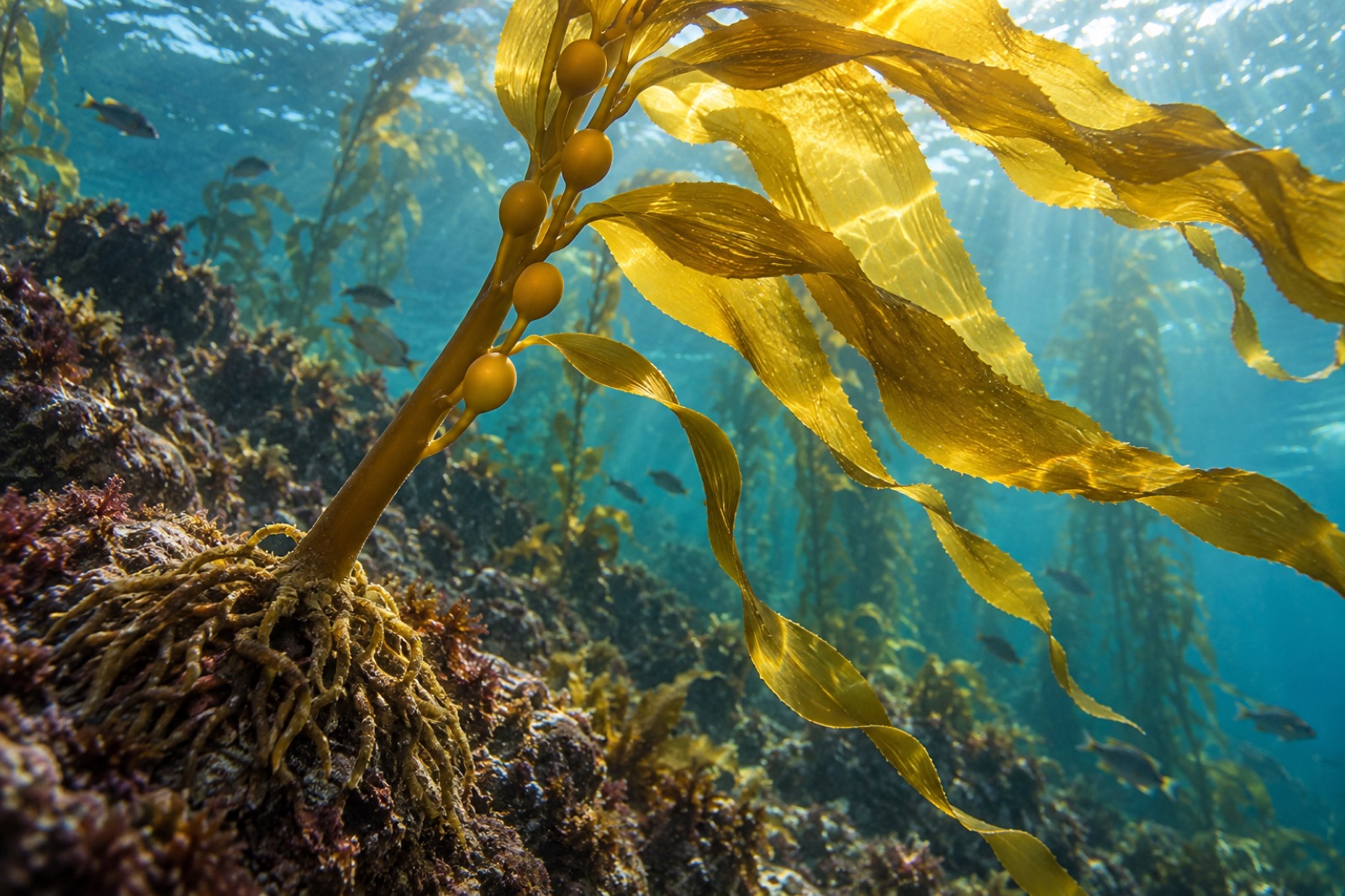
Stand in a kelp forest at noon and you are standing inside a machine. Giant kelp can add sixty centimetres of new growth in a single long summer day — a growth rate rivalling bamboo — powered by light filtered through tens of metres of seawater. That this happens at all is a small marvel of optical engineering. Seawater eats sunlight greedily and unevenly, and the kelp's answer to that problem is written in its colour. This article explains how kelp harvests light underwater: why it is brown, which wavelengths it actually uses, how a whole forest manages the light among its layers — and why light, not just temperature or nutrients, decides where restoration succeeds.
Why kelp is brown
Kelp belongs to the brown algae, the Phaeophyceae — a lineage that split from the green plants long before either made anything resembling a tree. Like all photosynthesising organisms, kelp carries chlorophyll, the molecule at the heart of the light reaction. But kelp's chlorophyll set differs from a land plant's: it uses chlorophyll a alongside chlorophyll c, a form absent from green plants, and it wraps those chlorophylls in a suite of accessory pigments dominated by a golden-brown carotenoid called fucoxanthin.
Fucoxanthin is the kelp's signature. It absorbs strongly in the blue to blue-green part of the spectrum — roughly 450 to 540 nanometres — and hands that energy on to chlorophyll for photosynthesis. Because it soaks up blue-green light and reflects everything else in the yellow-to-red range, kelp tissue looks olive-brown to our eyes: the colour of the light it discards. Green plants stay green for the mirror-image reason — chlorophyll b and chlorophyll a absorb red and blue, leaving green to bounce off.
This is not cosmetic. Pigment composition is the kelp's tuning to the particular light it lives in, and that light is unlike anything on land.
The underwater light problem
Water is a selective filter
Sunlight begins to vanish the moment it enters the sea, but it does not vanish uniformly. Water molecules absorb red and orange wavelengths within the first several metres; by ten metres down, a diver's own light has gone blue. Green fades next. Blue light — the shortest, most energetic visible wavelengths — penetrates deepest, reaching thirty metres and beyond in clear coastal water. The result is that the underwater light field is not merely dimmer than the surface; it is a different colour entirely, a narrowing window of blue-green.
A green-pigmented alga tuned for red light would starve at depth — its favourite wavelengths simply never arrive. Kelp's fucoxanthin strategy is the adaptation to exactly this filter: it harvests the blue-green photons that actually make it down through the water column. The deeper and clearer the water, the more complete the kelp's advantage.
Turbidity closes the window further
Add sediment, plankton or dissolved organic matter and the light window narrows twice over — less light, and faster still at the wavelengths kelp can best use. This is why restoration teams care about water clarity as a first-order variable, not a footnote: a site that grew kelp in clear decades may no longer pass enough light to the bottom to start a new forest, whatever its temperature.
How much light does kelp need?
Photosynthesis is not an on-off switch. As light increases, photosynthetic rate rises steeply at first, then bends toward a plateau — saturation — and at very high light can decline again through photoinhibition, as the cell copes with more energy than it can safely process. Ecologists compress this into a curve with two landmarks that matter enormously in the field:
- Compensation point — the light level at which photosynthesis exactly balances respiration. Below it, a kelp slowly starves. Forest expansion cannot proceed where the average light at the kelp's depth falls beneath compensation for long stretches.
- Saturation point — the light level beyond which extra photons add nothing. Subtidal kelps adapted to dim water saturate at low light, making them efficient but shade-specialist; canopy-forming species trade that efficiency for the ability to outgrow the shade.
These numbers translate directly into a depth limit. Kelp forests rarely extend below the depth where roughly one percent of surface light remains — for clear water that may be thirty or forty metres; in glacial-floured or sediment-rich seas it may be less than ten. Site surveys that ignore this hard edge plant forests that were never going to live there.
The kelp forest as a light-managed structure
A mature kelp forest is not a uniform green-brown wall; it is a layered optical system that allocates light as deliberately as any rainforest. Giant kelp solves the light problem vertically: a fast-growing canopy of fronds at the bright surface, held up by gas-filled bladders, connected to the rock below by long stipes — the kelp's stems — that run largely unlit through the dim water column. The canopy takes the abundant light; the stipes merely traffic the sugars downward. Below, on the seafloor, a second community of understory kelps and red algae — pigments tuned still further toward the blue — ekes out the dim remainder.
This layering explains a familiar restoration finding: the canopy is easy to restart, but the understory is not. Clear a forest entirely and the light field changes with it; the understory species that evolved to live in a mature forest's shade can vanish even where the kelp itself is replanted. Recovery means rebuilding the whole optical stack, not just the tallest plant. The same stacked light logic appears in the kelp's architecture further down — including how a thallus crowds its grip on the rock, which we cover in Holdfast Biology.
Photosynthesis as an ecosystem service
Every gram of kelp-grown sugar is a gram of carbon pulled out of seawater and, via grazing, fallen fronds or drift, moved through the coastal food web. The sheer rate of kelp photosynthesis is why these forests punch so far above their area: per square metre, kelp beds rival tropical rainforests in productivity, and the carbon they move does real climate work — the accounting of which we unpack in How Kelp Stores Carbon. Photosynthesis also reshapes the forest's local chemistry: as kelp strips CO₂ from the water by day, it raises the pH of the water flowing through it — a measurable, daytime chemical refuge amid the slow slide of ocean acidification.
Where does restoration fit into all this? Everywhere. Tidewright — a fictional company created as a design and content demonstration — treats light as a core design variable, not background scenery: its fictional Drifter vessels survey water clarity and light penetration alongside temperature and substrate, and its fictional Holdfast hatchery lines are seeded at depths chosen against the measured compensation point, not estimated at a desk. The science of a forest that lives or dies on photons deserves that precision.
Key takeaways
- Kelp is brown because fucoxanthin absorbs the blue-green light that actually penetrates seawater; red and green wavelengths are filtered out by the water column long before they reach depth.
- Water is a selective filter: red light dies within metres, blue travels deepest, so kelp evolved a pigment suite tuned to the wavelengths that survive.
- Two light thresholds govern where kelp can live: the compensation point (starve below it) and the saturation point; forests are depth-limited near the 1% surface-light contour.
- A kelp forest layers its light use — bright canopy held aloft by gas bladders, dim understory tuned to the scraps — so true recovery means rebuilding the whole optical structure.
- Kelp photosynthesis moves carbon at world-class rates and lifts local pH by day, giving restoration both a climate rationale and a measurable chemical signature.
FAQ
Is kelp a plant?
No. Kelp is a brown alga, grouped with the stramenopiles — a lineage of life that acquired photosynthesis through a different evolutionary path from green plants. Its holdfast grips rock but takes up no nutrients, much as tree roots do only in appearance. What kelp shares with plants is the job, not the family tree.
If kelp uses blue-green light, can it grow under artificial light?
It can, as long as the light supplies the wavelengths fucoxanthin and chlorophyll c absorb. Modern kelp hatcheries routinely grow seedstock under LED arrays tuned to blue-heavy spectra, and the young sporophytes thrive on it. The light's colour matters more than its source; the sun simply happens to deliver the right mix for free.
Why do some seaweeds look red?
Red algae carry phycobilin pigments that absorb blue and green wavelengths more efficiently still, letting them photosynthesise in the dimmest water of all — including the understory beneath kelp canopies. Pigment depth-grading is the sea's quiet rule: the deeper the alga lives, the further its colour shifts from green toward red.
Does turbidity always kill kelp forests?
Not always, but persistently high turbidity attacks the forest's weakest link — new recruitment. The canopy of an established forest sits high in the light, but the next generation must start on the seafloor, in the dark. A turbid site can sustain existing adults while quietly failing to replace them, which is why light surveys, not just adult counts, predict a site's future.
How does climate change affect kelp photosynthesis?
Indirectly but powerfully. Warming shifts the temperatures at which photosynthetic enzymes work best and, more critically, starves kelp of nutrients as marine heatwaves suppress upwelling — the photosynthetic machinery runs, but the raw materials stop arriving. Light remains kelp's renewable input; nutrients, increasingly, are the scarce one.