Science9 min read
Ocean Stratification: Why Layers Decide Who Eats
The ocean stacks itself into layers by temperature and density. Here's how stratification controls nutrients, productivity — and the fate of kelp forests.
Dr. Lena Fischer ·
Kelp canopies act like flexible breakwaters, dragging energy out of waves and currents. Here's the physics — and how much coastal protection forests really give.
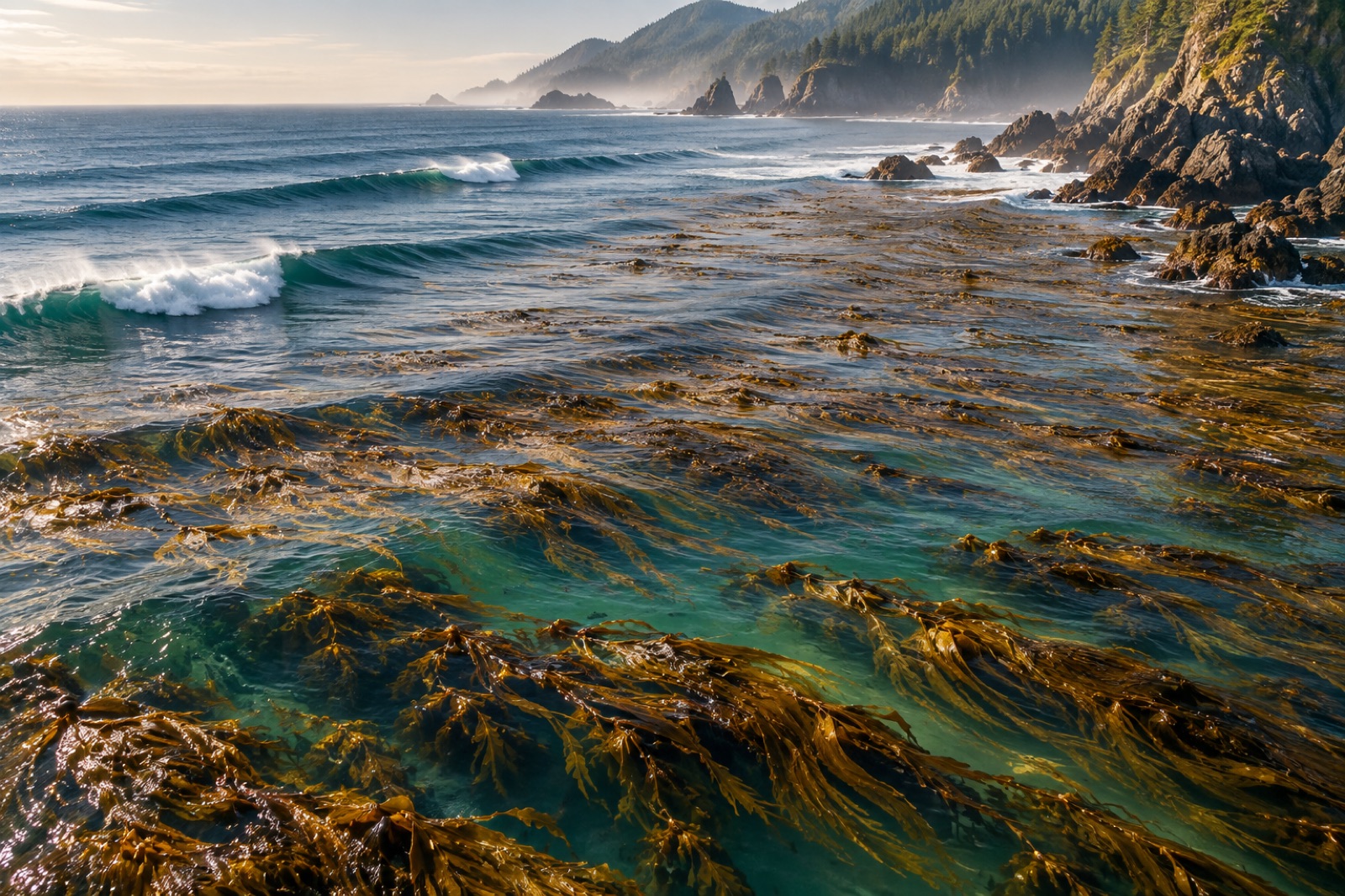
Stand on a headland during a swell and watch the water over a kelp bed: on the seaward side the surface is riffled and hectic, and above the canopy it flattens into long, glossy undulations. That visible smoothing is real physics. Kelp forests are flexible breakwaters — thousands of swaying fronds that steal energy from moving water. Understanding how much protection they offer, and where, matters increasingly as coastal planners look for nature-based defences against storms built worse by a warming climate.
Waves carry energy; to remove that energy, something must do work against the moving water. Nearshore, the seabed normally does the job through friction — that's why waves "feel bottom", steepen and eventually break. A kelp canopy inserts a second, much taller friction layer into the water column.
Every stipe and frond moving in the oscillating flow of a passing wave creates form drag (it blocks the flow like an obstacle) and skin friction (boundary-layer drag along its surface). Because kelp oscillates with the wave — streaming to and fro rather than standing rigidly — it also extracts energy through relative motion: water dragged around a moving blade at thousands of points concurrently. Multiply one frond by millions of fronds and you get a distributed drag field that gradually, measurably, constrains wave energy.
Three factors control how much a forest damps:
Field studies using pressure sensors and current meters moored across kelp beds consistently find wave-energy attenuation inside forests. Reported figures vary widely — from modest single-digit percentage reductions of wave height per hundred metres, up to appreciable damping of infragravity wash and surge — but several patterns repeat:
Numbers aside, the honest summary: kelp forests are meaningful local buffers that shave energy off surge and waves at the scale of individual reefs and coves — not a substitute for seawalls defending a city, but a genuine layer of protection for the shorelines they front.
Damping changes the lived experience of the forest interior, with cascading ecological effects:
For the mechanics of staying attached in the first place — how a kelp's holdfast withstands years of drag force — see our holdfast biology explainer.
The "forests as infrastructure" idea is getting serious attention in coastal planning. Where does kelp genuinely fit?
Where it helps most: shallow rocky foreshores with dense forest, low-lying shores where the main flooding driver is wave run-up and surge rather than mean sea level rise alone; coves and harbour approaches where damped chop reduces moorage damage and shoreline erosion.
The caveats, honestly stated:
The strongest case is always co-benefits: a restored forest brings fisheries habitat, biodiversity and blue carbon (see how kelp stores carbon) alongside any wave buffering. Plan for the bundle, not the breakwater.
In our own restoration work, hydrodynamics is a design input, not an afterthought. Before Drifter vessels seed a reef, the survey pass logs fine-scale wave exposure — swell direction, local refraction, crest-period bands — and our canopy mapping through Canopy Ledger tracks how returning forest changes measured current and turbidity profiles inside the bed. On calm-water pilot sites we position restoration patches to double as a protective lagoon-forming reef edge, shielding shallow nursery coves. Those internal findings are illustrative as evidence builds — rigorous, long-term before-after-control studies in the published literature are what the field is waiting for.
Wave damping reframes what a kelp forest is in economic and civic terms: not just a habitat to cherish but soft coastal infrastructure — self-repairing, self-replicating, and paying dividends in species and carbon and livelihoods. As governments rethink sea defence budgets, the argument for restoring the forest a wave must cross before reaching a house grows stronger by the year. Coastal councils weighing this option can explore our solutions for governments.
Published measurements vary a great deal by species, density and wave conditions — from negligible for short chop to appreciable percentage reductions in wave height over a few hundred metres, with stronger damping of long-period surge. Any specific number should be treated as site-specific.
No. At that event scale, the forest is small compared to the energy involved and will itself be damaged. Kelp meaningfully buffers everyday swell, wind-wave chop and infragravity sloshing — not catastrophic events.
Partially. Seeded longlines present moving drag surfaces too, and dense farms measurably slow currents inside the array; effect sizes are similarly modest and local. Farms' main coastal-defence relevance is economic, supporting restoration of the wild forests that matter more at scale.
Generally yes, per unit area — their dense, emergent structure in shallow intertidal water extracts more wave energy. Kelp fills a different niche: subtidal rocky coasts where marshes and mangroves cannot grow.
Deploy a small array of pressure sensors in a transect across an existing kelp bed through a storm season, compare spectra inside vs outside, and control for water depth. It's one of the more accessible pieces of coastal citizen science — see our citizen science guide for nearby spirit.
The ocean stacks itself into layers by temperature and density. Here's how stratification controls nutrients, productivity — and the fate of kelp forests.
Dr. Lena Fischer ·
Kelp has no true roots — its holdfast is a branching biological anchor built for storms. Explore holdfast anatomy, how kelp really feeds, and its hidden biodiversity.
Dr. Theo Nakamura ·
A deep dive into upwelling physics: Ekman transport, the world's great upwelling systems, how scientists track them from space, and what climate change does.
Dr. Lena Fischer ·