Science10 min read
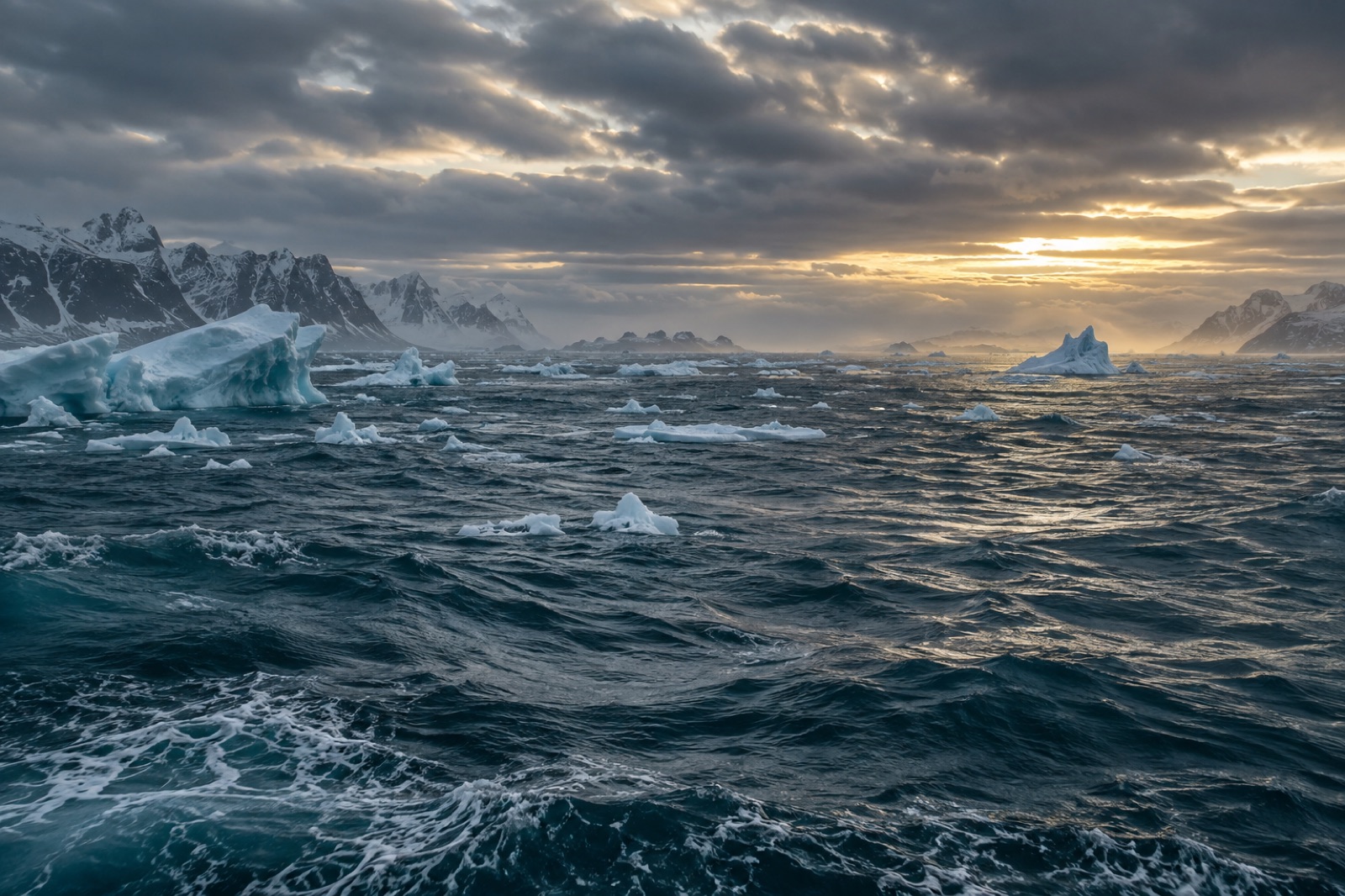
The AMOC Explained: The Atlantic's Overturning Engine
How the Atlantic's great overturning circulation works, what the observations say about its strength, and why its slowing matters for climate and coasts.
Dr. Lena Fischer ·
Journal author
Climate Scientist
Lena models ocean warming and marine heatwaves. She writes about the climate physics reshaping temperate coastlines — and what restoration can and cannot offset.
How the Atlantic's great overturning circulation works, what the observations say about its strength, and why its slowing matters for climate and coasts.
Dr. Lena Fischer ·
Nearly 4,000 drifting robots take the ocean's temperature from within. How Argo profiling floats work, what they measure, and why the data is free.
Dr. Lena Fischer ·
A region guide to Arraial do Cabo — the wind-driven upwelling that chills Brazil's warm coast, its kelp-like Sargassum beds, rich reefs and dive-season rhythms.
Dr. Lena Fischer ·
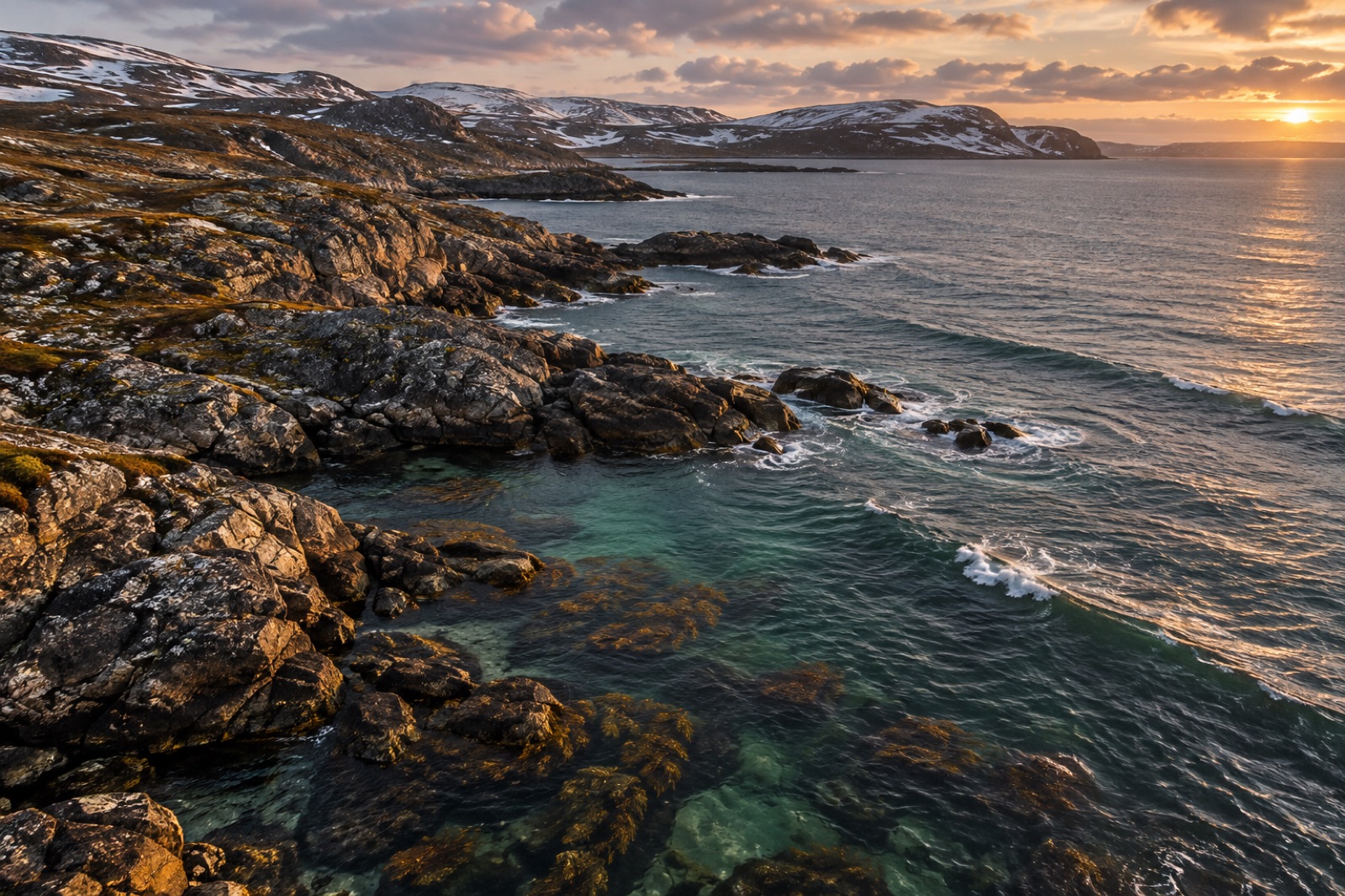
A Coastal Atlas guide to Russia's Murman Coast, the ice-free Arctic shore warmed by the Gulf Stream, where kelp forests grow far past the polar circle.
Dr. Lena Fischer ·
How the biggest tidal range on Earth reshapes kelp habitat — and where kelp still grips the outer headlands of the Bay of Fundy.
Dr. Lena Fischer ·
In the brackish, landlocked Black Sea, Cystoseira barbata once built kelp-like forests on shallow rock. Eutrophication broke them; now the coast is rebuilding.
Dr. Lena Fischer ·
A coastal atlas guide to Browns Bank, the Scotian Shelf plateau where kelp grows far offshore, urchins regrew and crashed, and science has watched for fifty years.
Dr. Lena Fischer ·
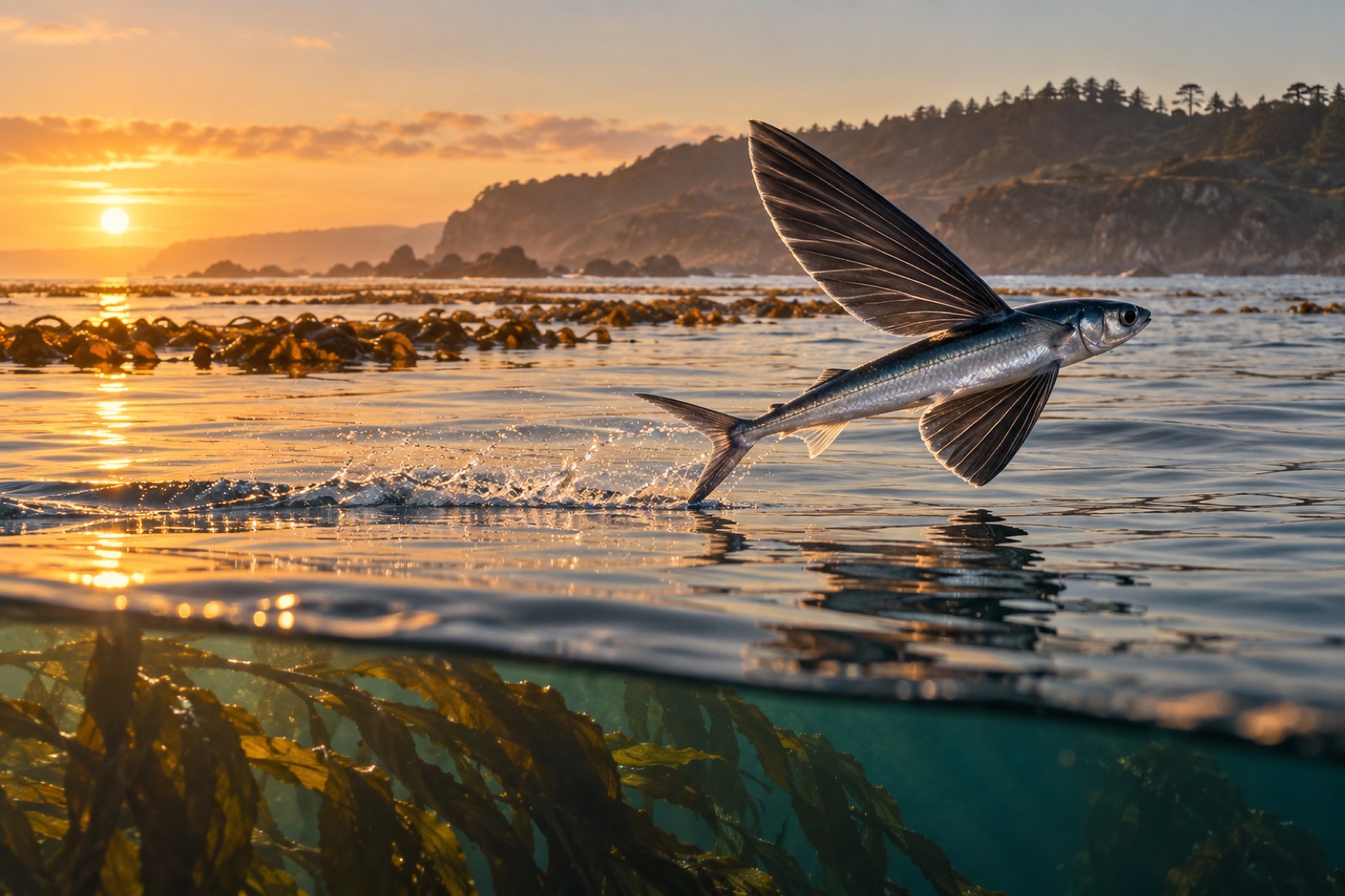
California flying fish: the biggest glider above the kelp coast. How they launch, why they arrive with warm water, and what eats them.
Dr. Lena Fischer ·
Seawater carries a built-in shock absorber for acidity: the carbonate buffer. How it works, why it's wearing thin, and what it means for shell-builders and kelp.
Dr. Lena Fischer ·
As seas rise, coastal habitats migrate inland — unless seawalls block the way. How coastal squeeze threatens kelp forests and the intertidal zone, and what helps.
Dr. Lena Fischer ·
Coastal trapped waves carry sea level, temperature and nutrient signals thousands of kilometres along coastlines — the ocean's long-distance phone line.
Dr. Lena Fischer ·
A CTD cast reads temperature, salt and depth through the whole water column. Inside the instrument that gave oceanography its vertical vision.
Dr. Lena Fischer ·
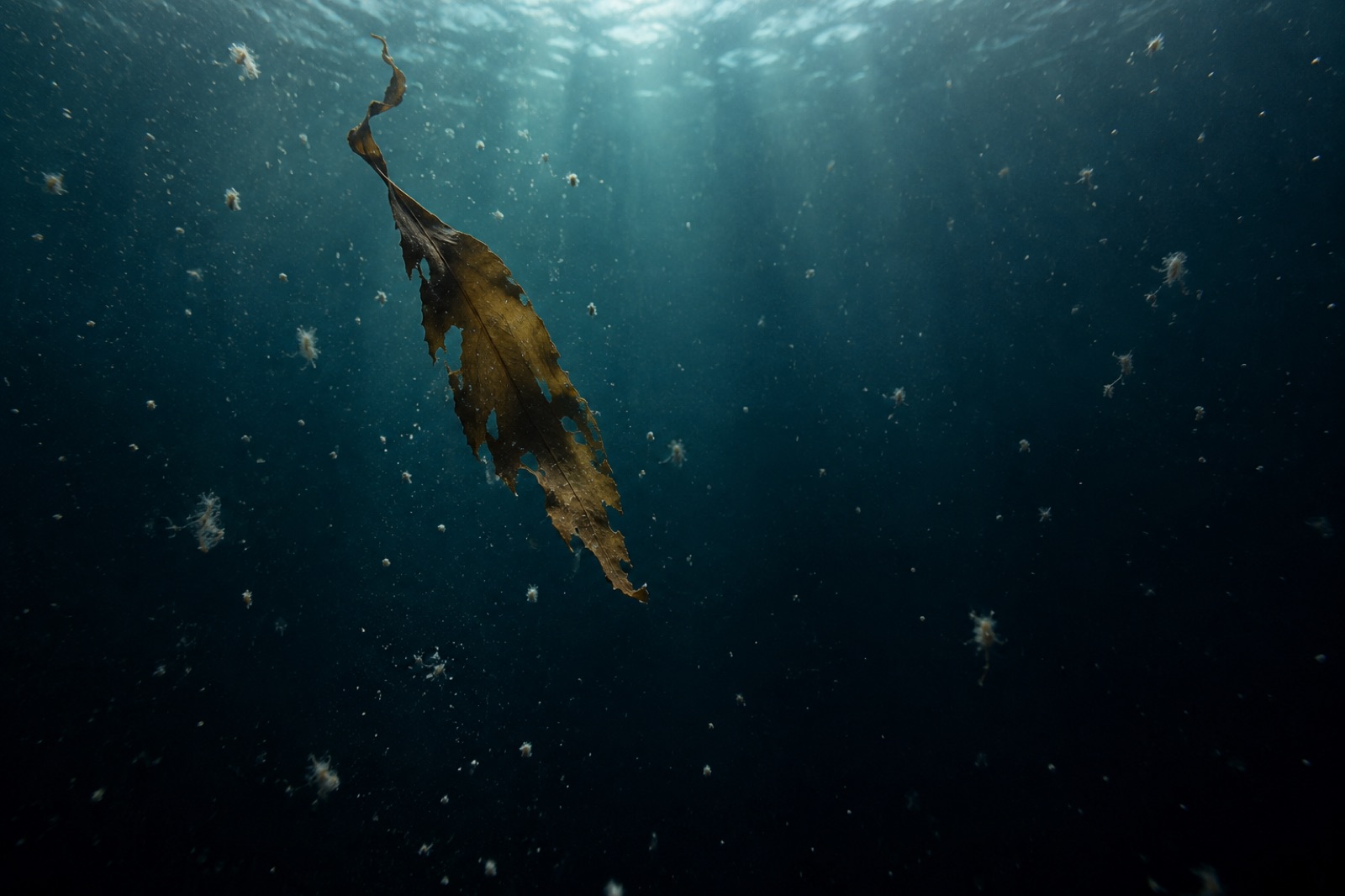
Burial is the finish line of blue carbon: organic matter locked into deep-sea sediment for centuries. Here's what burial means, how scientists prove it, and why it's rare.
Dr. Lena Fischer ·
The East China Sea around the Zhoushan archipelago: a legendary fishing ground, Yangtze plume ecology, seaweed farming south, and lessons in recovery.
Dr. Lena Fischer ·
What marine ecotoxicology careers involve — contaminants, lab and field work, qualifications, employers, pay — and how to enter this vital pollution science.
Dr. Lena Fischer ·
How the ENSO cycle works — trade winds, thermocline tilt, warm pools and global teleconnections — and why the Pacific's mood swings reach every ocean.
Dr. Lena Fischer ·
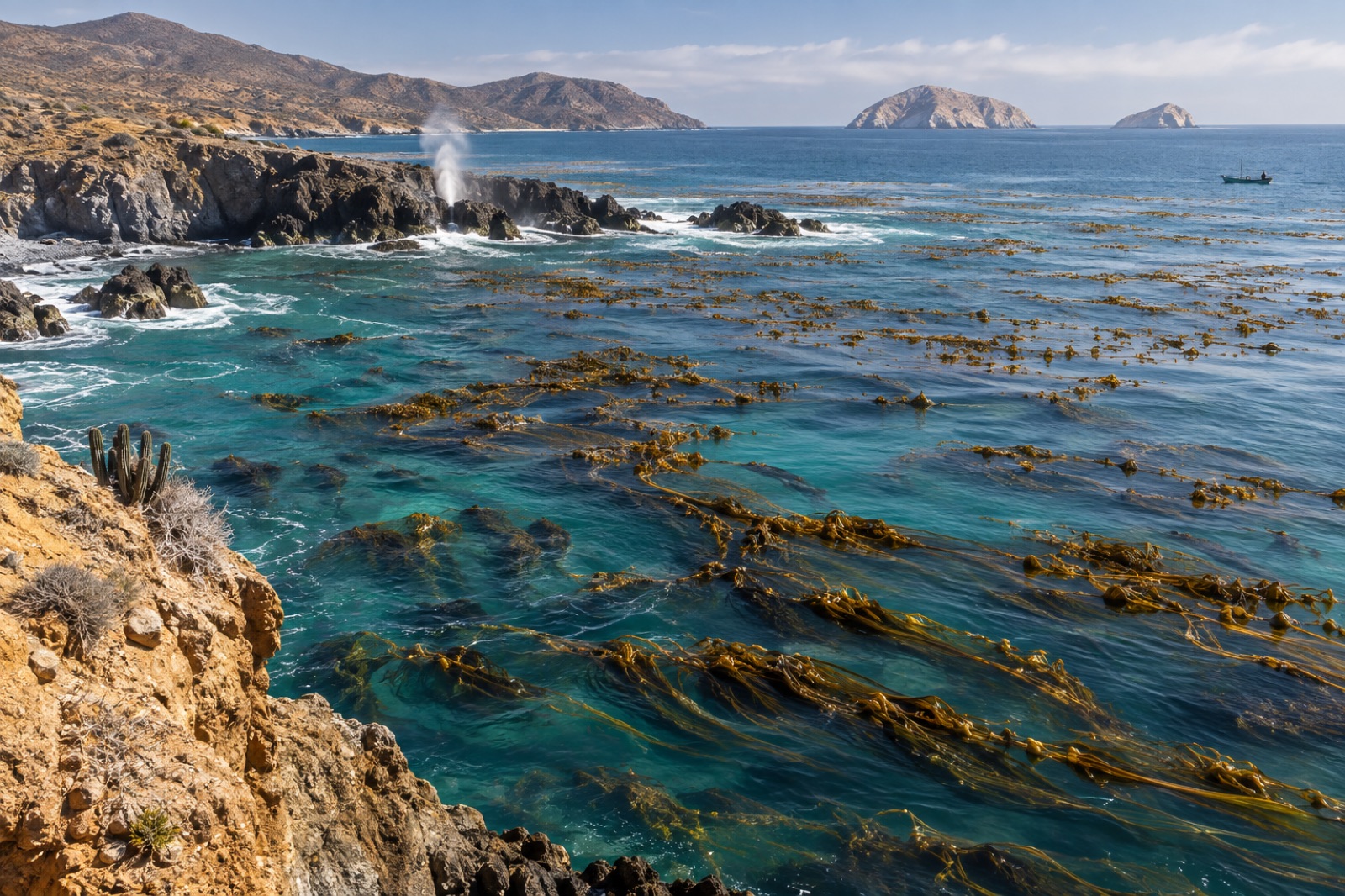
Where giant kelp fades toward its southern limit, Ensenada's upwelled bay hosts Mexico's only commercial kelp harvest and a coast of science, surf and urchins.
Dr. Lena Fischer ·
ENSO forecasts steer decisions on kelp coasts months ahead. Here's how they're made, how far ahead they're skilled, and what they can't tell you.
Dr. Lena Fischer ·
Falklands kelp grows so dense it damps waves, stalls boats and builds calm harbours. Inside the physics and ecology of the world's thickest kelp belt.
Dr. Lena Fischer ·
A Tidewright field note from Chile's Coquimbo coast: twelve days of sonar, CTD casts and dive transects to write the first baseline for our newest kelp program.
Dr. Lena Fischer ·
Milford, Doubtful and Dusky: a guide to Fiordland's drowned glacial fjords, where a dark freshwater lid hides kelp forests and shallow-growing black coral.
Dr. Lena Fischer ·
Two centuries of retreating ice opened fjords that kelp, otters and whales are still colonising — a guide to Glacier Bay's young, fast-changing underwater forests.
Dr. Lena Fischer ·
From Southeast Alaska's fjords to the Aleutian storm line, the Gulf of Alaska holds one of Earth's largest kelp coasts — and the otters it was built around.
Dr. Lena Fischer ·
The Gulf of Maine is warming faster than almost any body of water on Earth. What that means for its sugar kelp forests, its lobster economy, and its future.
Dr. Lena Fischer ·
Glaciers, an active volcano and some of Earth's loneliest kelp — a guide to Heard and McDonald Islands, Australia's subantarctic World Heritage group.
Dr. Lena Fischer ·
Sugar kelp under six months of sea ice, belugas in the estuary and a lengthening summer: a guide to the subarctic kelp fringe of Hudson Bay's Churchill coast.
Dr. Lena Fischer ·
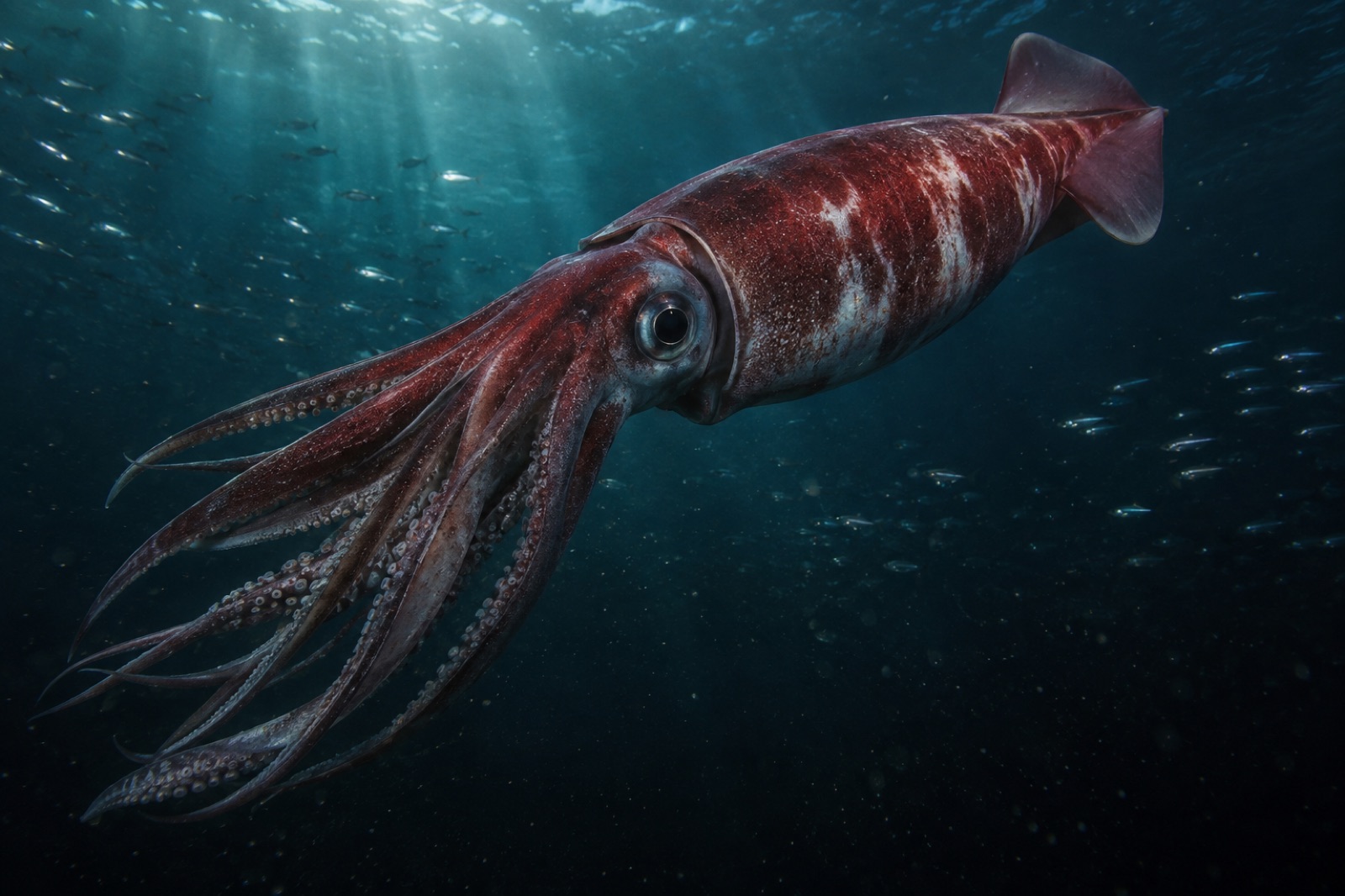
Humboldt squid (Dosidicus gigas): the fast-growing red devil of the Eastern Pacific, its twilight-zone life, and its warm-year marches north.
Dr. Lena Fischer ·
Beneath the surface tide runs a hidden one, pulsing cold nutrient-rich water onto reefs on a fortnightly beat. How the internal tide keeps kelp forests fed.
Dr. Lena Fischer ·
Internal waves arrive in packets of solitary giants, break underwater, and flood reefs with cold, nitrate-rich water. A field guide to the surf no one sees.
Dr. Lena Fischer ·
The ocean's biggest waves never break the surface. How internal waves ride the hidden boundary between water layers and deliver cold nutrients to kelp forests.
Dr. Lena Fischer ·
Kelp forests release iodine gases that seed coastal aerosol particles and change air chemistry. Here's what that really means for clouds — and what it doesn't.
Dr. Lena Fischer ·
Kelp survives storms not by being strong but by being soft. How flexible stipes, streamlined blades and smart materials let kelp cheat drag — and where the design fails.
Dr. Lena Fischer ·
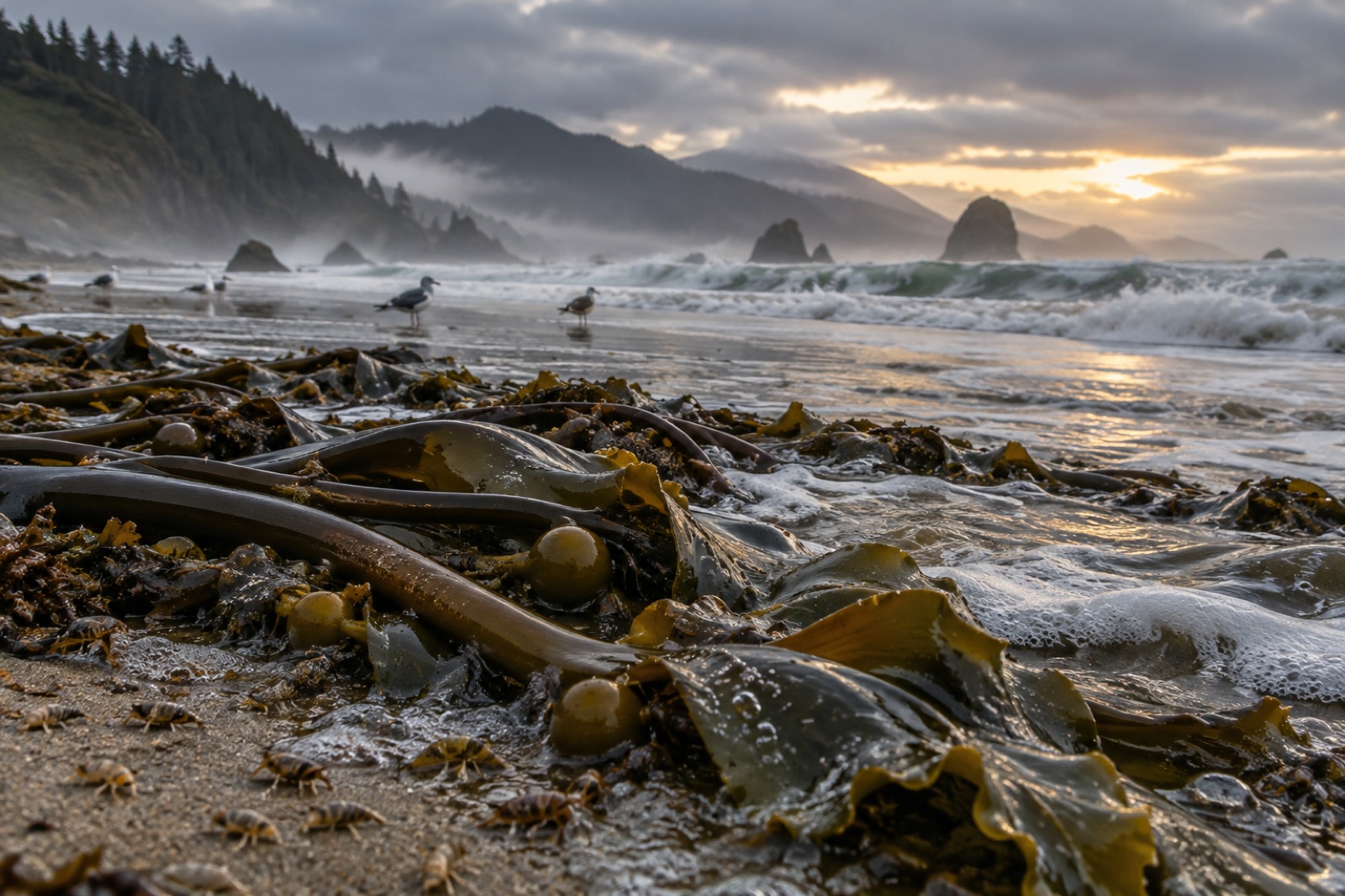
Kelp grows fast and dies young. Follow its carbon from sunlit blade to beach wrack, deep-sea fall and seafloor sediment — the full journey of kelp detritus.
Dr. Lena Fischer ·
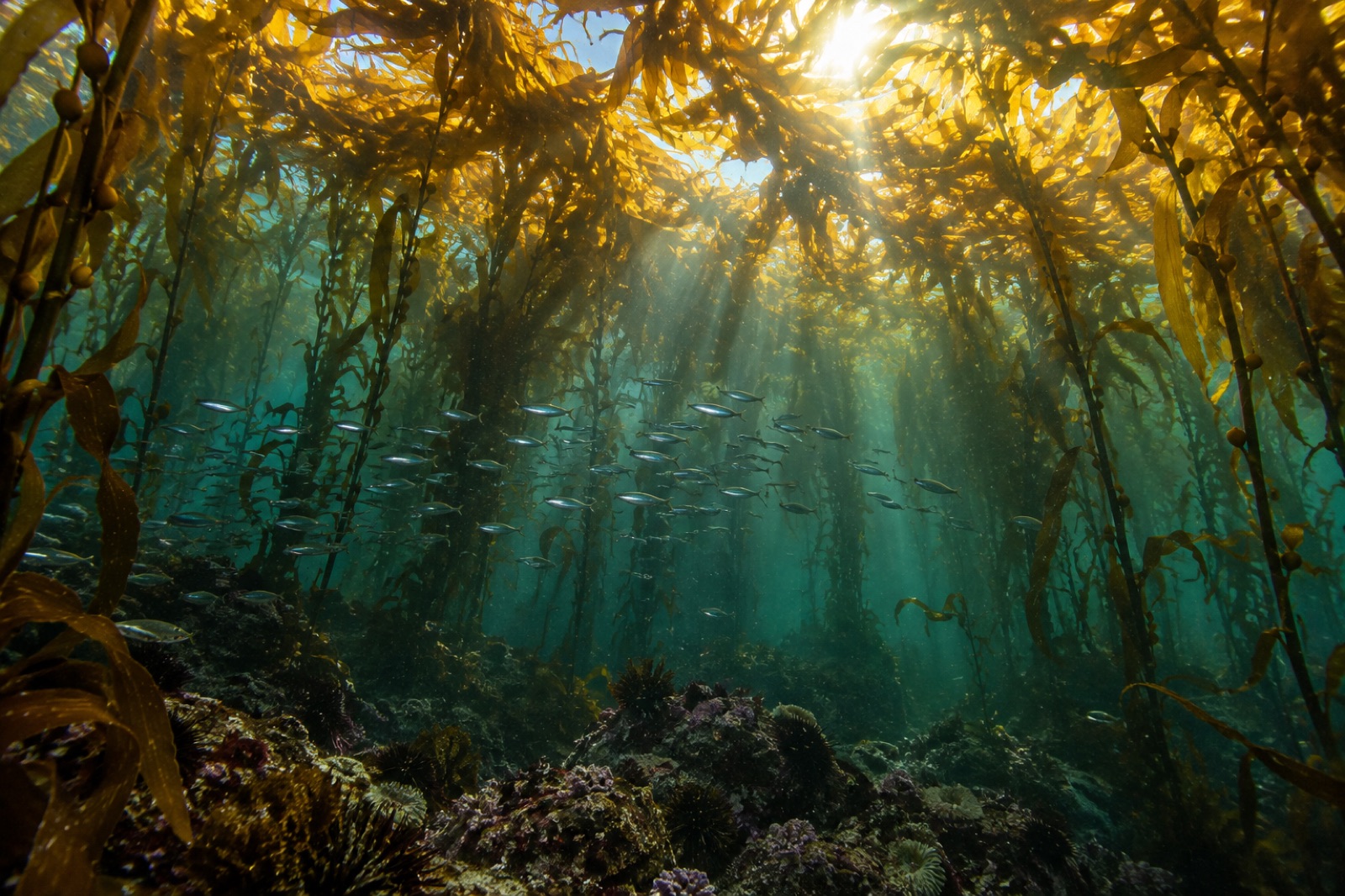
A kelp canopy does more than block light — it quietly rewrites the heat below. How canopy shade builds cool micro-refuges during heat spikes.
Dr. Lena Fischer ·
King tides are the year's highest tides — astronomy, not weather. How perigee, syzygy and the solstices stack up, and why they preview our coastal future.
Dr. Lena Fischer ·
Where a warm current runs the wrong way, kelp forests hold the tropical edge — the Margaret River capes, their wildlife and the heatwave that changed them.
Dr. Lena Fischer ·
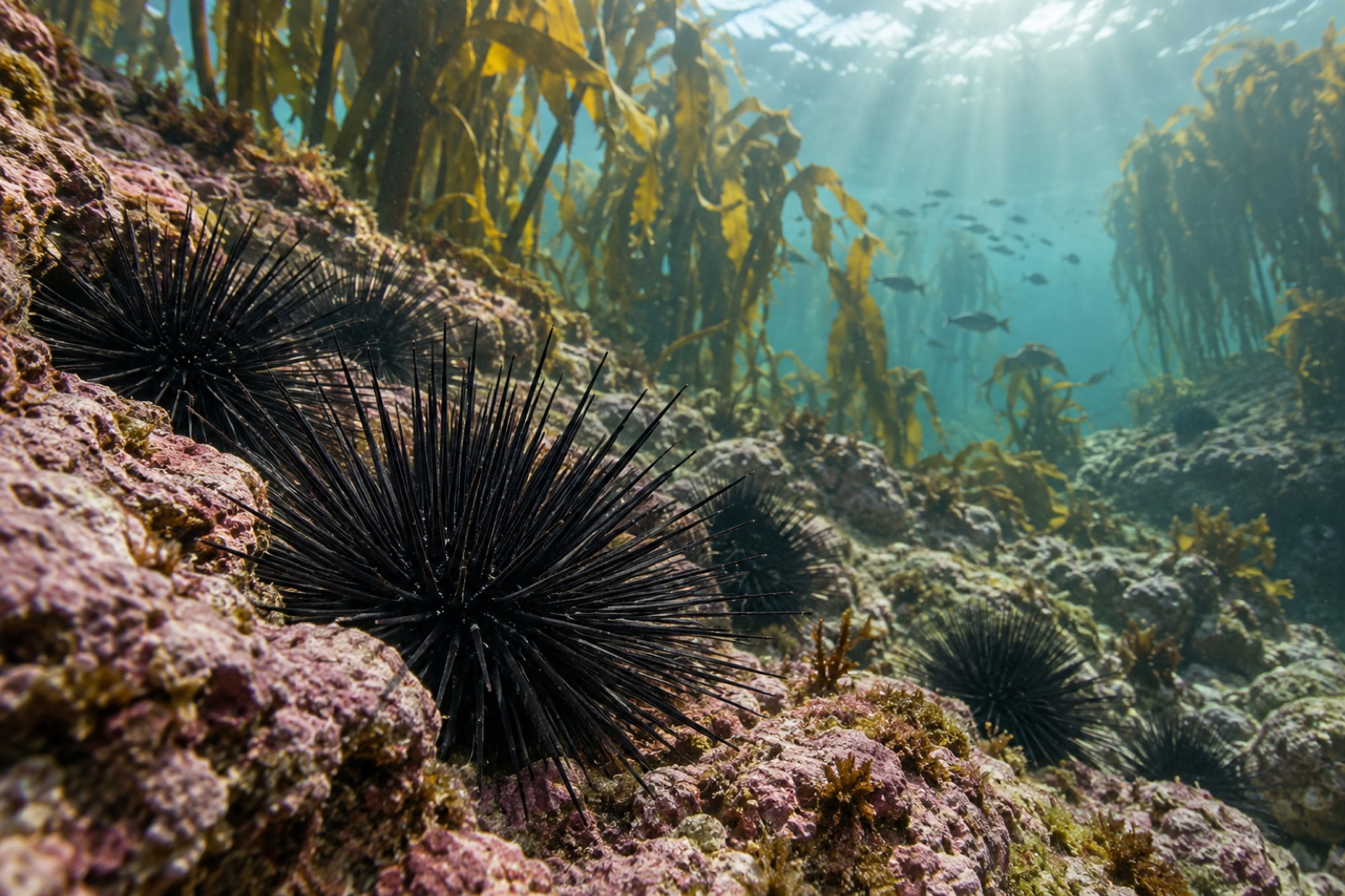
The long-spined sea urchin is reshaping Australia's temperate reefs as warming currents carry it south — a species profile of the barren-builder of Tasmania.
Dr. Lena Fischer ·
Off Namibia's windswept diamond coast, the Lüderitz upwelling cell brews some of the coldest, richest water in the Benguela — and a desert-shore kelp forest.
Dr. Lena Fischer ·
A low archipelago of red cliffs and dunes in the warming Gulf of St Lawrence, fringed with kelp and eelgrass and ringed by some of Canada's most dynamic coastal water.
Dr. Lena Fischer ·
Mount Desert Island's granite meets the cold Gulf of Maine — rockweed shores, subtidal kelp ledges and the science of a warming coast around Acadia.
Dr. Lena Fischer ·
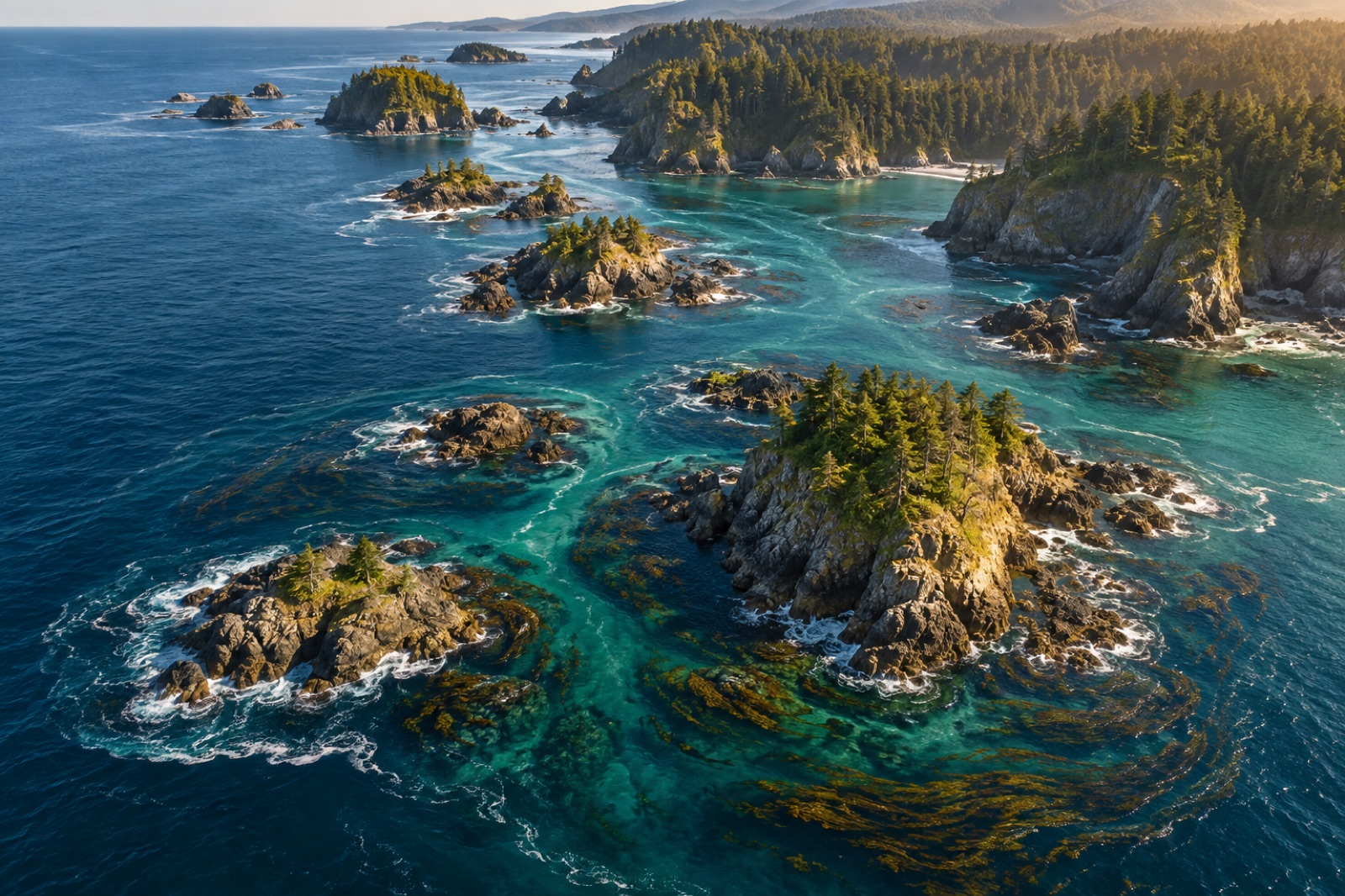
Reefs are joined by currents into a living network. How connectivity works, why stepping stones matter, and how it shapes marine reserves and kelp restoration.
Dr. Lena Fischer ·
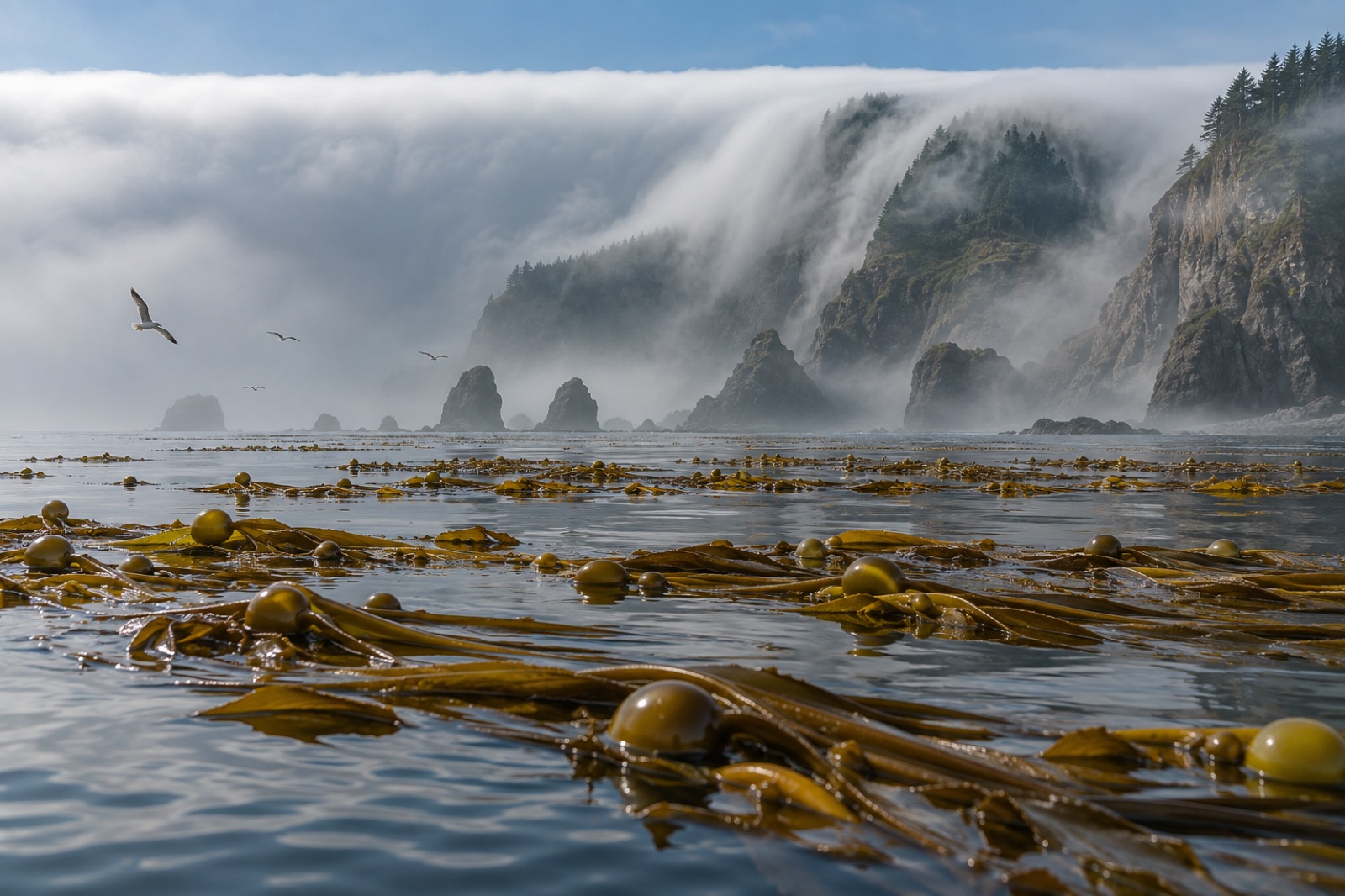
Why the world's great kelp coasts spend their summers under a blanket of fog, how the ocean manufactures it, and what a shifting grey sky means for forests below.
Dr. Lena Fischer ·
How attribution science works for marine heatwaves — fraction of attributable risk, model counterfactuals, and what it means for baselines and reversal risk.
Dr. Lena Fischer ·
Marine heatwaves are spikes riding on a rising baseline of ocean warming. How scientists separate the two signals — and why the difference matters for reefs.
Dr. Lena Fischer ·
Marine mucilage — the 'sea snot' that smothered the Sea of Marmara — is plankton slime gone rogue. What it is, why it happens, and the climate signal inside.
Dr. Lena Fischer ·
How oceanographers measure seawater pH and alkalinity, why it's harder than it looks, the sensor zoo from Argo floats to moorings, and what the numbers mean.
Dr. Lena Fischer ·
Mesoscale eddies — the ocean's weather systems — shuttle nutrients and larvae across continental shelves. How they form, how they're seen, why kelp cares.
Dr. Lena Fischer ·
The ocean's mixed layer — its wind-stirred surface engine — sets how much light plankton see and when deep nutrients return. How mixed layer depth works and why it matters.
Dr. Lena Fischer ·
Ocean alkalinity enhancement removes CO2 by shifting seawater chemistry. Here is the drawdown chain, dose-by-dose: how much carbon, how fast, and where.
Dr. Lena Fischer ·
The ocean is losing oxygen — measurably and globally. How warming and nutrient stress squeeze marine life's air supply, and what that does to kelp forests.
Dr. Lena Fischer ·
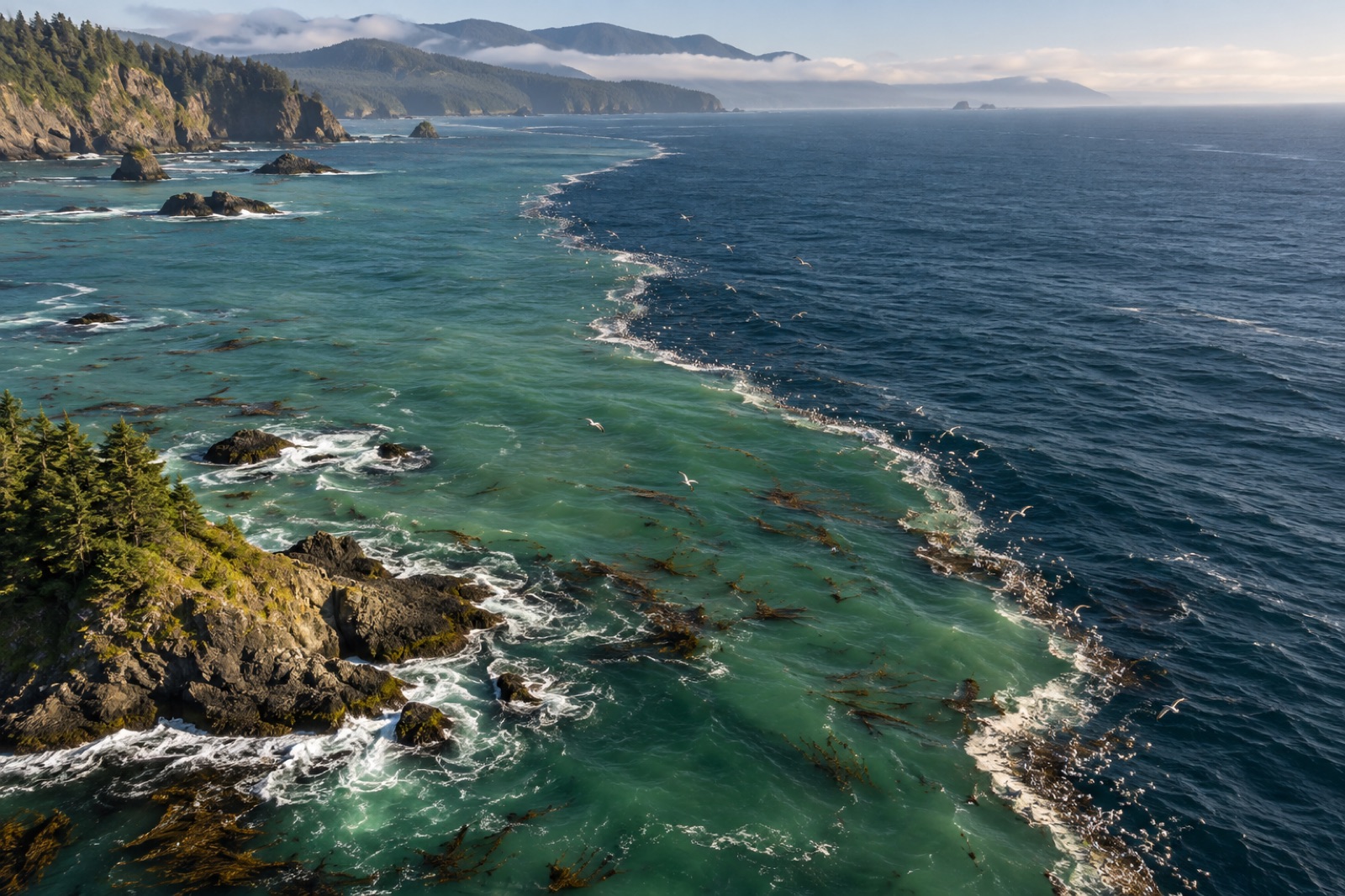
Ocean fronts — the sharp boundaries where different water masses collide — concentrate plankton, baitfish and predators into living lines. Here's why they matter.
Dr. Lena Fischer ·
Five vast gyres turn like slow wheels in every ocean basin, shaping currents, climate and where plastic gathers. Here's how ocean gyres actually work.
Dr. Lena Fischer ·
Over 90 percent of the planet's trapped heat is in the ocean. How we measure ocean heat content, from expendable probes to 4,000 drifting floats — and why it matters.
Dr. Lena Fischer ·
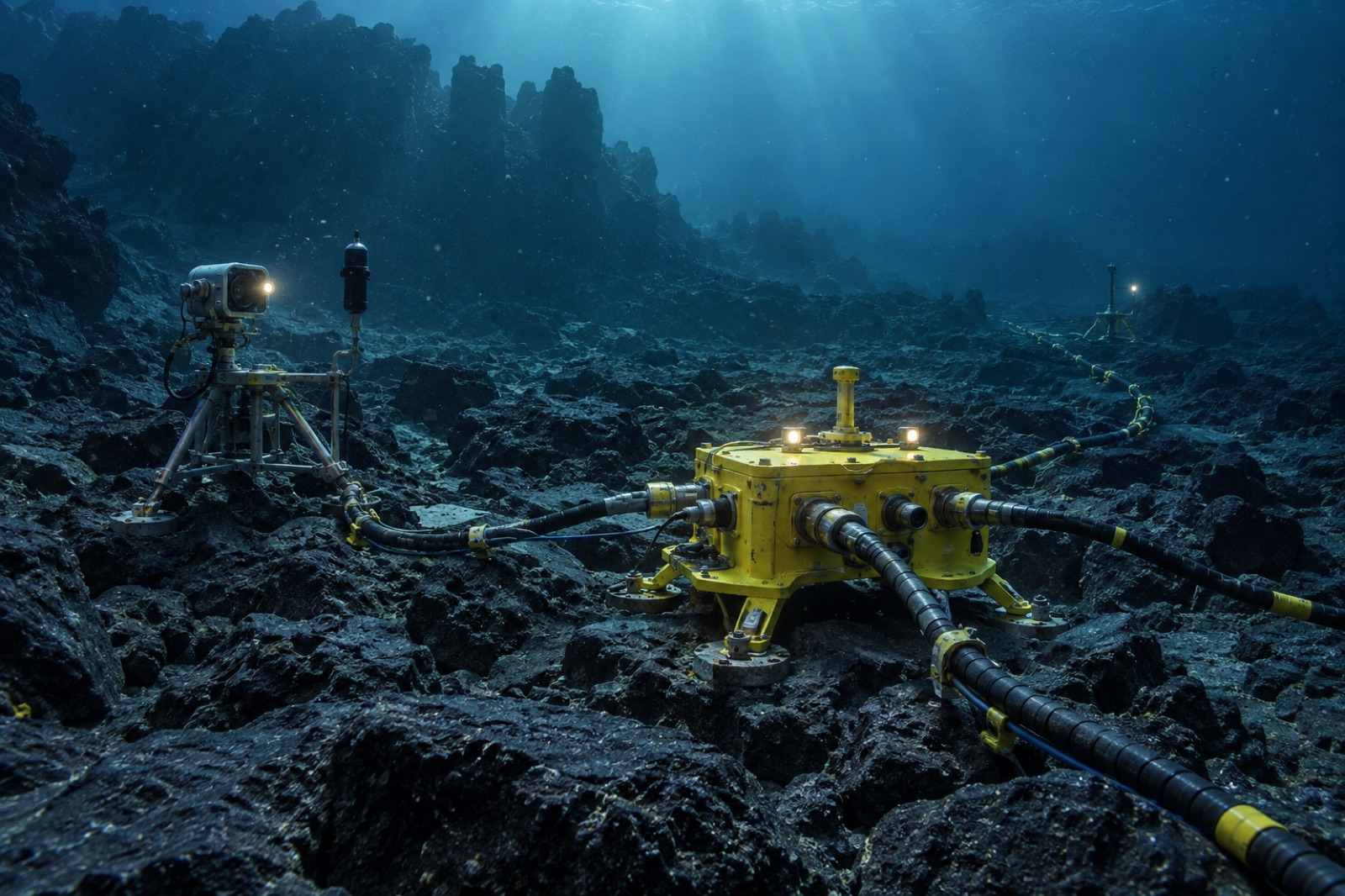
Cabled ocean observatories plug the deep sea into fibre and power, streaming data around the clock. What these wired reefs see that research ships can't.
Dr. Lena Fischer ·
'Every second breath comes from the ocean' — true, and incomplete. Here's the ocean's real oxygen budget, who pays in, and kelp's honest share.
Dr. Lena Fischer ·
Coastal planning, permitting, marine spatial planning, science advice — ocean policy careers translate research into rules communities live by. Your map in.
Dr. Lena Fischer ·
Kelp blades can't drink faster than the water next to them allows. How blade-scale turbulence and boundary layers quietly control how fast a whole forest eats.
Dr. Lena Fischer ·
What oxygen minimum zones are, where they form, how they shape the largest daily migration on Earth, and why warming is pushing them wider and shallower.
Dr. Lena Fischer ·
As oceans warm, tropical herbivores and warm-adapted species are moving poleward into kelp reefs — reshaping forests from Tasmania to Japan. The science of tropicalization.
Dr. Lena Fischer ·
What causes red tides and harmful algal blooms, the toxins behind shellfish closures, why warming waters are shifting the risk, and how scientists watch for them.
Dr. Lena Fischer ·
Rhode Island's kelp beds were already at their warm limit when the water started heating. What remains — and what was lost — is a preview of New England's future.
Dr. Lena Fischer ·
Rip currents are the surf zone's return plumbing — narrow, fast rivers of seawater leaving the beach. The physics behind them, and how to get out of one.
Dr. Lena Fischer ·
Rivers deliver iron, silica and nutrients that kelp need — and sediment, freshets and effluent that can bury them. How land–sea connectivity shapes kelp forests.
Dr. Lena Fischer ·
River plumes deliver nutrients that feed kelp forests — and floods that smother them in sediment and fresh water. The double-edged physics of the river mouth.
Dr. Lena Fischer ·
Sea ice forms, grows and melts on the ocean itself, reshaping light, salt and circulation. How it forms, why algae bloom under it, and what its retreat means for kelp.
Dr. Lena Fischer ·
Sea levels are rising faster than at any time in millennia. What actually drives it — expanding water, melting ice, sinking land — and what it means for coasts and kelp.
Dr. Lena Fischer ·
How satellites derive sea surface temperature from infrared and microwave radiometers, why clouds and fog mask kelp coasts, and how scientists validate SST.
Dr. Lena Fischer ·
From photon to map: the orbits, instruments, processing levels and data products behind satellite sea surface temperature — and how to read an SST map like an oceanographer.
Dr. Lena Fischer ·
Why the sea is salty, why it's slightly alkaline, and why its pH is drifting. A gentle but rigorous introduction to the chemistry that rules marine life.
Dr. Lena Fischer ·
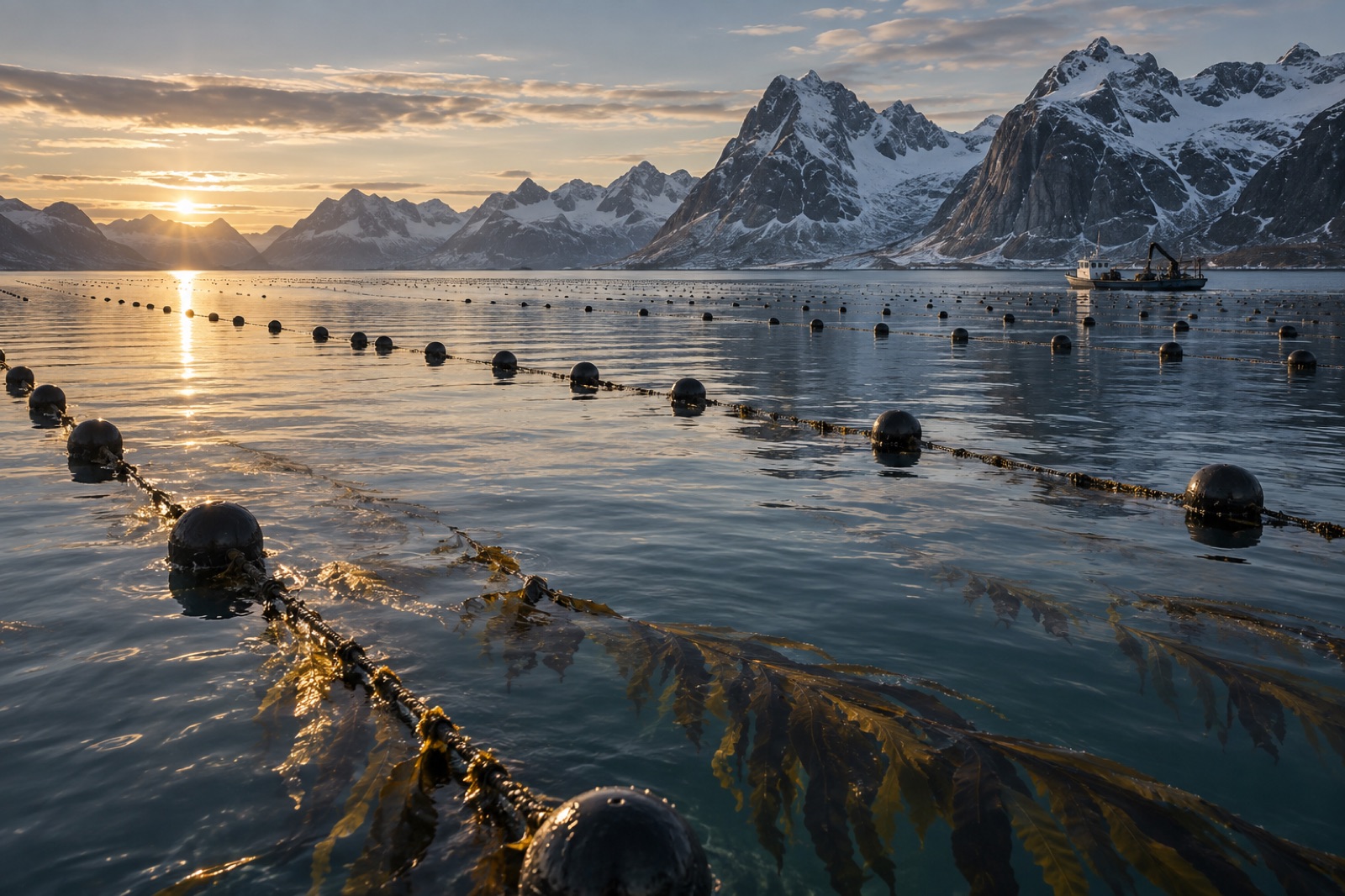
A regional guide to seaweed farming in Arctic and subarctic waters: compressed growing windows, midnight-sun growth, ice risk, cold-adapted kelps and northern markets.
Dr. Lena Fischer ·
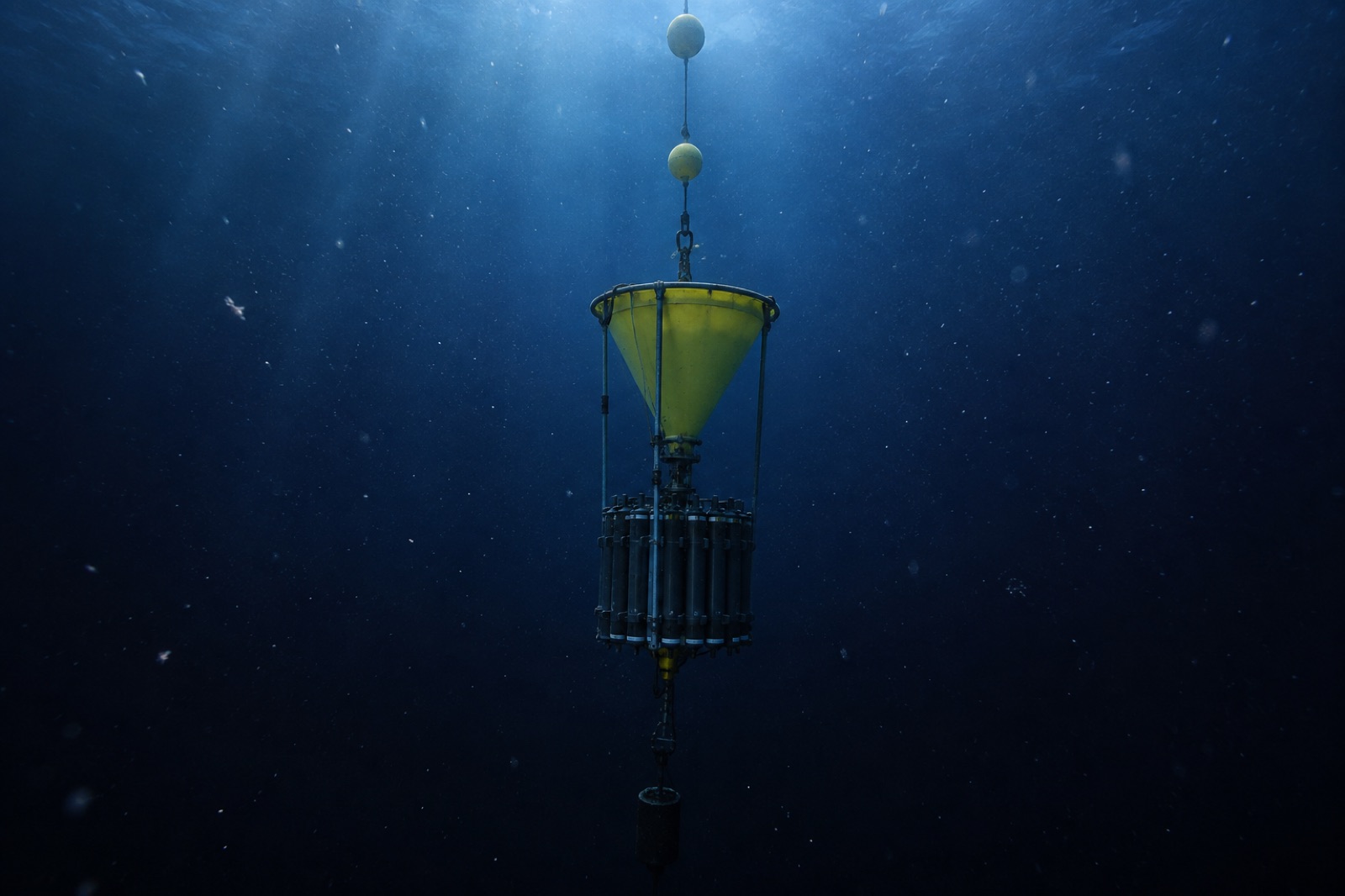
How do we measure carbon sinking through ocean? Sediment traps — moored funnels hundreds of metres deep — catch marine snow and tally the export flux.
Dr. Lena Fischer ·
A ring of giant kelp fringes South Georgia's glaciated mountains — and around it, whales, seals and penguins are crawling back from industrial ruin.
Dr. Lena Fischer ·
Storms tear kelp forests apart — and keep them young. How wave forces damage kelp, why disturbance is essential to forest health, and what a stormier future means.
Dr. Lena Fischer ·
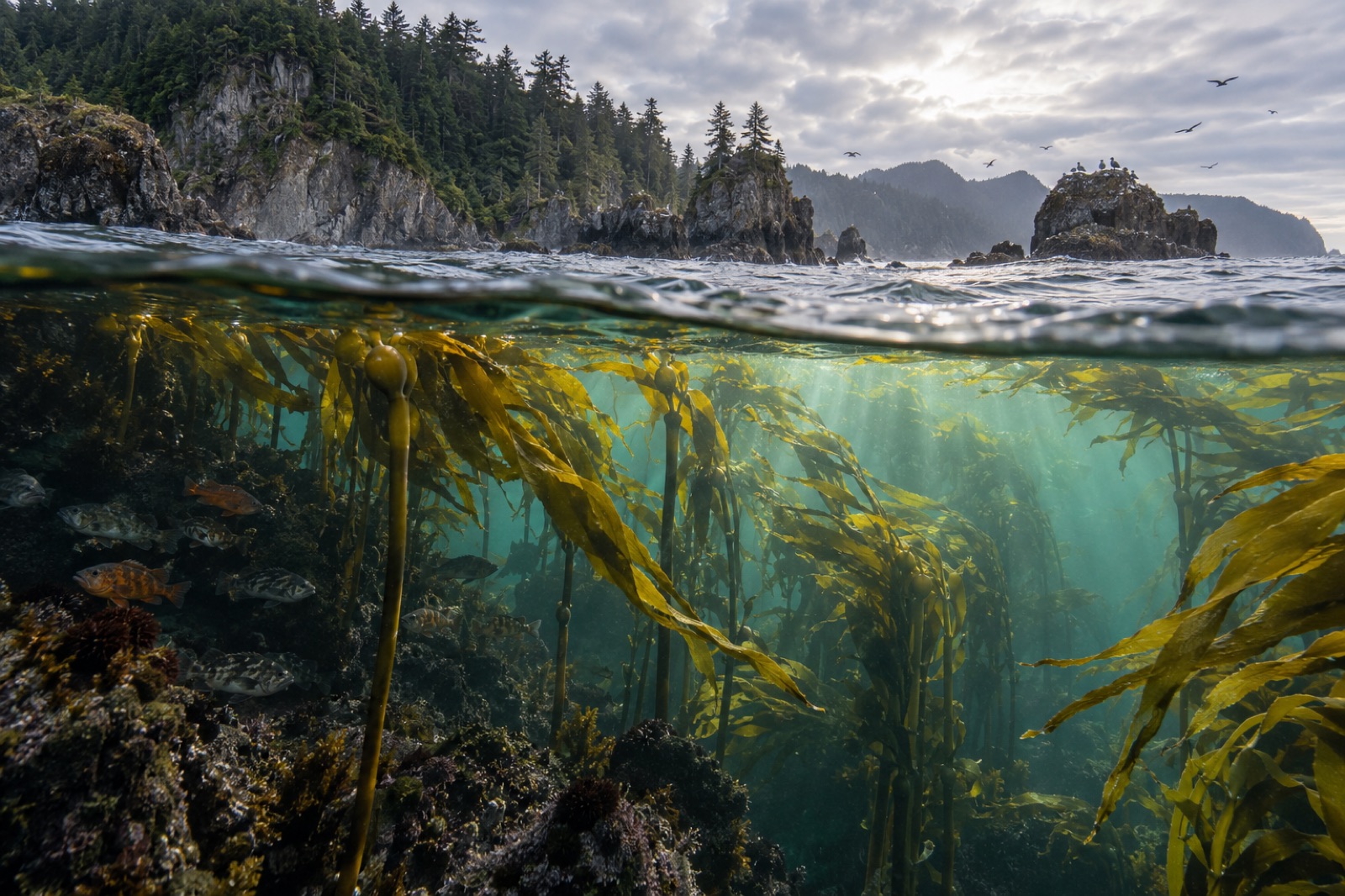
At the Salish Sea's front door, Pacific upwelling meets inland outflow over bull kelp forests and tidal races. A coastal atlas guide to the strait.
Dr. Lena Fischer ·
Freshwater doesn't stop at the shoreline. Submarine groundwater springs up through seabeds on kelp coasts worldwide — carrying nutrients, cool refuge and sometimes trouble.
Dr. Lena Fischer ·
Thermoclines, haloclines and pycnoclines are the invisible boundaries that slice the sea into layers. What they are, how they form, and why they run coastal life.
Dr. Lena Fischer ·
Tide pools are mini-climates in a handful of seawater. Some shield life through marine heatwaves; others become traps. The physics, the genetics and the conservation case.
Dr. Lena Fischer ·
Tides move more water than all the world's rivers. A clear guide to why the sea rises and falls — moon, sun, spring and neap tides, and what it all means for kelp.
Dr. Lena Fischer ·
Where wind-driven upwelling stalls behind headlands, pockets of warm, retentive water form. These 'upwelling shadows' shape larvae, kelp and climate refuges.
Dr. Lena Fischer ·
Light is kelp's only real ceiling. How seawater absorbs and scatters sunlight, what sets kelp's depth limit, and why water clarity is a restoration variable.
Dr. Lena Fischer ·
Waves bend toward shallow water, which concentrates energy on headlands and spreads it in bays. How refraction shapes reefs, kelp forests and coastlines.
Dr. Lena Fischer ·
How coastal engineers evaluate kelp forests as wave protection — transmission, per-metre damping, storm-survival limits, and where living breakwaters genuinely fit.
Dr. Lena Fischer ·
A semi-enclosed sea in northwest Russia where kelp grows beneath months of ice, fed by Arctic rivers and Atlantic tides — one of Earth's most unusual kelp ecosystems.
Dr. Lena Fischer ·
Every great kelp forest sits in the shadow of a great current. Here's how western and eastern boundary currents shape temperature, nutrients and the world's temperate reefs.
Dr. Lena Fischer ·
Northern Spain's Cantabrian coast holds kelp at the shrinking warm edge of its European range — the continent's best-documented climate front line underwater.
Dr. Lena Fischer ·
Kelp carbon only matters for climate if it stays out of the air for centuries. How kelp carbon reaches the deep ocean — and what engineered sinking must prove.
Dr. Lena Fischer ·
Wind blows, water turns ninety degrees. The gentle physics of Ekman transport — the spiral beneath the surface, coastal upwelling, gyre hills and spills.
Dr. Lena Fischer ·
Both make headlines as warm water, but El Niño and marine heatwaves are different beasts. How they differ, how they interact, and what each does to kelp.
Dr. Lena Fischer ·
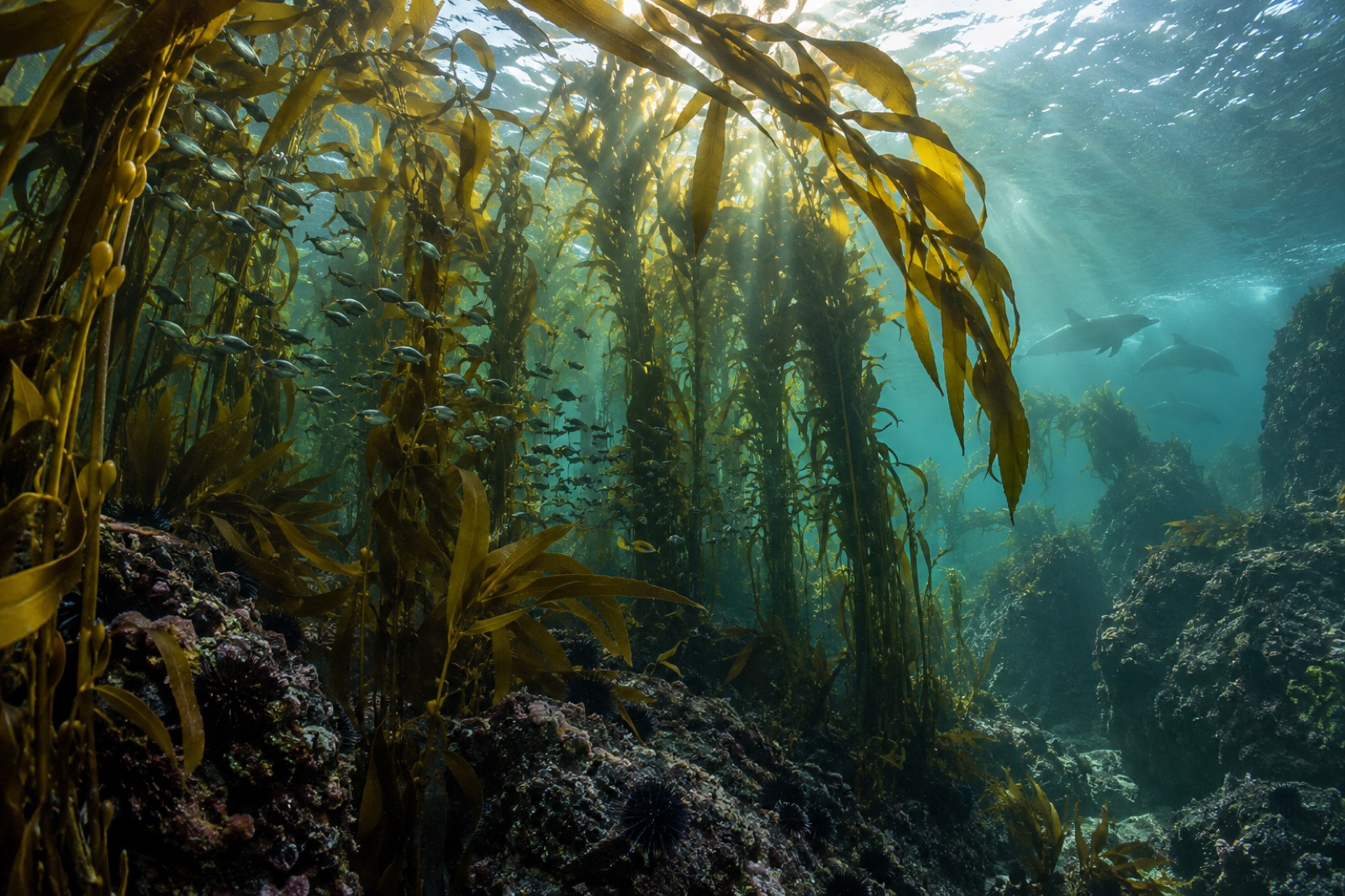
Inside the Falkland Islands' giant kelp beds — among the most extensive on Earth — and the penguins, seals and steamer ducks that run on them.
Dr. Lena Fischer ·
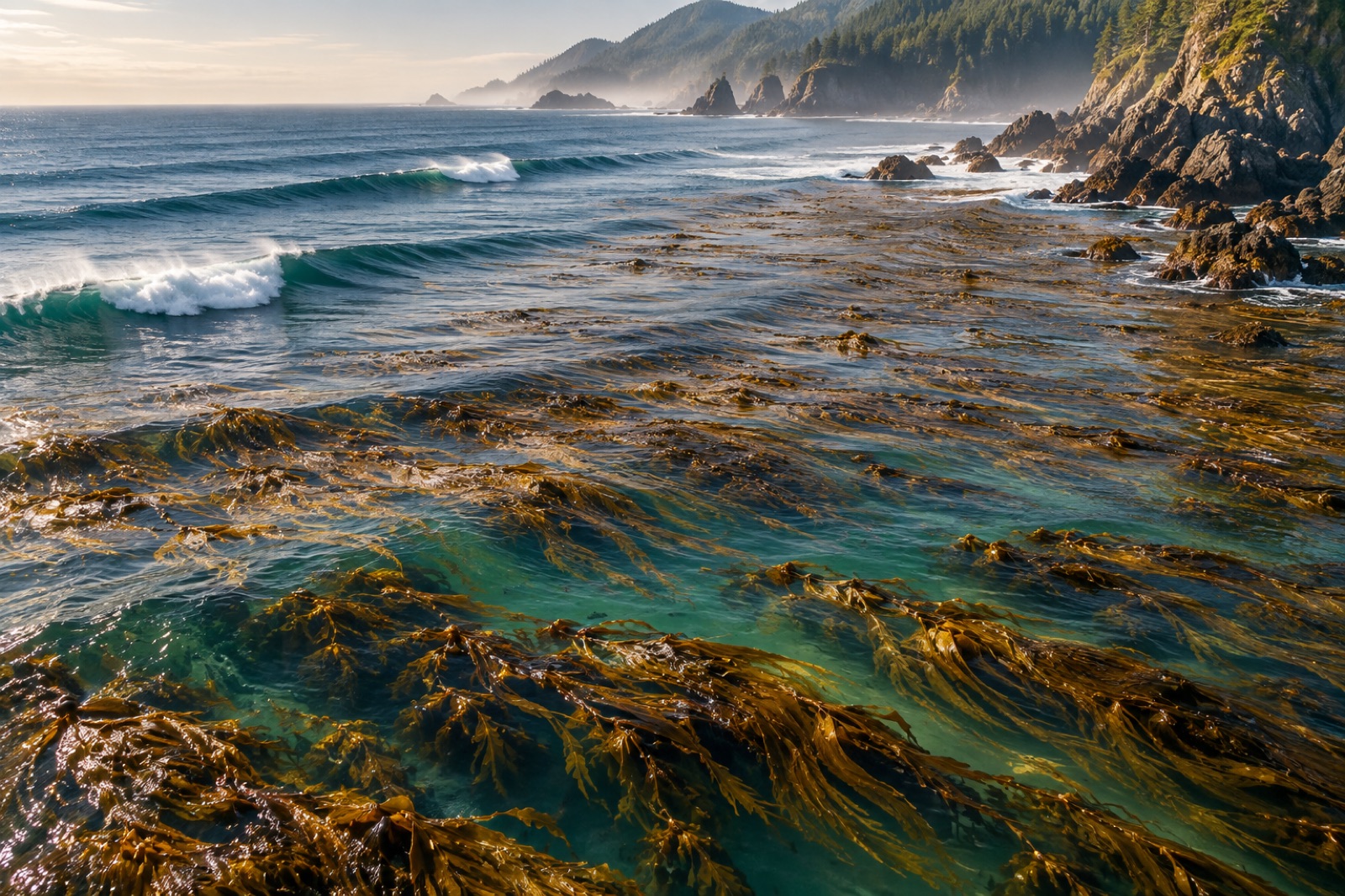
Kelp canopies act like flexible breakwaters, dragging energy out of waves and currents. Here's the physics — and how much coastal protection forests really give.
Dr. Lena Fischer ·
Ocean acidification goes far beyond a falling pH number. Here's where corrosive water actually shows up, what it does to hatcheries and fisheries, and how coasts adapt.
Dr. Lena Fischer ·
The ocean has absorbed about a third of our CO₂ emissions, quietly changing its chemistry. Here's the science of ocean acidification and what it means for sea life.
Dr. Lena Fischer ·
The ocean stacks itself into layers by temperature and density. Here's how stratification controls nutrients, productivity — and the fate of kelp forests.
Dr. Lena Fischer ·
No towns, no coast highway, 135 wild miles of rock and bull kelp under the Olympic mountains — the most intact temperate marine wilderness left in the lower 48.
Dr. Lena Fischer ·
Seasonal ocean forecasts can now flag elevated marine heatwave risk months ahead — sometimes. Here's what skill exists, where it fails, and who uses it.
Dr. Lena Fischer ·
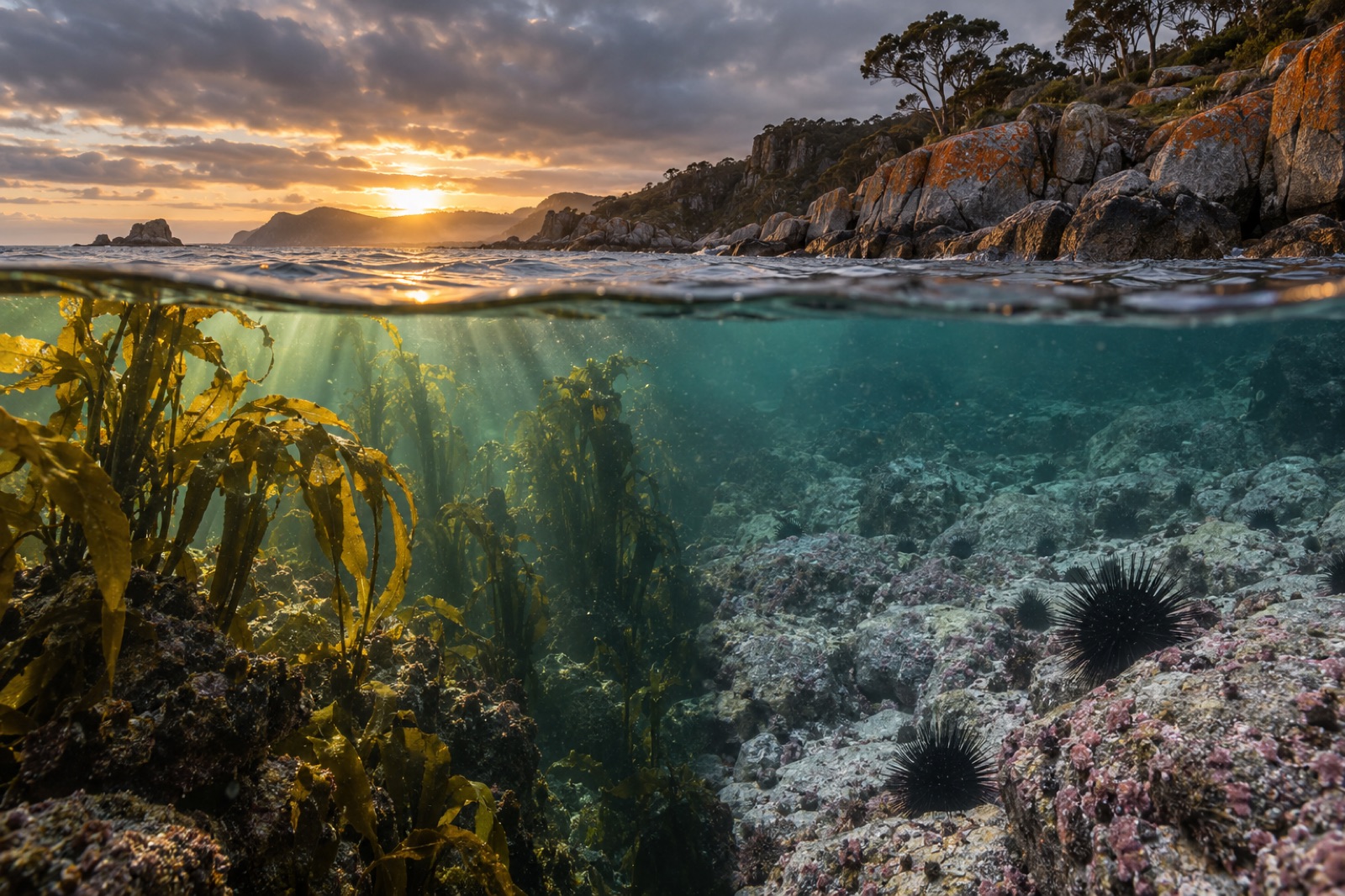
Tasmania's east coast has lost the vast majority of its giant kelp forests to warming seas and urchins. Explore what happened here, and what's coming back.
Dr. Lena Fischer ·
Coastal resilience planners decide how shorelines adapt to rising seas and fiercer storms. A guide to the role, the skills, the employers and the roads in.
Dr. Lena Fischer ·
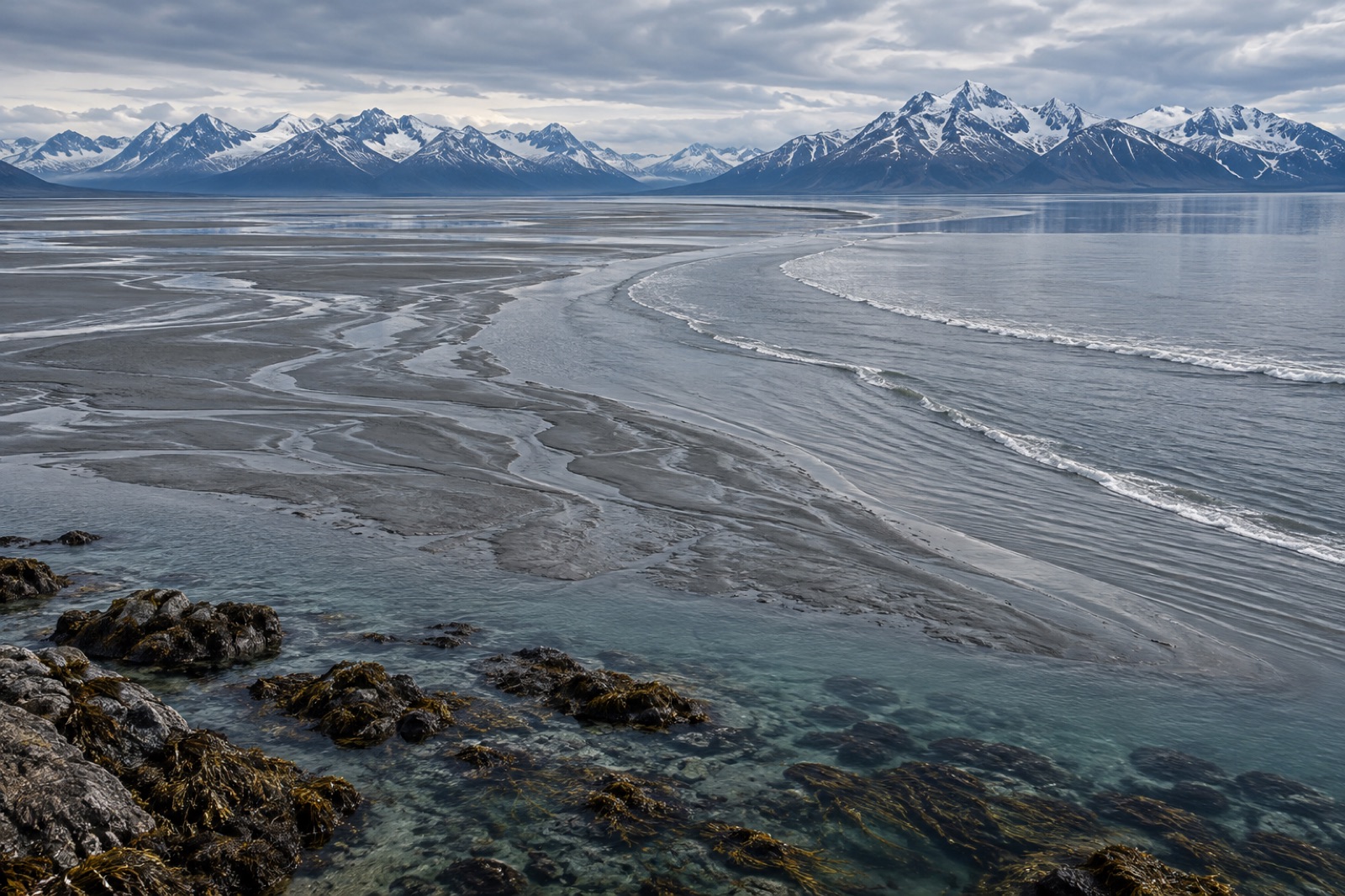
Cook Inlet is Alaska's great tidal estuary — bore tides, glacial silt, belugas and salmon, with rich cold-water kelp beds in its clear pockets. A Coastal Atlas guide.
Dr. Lena Fischer ·
From the Blob to the record-breaking 2023–24 ocean, the last decade of marine heatwave records shows extremes growing — and kelp forests in the firing line.
Dr. Lena Fischer ·
When Pacific oyster larvae began dying in Northwest hatcheries in the mid-2000s, ocean acidification stepped out of the textbook. Here's what happened.
Dr. Lena Fischer ·
A guide to the Gaspé Peninsula's kelp coast: cold green water, capelin runs on the beaches, the gannet cliffs of Percé, and the kelp forests of the St Lawrence.
Dr. Lena Fischer ·
How do you tell a real marine climate commitment from greenwash? A plain-language framework for reading net-zero ocean claims — and the questions that expose the gaps.
Dr. Lena Fischer ·
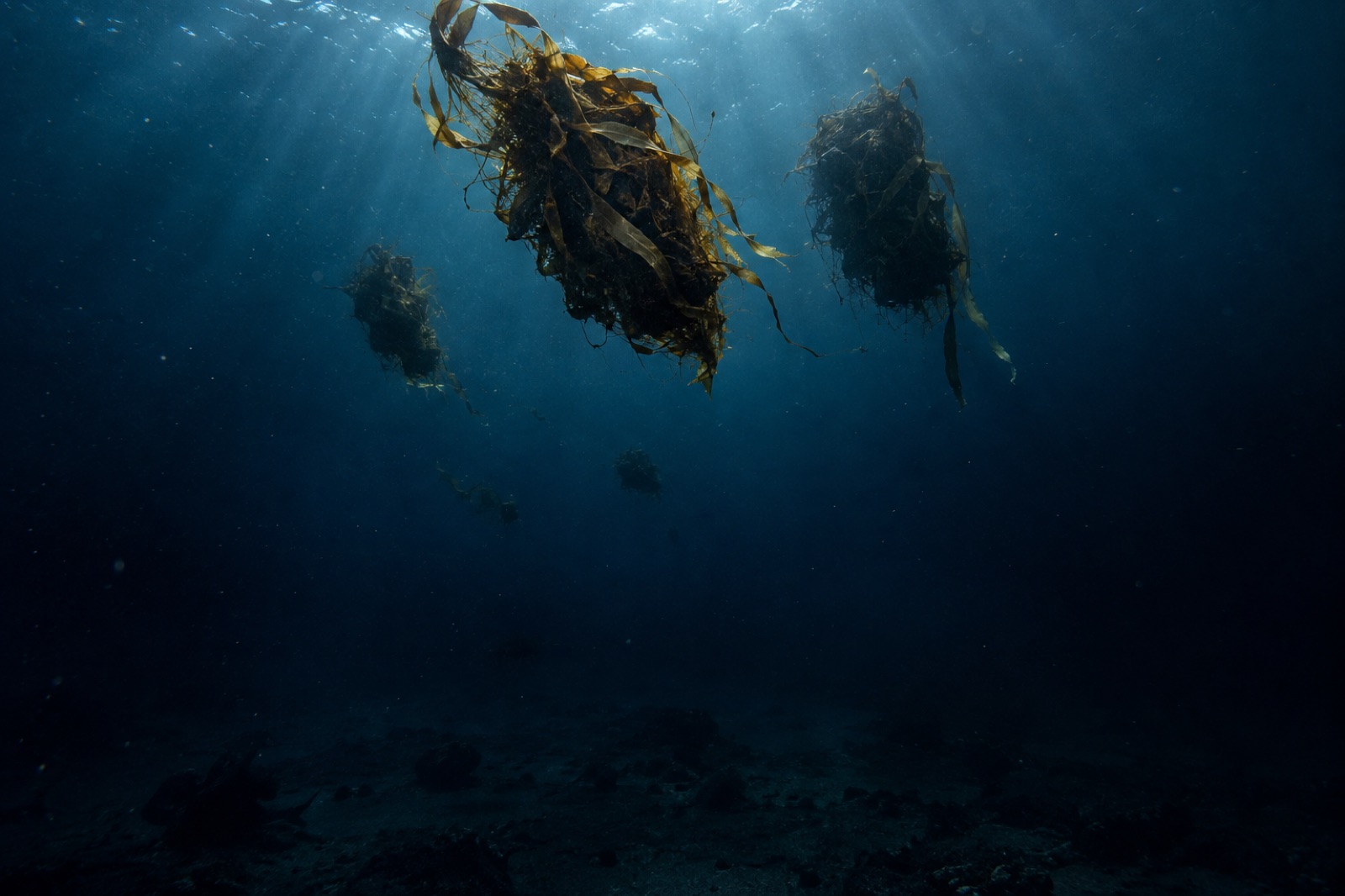
Seaweed sinking is the most contested idea in ocean carbon removal. Where the science has settled, where it hasn't, and five tests before crediting a tonne.
Dr. Lena Fischer ·
The Kattegat stacks brackish Baltic water over Skagerrak salt — a shallow sea where kelp forests grow, thin and vanish along a European salinity gradient.
Dr. Lena Fischer ·
Marine heatwaves are weeks of anomalously hot ocean that can deforest entire coastlines. Here's the science behind them and what restoration can do.
Dr. Lena Fischer ·
Why the ocean warms so slowly: heat capacity, thermal inertia and deep mixing hide enormous heat. What the ocean's long lag means for kelp forests and coasts.
Dr. Lena Fischer ·
A Coastal Atlas guide to Alaska's Kachemak Bay — nine-metre tides, famed seaweed diversity, otter-held kelp beds, kelp farms and how to visit from Homer.
Dr. Lena Fischer ·
Seawater filters sunlight within metres — reds vanish first, blues travel deepest. How underwater light sets the depth limits, seasons and colour of the world's kelp forests.
Dr. Lena Fischer ·
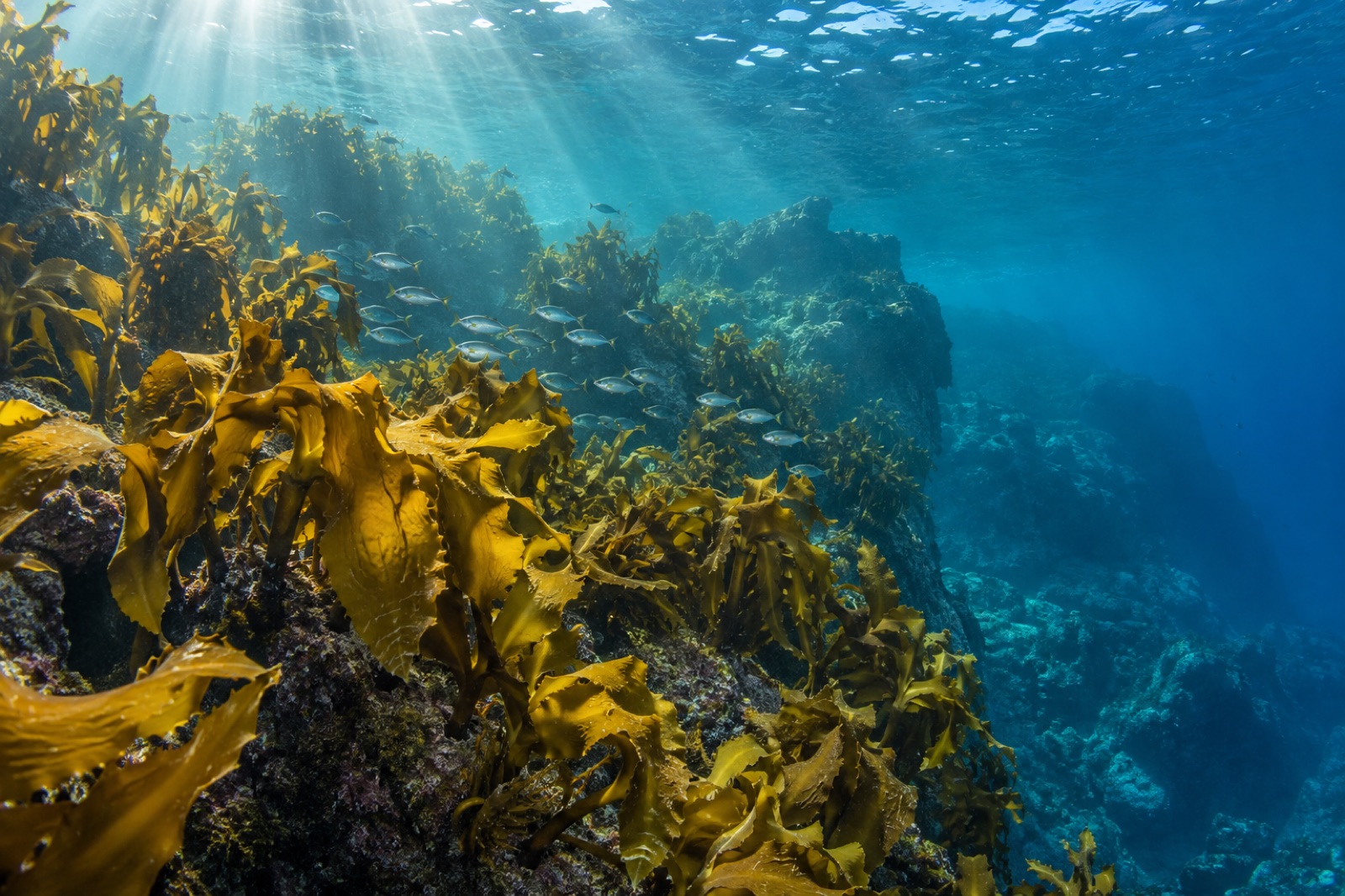
Explore Shikoku's Pacific coast, where the warm Kuroshio Current grazes the southern limit of Japan's kelp — and where the word 'isoyake' was born.
Dr. Lena Fischer ·
Coral reefs and kelp forests are the ocean's two great forests, but they almost never share a shore. Temperature, light and a line drawn by chemistry decide who rules.
Dr. Lena Fischer ·
Hydrographic surveyors map the seafloor for navies, ports, wind farms and science. Here's the training, certification and day-to-day reality of the job.
Dr. Lena Fischer ·
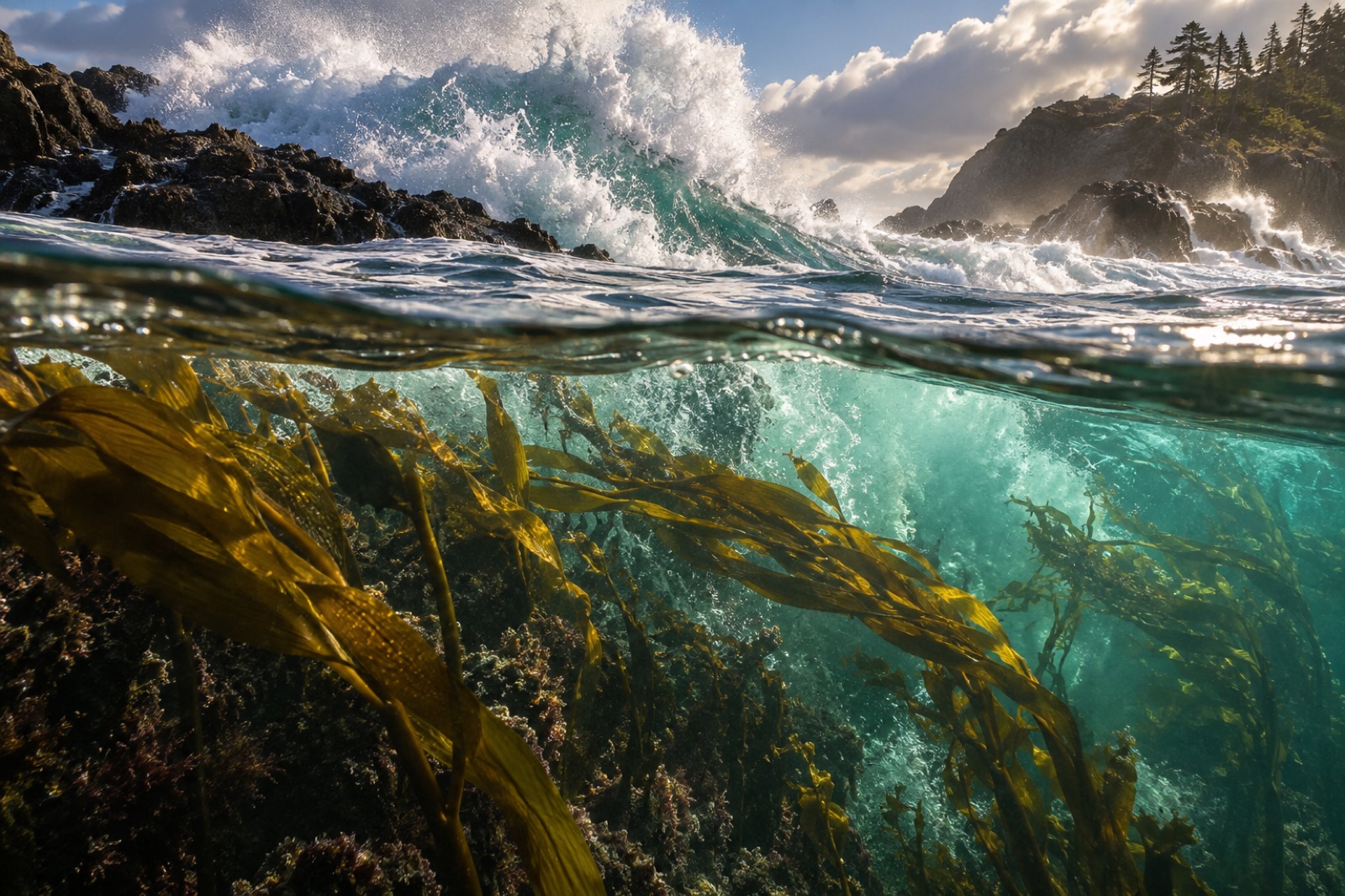
Wave energy is the architect of rocky reefs. How drag, shear and exposure gradients sort species, sculpt kelp and decide where a forest can stand.
Dr. Lena Fischer ·
The blue economy needs engineers as much as biologists — AUVs, satellites, eDNA and ocean data. A map of ocean-tech careers and how to enter them.
Dr. Lena Fischer ·
Langebaan Lagoon runs warm and shallow while the Atlantic outside stays cold and kelp-lined. A guide to South Africa's surprising West Coast shores.
Dr. Lena Fischer ·
Every kelp species has a temperature window. Learn the physiology of heat stress, why gametophytes are weakest, and how scientists measure and breed thermal tolerance.
Dr. Lena Fischer ·
Kelp canopies don't just slow water — they reorganise it. How canopy flow physics shapes turbulence, nutrient delivery and life inside a kelp forest.
Dr. Lena Fischer ·
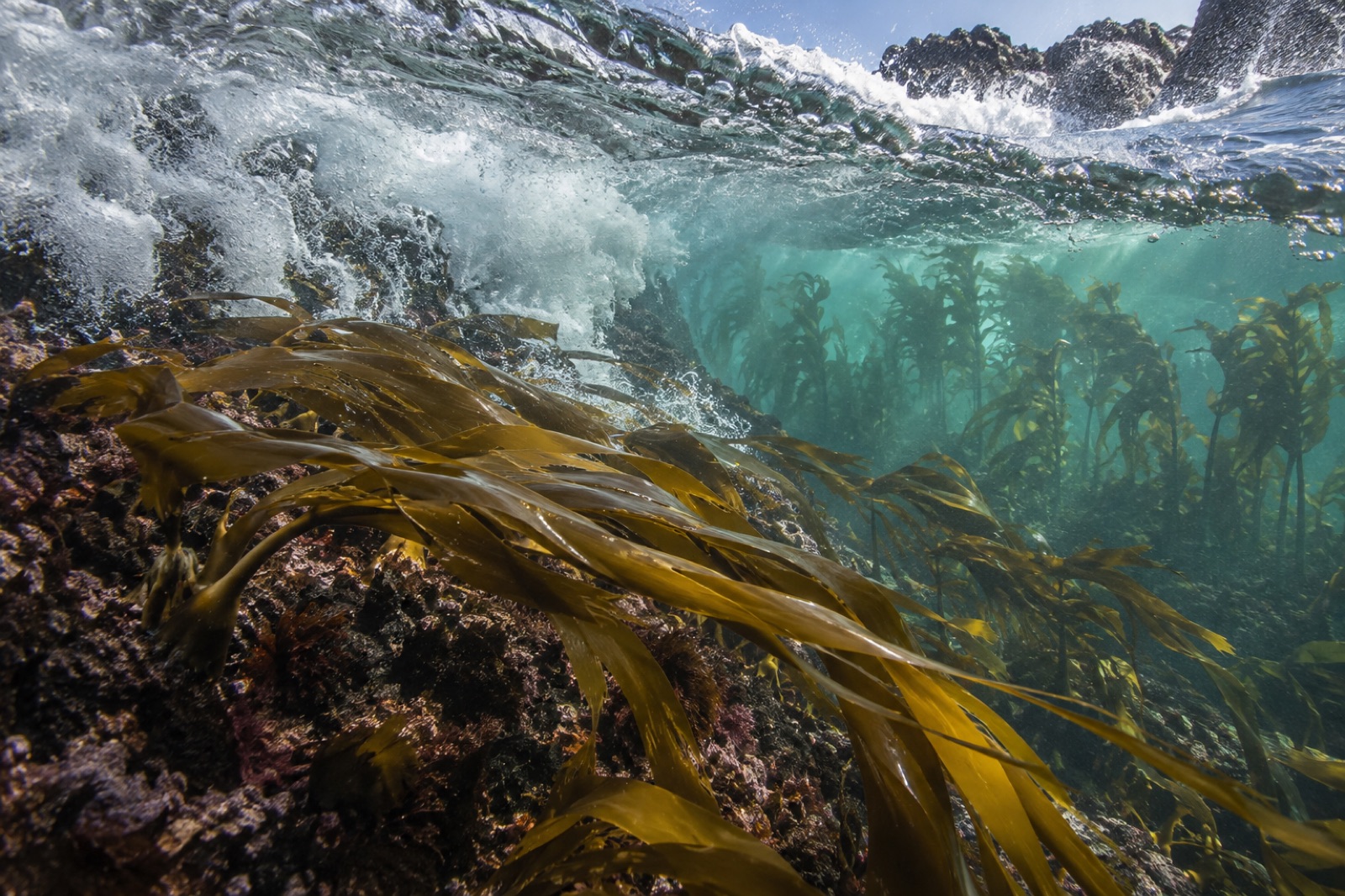
Wave exposure decides which kelp species can live where, and what shape they take. How ocean energy filters the forest — and why it matters for restoration.
Dr. Lena Fischer ·
How do scientists decide if a specific marine heatwave was caused by climate change? Inside event attribution, from FAR to counterfactual oceans.
Dr. Lena Fischer ·
St Helena Bay is where the Benguela upwelling cell is born — kelp fringe, rock lobster, seabird islands, and the dynamics of a bay that feeds an entire region.
Dr. Lena Fischer ·
A Coastal Atlas guide to Point Reyes: California's upwelling engine, fog-fed kelp, elephant seals and grey whales, and how wind builds a food web.
Dr. Lena Fischer ·
From satellite chlorophyll to shellfish closure thresholds, here's how harmful algal bloom forecasts are built, issued and used to keep seafood and coasts safe.
Dr. Lena Fischer ·
Marion and Prince Edward Islands hold giant kelp and bull kelp in the Furious Fifties — a coastal atlas guide to South Africa's wild, fiercely protected subantarctic outpost.
Dr. Lena Fischer ·
Cold water drinks CO2, and the overturning circulation locks it away for centuries. How the ocean's solubility carbon pump works — and what it costs.
Dr. Lena Fischer ·
Why is the sea salty, why is some sea fresher than the rest, and why does salt settle into layers? The ocean's salt budget and haloclines, explained.
Dr. Lena Fischer ·
Tides do more than raise and lower the shore. Where strong tidal currents rub against banks and sills, they stir deep nutrients up — and kelp coasts come alive.
Dr. Lena Fischer ·
Six hours in, six hours out: how 400 million cubic metres of water roar through Norway's Saltstraumen, why kelp thrives beside the whirlpools, and how to dive it safely.
Dr. Lena Fischer ·
Marine heatwaves are ranked Categories I–IV like cyclones — but the scale measures a temperature anomaly, not wind. Here's how the Hobday system works and how to read it.
Dr. Lena Fischer ·
How ocean CDR field trials actually get permitted: research exemptions, environmental review, discharge rules, marine consent and community engagement.
Dr. Lena Fischer ·
Every day, ocean life sends carbon raining into the deep. How the biological carbon pump works, who drives it, and how long its cargo stays buried.
Dr. Lena Fischer ·
The Moon and Sun raise the sea twice daily, and every coast turns that rise and fall into currents, mixing and zonation. The mechanics, plainly.
Dr. Lena Fischer ·
Where Humboldt Current upwelling meets a desert peninsula: kelp, the anchoveta fleet and the guano-bird cliffs of the Ballestas. A Coastal Atlas guide.
Dr. Lena Fischer ·
Where the Alderney Race hurls ten knots of tide over granite reefs, Normandy holds some of Europe's fastest-water kelp forests — and a long varech memory.
Dr. Lena Fischer ·
When heatwaves strip a coastline's kelp, some reefs stay cool and keep their forests. Here's how thermal refugia form — and why they're restoration gold.
Dr. Lena Fischer ·
How software and data professionals cross over into ocean data science: the skills that transfer, the ones to learn, and the portfolio that gets you hired.
Dr. Lena Fischer ·
Ocean alkalinity enhancement is a leading candidate for durable ocean carbon removal. How it works, what it might store, and the questions still open.
Dr. Lena Fischer ·
Much of the ocean goes hungry for a single trace metal. How desert dust, glaciers and hydrothermal vents decide ocean fertility — and the fertilisation debate.
Dr. Lena Fischer ·
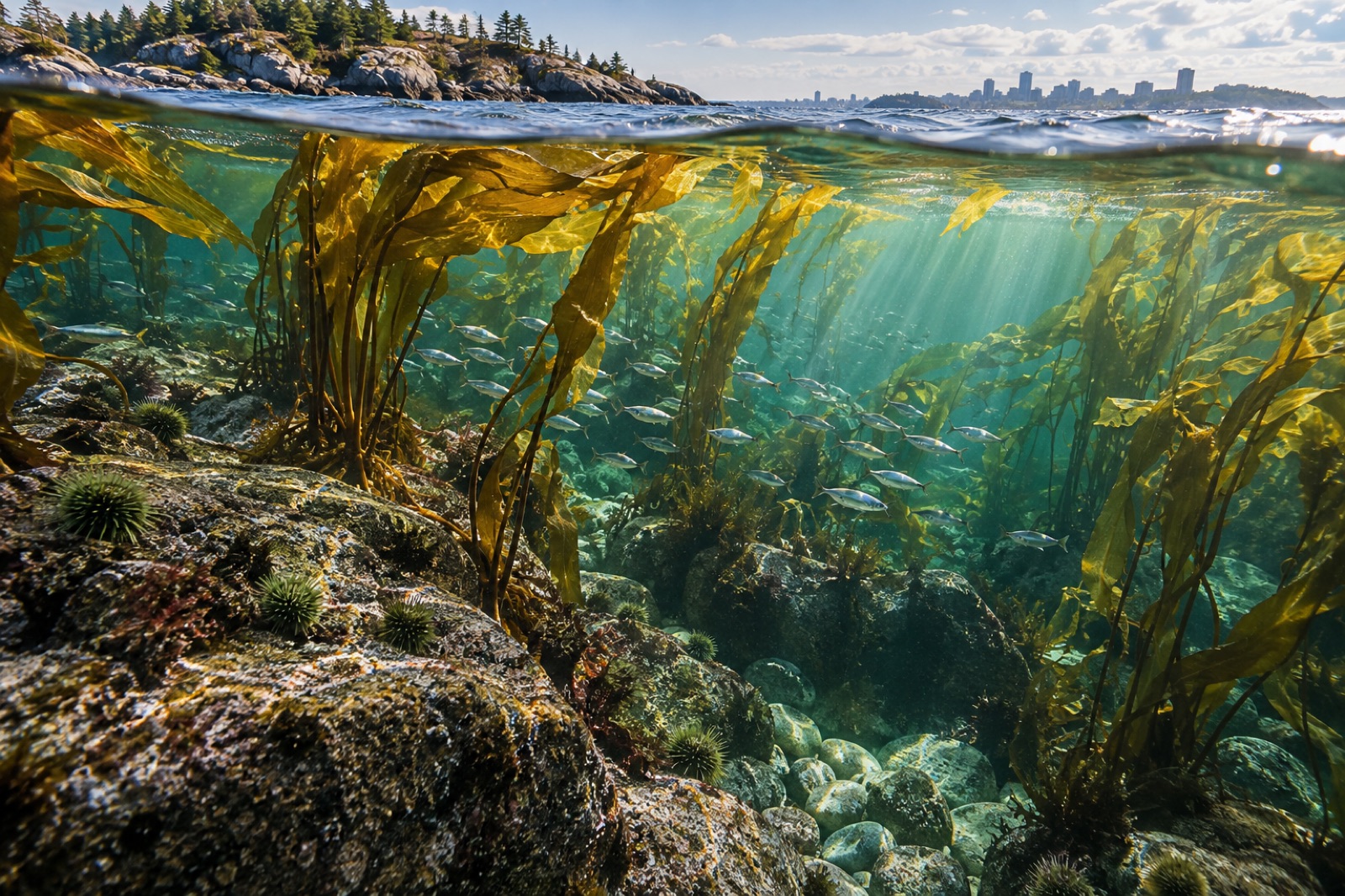
Boston's harbor went from punchline to one of America's cleanest urban seas, and kelp came back with it. A guide to the islands' underwater forests.
Dr. Lena Fischer ·
A coastal atlas guide to the northern Gulf of California: the warm-water edge of kelp, Eisenia arborea forests, tidal mixing and a sea under heat stress.
Dr. Lena Fischer ·
Oxygen minimum zones are vast, naturally breathless layers of the mid-water ocean. How they form, why warming expands them, and what that means for coasts.
Dr. Lena Fischer ·
Algoa Bay is where South Africa's kelp forests thin toward the tropics — penguins, gannets, dolphins and the warm Agulhas water that ends the forest's range.
Dr. Lena Fischer ·
A coastal atlas guide to Labrador's kelp: ice-scoured forests of sugar kelp and Arctic species, Inuit sea country, and a coastline warming fast.
Dr. Lena Fischer ·
The global overturning circulation, driven by heat and salt, moves water, carbon and nutrients around the planet over centuries. How the conveyor works.
Dr. Lena Fischer ·
A deep dive into upwelling physics: Ekman transport, the world's great upwelling systems, how scientists track them from space, and what climate change does.
Dr. Lena Fischer ·