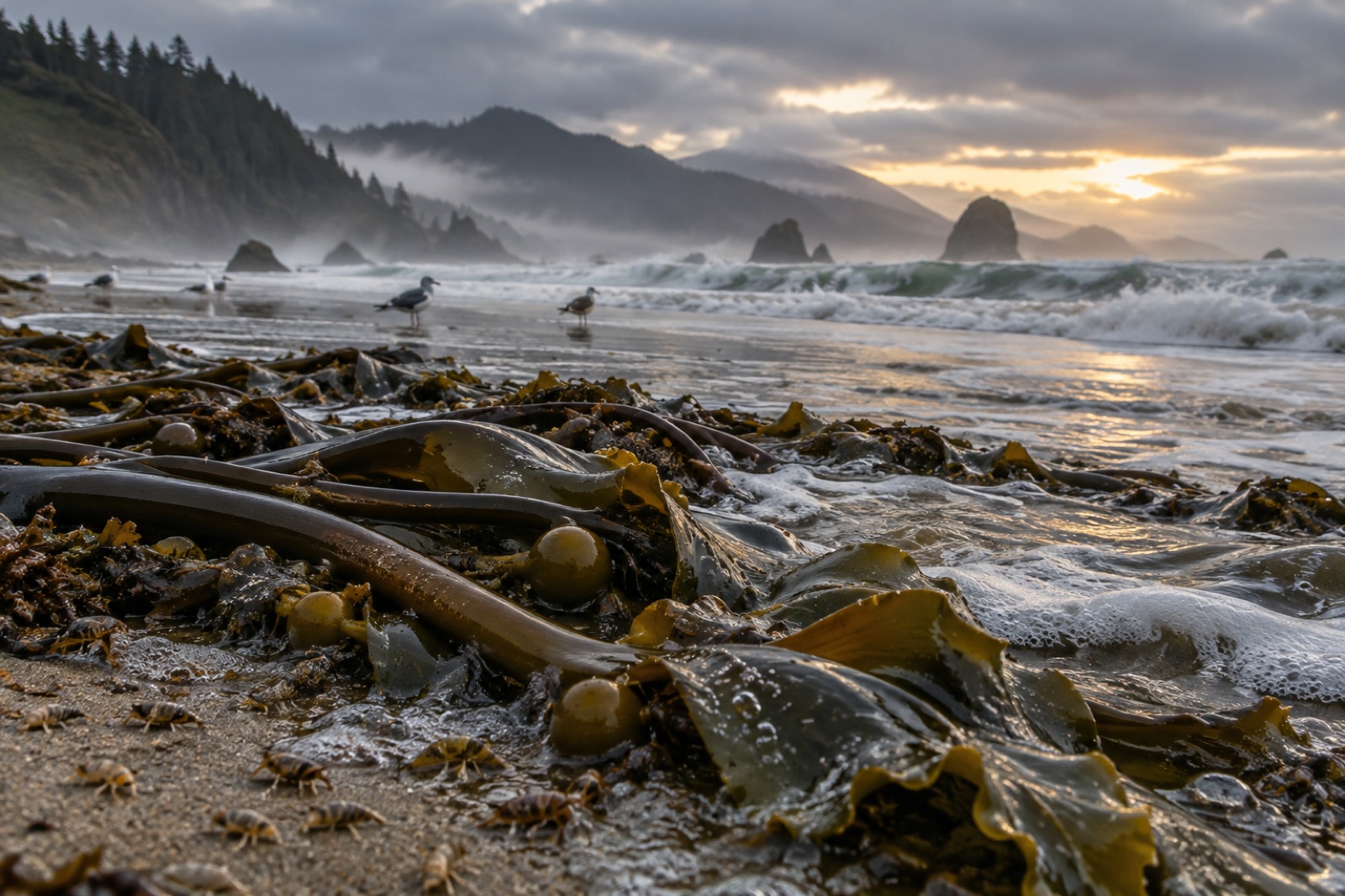
Kelp is one of the fastest-growing organisms on Earth — giant kelp can add half a metre of frond in a day — and that speed makes people ask an obvious question: where does all that carbon go? The honest answer is more interesting than the hype suggests. Almost none of a kelp forest's carbon stays in the forest. The blades are shed, grazed, shredded and exported in a constant, cascading leak of biomass that feeds everything from filter feeders on the reef to microbes in the deep sea. Tracing those pathways — blade erosion, drift, beach wrack, deep export — is essential both for understanding kelp ecology and for keeping the blue carbon conversation honest.
Start with the leak, not the standing stock
A kelp forest's standing biomass is impressive — tens of kilograms of wet weight per square metre in a healthy giant kelp forest — but the crucial ecological number is production: the new tissue grown each year. Kelp forests are among the most productive ecosystems ever measured, rivalling tropical rainforests in grams of carbon fixed per square metre per year. Yet the forest itself holds only a fraction of that production at any moment, because kelp tissue is built to be disposable.
Unlike a tree, which locks carbon into structural wood for decades or centuries, kelp builds soft, nutrient-rich blades with lifespans measured in weeks to months. Giant kelp continuously grows new fronds at the top and sheds older blades from the base; bull kelp renews most of its blade mass each growing season. The forest is less a storehouse than a conveyor belt — sunlight and nutrients in at one end, detached organic matter out the other.
Estimating that outflow is hard, but studies of kelp forests on several continents converge on the same picture: the large majority of kelp production — often cited as on the order of 80 percent or more — leaves as detritus rather than being eaten directly off the living plant. Detritus is not waste. It is the main product, and where it goes next decides its ecological and climatic fate.
Pathway one: the slow rain of blade erosion
Giant kelp blades don't detach whole very often. More commonly, they erode. As blades age at the frond base, their softened tips break away in small fragments — a metre here, a fistful there — released steadily through calm and storm alike. Add the mucus kelp constantly sloughs from its surfaces (dissolved organic carbon, or DOC), and a kelp forest operates like a gentle fountain of food rising from the reef.
This fine material has a short, busy afterlife:
- Filter feeders intercept it in the water column. Mussels, barnacles, tube worms and sponges on the reef below strain drifting fragments and mucus. In many kelp forests, the carpet of sessile invertebrates under the canopy runs largely on kelp-derived food.
- Microbes process the dissolved fraction. Kelp DOC is an important energy source for the bacterial communities in surrounding waters — some of it consumed within hours, some of it chemically altered into more persistent ("refractory") forms that can circulate for much longer.
- Grazers take the coarser fraction. Sea urchins in particular are detritivores first: given a choice, a purple urchin prefers to wait in a crevice and harvest the rain of drift fragments rather than attack living kelp. This matters enormously, as anyone who has read about urchin barrens knows — when kelp production collapses, urchins starve in place rather than disappear, forming barrens that persist for decades.
Pathway two: drift kelp, the wandering subsidy
Storms rip out whole plants — stipe, holdfast and all — and those rafts of "drift kelp" become mobile ecosystems and mobile meals. A single storm-cast giant kelp plant carries its own haptera full of brittle stars and worms; it is food and habitat in one drifting package.
Drift kelp travels. Towed by wind and current, rafts can cross tens or hundreds of kilometres before they sink or strand. Along the way they feed fish, birds and surface invertebrates, and they deliver kelp carbon to habitats that grow none of their own: seagrass meadows, sandy embayments, submarine canyons. In regions where kelp forests fringe deep water — Tasmania, California, the sub-Antarctic islands — drift export to depth is believed to be a meaningful share of total production leaving the coastal system entirely.
Canyons are the chutes that matter most. Where a kelp forest sits near the head of a submarine canyon, storm-detached material can ride downslope flows into water hundreds or thousands of metres deep within days. Carbon that reaches those depths in dense fragments is functionally removed from the atmosphere for a long time — the basis of the deep-sea export pathway in seaweed carbon accounting, and one of the few routes by which kelp carbon plausibly becomes lasting sequestration.
Pathway three: beach wrack, the shoreline economy
What doesn't sink often strands. Walk a kelp-fringed coast after a winter blow and the beach is banked with wrack — whole bull kelp heads, torn ribbons of oarweed, matted eelgrass-like tangles. To a beachcomber it's scenery; to the shoreline food web it's a seasonal bonanza.
Wrack feeds amphipods, kelp flies, beetles and shorebirds in great abundance, subsidising sandy-beach ecosystems that are otherwise food-poor. Much of it is then reworked by wind, waves and microbes; some is buried in beach sand or dunes; some washes back out on the next tide for a second journey. Wrack is also why thoughtful beach management matters: mechanically "cleaning" natural beaches every morning removes a genuine ecological input, however tidy it looks.
Pathway four: burial, the one route to long-term storage
Of all kelp carbon fixed each year, only a small slice ends up stored for centuries or longer. That slice is the fraction that reaches marine sediments — fjords, estuaries, deep basins — in a form resistant enough to escape decomposition and get buried. Sediments are where the ocean banks carbon on the timescales the climate cares about, which is why the sediment pathway gets such scrutiny in kelp sequestration research: the magnitudes are genuinely uncertain, almost certainly modest relative to total production, and very site-dependent.
The other plausibly durable reservoir is the refractory dissolved pool — kelp carbon so thoroughly transformed by microbes that it persists in seawater for many years. Measuring how much kelp DOC ends up refractory is an active research area, and one where today's numbers should be treated as working estimates, not facts. This humility is central to how Tidewright approaches its own canopy-to-carbon accounting: we map and report what is measured, and label what is modelled.
What this means for the food web and for restoration
The detrital view reframes what a kelp forest is for. The living canopy and its grazing drama — otters, urchins, sea stars, the trophic cascades that connect them — is the visible storey. But the forest's deeper economy is the subsidy: the steady export of food that pays for the filter-feeder floor, the canyon scavengers, the beach invertebrates and the microbial loop. Remove the forest and you don't just lose habitat; you switch off a regional food supply. That is one reason barrens and heatwave-stripped coasts show impacts far beyond the reef edge.
For restoration, the lesson cuts both ways. A regrowing forest restarts the detrital subsidy quickly — outplanted kelp begins eroding and feeding the reef within its first seasons, one of the earliest functional recoveries we can measure in our project field notes. But the same understanding disciplines carbon claims: fast growth is fast throughput, not automatically fast storage. Anyone selling kelp carbon should be able to tell you which pathway their tonnes travel, and how they know.
Key takeaways
- Kelp forests are production engines, not storehouses: most fixed carbon leaves the living plant as detritus — blade fragments, mucus and storm-torn whole plants.
- The largest flows feed food webs: filter feeders under the canopy, urchins as detritivores, canyon scavengers, beach invertebrates.
- Only a small fraction of kelp carbon reaches durable storage, mainly via sediment burial near export hotspots like submarine canyons, and possibly via persistent dissolved organic carbon.
- Magnitudes vary enormously by site, depth and season; honest carbon accounting names the pathway, not just the tonne.
- Restoration value isn't only canopy: a regrowing forest restores the detrital food subsidy that underwrites the wider ecosystem.
FAQ
Is kelp carbon sequestration the same as kelp carbon production?
No. Production is the total carbon kelp fixes per year; sequestration is the much smaller fraction stored long enough (century-scale) to count as climate mitigation. Confusing the two is the most common error in seaweed carbon claims. See our explainer on how much carbon kelp really stores.
Do grazers eat kelp directly or mostly eat its detritus?
Mostly detritus. Many "kelp grazers," including sea urchins, preferentially consume drift fragments. Direct grazing on living kelp dominates when detrital supply fails or grazer numbers explode — the shift that flips reefs into barrens.
How does kelp DOC differ from kelp detritus?
Detritus is particulate — visible fragments you can filter. DOC is dissolved: mucus and leakage from living blades. Both feed food webs, but microbes process DOC faster, and a portion may be chemically converted into long-lived refractory carbon.
Why do submarine canyons matter so much for kelp carbon?
Canyons are export chutes. Kelp torn loose near a canyon head can reach deep water in days, arriving compact and relatively intact — exactly the conditions that give carbon a chance of long-term burial rather than rapid decomposition.
Partially, and sooner than many expect. Outplanted kelp contributes detritus within its first growing seasons, re-feeding filter feeders and detritivores early in recovery — though mature-forest export volumes take years as biomass builds.