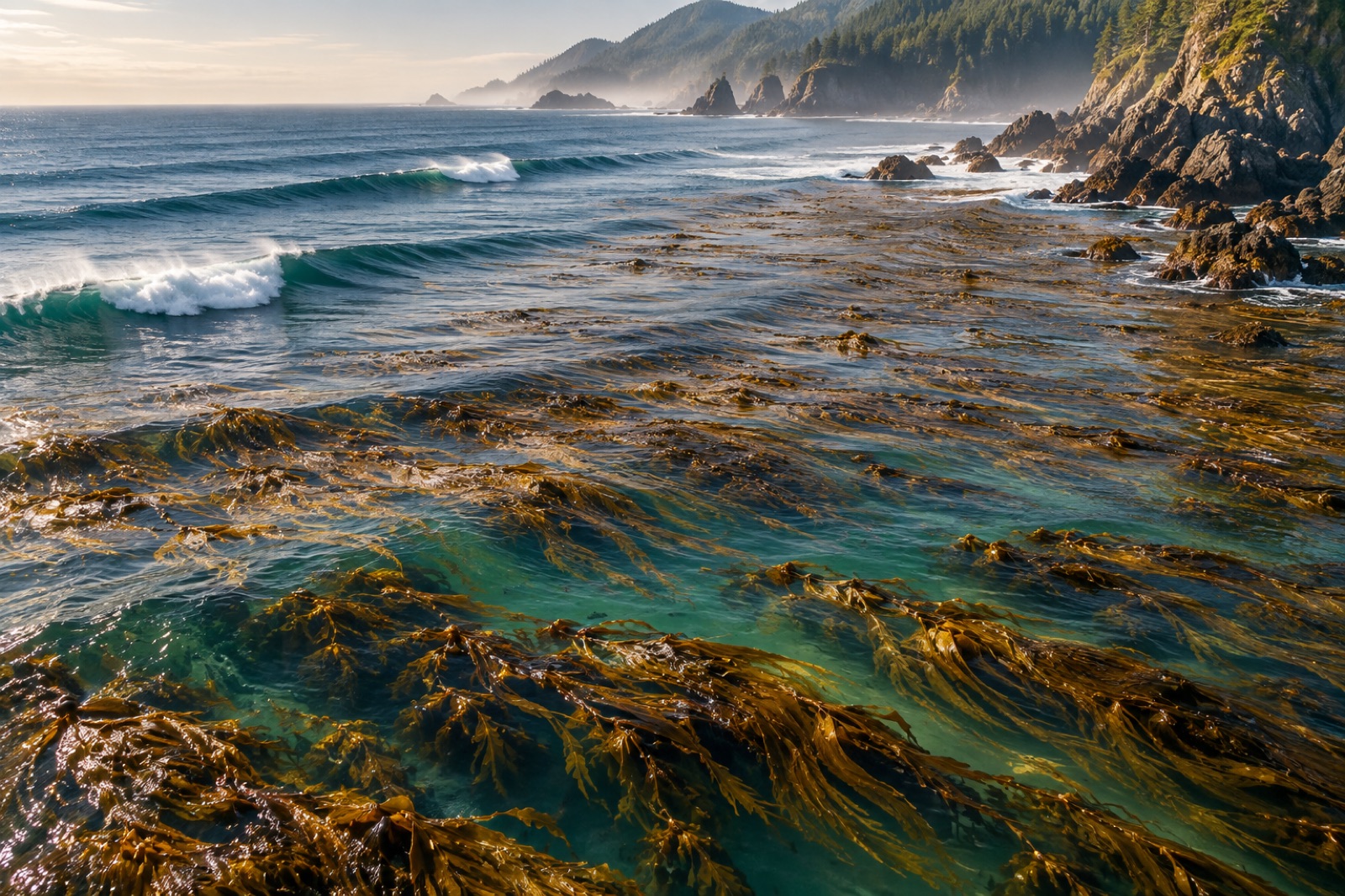
Every terrestrial gardener knows that a forest is two ecosystems stacked: a canopy chasing the sun and a floor making do with what's left. A kelp forest runs the same experiment, translated into seawater and sped up. Above the reef, thousands of blades form a living skylight that drinks in light, tints it, chops it into moving flecks and hands the leftovers down. What grows beneath — crustose pink pavements, turf, shade-adapted red algae, or almost nothing — is decided largely by how that canopy handles light. Understanding this vertical light economy is the key to why kelp forests look and function the way they do, and why restoring one is about more than planting blades.
What the canopy takes
Start with the raw material. Sunlight entering the sea is already on a budget: within the first metres, water and dissolved matter strip out much of the red; below 20 metres in typical coastal water, the world runs on blue-green. We cover the physics of light underwater in detail elsewhere. The quantity that matters to seaweeds is PAR — photosynthetically active radiation, the 400–700 nm band of usable light.
A dense giant kelp canopy intercepts the lion's share of what PAR arrives. Classic under-canopy measurements in mature forests found that the canopy can absorb most of the surface light — often 80 to more than 90 per cent — before it ever reaches the reef. That's a staggering toll: a reef floor under thick canopy lives in a permanent submarine twilight, at light levels comparable to dawn or dusk on land, in mid-afternoon. The canopy is not just living in the light; it is privatising it.
Three ways the canopy reshapes the light
The canopy doesn't just dim the light. It edits it, in ways the understorey community reads like instructions.
Intensity — the simple dimming
The most obvious effect: less light. Understorey algae under a full canopy must photosynthesise profitably at a small fraction of surface PAR. That filters the cast: only species adapted to low light — or with clever pigment tricks — can build a living down there. Many of the most abundant understorey residents are red algae, whose phycobilin pigments harvest the green-blue wavelengths that penetrate deepest (for the pigment logic, see why seaweeds are green, brown or red).
Spectrum — the greening of the world below
Kelp blades are brown because fucoxanthin preferentially drinks blue and red light and reflects amber; the light that leaks through a canopy is therefore spectrally tilted toward green. To a human diver this reads as the famous cathedral glow. To a seaweed it is a changed menu: green-enriched light under a kelp canopy favours exactly those understorey species with pigments tuned to those wavelengths — and disfavours relatives of the canopy kelp itself, a fact with intriguing consequences for where juvenile kelp can thrive.
Flicker — the light field in motion
A kelp canopy is never still. Waves and surge rock the blades; sun angles shift; clouds sweep overhead. The result is that light on the reef floor arrives not as a steady glow but as a flickering field of sunflecks and shade bands sweeping across the rock, on timescales from fractions of a second (wave-driven blade movement) to seasons (canopy growth and loss). Sensitive instruments recording under-canopy PAR show a signal that looks less like a dimmer switch and more like static. For a sessile alga, these moving flecks are real subsidy: a few minutes of sunfleck per hour can fund a meaningful share of daily photosynthesis, and understorey physiologies are tuned to exploit such pulses.
The understorey as a light-adapted guild
What you find under a kelp canopy is therefore not a random scrum but a set of guilds organised by light access:
- Encrusting coralline algae — the pink rock pavement — are among the most shade-tolerant photosynthesisers on the reef (and, conveniently, chemically summon settling kelp spores). Their slow, calcified lifestyle fits the dim floor: see the coralline algae profile.
- Understorey kelps and shade blades — species like stalked kelp (Pterygophora) and some broad-bladed reds — lift their own modest canopies into the second storey, trading height for shade tolerance.
- Turf algae — the opportunists. Where light does reach in quantity, turf algae explode; under cloaked canopy they dwindle to stubble. Turf is less a community than a standing answer to any extra photon.
- Fewer canopy competitors. Perhaps most important: the understorey rarely contains another full-size canopy kelp. That's not coincidence — it's the incumbency effect. The light the canopy takes is light a successor forest can't use to replace it.
When a gap opens: light as disturbance
Forests — marine or terrestrial — renew in gaps. A storm that strips blades, an urchin front that clears canopy, a heatwave that thins a stretch of forest: each is a disturbance that returns light to the floor, and the understorey responds fast. Turf greens and thickens, juvenile kelp and annual species launch out of the seed bank and spore rain, and the race is on to refill the empty sky.
This gap dynamics is one of kelp ecology's central rhythms, studied by clearing experimental patches of canopy and watching what recruits into the new light. The classic finding: canopy removal lets understorey and juvenile kelp surge, but which species capitalise depends on spore supply, grazing pressure and season — the same ingredients, rearranged by light. Overlaid on the seasonal beat of kelp phenology, gap-and-regrowth keeps the forest a patchwork of light environments rather than a single gloom.
Why the sculpted light matters beyond the reef
The canopy's grip on light has consequences that travel well past kelp physiology:
- It shapes the habitat. The dim, flickering, green-tinted world under a canopy selects a different fish and invertebrate community from the reef top — part of how kelp structure supports the kelp forest food web.
- It controls competition for space. By monopolising light, the canopy suppresses turf and rival algal overgrowth on the rock — an underappreciated ecosystem service that keeps settlement surfaces open for its own recruits. Lose the canopy and, as our turf article warns, the light floods in and turfs and barnacles claim the space before kelp can.
- It writes the satellite's-eye view. Remote sensing of kelp sees only the canopy — the fraction of the forest that touches the light (see how satellites see kelp). A canopy's light economy thus determines what we can and can't measure from orbit, and why canopy area is a legible but incomplete proxy for forest health.
For restoration, the implication is subtler than "replant the canopy." A restored forest's goal is to re-establish this vertical light economy — enough canopy to hold the upper water column and exclude the turf, structured enough that light flecks still reach a living understorey, dynamic enough that a storm opens a gap rather than ending the forest. Tidewright's (fictional) canopy-structure monitoring on the impact dashboard tracks this: not just how much kelp, but how the forest stands in the light. Light, after all, is the resource the whole architecture exists to manage.
Key takeaways
- A dense kelp canopy can absorb 80–90+ per cent of incoming PAR, leaving the reef floor in a permanent green twilight.
- The canopy edits light in three ways: it dims it, tints it green (fucoxanthin strips blue and red), and chops it into moving sunflecks that understorey algae are tuned to exploit.
- The understorey is a light-adapted guild: shade-tolerant coralline pavements, second-storey understorey kelps, and turf algae poised for any photon.
- Gap dynamics — storm, urchins and heat opening the canopy to light — is a core renewal rhythm, deciding what recruits and when.
- Managing this light economy, not just kelp area, is what canopy restoration and canopy monitoring are really tracking.
FAQ
How much light actually reaches the kelp forest floor?
Under a full canopy, typically a small fraction of surface light — often on the order of 10–20 per cent or less, varying with canopy density, depth, turbidity and sun angle. Instruments under mature canopies record light levels comparable to dusk on land, punctuated by wave-driven sunflecks.
Why does the water under kelp look so green?
Kelp blades absorb blue and red light for photosynthesis and let more of the green through; seawater itself also tints transmitted light blue-green. Stack the two filters and you get the famous emerald glow of a dive beneath a kelp canopy.
Can giant kelp grow in its own shade?
Poorly. Giant kelp's young sporophytes are outcompeted by their own parents' shade and generally recruit in gaps where the canopy has opened. A mature forest's grip on light helps lock in the incumbent generation — a reason succession moves in waves and clearings matter.
Why doesn't turf algae simply take over under every canopy?
Turf needs light. Under a closed canopy it is starved down to sparse stubble; it flourishes in gaps, at edges, and after the canopy falls. This is why turf is a classic indicator of canopy loss — it announces where the light has returned, wanted or not (see turf algae).
Do restoration projects measure under-canopy light?
Some do — with PAR loggers moored on the reef, or by modelling canopy shading from canopy maps. It's a demanding measurement but increasingly seen as one of the best single reads on whether a restoration has rebuilt function, not just area. Tidewright's (fictional) Canopy Ledger program incorporates underwater light monitoring into its methodology; the figures are illustrative.