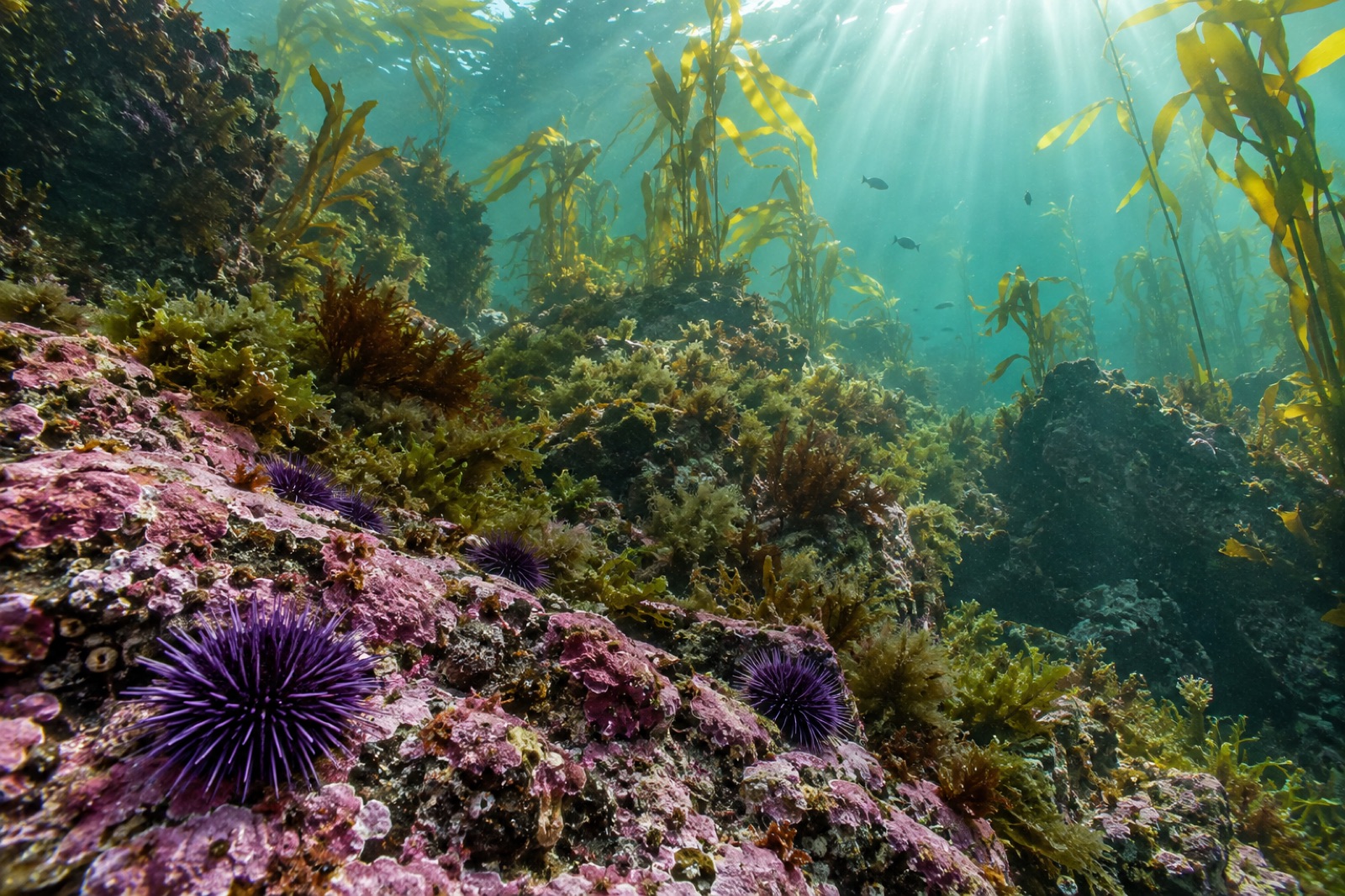
Every forest keeps time. On land it is obvious: buds break, flowers open, leaves fall. The same is true of a kelp forest — the timing is just harder to see from above water. Kelp phenology, the study of when kelps grow, reproduce and die back through the year, explains why a bull kelp bed looks exuberant in July and nearly bare by February, why hatchery windows open in particular weeks, and why a heatwave in the "wrong" month can do far more damage than one in another. Get the calendar right and restoration gets dramatically cheaper; get it wrong and you are seeding into a scheduling conflict with the ocean itself.
What phenology means underwater
Phenology is the science of recurring biological events and their relationship to climate and daylength — leaf-out, flowering, migration, spawning. Kelps run their own version of this cycle: blade growth spurts, the appearance and ripening of sporangial patches (sori, in many species), spore release, the growth of the microscopic gametophytes, and in annual species the autumn dieback of whole plants.
The word matters because kelp forests are not static backdrops that occasionally suffer damage. They are forests on a schedule, and the schedule is set differently by each species. To understand a particular reef, you need to know both what grows there and when.
Two strategies: the annuals and the perennials
Kelp species divide roughly into two temporal tribes, and most of phenology is a story about the difference.
Perennial kelps persist as individuals for years. Giant kelp (Macrocystis pyrifera) plants live for several years, continuously producing new fronds at the meristematic base and shedding old blades from the frond tips; a mature plant is a mixture of ages, renewing itself in place. The oarweeds of the North Atlantic, like Laminaria hyperborea, keep a woody stipe for a decade or more while growing a fresh blade each year — the old blade is cast off in spring as the new one expands from the growth zone, a bit like a deciduous tree that keeps its trunk and swaps out its canopy.
Annual kelps commit to a single sprint. Bull kelp (Nereocystis luetkeana) is the classic: spores settle on cleared rock in late summer and autumn, microscopic stages overwinter, and the visible plants rocket from the seafloor to the surface — often 10 metres or more — over a single growing season. The canopy peaks in mid to late summer, the bulbs at the frond tips begin to rot or rip away in autumn storms, and by late winter the bed may be largely bare rock again, waiting for the next batch. Anyone who has watched a bull kelp coast through a winter of loss knows the sight; anyone who doesn't know the calendar might mistake it for collapse.
The distinction changes what "loss" means. Losing a perennial forest is losing an old, established structure that may take years to re-establish. An annual forest naturally runs to zero in winter — the question that matters is whether the bed recruits the following spring.
What sets the clock
Three environmental signals do most of the scheduling, and they interact.
Daylength. Kelps are photoperiodic: they can measure night length through blue-light sensing and use it to time internal events. In many oarweeds, sorus formation and spore release are compressed into autumn and winter as the days shorten. Photoperiod is the one environmental cue that does not drift with climate change — daylength at a given latitude is the same every December — which makes it a reliable anchor and, increasingly, a source of ecological mismatch when the temperature moves without it.
Temperature. Growth rates of kelps follow a bell curve in temperature, with different optima per species and per life stage. Warm water accelerates metabolism past the point where photosynthesis can feed it; cold water slows everything down. Temperature also gates reproduction — gametophyte development and egg release in many species only proceed inside a bounded temperature window, which is one reason gametophyte biology is such a core science for restoration hatcheries.
Nutrients. In most temperate regions, nitrate arrives on a schedule too — pumped up by winter storms, mixed down by convection, or delivered seasonally by upwelling in places like the California coast or the Humboldt system. Kelps cope with the lean summer months partly by storing nitrogen in their tissues when it is abundant, then spending those reserves on growth through the nutrient-poor, light-rich season. Slow the supply two months early and the whole year's budget is renegotiated.
Why timing matters: mismatch and the moving baseline
The classic phenology worry from terrestrial ecology — plants flowering before their pollinators wake up — has an oceanic analogue. Kelp forests coordinate across species: crustose coralline algae that induce kelp spore settlement, grazers whose populations peak with summer productivity, juvenile fishes that recruit to the canopy in particular months, the food web woven from these timings. When one element shifts earlier or later and others do not, the cohorts fall out of step.
Marine heatwaves make this vivid. A warm event in early spring — when annual kelps are in their exponential growth phase and nutrient stores are thin — can stall a whole cohort before it reaches the surface. A comparable event in late autumn, after perennial sporulation, may barely dent the forest. The event is the same size; the calendar position is what turns it into a catastrophe or a footnote. Long-term warming also pushes seasonal boundaries — warm-affinity turf seaweeds and grazers lengthen their active seasons while cool-affinity kelps shorten theirs, quietly recomposing the forest even in years without a headline event.
Phenology as an operating manual
For Tidewright, phenology is not an academic nicety — it is the schedule the whole operation runs on.
Survey timing. Canopy extent is only comparable within the same seasonal window. Our Canopy Ledger platform anchors satellite and drone mapping to each region's historical peak-canopy month, so a "healthy summer hectares" number means the same thing on a 2019 map and a 2026 map. Mapping a bull kelp bed in December would undercount it against July by the biology, not by decline.
Seeding windows. Holdfast lines have to be laid when spores will find suitable rock, gametophytes will mature without thermally aborting, and the first visible sporophytes will have time to gain size before summer's nutrient drought or winter's storms. The right window is a per-site calculation — driven by local temperature curves and provenance-matched seedstock from our Holdfast nurseries — not a universal date. Seed too early and storm season scours the lines; too late and the juveniles miss the spring growth flush.
Harvest and monitoring. On the restoration-adjacent farms that fund the work, phenology sets the harvest calendar: blades are cut at maximum nutrient and growth quality, which is usually just before the seasonal sorus onset. And on the science side, phenology explains what a survey actually saw — an eDNA bottle sampled in August reads a different forest than one sampled in February, and analysts have to treat them differently.
Reading the clock is getting harder, and more important
Field phenology is one of the cheapest high-value observations in coastal science — repeated photography of the same bed, dive transects that note reproduction status, drone passes logged for season. Harmonising those records across decades exposes the long baseline drift that one-off surveys cannot see. Kelp phenology didn't used to be headline stuff; it has become front-line operational data.
Key takeaways
- Phenology is the seasonal schedule of kelp growth, reproduction and dieback — per species, per region.
- Perennial kelps keep individual plants alive for years and renew blades; annuals' whole strategy is a one-season sprint, so empty rock in winter is normal succession, not collapse.
- Daylength, temperature and nutrient supply set the clock; only daylength stays put in a warming ocean, which is why climate-driven mismatches are appearing.
- The timing of a heatwave can matter as much as its size — the same event can devastate a spring growth cohort or barely disturb the autumn canopy.
- Restoration, monitoring and harvest all run on phenological windows; getting the calendar right is one of the highest-leverage parts of the work.
FAQ
Is kelp phenology the same thing as the kelp life cycle?
No. The life cycle is the sequence of generations — sporophyte, gametophyte, spore, gamete — that every individual goes through. Phenology is about when those stages occur across a population and a year, and how that timing lines up with seasons, climate and other species.
Why do kelp beds look barren in winter on some coasts?
On coasts dominated by annual kelps (like bull kelp), the canopy is designed to die back in autumn storms; the winter bareness is the normal end of the annual cycle. What matters is whether recruits return the following spring. Perennial forests (giant kelp, oarweeds) keep structure through winter but still shed and grow blades seasonally.
Is climate change shifting kelp phenology?
Yes — studies from both hemispheres report earlier spring growth, longer stressed periods in summer, altered sporulation timing and shorter winters in many kelp regions. Because daylength doesn't change but temperature does, cue mismatches between light-timed and temperature-timed processes are a particular concern.
Why does phenology matter for restoration?
Because the ocean's windows are narrow. Spore-settlement conditions, temperature limits for gametophyte development, storm risk and nutrient timing all have seasons, so seeded lines must go in during the right weeks per site. A mistimed operation wastes the seedstock and the season.
How do scientists measure kelp phenology?
With repeated observation over time: diver and video transects, fixed camera stations, drone mapping synchronized to peak-canopy months, satellite time series and opportunistic records like herbarium sheets — any dated record of growth or reproduction stage contributes.