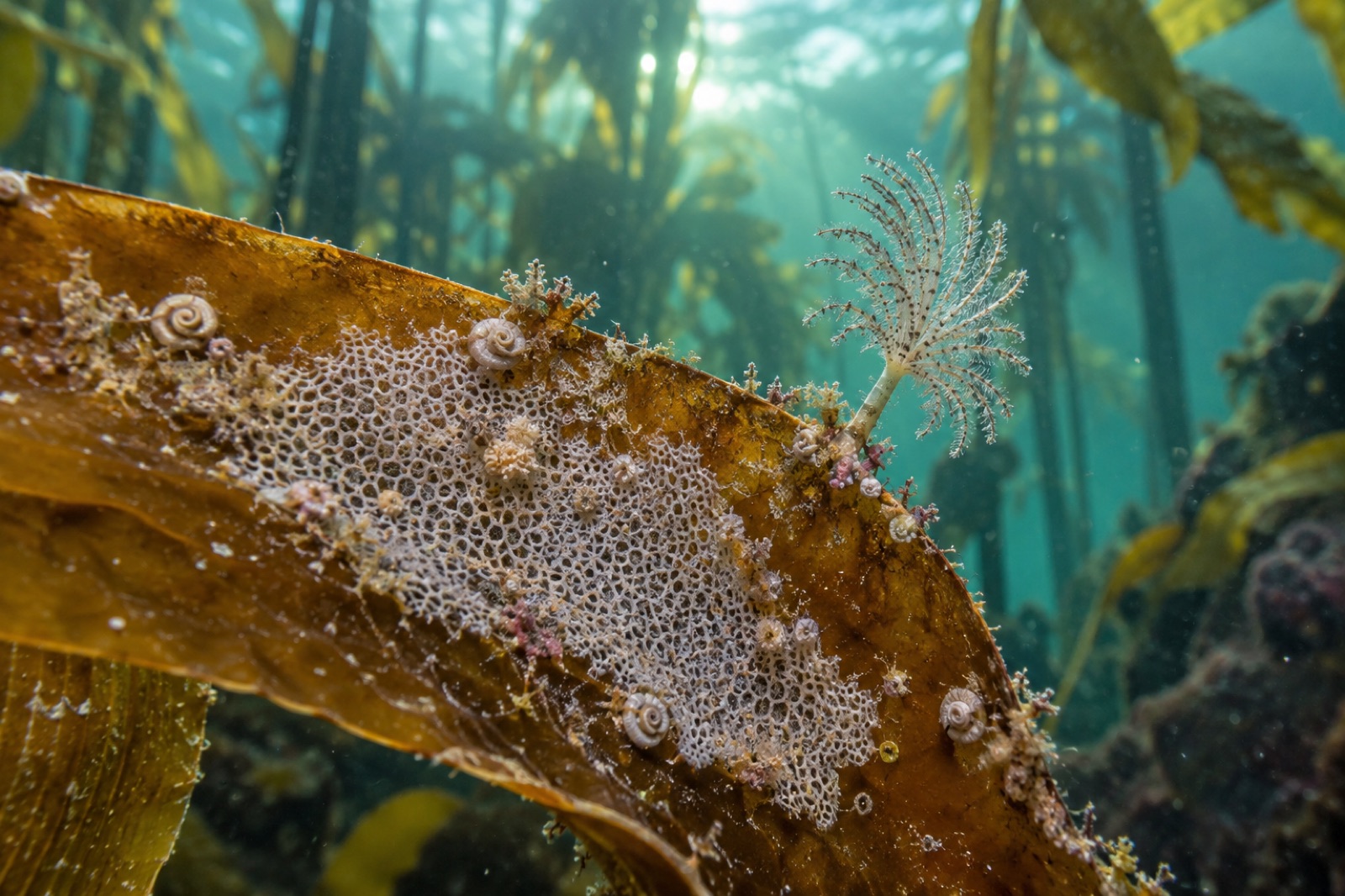
Long before a kelp blade bleaches, frays or tears, something quieter has already gone wrong. The community of bacteria and microbes living on its surface — the kelp microbiome — reorganises. Specialist resident taxa thin out; opportunists move in; the chemical conversation between host and film stutters. To a molecular ecologist, this shift is not just a symptom of coming trouble. It is a diagnostic: a measurable, comparable signal of kelp health that can be read days to weeks before a diver's eye sees anything, and that restoration programs are beginning to treat as a vital sign.
This article is about reading that vital sign: how researchers sample and sequence kelp microbiomes, what "healthy" and "stressed" communities look like, where the science is solid and where it is still emerging, and how the idea is being put to practical use in hatcheries and on wild reefs. (Our primer on the kelp microbiome itself covers who lives in the film and what it does; here we focus on the diagnostic read-out.)
Why bother listening to bacteria at all?
Three properties make the microbiome attractive as a health instrument:
- It responds fast. Microbial generations take hours; kelp tissue shows stress over days to weeks. In warming experiments, community shifts on the blade surface repeatedly precede visible tissue damage — the film is the forest's earliest instrumentation.
- It integrates. The microbiome accumulates the host's physiological history — heat, nutrient stress, grazing, pollution — into one sample, rather than forcing a choice of which single chemical marker to chase.
- It is measurable with a swab. Sampling is cheap, non-destructive and parallelisable. A single diver can collect dozens of microbiome samples on the transect time of one biomass quadrat; the expensive part happens back at the bench.
The catch, and it is a real one: variability. A microbiome is a stream shaped by season, site, depth, kelp species, blade age and recent weather. Diagnostics in this space are diagnostic relative to baselines, not absolute values — which is why the reference-quality baselining described below is where most serious programmes invest their effort.
How a kelp microbiome gets measured
Sampling
The field protocol is dull in the best way. A defined patch of blade (or a swab of defined area) is taken into preservative, chilled, and handled alongside strict field blanks. Holdfasts, meristems and blade tips each carry recognisably distinct communities (the holdfast's crevice city is the most diverse), so diagnostics standardise tissue position ruthlessly. Water-column controls are collected alongside, because the first question any sequence run must answer is: did we sample the kelp's residents, or the ocean's passengers?
Sequencing
Two levels dominate:
- 16S rRNA amplicon sequencing reads a shared bacterial barcode gene across the whole community, producing a census of which bacterial taxa are present and in what relative abundances. Cheap, robust, comparable across studies — the workhorse of kelp microbiome ecology.
- Metagenomics and transcriptomics read everything — genes, not just names — sketching functional potential (nitrogen cycling, virulence factors, photosynthesis of epiphytes) and, with RNA, what the community is actually doing. Expensive, data-hungry, and reserved for deep questions, like the early-warning work below.
Increasingly, eDNA sampling of the surrounding water rides along: kelp sheds microbial and host cells continuously, and the water column carries a diluted echo of the blade film, obtainable without touching the kelp at all.
Analysis
Raw sequences become a table of taxa and abundances; from there the ecological statistics are familiar — diversity indices, ordinations, indicator-species testing — with a microbiome-specific caveat: the data are compositional (shares of a whole, not absolute counts), so statements like "X doubled" need care. Experienced groups increasingly pair relative profiles with absolute quantification, and archive samples so that tomorrow's better methods can revisit today's baseline.
The signatures of stress
Across studies of brown algae under warming and pollution gradients, a repeated grammar of dysbiosis has emerged:
- Loss of specialist residents. Host-associated, often-constant taxa — the film's incumbents — thin first. Granulosicoccus-type associates on kelp are among the groups reported to track host condition in several surveys.
- Rise of opportunists. Fast-growing generalists and taxa with virulence or algicidal potential expand as host chemical defences weaken — the same pattern documented in mechanistic detail for summer bleaching of the red alga Delisea pulchra in Sydney Harbour, where warming suppresses the host's antimicrobials and the community tips toward pathogens.
- Divergence among individuals. In stressed stands, kelp-to-kelp community similarity often falls — neighbours that used to share a characteristic film begin to drift in idiosyncratic directions. This "Anna Karenina" pattern — every unhappy kelp unhappy in its own way — showed up in gut-microbiome research first and is appearing in seaweeds too.
- Functional drift. Metagenomic work finds shifts in nitrogen cycling, sulphur metabolism and biofilm-formation genes ahead of taxonomic changes — the machine's parts list changes before its cast does.
None of these is a standalone verdict. In combination, and against site-specific baselines, they form a genuinely useful early-warning panel.
Case study-shaped science: the bleaching precedent
The field's clarity comes from a red alga, not a kelp — and that precedent structures every kelp claim. The Delisea system demonstrated, in sequence, warming → weakened host defence → microbial community shift → opportunist colonisation → tissue bleaching and decay. Kelp equivalents are accumulating: summer heatwave studies on wild stands find film reorganisation before tissue stress, and farmed kelp disease outbreaks reliably follow stress events. Researchers treat the kelp data as consistent-but-still-maturing, and nobody honest sells microbiome scores as a black-box health grade yet.
The practical frontier being explored in the literature, stated cautiously:
- Dysbiosis indices — multivariate scores relative to healthy baselines; good for ranking and flagging sites, bad at absolute verdicts.
- Indicator taxa panels — short lists of sensitive incumbents and known opportunists; interpretable and qPCR-cheap.
- Trait-of-the-film markers — functions (virulence genes, algicidal pathways) that may predict breakdown better than names do.
From diagnosis to treatment: hatcheries and the probiotic question
If you can read the film, can you repair it? The most developed idea is microbiome stewardship in hatcheries: the controlled environment where restoration seedstock is started. Conceptually the support flows both ways. Gametophyte and juvenile kelp cultures raised on benign, characterised microbial consortia may establish more robust films at outplanting; nursery water quality, surface communities and handling stress show up quickly in microbiome reads, so microbial monitoring works as a process-control instrument — a smoke alarm on the hatchery. Within Tidewright's Holdfast program, routine film screening of seedstock lines is one of the nursery health checks we describe (our implementation details and metrics are illustrative), and the peer-reviewed rationale behind it is the honest part: stress shows up in the microbes first.
Deliberate probiotic inoculation of wild kelp — spraying or coating blades with beneficial consortia — is earlier-stage. Lab trials with selected strains have shown promise in other algal systems; in the sea, residence time, dispersal, and ecological-release questions are unresolved, and responsible programmes approach it with the same caution applied to assisted migration and genetic interventions. The far safer application today is selection, not administration: choosing restoration seedstock that carries or recruits robust films, and managing nursery conditions so healthy ones assemble naturally.
What this means for restoration practice
Assembled, the implications for a working restoration program look like:
- Baseline before you need it: collect reference microbiome reads from healthy donor stands before heat season, so that mid-event samples mean something.
- Monitor the film alongside the forest: the microbiome is the fast layer in a stack that already includes canopy imaging, biodiversity surveys and environmental logging.
- Treat it as an indicator, not a verdict: pair any microbial flag with tissue condition, temperature and nutrient data before acting.
- Keep the claims modest: microbiome diagnostics are real, maturing science — and they are one vital sign among several. The forest's fate is written in the kelp, the grazers, the currents and the climate, not in any single swab.
Key takeaways
- The kelp surface microbiome reorganises under stress days to weeks before visible symptoms, making it one of the fastest biological indicators available.
- Diagnostics are built on standardised swab sampling, 16S amplicon censuses (with metagenomics for function), and comparisons against site-specific healthy baselines.
- Replicated stress signatures include loss of host-specialist residents, rise of opportunists, increased kelp-to-kelp divergence, and shifts in functional gene profiles.
- The mechanistic precedent comes from red-algal bleaching research; kelp evidence is consistent and growing but diagnostics are best used as flags alongside other measures.
- Practical applications exist already in hatchery process control and seedstock screening; environmental probiotic treatment is still experimental and should be handled with the same care as genetic interventions.
FAQ
Can you tell a sick kelp from a healthy one just by sequencing its microbes?
In relative terms, increasingly yes — you can score a sample against a baseline of known healthy stands and detect dysbiosis signatures before tissue symptoms. An absolute, universal "healthy microbiome" definition does not exist: health is site-, season- and species-specific, and responsible programmes report scores against matched references.
Does the microbiome cause kelp disease, or just reflect it?
Both, in different cases. In the best-studied algal bleaching system, the microbial shift sits in the causal chain — weakened host defences hand the surface to opportunists that then drive tissue decay. In other cases the film simply shadows the host's condition. Untangling cause from consequence is one of the field's central questions, and it is why mechanistic lab work has to accompany field surveys.
How does this differ from eDNA monitoring?
eDNA surveys census the macroscopic community — fish, invertebrates, kelps — from DNA shed into seawater. Microbiome diagnostics census the microbial film on and around the kelp itself. The two are complementary layers: species list and vital sign, often collected on the same dives.
Is anyone really putting "probiotics" on kelp?
In laboratory and small-scale experimental settings, yes: researchers have tested beneficial-strain inoculation on several seaweeds with encouraging early results. Operational, at-sea probiotic treatment is not standard practice anywhere; dispersal, persistence and non-target effects remain open questions, much like other intervention debates canvassed in our kelp restoration toolkit.
What does Tidewright do with microbiome data?
Within our (clearly illustrative) monitoring stack, film screening complements canopy mapping and water-column eDNA: nursery lines are checked before outplanting, restoration sites are re-sampled after heat events, and trends feed the same ledger our partners see — demonstrating what a multi-layer restoration health record can look like.