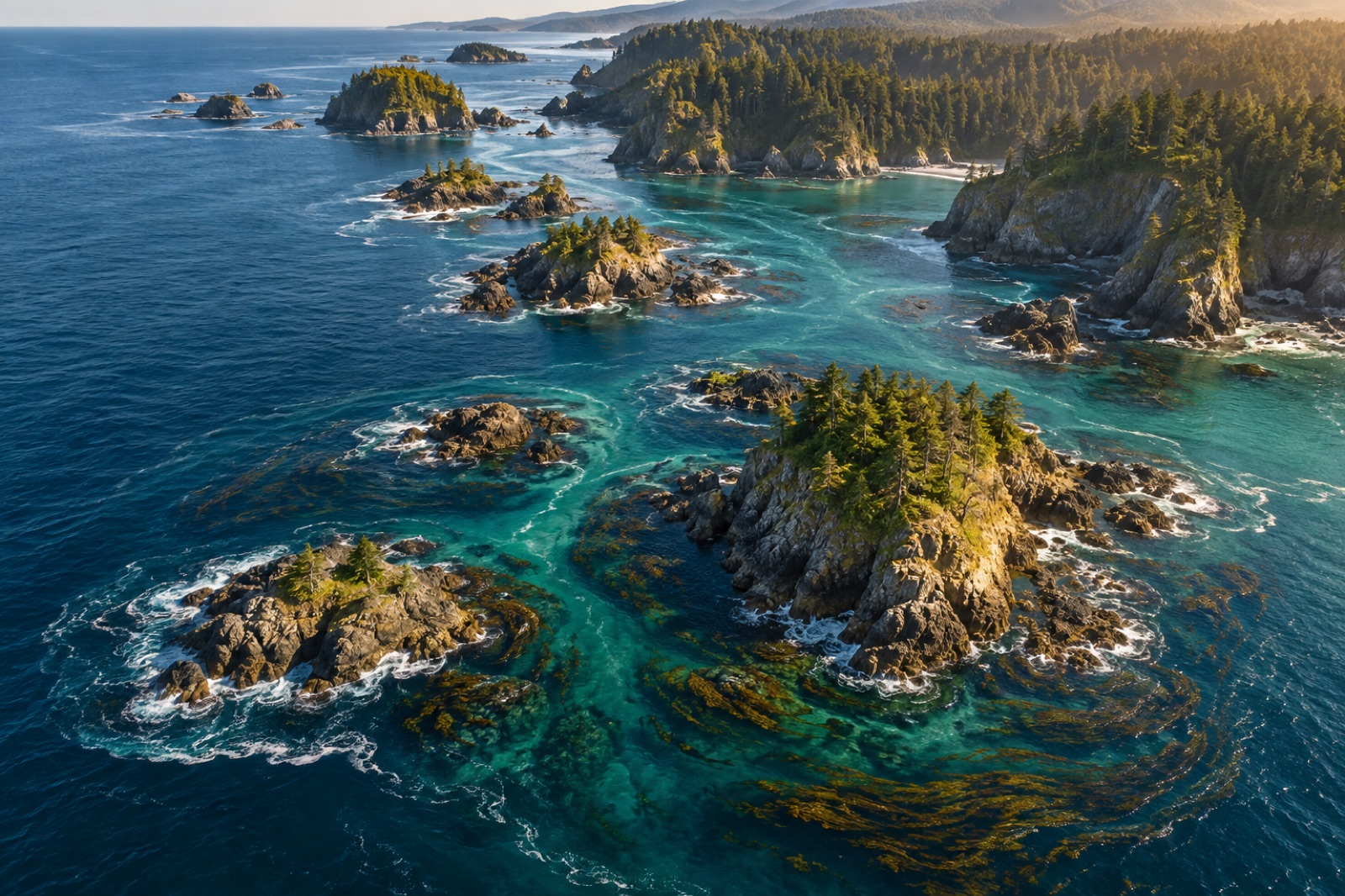
From the air, a coastline of kelp forests reads as an archipelago: green patches separated by sand channels, river mouths and long reaches of bare rock. It is tempting to think of each forest as an island unto itself. It isn't. Every reef on that coast is wired to its neighbours by a traffic of spores, drifting fertile blades and the larvae of the hundreds of species the forest shelters — a hidden map of connections that decides where forests reappear after catastrophe and where they cannot. Because "larval dispersal" and "kelp" are often searched together, this article covers the full propagule picture: the microscopic zoospores kelp itself releases (kelp technically has no larval stage), the larvae of the reef community it hosts, and the larger rafts that carry genes improbable distances.
The spore lottery — and its long tail
A mature giant kelp sporophyte carries blades of sporophyll tissue near its base that can release enormous numbers of swimming zoospores — over a reproductive season, a fertile patch can shed them in quantities beyond counting. Each spore swims feebly, for hours to a few days, and must land on clean hard substrate within reach of light. The mechanics of that journey — survival, sinking, settlement cues — are covered in detail in how kelp spores disperse.
What matters for connectivity is the shape of the dispersal kernel: the curve describing how many spores travel how far. For most kelp it is steeply peaked near the parent — the great majority of spores settle within metres to a few hundred metres — but it has a long, fat tail. A small but consistent fraction travels kilometres; a rare few, caught in the right current at the right moment, travel much farther. In population terms the tail is what counts. A reef too isolated to receive those rare arrivals is demographically on its own: if wiped out, it may not be reseeded within a human lifetime.
Hitchhikers on the wind: rafting as a dispersal engine
Spores are not the whole story. Storm-torn kelp — and in some species, entire buoyant plants with gas-filled floats — drifts at the surface, sometimes still fertile, carrying not just spores but whole hitchhiking communities of holdfast fauna. Rafts of buoyant kelp species have been tracked across currents far beyond normal spore range, and genetic evidence shows they do sometimes establish: they are the mechanism behind genuine long-distance colonisation events, including the recolonisation of sub-Antarctic islands.
Rafting rewrites the connectivity map interestingly, because it follows surface currents and winds rather than the nearshore flows that move swimming spores — often exporting material in the opposite direction to the counter-currents that hug the bottom. A complete connectivity model needs both layers.
How scientists actually measure the invisible
Connectivity is one of the hardest things to observe directly in ecology, so scientists triangulate from several toolkits:
Lagrangian particle models
Ocean current models — built from satellite altimetry, buoy data and high-resolution coastal circulation models — are seeded with virtual "particles" endowed with realistic biology: a swimming duration, a settlement window, a mortality rate. Run millions of particles from each reef over many years and you get an estimated exchange matrix: which reefs seed which, how often, and how the pattern flips between seasons and between El Niño and La Niña years.
Genetics as a revealed record
Where particles are hypothetical, genes are historical. If two forests exchange even a handful of successful migrants per generation, their allele frequencies converge; reefs that have been isolated for centuries drift apart measurably. Population genetic surveys — the same methods described in kelp population genetics — therefore read out the effective connectivity averaged over generations, which is exactly the timescale relevant to persistence. Tasmanian giant kelp populations, for example, show genetic structure that tracks habitat configuration: forests separated by long sandy gaps carry genuinely different gene pools.
Otoliths and chemistry for the animal community
For the reef's fishes, connectivity has other tracers. The chemistry of fish ear bones records the water each fish lived in at each life stage, revealing whether a population is locally replenished by its own larvae or subsidised by distant reefs — data that complements the kelp-spore picture and makes a reef's value as a nursery quantifiable.
Stepping stones, sources and sinks
Assemble these measurements and familiar patterns emerge:
- Hub forests — often large, old, mid-coast stands — export propagules broadly and anchor the network.
- Source–sink pairs — persistent upstream forests that seed downstream reefs which could not sustain themselves alone; losing the source silences the sink.
- Stepping stones — small, easily overlooked reefs whose removal severs the only link between two larger forest regions.
- Dead ends — scenic, healthy forests that receive plenty but export little, making them poor choices as sole restoration anchors.
This vocabulary has practical teeth. Marine protected area networks designed with connectivity in mind — spacing reserves within dispersal range of one another, deliberately protecting stepping stones, reserving a recognised source reef — outperform equal-area networks chosen on habitat maps alone. The theory and evidence are laid out in the science of MPA networks, and the concept is explored more broadly in marine connectivity.
What the map means for restoring forests
Connectivity thinking has quietly become the operating system of kelp restoration, including our own. Three rules it hands down:
- Site selection is a network decision. Restoring a reef that sits at a network hub multiplies the return: the site not only regains a canopy, it becomes a donor that reseeds and re-genes its neighbours. Restoring a dead-end reef is still worthwhile locally, but should not be mistaken for coast-wide recovery.
- Provenance choices should respect the network. Seedstock for outplanting is best drawn from within the genetic neighbourhood — donors the reef was historically connected to — which is why Holdfast's nursery protocol matches hatchery stock to site genetics rather than shipping one convenient strain everywhere. Where a coast's own gene pool has contracted too far, the harder question of assisted migration — deliberately bridging the map — arises.
- Recovery forecasts must be network forecasts. When a heatwave strips a coastline, the question is not "will kelp come back to this reef?" but "what does the remaining network supply, and to whom?" — the question succession science asks at coast scale — see how a bare reef becomes a forest again.
At Tidewright projects, this translates into practice: before the first Drifter lays a seeded line, the team models the site's particle-exchange footprint and screens donor genetics, so that each restoration is placed where the hidden map says it will matter most.
Key takeaways
- Kelp propagules disperse as swimming zoospores with a steeply local dispersal kernel but a long, consequential tail; rafting of buoyant, fertile kelp adds true long-distance jumps along surface currents.
- Effective connectivity is revealed by ocean particle models, population genetics and chemical tracers in reef fishes — three toolkits that must agree before a map is trusted.
- Every coast's connectivity map has hubs, sources, sinks, stepping stones and dead ends, and these roles, not just habitat quality, determine which forests persist.
- Connectivity-aware marine reserve design and restoration siting deliver disproportionate recovery relative to the area protected or planted.
- Restoration should plant at network hubs, source seedstock within the genetic neighbourhood, and forecast recovery at the scale of the coastline, not the single site.
FAQ
Does kelp have a larval stage like fish or urchins?
No. Kelp releases motile zoospores — single cells, a few micrometres across, that swim for hours and then settle. There is no feeding larval equivalent in the kelp life cycle, though the microscopic gametophyte generation that follows settlement plays a similar early, vulnerable demographic role.
How far can kelp actually travel?
Most spores settle within a few hundred metres of home; connectivity beyond roughly 10 kilometres by spores alone is rare in most species. But the picture changes with rafting: buoyant, fertile kelp drifting on surface currents has carried populations across entire basins given enough generations. Barriers like long sand flats and river plumes matter as much as distance.
Are all kelp coasts equally well connected?
No. Long, continuous rocky coasts with modest sand gaps — much of Chile or Norway — tend to be tightly connected. Coastlines chopped by big estuaries, long beaches or deep thermal gradients — parts of Tasmania or southern California after heatwaves — have weaker links and more isolated gene pools, which is exactly where genetic monitoring matters most.
Why should a carbon buyer or investor care about connectivity?
Because canopy persistence is a network property. A credit resting on a dead-end site with no natural subsidy is riskier than one at a connected hub that self-reseeds after storms. Connectivity analysis is becoming a standard lens in the monitoring and risk frameworks that platforms like Canopy Ledger carry into project due diligence.
Can restoration itself alter the connectivity map?
Yes — deliberately. New or re-established reefs at strategic locations act as new nodes and links, knitting fragmented networks back together. That is one of the quiet superpowers of restoration: done well, it doesn't just add forest, it rewires the coast so natural processes can take over again.