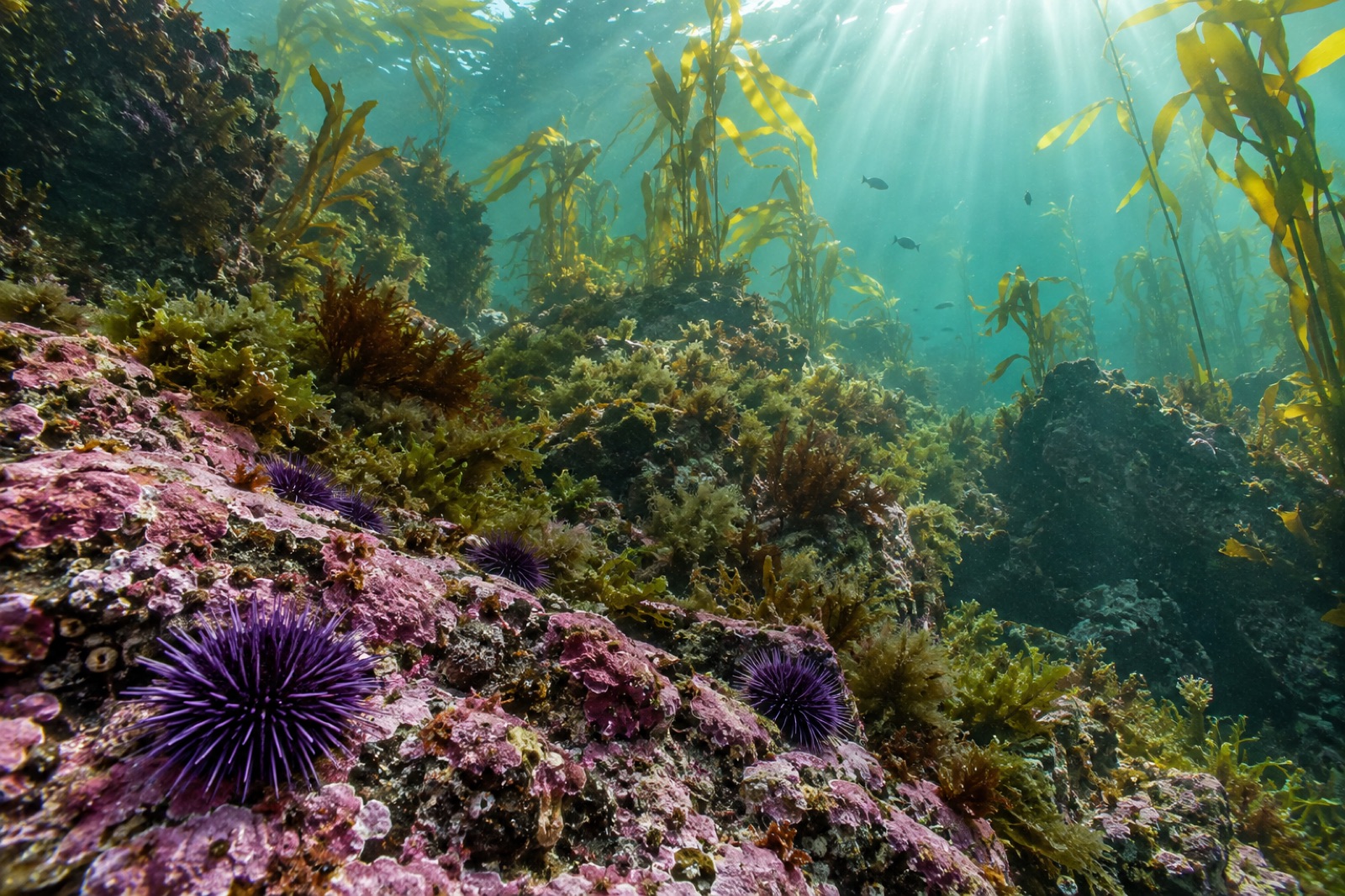
When a kelp forest is stripped back to bare rock — by a marine heatwave, a storm, or an army of sea urchins — the reef does not stay empty for long. What grows back, and in what order, follows a pattern ecologists call succession: a roughly predictable sequence of communities, each one changing the habitat for the next. On land, succession is the story of grassland becoming shrubland becoming woodland. Underwater, it is the story of crust becoming turf becoming forest.
Understanding that story matters for more than curiosity. It tells a coastal manager how long natural recovery might take, why some reefs seem stuck, and — for a restoration company like Tidewright — which stages of the sequence can be accelerated, and which can be skipped entirely.
What succession means underwater
The concept comes from terrestrial ecology, where scientists watched old farm fields and glacier forelands change over decades. The marine version has the same skeleton but different actors and a faster clock.
Primary succession begins on genuinely new substrate — fresh volcanic rock, a newly deployed artificial reef, a boulder rolled downslope by a storm. Secondary succession begins after a disturbance that removes the community but leaves the substrate and some biological memory behind: spore banks in the sediment, surviving holdfasts, a refuge of kelp just down the coast. Nearly all kelp forest recovery is secondary succession, and it is usually measured in seasons rather than decades.
The engine of succession is a three-way push and pull between facilitation (early species make the habitat better for later ones), inhibition (early species block later ones), and tolerance (later species simply outcompete the pioneers whenever they arrive). A real reef runs all three at once, which is why recovery looks messy up close and patterned only from a distance.
The stages of reef recovery
Ask a kelp ecologist to describe a recovering reef and they will usually sketch four broad stages. The boundaries blur, and not every reef passes through every stage, but the backbone is consistent from California to Tasmania.
Stage 0: The barren that is not really barren
A reef that has lost its kelp almost never looks like clean concrete. The rock is typically painted pink and purple with crustose coralline algae — living limestone that cements the reef and, importantly, releases chemical cues that invite the larvae of abalone, urchins, and other invertebrates to settle. If grazing pressure is the reason the forest fell, this stage may also be crowded with sea urchins in a state of siege: sedentary, half-starved, waiting for drift kelp rather than roaming. This is the urchin barren state, and it can persist for years or decades because crack the crusts and hungry grazers reclaim them within weeks.
Stage 1: Pioneers — the green flash
When grazing pressure relaxes — after an urchin disease, a predator return, or human removal — the first colonists are fast, cheap, and expendable. Filamentous green and brown algae, diatom films, and opportunistic blades like Ulva and young acid weed (Desmarestia) race through their life cycles in weeks. They are the weeds of the reef: high growth rates, poor defences, short lives. Their job in the successional play is speed. Within a single spring, bare rock can go from pink to shaggy green, and that film of life starts trapping sediment, hosting amphipods, and feeding the first grazers that return.
Stage 2: Turfs and understory kelps
Next come the longer-lived brown turfs and the understory kelps — species like Pterygophora and Agarum on North American reefs, or juvenile Ecklonia in Australia. They invest more in structure and chemistry, survive grazing better, and begin to shade out the pioneers. Crucially, many canopy kelp spores settle at this stage too. A giant kelp zoospore does not wait for an engraved invitation from stage two; it settles whenever bare rock and light coincide. Early canopy recruits often grow up within the understory assemblage rather than after it.
The final structural stage belongs to the giants: giant kelp, bull kelp, and their relatives, whose buoyant fronds climb to the surface. Once a canopy closes, light reaching the understory can drop by 90% or more, shade-intolerant turfs thin out, and a shade-adapted community of red algae and sessile invertebrates takes over the dim floor. The reef now looks like a forest because, functionally, it is one: layered, light-limited at the bottom, and dominated by a few large organisms — much like the subtidal zonation you can read on any layered reef wall.
The climax is a mosaic, not an endpoint
Mature kelp forests never actually finish. Storms tear gaps in the canopy every winter; senescent plants fall; a localised urchin front opens a clearing. Each gap restarts a miniature succession, so a healthy forest is a shifting patchwork of stages zero through three existing side by side. Ecologists call this gap-phase dynamics, and it is a feature, not a flaw — the mosaic is what allows so many species with different light and shelter needs to share one reef.
What speeds succession up — and what stalls it
The difference between a reef that refills in two years and one stuck for twenty usually comes down to three levers.
Grazing pressure is the master switch. While urchins or overabundant herbivorous fish hold the line, succession cannot advance past stage zero no matter how many spores rain down. This is why recovering predator populations — sea otters, large lobsters, sheephead — so often precede forest recovery, the classic trophic cascade in action.
Propagule supply is the next constraint. Most canopy kelp zoospores travel metres, not kilometres; even buoyant rafts of fertile tissue rarely beat tens of kilometres against prevailing currents. A reef isolated from surviving forests — by distance, by currents, or by a coastline-wide heatwave that removed every parent — faces a recruitment bottleneck that no amount of favourable habitat can fix. The physics of this dispersal problem are covered in our explainer on how marine life colonises new reefs.
Environmental windows decide whether recruits survive their first season. A succession that begins in a cool, nutrient-rich spring can be erased by a warm stratified summer. Increasingly, the window itself is what restoration teams plan around.
Succession in restoration: skipping the queue
Here is where succession stops being pure description and becomes engineering. Active restoration works by intervening at specific stages:
- Stage 0 → break the barren. Removing excess urchins (by harvest or relocation) and adding structure where substrate has been buried resets the board so succession can start.
- Stage 1 → don't wait for pioneers. Pioneers arrive on their own, usually within weeks. No one needs to plant weeds.
- Stages 2–3 → skip the recruitment lottery. Instead of waiting years for spores to drift in from a distant forest, restoration outplants later-stage kelps directly. Tidewright's Holdfast hatchery lines carry juvenile kelp sporophytes grown from locally sourced, climate-screened seedstock — effectively stages two and three arriving on day one. The naturally recruiting pioneers then fill in around them, and the sequence completes from both directions.
- Guard the gaps. For the first one to two seasons, outplanted kelp is vulnerable to exactly the grazing pressure that caused the collapse, so grazer management continues until plants reach reproductive size and begin seeding the reef themselves.
The principle is general and old — foresters call it planting late-successional species under nursery cover. What is new underwater is the ability to do it with genetic matching: seedstock chosen from populations already performing well at the warmer edge of the species' range, so the recovering forest is pre-adapted to the temperatures of the next decade, not the last one. Tidewright reports survival and canopy-closure trajectories for each site in its project field notes (all Tidewright figures are illustrative of our programs, not audited scientific results).
Succession under a changing climate
Every generation of kelp ecologists has had to revise the succession story slightly, and ours is no exception. Three pressures are reshaping the script.
First, resets are becoming more frequent. If a heatwave arrives every five years but full canopy recovery takes seven, a reef may never again reach stage three — it lives permanently in the weedy middle acts. Second, the cast is changing: warm-affiliated turf algae and subtropical herbivorous fish are joining stage one and two communities at higher latitudes, altering facilitation and grazing in ways we are still measuring. Third, the referee matters more: scattered thermal refugia — pockets of cool upwelled water — now act as the source forests that seed succession everywhere downstream, making their protection one of the highest-leverage conservation moves available.
The hopeful reading of the same science is that succession is resilient in its direction, even when its pace changes. Given bare rock, light, nutrients, grazing relief, and a supply of spores, the sea builds a forest. Our job — as ecologists, and as restorers — is to make sure those five ingredients keep arriving.
Key takeaways
- Ecological succession on a rocky reef runs from crustose barren → pioneer algae → understory kelps and turfs → canopy giants, with each stage modifying the habitat for the next.
- Healthy mature forests never "finish"; storms keep a mosaic of successional stages alive side by side, which maintains biodiversity.
- Grazing pressure, spore supply, and environmental windows are the three levers that decide whether recovery takes two years or twenty.
- Restoration accelerates succession by clearing grazers and outplanting later-stage kelps, skipping the slow recruitment lottery while letting pioneers arrive naturally.
- Frequent heatwaves can trap reefs in permanent intermediate stages; protecting thermal refugia protects the source populations every recovery depends on.
FAQ
How long does it take a bare reef to grow back into a kelp forest?
Where spore sources are close and grazing is controlled, canopy kelp can appear within one to two growing seasons, and a visibly structured forest within three to five years. Where parent forests are distant or urchins still hold the reef, recovery may stall indefinitely — which is why urchin barren formation is a focus of so much kelp science.
Does succession always end with kelp?
No. Succession ends with whatever the local light, temperature, nutrients, and grazers permit. On deep or turbid reefs the end state may be sponges and sea whips; in very warm water it may be turf algae. Kelp is the climax only in the cool, clear, nutrient-fed band where kelps are physiologically competitive.
What is the difference between a pioneer and a climax species?
Pioneers trade everything for speed: fast growth, quick reproduction, minimal defence, short lives. Climax species do the opposite — slow, armoured, long-lived, and able to monopolise light or space for decades. A recovering reef needs both, in sequence.
Can you really "skip" stages in succession?
You can skip the waiting, not the biology. Outplanting juvenile canopy kelp removes the years spent hoping spores drift in from a distant forest, but the pioneers, grazers, microbes, and understory still assemble around the planted kelp on their own schedule. Good restoration works with succession rather than pretending to replace it.
Is the successional sequence the same after a storm as after a heatwave?
The sequence is similar, but the starting conditions differ. Storms leave nutrients, surviving holdfasts, and nearby parent kelp intact, so recovery is quick. Heatwaves remove parents across whole coasts and often coincide with nutrient-poor water, so both propagule supply and growing conditions are degraded at once — which is exactly the scenario active restoration is designed for.