Science7 min read
The Kelp Forest Food Web: Who Eats What
A map of the kelp forest food web — from drifting fronds and grazing urchins to otters, octopus and rockfish — and why detritus powers most of it.
Dr. Mara Ellison ·
A temperate reef is stacked like a city: canopy, understory, turf and encrusting floor. Learn what drives subtidal zonation and why divers see it everywhere.
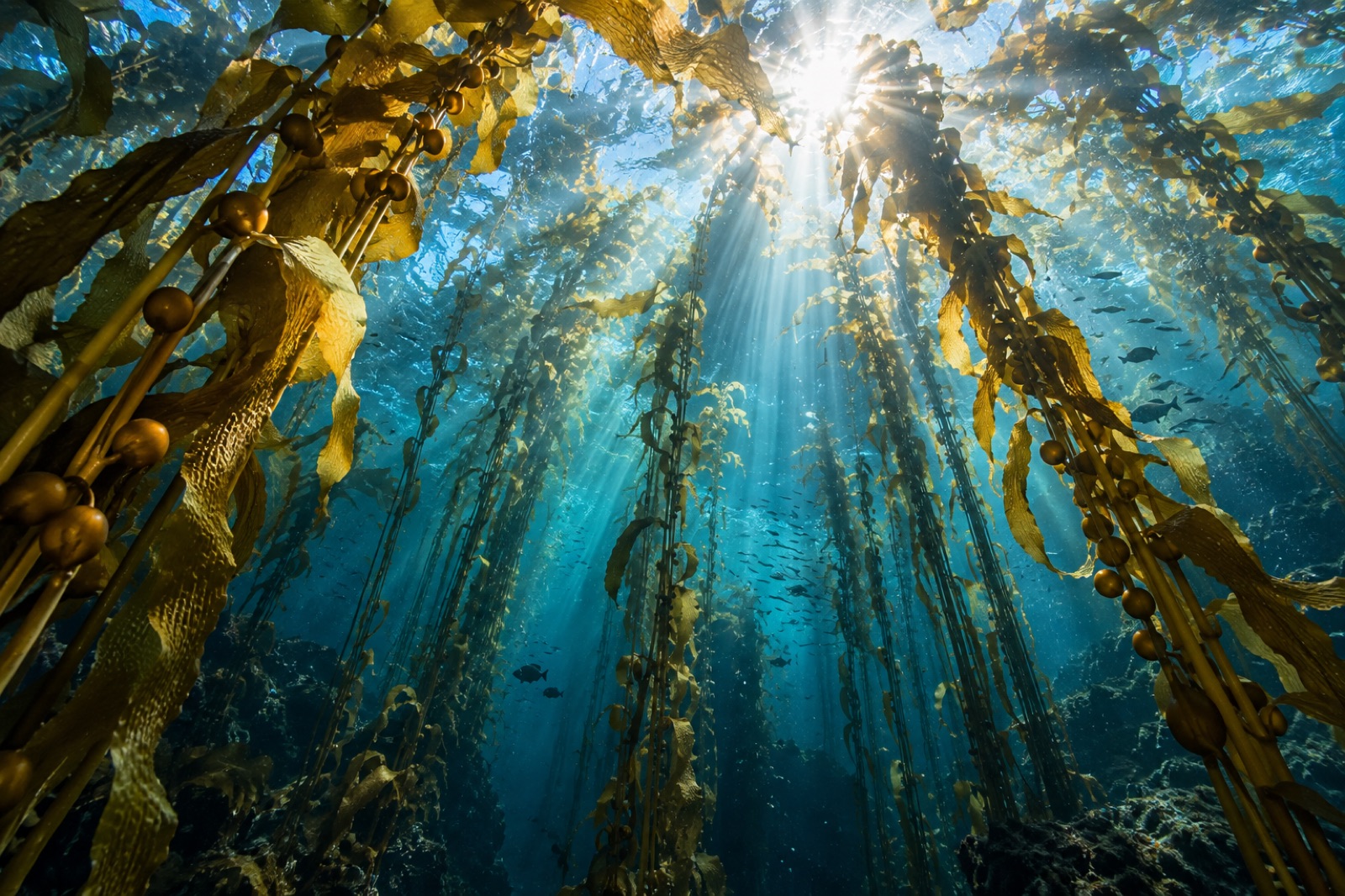
Descend onto a healthy temperate reef and you are not entering one habitat but a stack of them. In the first few metres the water is bright and storm-rocked; giant brown kelps carpet every rock. Drop to ten metres and a canopy spreads over your head, filtering the light to cathedral green. Keep going and the canopy thins into parkland — scattered kelps over low tufted algae — until, somewhere between twenty-five and forty metres depending on the water, the seaweeds give up entirely and the rock belongs to sponges, anemones and encrusting reds that need almost no light at all.
This vertical ordering of life is zonation, and it is one of the most predictable and useful patterns in marine ecology. Once you learn to read the layers, a single dive tells you about light, wave energy, grazing pressure and water quality — and tells a restoration team exactly where and how to work.
Three gradients do most of the work:
Light falls off fast. Even in clear oceanic water, red wavelengths are gone within the first metres, and usable light halves every few metres thereafter. Photosynthetic organisms are therefore rationed by depth, each species equipped with pigments tuned to whatever light is left. Kelps cope better than most thanks to fucoxanthin, the accessory pigment described in how kelp photosynthesizes, which harvests the blue-green light that penetrates deepest — but even fucoxanthin runs out of photons eventually.
Wave energy falls off too. At the surface, storm swell delivers forces that only the toughest, most flexible algae survive. A few metres down, the same swell is a gentle sway. This is why shallow zones are dominated by leathery, low-profile species while the canopy kelps — mechanically fragile in surge, glorious in calm — live deeper.
Grazing and competition complete the pattern. Urchins and other herbivores have depth preferences and tolerances; sea stars hunt deeper than waves wash but shallower than dark. Where grazers run uncontrolled, whole bands of the zonation pattern collapse into barren crust — the signature of an urchin barren, which is essentially a reef with most of its layers deleted.
Exact depths vary with region and water clarity, but on a clear Pacific coast the canonical stack looks like this.
The splash-adjacent band (0–3 m). Above and just below the surface, everything is violence. Organisms here are either armoured, glued down, or flexible to the point of comedy. This is the realm of surf grasses, rockweeds, and specialists like the sea palm, which lives precisely on the wave-washed boundary. Most seaweeds you meet here are small, tough and short-lived.
The sub-canopy or shallow kelp band (3–10 m). Light is abundant, surge is manageable, and productivity peaks. On coasts with canopy-forming kelps, young plants race upward from this band; where canopy formers are absent, this zone carries dense golden kelps, feather boa kelp and other mid-sized browns. Competition for space is ferocious, and the winner is usually whoever can occupy the light fastest.
The canopy (5–20 m on clear coasts). Where giant or bull kelp forests grow, the mature canopy sits at the surface, but its light-absorbing fronds shade everything beneath. Giant kelp canopies reshape the whole stack: understory species beneath them must be shade-tolerant, and light-demanding species are pushed to canopy gaps and edges. The forest interior is a world of green twilight, drifting fish and slow invertebrate life.
The understory (10–30 m). Beneath the canopy, a second tier of shorter kelps and foliose red algae holds on in dim light. This is one of the most species-rich bands on the reef: small kelps in the genus Laminaria and relatives, delicate reds, and turf communities. It is also the first zone to suffer when water turbidity increases — light that was marginal becomes insufficient.
The deep reef / encrusting zone (below the kelp line). Below the deepest kelp, light drops below what macroalgae can pay their energy bills with, and the reef shifts to animals and encrusting coralline algae — the pink, cement-like crusts that also happen to be critical settlement cues for abalone and other larvae. Sand channels, boulder fields and biological structure dominate. In very clear water the kelp line can sit beyond 30 metres; in turbid harbours it may sit at 5.
Depth is the steep gradient, but zonation runs sideways too. Wave exposure sorts communities along a coast: exposed headlands carry surge-adapted kelps and rich filter-feeder carpets; sheltered bays carry sediment-tolerant species and often denser urchin populations. Upwelling-favoured sides of headlands are kelp-rich; warm, stratified lee sides can be species-poor. Reading a reef means reading both axes at once — the physics of upwelling and boundary currents writes as much of the pattern as depth does.
Zonation is not just a naturalist's parlour trick; it is operational information.
Siting reseeding by depth band. A restoration line seeded with giant kelp belongs in the depth band where giant kelp actually wins — deep enough to escape surge, shallow enough for growth. Holdfast nurseries in Tidewright's fictional program (the platform overview) match seedstock depth bands to the local zonation map of each project reef, a detail our field crews describe first-hand in Why We Lay Lines at Forty Degrees.
Diagnosing reef health. A reef with its understory intact but canopy missing tells a different story than a reef scraped to crust. The first suggests a recent canopy disturbance (storm, urchin pulse) with regeneration capacity preserved; the second suggests a chronic barren state requiring urchin management before any seeding.
Interpreting satellite and drone maps. The canopy visible to satellites — the mapping logic explained in how satellites see kelp — is only the top layer. A "canopy loss" signal can coexist with a healthy understory poised to recover, or can mask an understory already collapsing. Depth-stratified dive surveys are how monitoring programs (ours included; see the impact methodology) resolve that ambiguity.
Predicting climate responses. Warming does not hit all layers equally. Deep strata cool more slowly, so deeper bands increasingly act as thermal buffers — the same refuge logic, at reef scale, that drives thermal refugia at coast scale. Understory species can also pre-adapt forests to shade regimes expected under shifting canopy cover.
The practical skill is simple: on any dive, note where each layer begins and ends — the depth where kelp yields to turf, where turf yields to crust, where fish communities change. Do it consistently and you build a personal survey instrument. Citizen-science reef programs formalise exactly this habit; our guides to kelp forest diving for beginners and citizen science from the shore show how to turn pattern-reading into useful data.
Learn the layers, and the reef stops being scenery. It becomes a legible record of physics and history — every band a symptom, every transition a question, every dive a chance to watch an entire ecology negotiate with the light.
It varies enormously with water clarity. In very clear water kelp can persist below 30 metres; in turbid coastal water the lower limit may be 5–10 metres. The hard boundary is the compensation depth — where light supplies exactly what a plant needs to balance its metabolic costs — and it shifts with season, storms and plankton blooms.
The drivers are universal — light, waves, grazers — but the cast changes. Australia's Great Southern Reef stacks golden kelp differently than California stacks giant kelp, and Arctic coasts have few canopy formers at all. Learn the local species and the pattern still reads clearly.
A barren is a reef where grazing has eliminated the erect algae of the shallow and mid-depth bands, leaving encrusting corallines and grazers. The depth structure of the reef remains, but the biological layers are stripped to the foundation — which is why recovery often appears as layers reassembling in order.
Constantly. Storms prune the canopy, which floods the understory with light and triggers recruitment; years of calm let canopy recover and shade out opportunists. Zonation is a dynamic equilibrium, and long-term shifts — like heatwave-driven canopy loss, covered in Marine Heatwaves 101 — rewrite it.
Start by carrying a dive slate or camera and recording the depths of each transition you see. Compare rocky reefs at different exposures on the same day. Within a few dives, the pattern will start announcing itself before you look for it — and shore-based intertidal zonation, visible on any low-tide walk, teaches the same lesson on land.
A map of the kelp forest food web — from drifting fronds and grazing urchins to otters, octopus and rockfish — and why detritus powers most of it.
Dr. Mara Ellison ·
Kelp has no true roots — its holdfast is a branching biological anchor built for storms. Explore holdfast anatomy, how kelp really feeds, and its hidden biodiversity.
Dr. Theo Nakamura ·
Why is kelp brown, not green? The answer is a pigment strategy tuned to underwater light — and it explains how kelp forests become some of Earth's most productive ecosystems.
Dr. Theo Nakamura ·