Explore7 min read
Cold-Water Dive Gear for Kelp Forests: A Complete Kit List
The complete cold-water kit for kelp forest diving: wetsuit thicknesses, drysuits, hoods, gloves and the small accessories that save a dive.
Tom Okafor ·
Your first kelp forest dive is easier — and more magical — than you think. Gear, skills, marine life and etiquette for new divers entering the green cathedral.
Part of a learning path
This article is stop 2 of 9 on Into the Canopy — A cold-water diver’s route from first kelp dive to night forest.
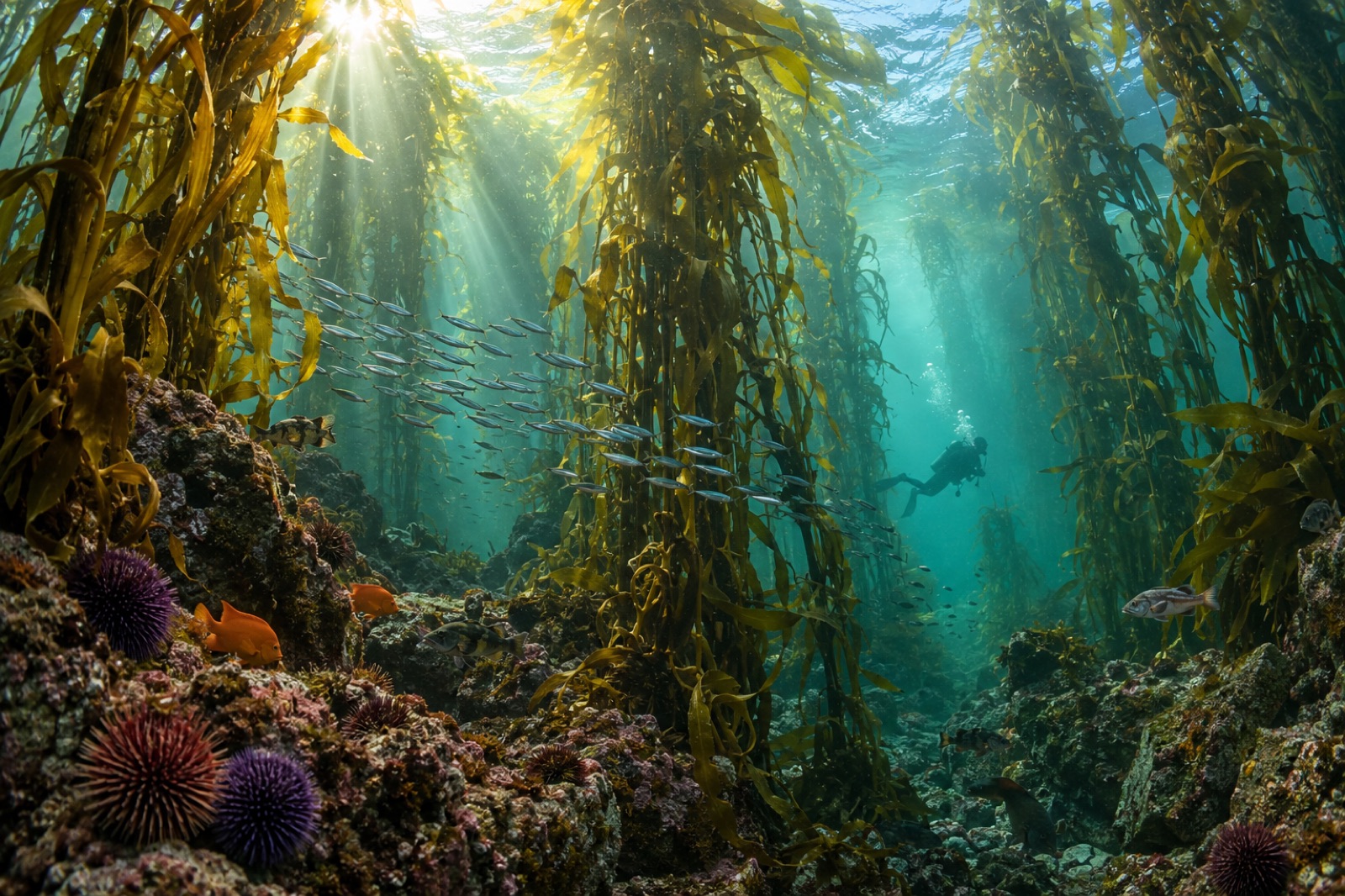
There is a moment, usually on a first kelp dive, when you stop finning and just hang in the water. Sunlight comes down through the canopy in slanted green columns. A school of small fish turns overhead like weather. Something large and slow moves between the stipes and is gone. Divers call kelp forests "cathedrals," and they are not exaggerating. If you have a scuba certification and a tolerance for cool water, this guide will get you from the car park to that moment safely — and tell you what you're actually looking at when you get there.
Kelp grows where the water is cool, clear enough for light, and rich in nutrients — the same conditions that produce spectacular temperate reefs. That means kelp diving is, almost everywhere, cold-water diving: surface temperatures from roughly 8°C in Tasmania and Norway to about 20°C in a Southern California summer. You do not need to be an expert, but you do need three things:
If any of those are shaky, spend a few dives with an instructor or a divemaster-led group first. Nearly every kelp coast on Earth has a local dive shop that runs guided shore dives, and guided is genuinely the best way to learn a new temperate site.
Kelp is not coral, and it is not a plant in the way you imagine. Giant kelp and its relatives are brown algae anchored to rock by a root-like tangle called a holdfast — which absorbs no nutrients at all; it is a grappling hook, not a root system. (The biomechanics are fascinating on their own — see our explainer on holdfast biology.) From each holdfast, stipes rise toward the light, buoyed by gas-filled floats, and spread into canopy at the surface. In clear water the forest reads in layers: a holdfast understory hiding fish and octopus, a mid-water column of drifting stipes, and a sunlit ceiling fringed with blades.
That layered structure shapes how the dive feels:
For a first kelp dive, favour protected coves with easy entries over boat dives in open water. You want a sandy channel or easy rock entry, modest depth, and kelp that starts within a short surface swim. Classic beginner-friendly kelp regions include Monterey Bay in California, where sheltered sites let you swim out over sand and meet the forest edge gradually, and the Channel Islands, where day boats drop you into some of the most pristine forests left on the Pacific coast. In Australia, the eastern bays of Tasmania and the gulfs of the Great Southern Reef offer golden kelp over granite boulders in water calm enough for new divers.
Whatever the region, ask the local shop four questions: What is the entry and exit like at this tide? Where is the kelp thickest, and where is the clear-water edge? What is the surge doing today? And what is the plan if we get separated? A good shop answers all four without being asked.
Everything in kelp diving flows from buoyancy. You want to hover horizontally, slightly above the reef, moving with slow frog kicks that don't wash water down onto anemones and sponges. Practise before your trip if you can. The reward is enormous: a diver in good trim can stop mid-water and watch a sheephead work a holdfast three metres away without spooking it.
Kelp stipes are tougher than they look, but the forest is alive and slow-growing. The rules are simple:
Kelp forests sit along coastlines, which gives you a gift: a natural navigation reference. The shore is in one direction; deeper water is in the other. Note your heading on the way out, and you can nearly always find your way back by reversing it along a compass reciprocal plus depth. Still, carry and actually use a compass — fog on land has no effect underwater, but a dim kelp interior on a grey day can disorient anyone until they learn to trust the terrain.
First-time kelp divers often expect sharks and drama. What you get instead is texture: life layered on life. In California forests you will meet garibaldi guarding algal gardens like bright orange gardeners, California sheephead cruising for urchins, and — if you are lucky — a giant Pacific octopus packed into a den, watching you with unsettling intelligence. On southern Australian reefs, weedy seadragons drift through the kelp edge like colonies of animate seaweed, and eastern blue gropers will follow a calm diver out of sheer curiosity.
The grazers tell the forest's story if you know how to read it. A reef trailing with purple sea urchins in their pit-like homes is a forest mid-argument; where predators like sea otters or sheephead keep urchins in check, kelp stands tall. Once you see that relationship — explored in our piece on trophic cascades in kelp forests — you never look at a reef the same way.
Kelp diving's real hazards are the water itself, not the seaweed:
A sensible ladder looks like this: one guided shore dive in a protected cove; a second with less hand-holding, practising buoyancy in the mid-water lanes; a third working a longer navigation route along the forest edge; a fourth at slightly greater depth on a wall or boulder field; and only then a boat dive in less sheltered water. Add a drysuit course if you fall in love with cold water — most kelp divers do. And when you want to go deeper into the ecosystems themselves, the Explore section of our journal grows with trip reports, technique guides and site profiles, and our teams at Tidewright run citizen-science and community programs on some restored reefs that welcome trained volunteer divers.
No. Any open-water certification is enough to begin, ideally with a guided first dive. If you plan to dive in a drysuit, take a drysuit specialty course — the buoyancy dynamics are different enough that self-teaching is a known cause of accidents.
Entanglement is the most feared and least dangerous issue. Kelp breaks easily, and the correct response — stop moving, breathe, unwind calmly — resolves almost every wrap in seconds. Cold, surge, boat traffic and separation from your buddy are far more consequential risks, and all are managed with planning.
Comfort is personal, but most new cold-water divers do well from about 12°C upward in a good 7mm wetsuit with hood and gloves. Below that, a drysuit transforms the experience. If you finish a dive unable to feel your lips, the gear — not your toughness — needs upgrading.
Absolutely, and in many places it is the best first step. A snorkel over canopy on a calm day offers most of the beauty with none of the logistics. Our guide to snorkelling safely over reef and kelp covers conditions, entries and buddy practices.
It depends on the coast. In California, autumn often brings the clearest water and calmest seas after summer upwelling. In Tasmania, late summer and early autumn are warmest. Ask local shops about seasonal visibility patterns — kelp coasts have them, and they matter more than air temperature.
The complete cold-water kit for kelp forest diving: wetsuit thicknesses, drysuits, hoods, gloves and the small accessories that save a dive.
Tom Okafor ·
Kelp forests are safe, magical snorkeling — if you respect cold water, surge and canopy. Skills, gear, hazards and spots for your first kelp snorkel.
Dr. Theo Nakamura ·
Freediving a kelp forest is the purest way to meet the reef. Learn blackout-safe practice, one-up-one-down buddying, and etiquette for breath-hold diving in kelp.
Tom Okafor ·