Encyclopedia7 min read
Leafy Seadragon (Phycodurus eques): Species Profile
The leafy seadragon is the most perfectly disguised fish in the sea. Explore its South Australian strongholds, brooding males and fragile future.
Dr. Mara Ellison ·
Australia's weedy seadragon drifts through kelp like fallen seaweed come alive. Discover its camouflage, male egg-brooding, range and conservation.
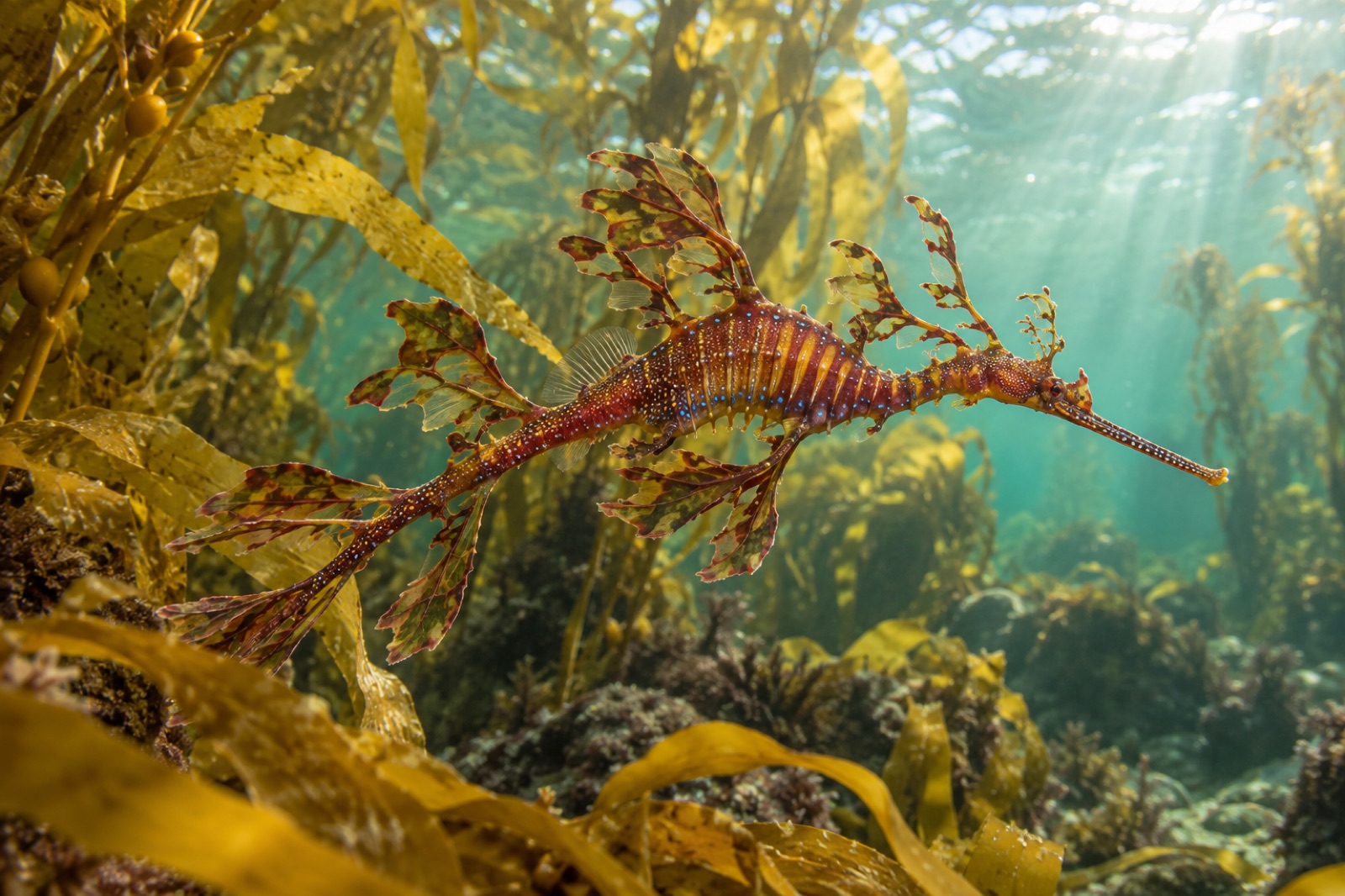
The weedy seadragon (Phyllopteryx taeniolatus) is the ocean's best argument that camouflage can be extravagant. A 45-centimetre relative of the seahorse, dressed in garnet, gold and electric blue, it drifts through southern Australia's kelp beds looking precisely like a scrap of free-floating seaweed — until its tiny, whirring fins betray it. Found nowhere else on Earth, the weedy seadragon is both a flagship for Australia's temperate reefs and one of the strangest pieces of engineering evolution has ever bolted onto a fish.
| Scientific name | Phyllopteryx taeniolatus |
| Family | Syngnathidae (seahorses, pipefish, seadragons) |
| Maximum size | About 45 cm total length |
| Colour | Ruby-red to burgundy body with yellow bars and iridescent blue spots, sprouting leaf-like skin flaps |
| Depth range | Commonly 3–30 m, recorded to about 50 m |
| Distribution | Endemic to southern Australia, from about Port Stephens (New South Wales) around the coast to Geraldton (Western Australia), including Tasmania |
| Diet | Mysid shrimp and other tiny crustaceans, taken by suction feeding |
| Status | IUCN Least Concern; protected in all Australian states |
Seadragons are seahorses, remixed. They share the same tubular snout, bony body rings and upright posture, but a weedy seadragon has abandoned the seahorse's defining trick: the prehensile tail. Its tail hangs straight and useless for gripping, which tells you everything about how this animal lives.
A weedy seadragon swims with two fins most divers never see. A single dorsal fin beats rapidly — many times per second — to drive the fish forward at walking pace, while a pair of small pectoral fins behind the gills handles steering. The result is less swimming than levitation: the body stays rigid and only the fins blur, like a balsa-wood model on hidden wires. Speed was never the point. Drift was. A seadragon that yields to surge and current doesn't fight its disguise — it completes it.
The skin flaps that give the weedy seadragon its name sprout from the trunk and tail like sprigs of kelp. They contain no muscle and play no role in swimming; they break up the body outline and mimic the seaweed around the fish, matching it in colour, translucency and — critically — in motion, waving with the same rhythm as the surrounding fronds as surge passes through the bed. Against that backdrop, the fish's actual bright palette dissolves into dappled light.
The disguise works on humans, too. Most divers' first weedy seadragon is pointed out to them on exactly the patch of reef they already stared at for five minutes.
Every seadragon on Earth lives in Australian waters, and the weedy seadragon holds the broadest slice of that territory: a vast arc of temperate coast from mid-New South Wales south around Victoria and Tasmania and west to the mid-coast of Western Australia. The Coastal Atlas covers these regions — from Sydney's harbour-fringe kelp beds to the Alonnah reefs of Tasmania — in detail.
Three features define weedy seadragon habitat wherever it occurs:
The seadragon's head is a machine for one action. Its fused, toothless jaws form a narrow tube, and when a mysid drifts within range the fish drops the floor of its mouth almost explosively, generating suction that inhales prey from several centimetres away in milliseconds. The strike barely displaces the body — a seadragon feeding looks like a piece of kelp that occasionally hiccups.
That efficiency comes with a hard limit: prey must be small enough to fit a snout a few millimetres wide. Mysid shrimp form the core of the diet, supplemented by small amphipods and larval crustaceans. A weedy seadragon is therefore a specialist running on continuous grazing, spending much of each day hovering face-down over algae and sand patches, vacuuming.
In the syngnathid family, pregnancy is male work, and the weedy seadragon's version is elegant and exposed.
The strategy trades a seahorse-style sealed pouch for visibility: embedded tail eggs get direct oxygenation from the water, and the male's camouflage protects brood and bearer together.
The weedy seadragon is listed as Least Concern by the IUCN, and it is protected from collection in every Australian state — a legal shield largely prompted by the aquarium trade, which once took wild dragons in numbers wild populations could not sustain. But a broad Least Concern listing hides the local truth divers notice first: seadragons are site-loyal animals on habitat that is under acute pressure.
Monitoring is the weak point. Seadragons are hard to count — cryptic, patchily distributed, tracked poorly by the trawl and transect methods used for fisheries. Citizen science programs have filled some of the gap, with divers' photo-sightings used to map distributions and, in some cases, to follow individuals over time using their unique spot patterns.
The weedy seadragon is one of the great easy wins of temperate diving: often found between 3 and 12 metres, tolerant of quiet observation, and active in daylight. The ethics are simple — never touch, never herd a fish to open water for a photograph, and never handle a male carrying eggs. Sites near well-known populations can get crowded in season; give a dragon its personal metre and let it drift to you.
Neither. They have no bite, no sting and no toxin — their entire defence is to be mistaken for vegetation. They are completely harmless to handle-avoidant divers, and should never be touched regardless.
The leafy seadragon carries far more elaborate, branching appendages over its entire body and is generally more uniformly olive-gold; the weedy seadragon has fewer, sparser flaps, a redder body with bold yellow bars, and blue spots. Weedies also range farther east and north; leafies are concentrated along South Australia and the west.
Wild lifespan is uncertain — estimates range from five to ten years — because aging small, cryptic fish without fisheries data is genuinely hard. Captive individuals have lived well over a decade.
No. Like all syngnathids they are toothless suction feeders, inhaling tiny crustaceans whole through a tubular snout.
They are illegal to collect from the wild in Australia and are exceptionally demanding in captivity, requiring live mysid diets and exacting water quality. Only specialist public aquaria should attempt them.
The leafy seadragon is the most perfectly disguised fish in the sea. Explore its South Australian strongholds, brooding males and fragile future.
Dr. Mara Ellison ·
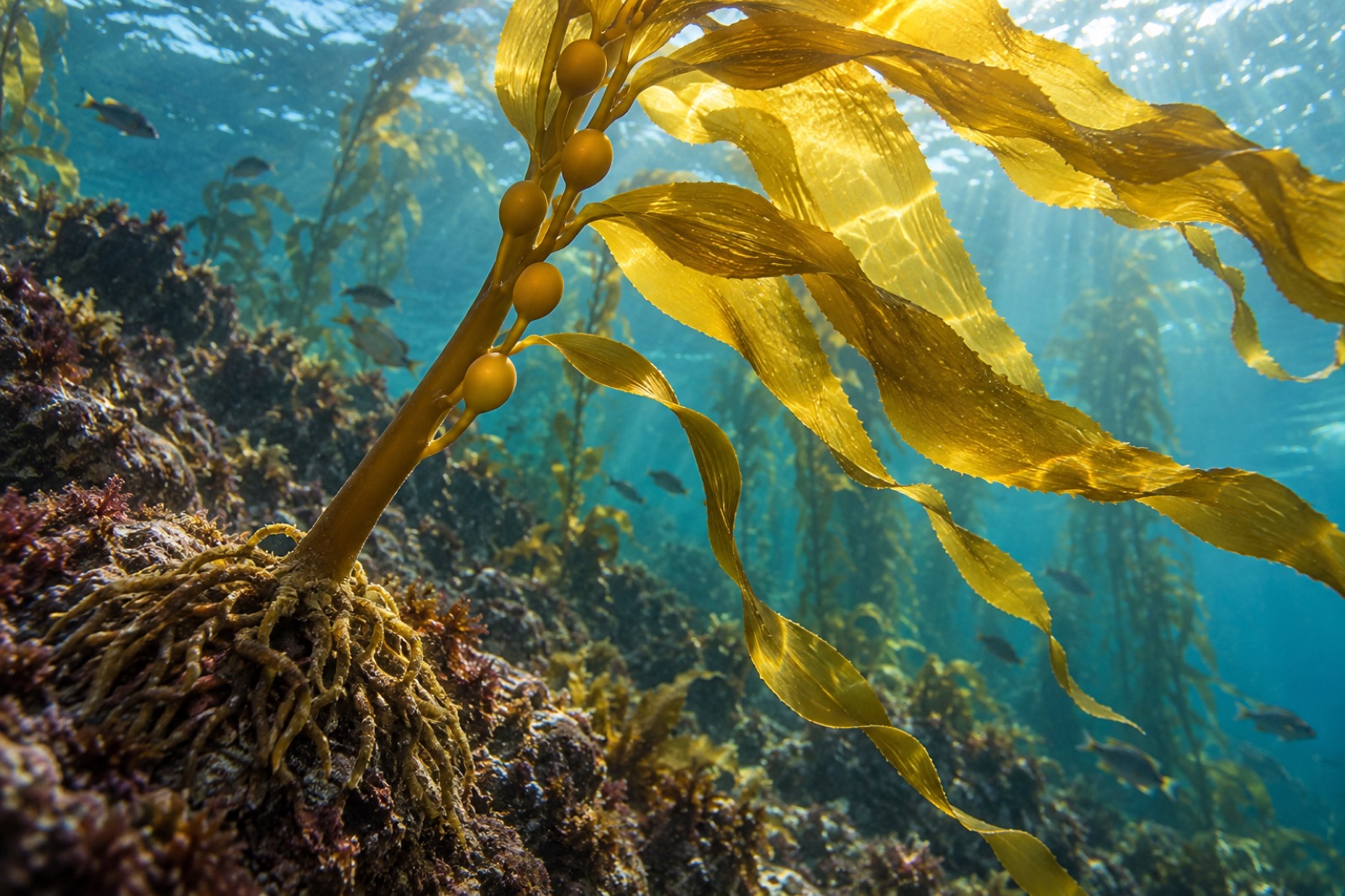
Giant kelp is the fastest-growing organism on Earth and the architect of undersea forests. Learn its biology, life cycle, range and why it matters.
Dr. Theo Nakamura ·
The blacklip abalone is southern Australia's largest abalone — a kelp-fed reef grazer that supports one of the world's most valuable wild shellfish fisheries.
Dr. Theo Nakamura ·