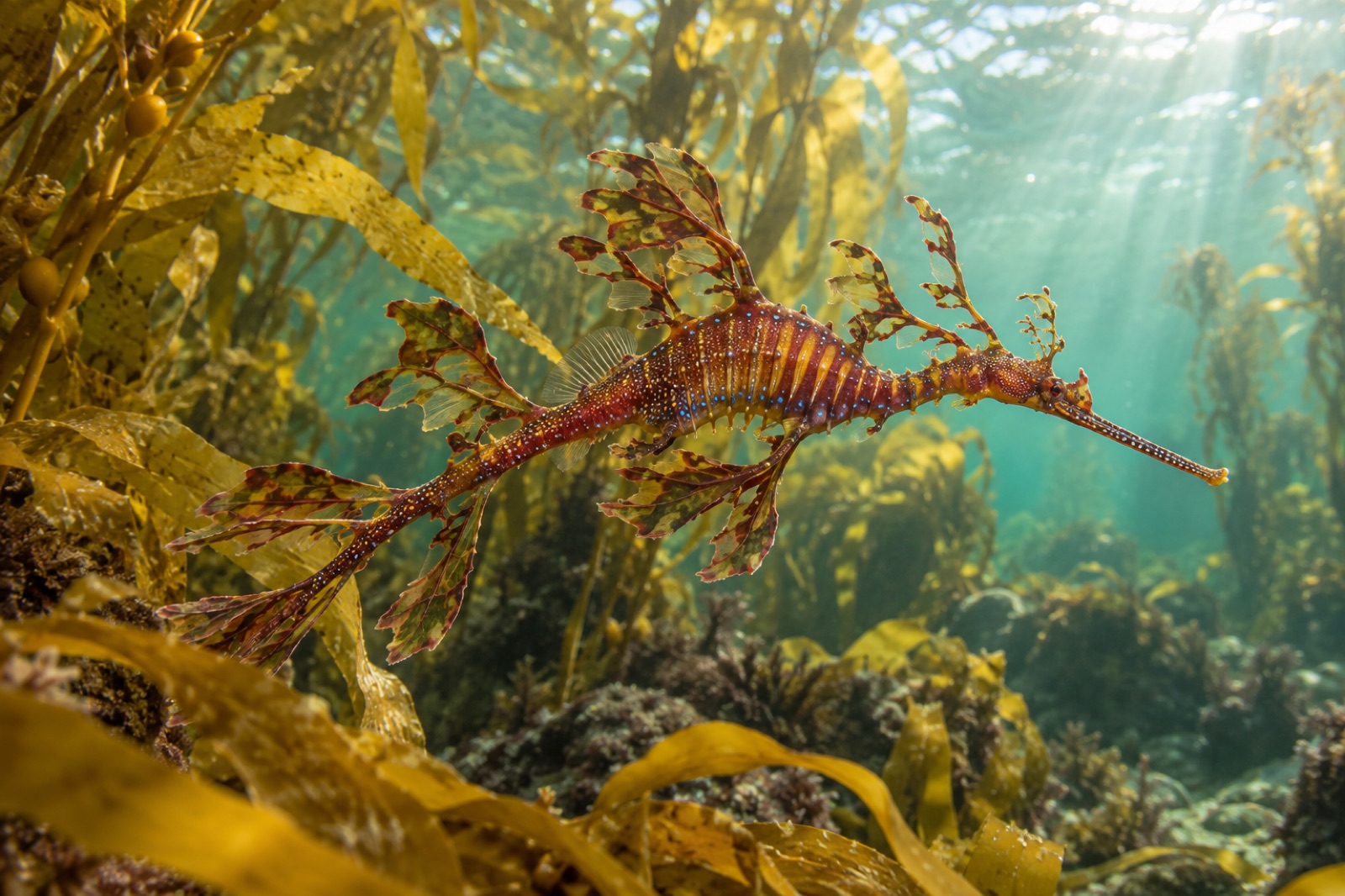
The leafy seadragon (Phycodurus eques) is the fish that makes experienced divers doubt their own eyes. Draped head to tail in translucent, branching appendages that are indistinguishable from the weed around them, an adult leafy hovering over a South Australian reef simply vanishes — and reappears only when it moves. South Australia loves it back: the species is the state's official marine emblem, the star of its jetties and the quiet economic engine of a whole village of dive tourism. It is also, by most assessments, the more vulnerable of the two true seadragons.
Fast facts
|
|
| Scientific name |
Phycodurus eques — sole species in the genus Phycodurus |
| Family |
Syngnathidae (seahorses, pipefish, seadragons) |
| Maximum size |
About 35 cm total length |
| Colour |
Olive, gold or burgundy base with pale stripes, every surface feathered with elaborate skin flaps |
| Depth range |
Shallow, sheltered reef; most encounters in 4–15 m |
| Distribution |
Southern Australia: roughly from southern New South Wales coast around to Geraldton (Western Australia), with strongholds in South Australia and the west |
| Diet |
Mysid shrimp, small amphipods and larval crustaceans, suction-fed |
| Status |
Listed as Vulnerable on the IUCN Red List; protected across Australia |
The disguise, examined up close
Compared to its red-barred cousin the weedy seadragon, the leafy carries far more armour of pretence: every few centimetres of spine and snout sprouts a broad, branching, kelp-yellow appendage. Every one of these flaps is inert — no muscle, no blood supply to move it — pure ornament. Together they do three jobs at once:
- Outline erasure. The flaps break the recognisable body silhouette into a dozen small, leaf-shaped motion sources.
- Colour and texture matching. Translucent membranes pick up the green-gold of backlit kelp, mimicking fronds in hue and in the way light passes through.
- Motion matching. Because the flaps are soft, they flutter in surge at the same frequency as the real weed; the fish doesn't imitate kelp so much as join the kelp's rhythm.
The body that drives the disguise is a syngnathid chassis: a rigid, bony-ringed trunk, a tubular toothless snout, and propulsion from a single invisible dorsal fin and a tiny pair of pectorals. A leafy seadragon at full speed is barely faster than the current it's pretending to be.
South Australia's dragon coast
Leafy seadragons range right across southern Australia, but the species' public life happens on the temperate coast of South Australia. The second half of the gulf region — the calm, silt-sprinkled reefs of Gulf St Vincent, the jetties of the Fleurieu Peninsula, the weed walls of Yorke Peninsula and the lee shores of Kangaroo Island — holds the densities that made the animal famous.
Several qualities make these South Australian waters ideal:
- Shelter. The twin gulfs damp ocean swell into exactly the slow surge a drifting animal depends on; on open coast leafies are patchy and rare.
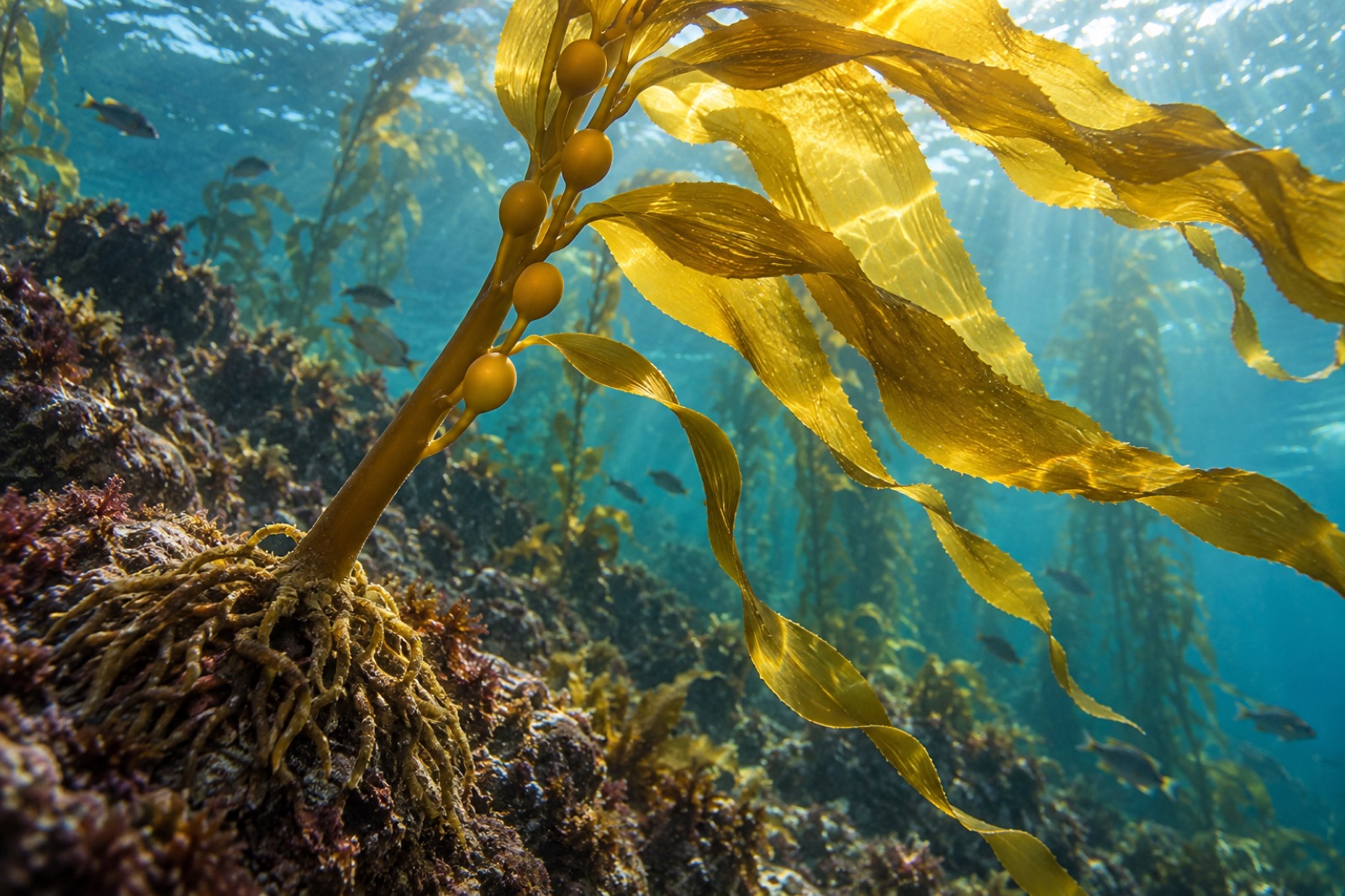
- Weed diversity. These reefs carry mixed canopies—brown kelps, green Caulerpa gardens and epiphytic warps — giving the fish many disguises to switch between as it travels.
- A mysid-rich seabed. The gulfs' shallow, warm, nutrient-fed bottoms grow the tiny crustaceans the dragon's snout requires by the cloud.
The Coastal Atlas surveys this coast region by region, with guides to the jetties — among the world's most reliable seadragon sites — and to the kelp forests that hold them together.
A slow life on the drift
Leafy seadragons are not travellers. Photo-identification studies — each individual's spot pattern is as fixed as a fingerprint — show that many adults occupy home areas measurable in tens of metres for months or years at a time. Some individuals become fixtures of a particular reef face or jetty piling cluster for successive seasons, recognisable to divers who visit week after week.
That site-fidelity is the double-edged sword of the whole species' strategy. It means a snorkeller at the right jetty can virtually be guaranteed a dragon. It also means that when a site's weed, water clarity or prey field collapses — after a storm, an algal bloom or an urchin grazing front — its resident dragons do not simply swim to better ground. There is nowhere in a leafy seadragon's instincts for emigration.
Feeding hour by hour
Like other syngnathids, leafies are ambush-grazers. Much of the day passes face-down over weed patches and sandy pockets, snout ticking as one mysid after another is inhaled at roughly the speed of blinking. The eyes, set high and independently mobile, scan like a chameleon's — the only fish behaviour that visibly betrays all that camouflage.
Breeding: a tail full of rubies
Leafy seadragon reproduction follows the syngnathid pattern of male pregnancy, in the open-tailed style the dragons share:
- Courtship. Through the cool months into spring, a pair mirror-dances — rising together in slow vertical spirals, sometimes over successive days.
- Egg transfer. The female deposits roughly 250–300 eggs onto a spongy brood patch on the underside of the male's tail. The eggs embed individually into the skin, bright as pomegranate seeds.
- Seven weeks of drift. The male aerates and carries the clutch through six to eight weeks of otherwise ordinary life — feeding, hiding, occasionally being photographed by a delighted diver.
- Hatching. The young are released already miniatures of the adult, around 2 cm and waving their first true flaps. They disperse on currents and receive no further care.
Young leafies tend to settle in slightly different, shallower weed than their parents, a built-in hedge against competing with the generation before.
Conservation: the fragile flagship
The leafy seadragon is listed as Vulnerable on the IUCN Red List, and it enjoys protection from collection across Australia. Its pressures are the quiet, unglamorous kind that are hardest to police:
- Habitat loss. Urban stormwater and sediment cloud the sheltered gulf reefs that hold the species' strongholds; dying weed turns a camouflaged fish into an exposed one.
- Urchin barrens. Where fisheries remove the lobsters and large fish that control sea urchins, grazing fronts strip the algal cover dragons need; this habitat feedback is the same one Tidewright's restoration projects attack, alongside canopy-building kelps like giant kelp.
- Climate change. South Australia's gulfs are a warming hotspot, and the warming is compressing the cool-temperate weed assemblages the species matches itself to; our explainer on marine heatwaves covers the mechanism.
- Illegal collection. The ornamental value that got dragons protected remains an ongoing temptation.
The honest summary is that a leafy seadragon's fate is not decided by fishing quotas but by the health of the unremarkable sheltered weedy reef a municipality sees as the bottom of a storm drain. That is what makes it such a precise indicator: when you protect what a seadragon needs, you have protected an entire temperate reef community by accident.
Watching one, the right way
If you are lucky enough to meet a leafy seadragon at a jetty, the etiquette that protects them is also the technique that gets you a better look: calm buoyancy, hands clasped, no chasing, no flash storm, and an absolute rule against touching or crowding a male heavy with eggs. Let the fish decide the distance. A leafy that trusts you — and they do learn to trust slow, quiet divers at well-visited sites — will feed amiably half a metre from your mask.
Key takeaways
- The leafy seadragon is South Australia's marine emblem and, despite the spectacle, fully protected and IUCN-listed as Vulnerable.
- Its appendages are inert ornaments; the fish swims with invisible fins and convinces the eye by joining the weed's motion, not fighting it.
- Strongholds are the sheltered, weed-furred gulfs and jetties of South Australia and the southern coast — not open-ocean reef.
- Males carry around 250–300 embedded eggs for six to eight weeks before releasing independent young.
- Individuals are intensely site-faithful, which makes local habitat quality — water clarity, weed cover, urchin control — the real conservation battleground.
FAQ
Are leafy and weedy seadragons the same species?
No. The leafy (Phycodurus eques) is the sole member of its genus; the weedy seadragon is a separate species with sparser flaps, redder colour and a broader range. A third species, the ruby seadragon, was described in 2015 from deep-water trawl specimens off Western Australia.
Why have we never seen leafies outside Australia?
Temperate southern Australia is their entire natural range — the species is endemic, and the weed-furred, sheltered gulf habitat it requires simply doesn't occur in the same configuration elsewhere.
How long does a leafy seadragon live?
No firm number exists for the wild; estimates of seven to ten years are typical guesses, and captive animals have exceeded that. Their rarity and camouflage make direct wild-aging studies very hard.
Do leafy seadragons make good aquarium pets?
Absolutely not. They are protected from wild collection, and their husbandry — live mysid diets, exacting water chemistry, enormous gentle flow — exceeds what any home aquarium should attempt. Enjoy them through responsible dive operators or accredited public aquaria.
When is the best season to see one?
Dragons are visible year-round at their stronghold sites. The winter-to-spring breeding season offers the best odds of seeing courting pairs and egg-carrying males, at the cost of colder water.