Encyclopedia7 min read
Northern Kelp Crab (Pugettia producta): Species Profile
The northern kelp crab is a colour-changing spider crab that lives its whole life in the kelp canopy. Learn its biology, diet, and role in the forest.
Dr. Theo Nakamura ·
Decorator crabs build living costumes from algae, sponges and anemones using velcro-like hairs. How the disguise works, why it evolved and where to see it.
Somewhere on almost every kelp reef on Earth, a piece of the reef itself is walking. A decorator crab — snipping, fraying and pressing fragments of algae, sponge, hydroid or shell onto rows of hook-like hairs across its back — is the closest thing the ocean has to an animal that gardens its own body. "Decorator crab" is not one species but a way of life practiced by dozens of spider crabs worldwide, and it is one of the best-studied camouflage systems in the sea: an experiment in disguise that researchers have pulled apart with tweezers, swapped costumes under controlled conditions, and tracked back through the crab family tree. This guide covers the behaviour globally and the science behind it, with special attention to the northeast Pacific species divers meet most often.
| What "decorator" means | A guild of crabs — mostly spider crabs, superfamily Majoidea — that deliberately attach living material to hook-tipped setae on the carapace |
| Geographic reach | Every ocean, tidepool to deep sea; richest on cold- and warm-temperate reefs, including all the world's kelp coasts |
| Famous members | Giant spider crab (Macrocheira kaempferi, Japan), European spider crab (Maja brachydactyla), moss crab (Loxorhynchus crispatus, California), graceful decorator (Oregonia gracilis, Alaska–California), southern spider crab (Leptomithrax gaimardii, SE Australia) |
| Wardrobe options | Red, brown and green algae, sponges, hydroids, bryozoans, anemones, sea squirts, shell, marine debris |
| Proposed benefits | Visual camouflage, chemical deterrence (unpalatable or stinging decorations), motion and silhouette disruption |
| The trade-off | Time spent decorating, drag in moving water, and a "naked window" after every moult |
Taxonomically, the decorating habit belongs to the spider crabs — the Majoidea — but it appears in varying intensity across the group, and related "crab-lobster" lineages outside it plant tufts of weed on themselves too. That patchiness is scientifically telling. Comparisons across dozens of majoid species show decoration frequency lining up with the structure of the shell hairs: crabs with dense, deeply hooked setae tend to decorate heavily; crabs whose setae are sparse or weakly hooked, like the bold, bare-backed northern kelp crab, barely bother. In other words, you can read the behaviour off the anatomy — the wardrobe predicts the habit.
Dressing habits also shift over a single crab's life. In several long-studied western Atlantic spider crabs, juveniles are compulsive decorators, while older, larger adults decorate less and less — as if, once a crab outgrows its predators' gape, the costume stops being worth the drag. Decoration, this suggests, is not decoration at all: it is armour worn most seriously by the most vulnerable.
Researchers have tested the disguise hypothesis directly, and the results are more interesting than "it helps them hide."
The costume is removed, and predation rises. In classic experiments, decorated crabs stripped clean and placed back on the reef are taken by fish and octopus at markedly higher rates than their dressed tank-mates. Re-dressed crabs — even crabs dressed by experimenters, in whatever weed was at hand — recover much of the protection. That last detail matters: it showed that part of the benefit is generic. A crab wearing almost anything that breaks up its outline is harder to pick out from the reef than a clean crab moving.
Crabs shop for chemistry, not just looks. In work with the tropical decorator Camposcia retusa, crabs offered a choice of sponges preferentially selected species that deter fish — and test predators spat out crabs dressed in chemically defended sponge at far higher rates than crabs wearing palatable material. The crab, in effect, rubs itself with its neighbours' toxins. This finding reframed the whole guild: decoration is not only visual camouflage but an externally worn chemical defence system, assembled by an animal that produces no poison of its own.
Some costumes sting. Across the family, crabs regularly choose hydroids and small anemones — organisms armed with stinging cells. Whether a crab "knows" it is wearing a battery of nematocysts is unknown; the preference could simply track what stays put and stays alive on hooked setae. But to a young rockfish sizing up a snack, a crab crackling with stinging cells is a poor prospect either way.
Every benefit above has a cost line, and the trade-offs explain a lot of decorator crab behaviour:
The giant spider crab (Macrocheira kaempferi), spanning over three metres leg-to-leg, is the largest arthropod alive — and a fairly casual decorator. It hangs algae and sponge on its back, but at that size and depth (50–600 m off the Pacific coast of Honshu) it likely has little need of a full costume: it outgrew most of its predators. It is the exhibit-A crab for the size-relaxes-decoration pattern.
The European spider crab (Maja brachydactyla) of Brittany's kelp coasts and Cornwall decorates heavily as a juvenile with algae and hydroids, then undertakes one of the most famous crab behaviours on Earth: summer aggregations of tens of thousands of crabs in shallow water. These gatherings are moulting events — the crabs pile up for mutual protection during their soft-shell days. Watching a spider crab aggregation is watching the decorating life cycle at industrial scale: thousands of armoured gardeners, naked all at once, trusting in numbers.
The moss crab (Loxorhynchus crispatus) and its giant relative the sheep crab are the most comprehensively dressed animals in the kelp forest, alongside the gracefuls (Oregonia and Pugettia gracilis) that dress the understory along the coasts covered in our Monterey Bay atlas guide.
Off Melbourne and around Tasmania, the southern spider crab (Leptomithrax gaimardii) forms its own winter moulting aggregations in shallow bays — Australia's answer to the European phenomenon, on the northern edge of the Great Southern Reef. Divers there find the crabs stacked in heaps, still wearing last season's weed until the shell comes off.
It is tempting to file decoration under "cute trick" and move on, but decorator crabs sit at real chokepoints in the kelp forest food web:
Yes — the costume is attached to the shell, so every moult leaves the crab bare. Some species transfer favoured decorations onto the new shell; most rebuild from scratch, and juveniles — which moult often — dress most densely.
Not their best pieces. Decorations are usually materials the crab finds defensively useful rather than nutritious: unpalatable sponges, stinging hydroids, tough red algae. However, algal turf on the back does grow, and grazing at it is not unknown — the garden doubles as a snack shelf in a lean week.
Every cold-temperate coast has them. Kelp forest reefs from Monterey to Maine to Brittany to Tasmania host resident species; low-tide turn-overs of cobbles will often reveal small Pugettia-type kelp crabs. The mass spider-crab gatherings off the English Channel and Port Phillip Bay are seasonal spectacles for divers.
Largely, yes. Sponges keep filtering, hydroids keep stinging, algae keep photosynthesising — which is what makes the disguise so convincing. The crab is wearing a functioning slice of the reef, not dead material.
No. Decoration intensity varies from compulsive dressers (moss crabs) to near-bare species (the northern kelp crab); how hooked the shell's setae are predicts how much a species decorates.
The northern kelp crab is a colour-changing spider crab that lives its whole life in the kelp canopy. Learn its biology, diet, and role in the forest.
Dr. Theo Nakamura ·
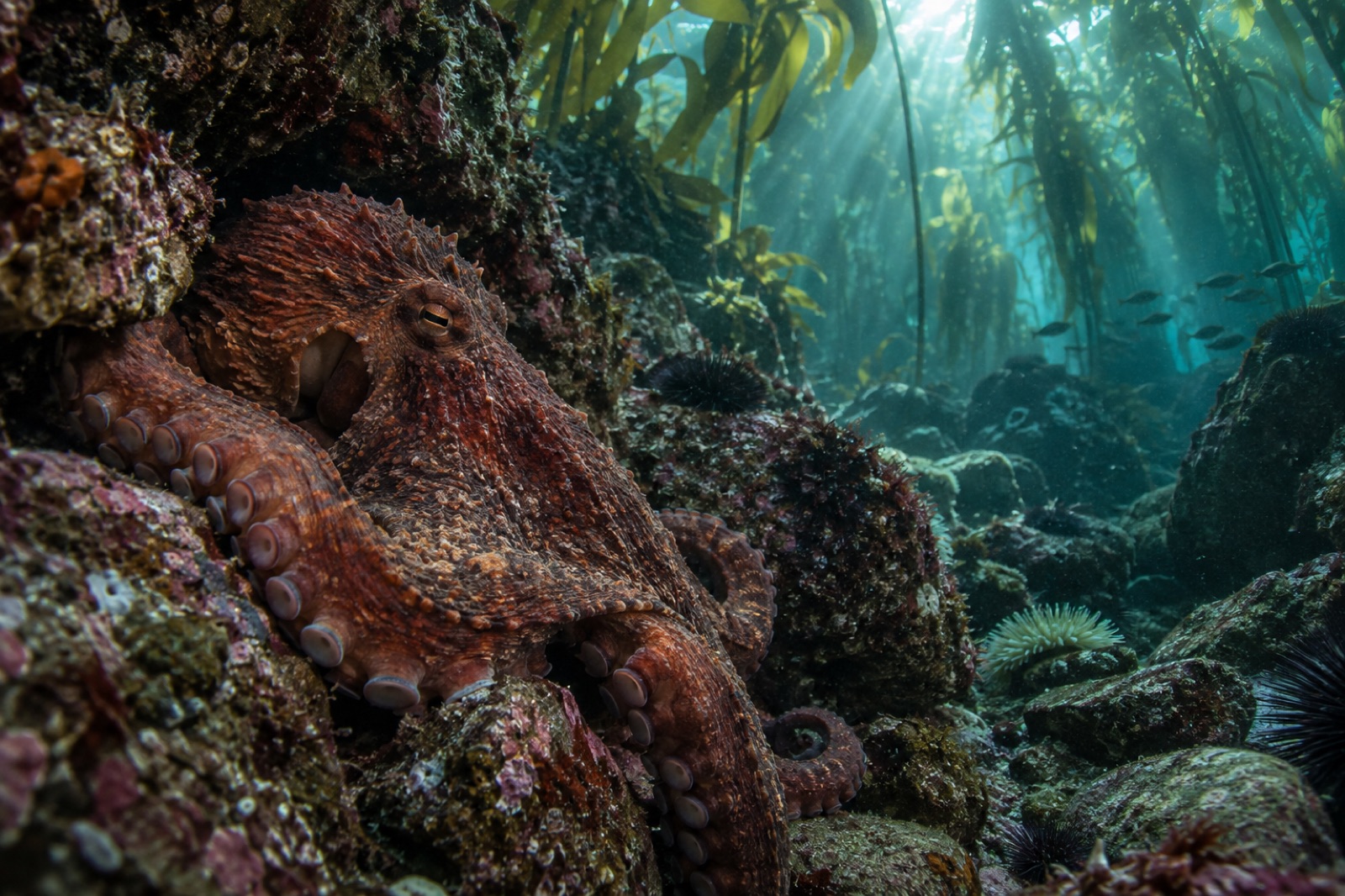
Meet the giant Pacific octopus: the world's largest octopus, a kelp-forest den-dweller with three hearts, blue blood and one shot at motherhood.
Dr. Theo Nakamura ·
Kelp isopods graze fouling algae off giant kelp blades — and in boom years can chew through the stipes themselves. Meet the forest's smallest crew.
Dr. Theo Nakamura ·