The northern kelp crab (Pugettia producta) is the only crab most North Pacific divers will find living twenty metres up a tree. While its cousins prowl the seafloor, this smooth-shelled spider crab climbs into the canopy of giant and bull kelp, hangs from the fronds by its hooked legs, grazes its home plant directly, and changes its own colour to match whatever it has been eating. It is one of the kelp forest's most charming paradoxes: a herbivore with claws, an ornament on its own food plant, and — when it turns up in a sea otter's paws or a rockfish's stomach — a crucial pipe through which the canopy feeds the rest of the reef.
Fast facts
|
|
| Scientific name |
Pugettia producta; family Epialtidae (kelp and spider crabs) |
| Maximum size |
Carapace to roughly 9 cm wide; legs span considerably more |
| Colour |
Variable by diet: dark kelp-brown, olive, or warm crimson to purple-red among red algal beds |
| Shape |
Smooth, tapered, shield-like carapace, widest toward the rear, with a pointed rostrum and long slender legs |
| Depth range |
Intertidal pools to at least 70 m; densest in shallow kelp canopy |
| Distribution |
Southern Alaska to Baja California; one of the most abundant large crustaceans of the NE Pacific kelp zone |
| Diet |
Primarily kelp and other algae; supplements with small invertebrates |
| Status |
Not assessed / no conservation concern; no directed commercial fishery |
The canopy specialist
Most crabs own the ground. The northern kelp crab evolved to own the vertical world above it, and its whole body plan confesses the renovation:
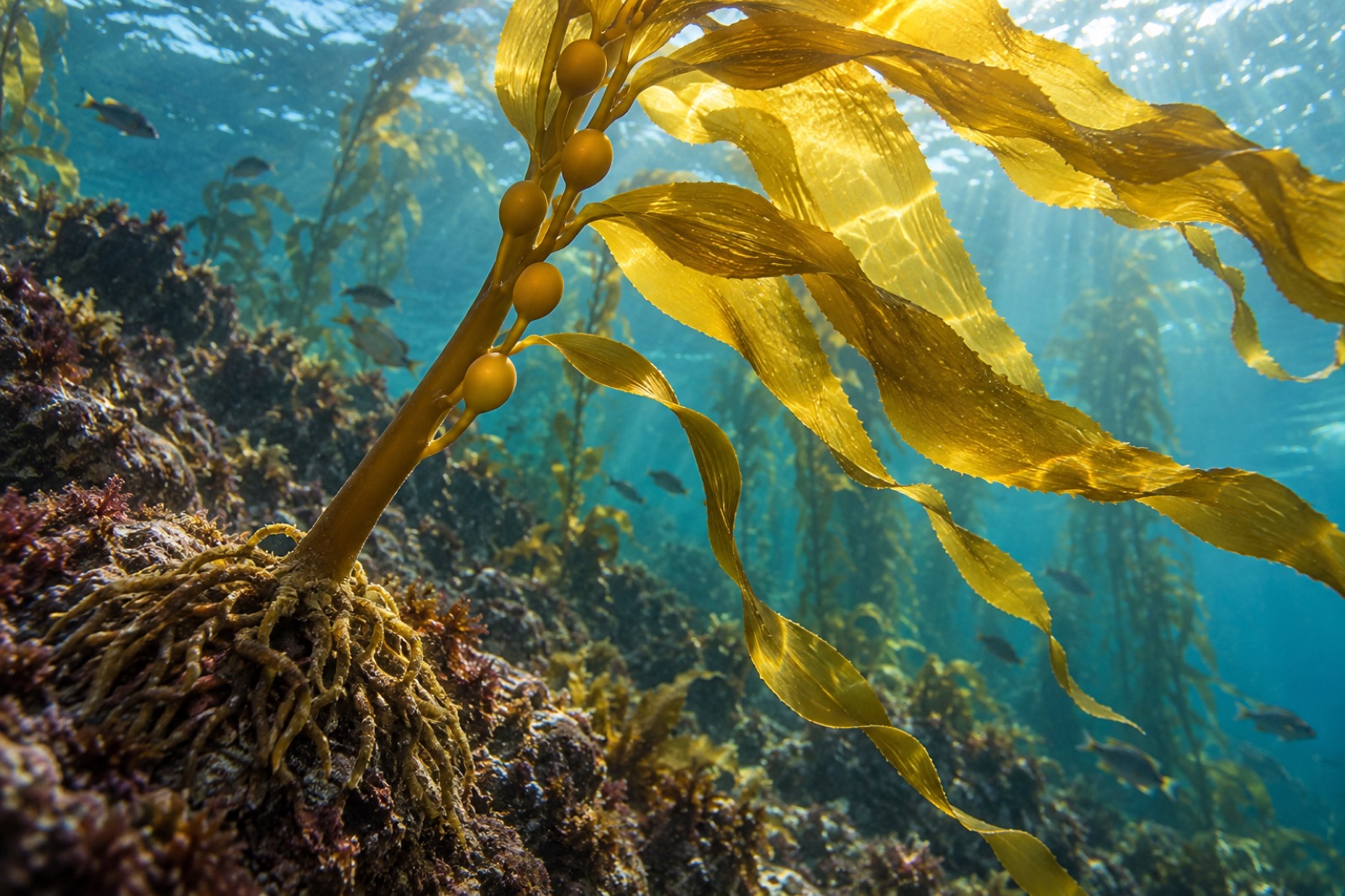
- Hooked climbing legs. The walking legs end in sharp curved dactyls that hook around kelp fronds, stipes and pneumatocysts; a kelp crab can hold position on a waving frond in surge that would peel a limpet.
- A smooth, streamable shell. Where seafloor spider crabs armour up with spines, P. producta carries a glassy, friction-free carapace that slides through the kelp without snagging — the silhouette reads as "plant leaf" to anything hunting beneath the canopy.
- Modest decoration. Its close relative, the graceful kelp crab (P. gracilis), dresses head to toe in camouflage algae glued to hooked hairs. P. producta mostly skips the wardrobe and relies on colour and stillness instead — it is the minimalist of the family.
Life in the fronds is a good deal. Up in the canopy the crab sits metres off the seafloor, away from the wolf eels, octopuses and sculpins that patrol the rocks, surrounded on all sides by an endless standing crop of its favourite food. The kelp is both the apartment and the pantry.
You are what you eat — literally
The kelp crab's colour is not painted on at birth; it is compounded from the pigments of its last several months of meals, deposited into the new shell at each moult. Crabs grazing brown kelp moult out dark chocolate-brown; those feeding among red algae come up carmine or plum. Researchers have moved crabs between diets and watched successive moults swing them across the palette — camouflage assembled from the inside out.
This has a lovely consequence for naturalists: the crab on a red algal frond wears a red flag advertising exactly what it has been eating. It also means a kelp crab that has strayed onto the "wrong" background is conspicuous in a way no fixed-colour animal ever is.
The diet itself
The staple is kelp tissue — especially the fronds of giant kelp (Macrocystis pyrifera) and bull kelp — nipped away a few millimetres at a sitting. The menu widens with opportunity: epiphytic algae growing on the kelp surface, drifting carrion, small snails and worms encountered while browsing. A kelp crab is a grazer first and an omnivore by convenience, and in stillness it clears kelp blades of fouling growth as tidily as it prunes them.
A grazer with teeth: the kelp damage question
Kelp crabs are normally polite guests on their habitat. Where their numbers are held down by predators — sea otters above all, but also kelp rockfish, cabezon and gulls — their grazing is pruning: light damage that a healthy, fast-growing kelp plant shrugs off.
Break the predator link and the relationship turns. In systems where otters are absent and crab numbers climb, kelp crabs can clip fronds faster than the plant replaces them, shred the blade margins, and concentrate on the meristem — the growth zone at the base of each frond — stunting the canopy outright. It is a quiet, crustacean echo of the urchin-barren story told in our kelp forest food web explainer: temperate reefs stay forested when something is eating the grazers.
For seaweed farmers the crab has a third reputation: pest. Wild kelp crabs recruit onto farmed lines and mow young blades. Growers from Alaska to California learn to budget for "crab days" and to harvest before the summer crab cohort discovers an untended longline — one of the very first husbandry lessons covered in our guide to seaweed pests and diseases.
Life cycle: carried eggs and a soft-shell wedding
Mating in kelp crabs, as in many spider crabs, is governed by the female's shell. A female can only mate in the brief window after she moults, while her new exoskeleton is still soft. Males — alerted, remarkably, by chemistry in the water — guard a pre-moult female for days beforehand, fending off rivals and waiting for the instant the old shell splits. The pairing is brief and the male departs; the female extrudes a dark, blackberry-like mass of tens of thousands of eggs beneath her abdomen and aerates them for weeks as the embryos develop.
The larvae that hatch are planktonic, drifting through several moults over weeks before the last larval stage settles onto kelp or reef as a thumbnail-small crab. That drifting window is the species' only true journey: adults are strongly site-faithful, and a kelp crab found on your favourite frond in July is plausibly the same individual there in October.
Predators: the otter's favourite snack
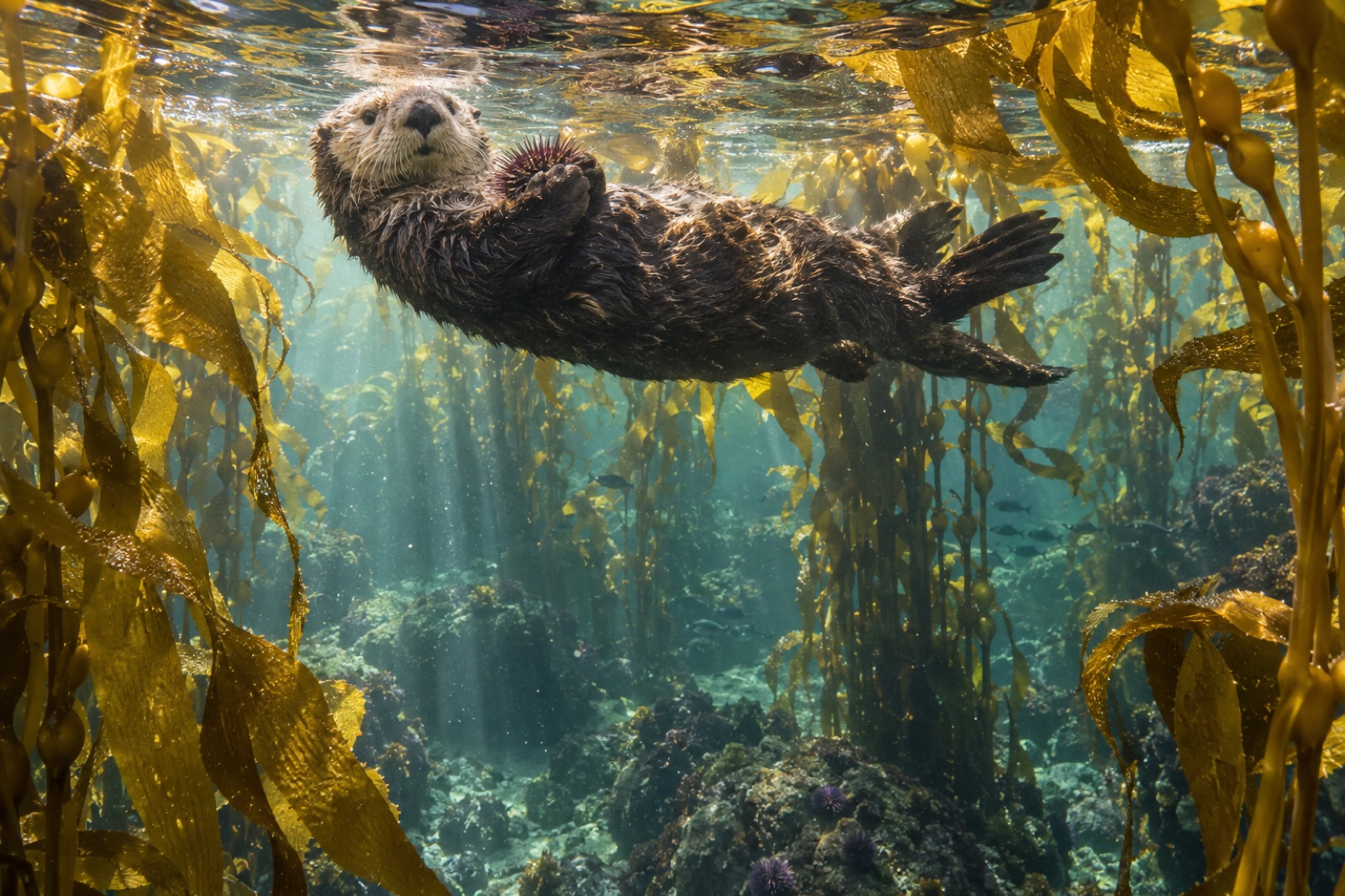
Ask a sea otter what a kelp crab is and the answer would be "lunch." In Alaska and British Columbia, otters pick crabs off fronds with an efficiency that has reshaped nearshore communities; kelp crabs can be a major share of some otters' diets, and an otter raft working a canopy can meaningfully lower crab density on the reef below. This is one engine of the otter–urchin–kelp trophic cascade at its indirect best: otters eat kelp crabs, relieving the canopy of its herbivore; otters eat urchins, relieving the seafloor of its herbivore. One predator, two switches, forest on.
Below the otter, kelp rockfish, cabezon, gulls, octopus and wolf eels all take their share — the kelp crab is the canopy's primary conduit for moving kelp energy into fish and mammal biomass, and its abundance through the food web is one reason we treat crab counts as a standard monitoring line-item on restored sites in the Canopy Ledger platform.
Identifying Pugetta producta in the field
Three Pacific coast spider crabs cause most of the confusion:
- Northern kelp crab (P. producta): smooth, unspined, distinctly widest near the rear; uniform brown, olive or red matching its algae diet; in the canopy or at the kelp's base. The common one.
- Graceful kelp crab (P. gracilis): smaller, leggier, habitually decked with glued-on algae and debris; usually down on the reef among turf.
- Cryptic kelp crab (P. richii): sharply ridged carapace; more subtidal and algae-camouflaged; the least likely of the three for a casual diver to find.
The behaviours settle arguments between close cases: the spider crab sitting exposed on the face of a giant kelp blade at 10 metres, brown and glossy as a conker, is P. producta. There is no second species that lives so plainly in the open in the upper canopy.
Watching kelp crabs responsibly
Kelp crabs make superb photographic and observational subjects, exactly because they trust their camouflage and stand their ground. A few field habits keep encounters good for everyone:
- Approach slowly and from alongside, not above — the crab's predators come from below and the surface; anything overhead triggers the drop-off-and-vanish response.
- Never pluck or pull fronds to bring a crab into view; the frond is the crab's home and the kelp's growth asset. Watch where it lives.
- Don't handle them. Their pincers are small but earnest, and a molting soft-shelled crab can be fatally damaged by fingers meaning no harm.
- Photograph, log, report. Kelp crab counts are useful, honest citizen science; programmes collecting observations from the canopy layer make the restored sites we monitor at Tidewright markedly better documented. Our dive editors' underwater photography guide has settings notes for canopy subjects.
Key takeaways
- The northern kelp crab is a smooth-shelled spider crab of the NE Pacific that lives in kelp canopy from Alaska to Baja California.
- Its colour is diet-derived: it moults out brown on brown kelp and red among red algae — camouflage assembled from its own meals.
- It is a true kelp grazer; kept in check by sea otters and fish it light-prunes, and released from predation it can damage canopy growth zones.
- Mating happens only in a female's post-moult soft-shell window; the planktonic larvae are the species' sole dispersal phase.
- It is the canopy's chief energy conduit to otters, rockfish, octopus and birds — a small crab with a structural role in the forest.
FAQ
Can you eat northern kelp crabs?
They are technically edible and were harvested to a small degree historically, but the body is scrawny and the yield miserable next to a Dungeness or red rock crab. Almost no one targets them, and there is no meaningful fishery. Watch them instead.
Why is my kelp crab red? I thought kelp was brown.
Because colour follows diet. A crab feeding among red leafy algae will moult into a matching crimson shell over a season; the same animal on a giant kelp diet comes out chocolate brown. The pigments pass from food into the new exoskeleton.
Do kelp crabs sting or pinch?
No sting, and the pinch is trivial — the claws are small but purposeful. What they will do is scissor frantically, drop off the frond, and vanish into the understory, which is reason enough to leave them where they hang.
Are kelp crabs bad for kelp forests?
No — they are part of the kelp forest, and under a full community of predators their grazing is a healthy pruning service. Where otters and predatory fish have been removed, crab densities can balloon and damage the canopy; the problem is the missing predators, not the crab.
Where should I look for one on a dive?
Mid-canopy on a calm day. Work slowly along the outside face of the kelp at 5–15 metres, looking for the spider-crab silhouette against the light on a blade's upper surface — a spider shape pasted onto the gold. In the Pacific Northwest and Alaska, check bull kelp fronds in late summer when the crab cohort is at full size.