Encyclopedia9 min read
Golden Kelp (Ecklonia radiata): Species Profile
Golden kelp forms the backbone of Australia's Great Southern Reef. Learn to identify Ecklonia radiata and why this habitat-maker is on the move as oceans warm.
Dr. Mara Ellison ·
Meet bull kelp, the fast-growing annual giant of North America's Pacific coast — its biology, Indigenous heritage, dramatic decline and the race to restore it.
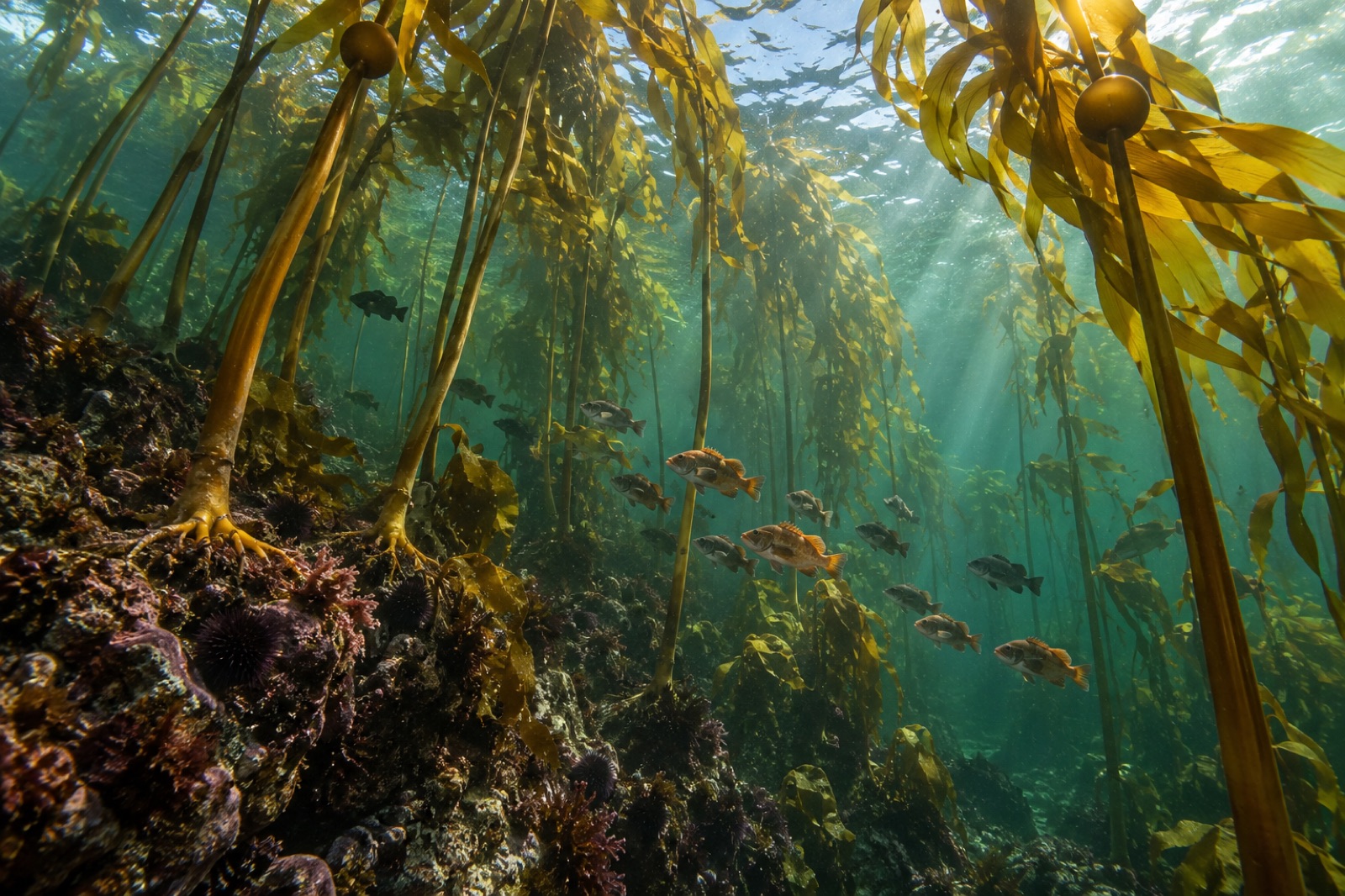
Bull kelp (Nereocystis luetkeana) is the whip-fast annual kelp of the North Pacific — a plant, or rather a brown alga, that can grow from a pinhead-sized spore to a 30-metre giant in a single year. It forms the floating surface canopies of the Pacific coast of North America, shelters young rockfish, feeds sea otters' prey, and in the last decade has suffered one of the most dramatic ecosystem collapses ever recorded in a kelp forest. Understanding bull kelp — how it grows, how it reproduces, and why it crashes — is the first step to bringing it back.
In spring, along the cold, nutrient-rich coast from California to Alaska, bull kelp does something that still startles scientists: it can lengthen by tens of centimetres in a single day. By midsummer a mature plant trails a hollow, whip-like stipe from a modest holdfast on the seafloor all the way to the surface, where a gas-filled bulb keeps a crown of long blades afloat. A dense bed, seen from above, is a slick of golden-brown ribbons streaming down-current; from below, it is a cathedral of light, with sunbeams shifting through swaying fronds.
Because nearly every plant is in its first and only year of life, a bull kelp forest is perpetually young — and perpetually rebuilt. When conditions are right, that is its superpower: bare rock can be re-canopied within a season or two. When conditions are wrong, the entire forest can vanish in a matter of months. Compared with the longer-lived golden kelp of the Southern Hemisphere, bull kelp trades durability for speed.
Bull kelp's engineering is worth a closer look, because each feature solves a specific problem of life in surge.
At the base sits a small, disc-like holdfast — a cluster of haptera, root-like strands that grip bare rock. It is strikingly modest for such a large plant. Bull kelp does not anchor deeply; it anchors flexibly, and it relies on the lightness of everything above.
The stipe — the kelp equivalent of a trunk — is a single unbranched tube, hollow and tapering, just a couple of centimetres wide but up to 30 metres long. It is remarkably strong in tension, which Pacific Northwest Indigenous peoples knew well: whole dried stipes were worked into fishing lines and ropes. The hollow interior helps keep the stipe buoyant as it streams in the current.
At the top of the stipe sits the bulb that gives the plant its most popular common name feature — the pneumatocyst, a gas-filled float the size of a large lemon to a small football. Its internal atmosphere is unusual: analyses have found that it contains measurable carbon monoxide, a curiosity that has been studied for decades. Whatever its precise function, the bulb lifts the crown of blades to the sunlight and holds them there through the growing season.
From the pneumatocyst emerge two dozen or more long, strap-shaped blades, each up to several metres in length. These blades are the photosynthetic powerhouse — thin, wrinkled, and textured to capture light in green, dim water. When storms rip plants free, whole stipes wash ashore as "bull whips," and throughout autumn the beach wrack quietly exports kelp carbon to deeper water and sandy shores, a pathway our science team explores at Tidewright's Impact dashboard.
Bull kelp is an alternator of generations — like all kelps, it cycles between a big, visible sporophyte (the plant you see) and a microscopic gametophyte stage you need a lens to find. In late summer and autumn, blades develop dark patches called sori, which are shed as small spore-bearing packets that sink onto nearby reef. Each packet releases millions of motile spores; spores settle, grow into microscopic male and female gametophytes, and — if a female is fertilised within days to weeks — a new sporophyte begins.
That tight reproductive coupling is the key vulnerability. A spore packet travels only metres. If the canopy disappears from a stretch of coast for two or three consecutive years, local spore supply can effectively run out, and recovery stalls even after conditions improve. It is exactly the failure mode that low-relief, spore-limited reefs show in parts of California today — and exactly the gap that reseeding technologies, such as the seeded lines grown in Tidewright's Holdfast hatcheries, are designed to bridge.
Long before ecosystem engineers had a name for it, coastal Indigenous nations managed bull kelp as both habitat and material. Peoples of the Pacific Northwest — including Makah, Nuu-chah-nulth, Haida and others — cured whole stipes over fire and moulded them into strong fishing lines, anchor ropes, and even watertight containers, some used to store precious eulachon oil. The beds themselves were fishing grounds and hunting grounds, and kelp knowledge was threaded through law, story and teaching.
That heritage matters for restoration today. Along many coasts, Indigenous guardians and sea-country rangers are leading kelp monitoring and recovery work, combining generational knowledge with modern survey tools — an approach Tidewright embraces in its community programs and across its project portfolio.
From 2014 to 2016, a vast marine heatwave — nicknamed "the Blob" — spread warm, nutrient-poor water across the northeast Pacific. Bull kelp, which depends on cool, nitrate-rich water, starved. At the same moment, a wasting epidemic was devastating sea stars along the entire coast, including the sunflower sea star, the main predator of the purple sea urchin. Urchin populations exploded, and the hungry grazers mowed down surviving kelp and, crucially, every new sporophyte trying to recruit.
The result, documented by surveys off Sonoma and Mendocino counties, was a collapse of more than 90 percent of bull kelp canopy over just a few years, followed by the crash of the region's red abalone fishery and urchin fishery. The reefs flipped into "urchin barrens" — expanses of rock carpeted in starving urchins that can persist for years, outlasting the kelp's one-year memory of spores.
Farther north, the picture is less catastrophic but not calm: beds in British Columbia, Washington and Alaska have held up better overall, yet face their own heatwaves, grazing shifts and storm stress. The whole system now swings faster than it used to, which is why continuous canopy mapping — the kind provided by our Canopy Ledger partners — has become essential infrastructure.
Yes — and the annual life history that makes bull kelp fragile also makes it restorable. Three levers are proving effective along the coast:
Success stories are accumulating: where grazing pressure is managed, bull kelp's speed turns from vulnerability into recovery engine.
Yes. The blades and stipes are eaten in Alaska and British Columbia — pickled stipe rings ("sea pickles") are a local favourite — and bull kelp can be dried into flakes. Harvest responsibly: never take the pneumatocyst and blades below their meristem if you want the plant to survive, and check local regulations.
Under good spring conditions the stipe can lengthen by roughly 25–30 centimetres in a single day, making it one of the fastest-growing organisms on Earth.
The name refers to the long, thick, whip-like stipe — a "bull whip." Note that in New Zealand and southern Australia the unrelated brown alga Durvillaea is also called bull kelp; the two are distant cousins, not the same species.
Normally one year. A small fraction of plants carry over a second winter, but the species is functionally annual — which is why canopy loss can be so abrupt.
No single cause. A marine heatwave (2014–2016) starved and stressed the kelp at the same time that sea star wasting removed the main urchin predator. Purple urchins then multiplied, mowed the survivors, and held the reefs as barrens — a classic trophic cascade with a warming trigger.
Golden kelp forms the backbone of Australia's Great Southern Reef. Learn to identify Ecklonia radiata and why this habitat-maker is on the move as oceans warm.
Dr. Mara Ellison ·
Sugar kelp is the sweet-tasting cold-water kelp that farmers love. Explore its biology, range, life cycle and why it anchors a new wave of ocean farming.
Dr. Theo Nakamura ·
Oarweed is the digitate kelp marking the low-water line of North Atlantic shores. Learn its biology, industrial past, and the warm-water rival now replacing it.
Dr. Theo Nakamura ·