Encyclopedia9 min read
Oarweed (Laminaria digitata): Species Profile
Oarweed is the digitate kelp marking the low-water line of North Atlantic shores. Learn its biology, industrial past, and the warm-water rival now replacing it.
Dr. Theo Nakamura ·
Sugar kelp is the sweet-tasting cold-water kelp that farmers love. Explore its biology, range, life cycle and why it anchors a new wave of ocean farming.
Sugar kelp (Saccharina latissima) is the wrinkled, amber-brown kelp that has become the poster species of the new ocean farming movement — a cold-water brown alga that grows like a weed in winter, tastes faintly sweet, absorbs farm-cleansing nutrients as it grows, and drops into the kitchen as a home-grown kombu. Whether you met it on a Maine longline, a Norwegian fjord farm, or a tidepool at the low shore, this guide covers what sugar kelp is, where it lives, how it grows, and why farmers and chefs keep coming back to it.
Sugar kelp is unmistakable once you know its texture. A single broad blade — not branched, just one long strap — rises from a short smooth stipe and a small, unassuming disc of a holdfast. The blade surface is dimpled, like bubble wrap pressed flat, and its margins ripple in tight ruffles. It is those two features, the dimples and the ruffles, that distinguish sugar kelp from smooth look-alikes such as young oarweed.
The colour runs from pale olive-yellow to rich amber-brown. In summer, older blades often wear a crust of white-tipped epiphytes — tiny bryozoans and hydroids — near their tips, and the blade end may wear ragged, since sugar kelp grows at its base while surf and time erode its tip. A winter-harvested blade is a different animal: glossy, clean, and sweet-smelling.
Sugar kelp is a boreal-Arctic species, at home wherever winter water stays cold. In the North Atlantic it grows from Arctic Canada and Greenland down both sides of the ocean — along the North American coast to about New England, and along the European coast from Arctic Norway to Brittany. It also occurs through the North Pacific, and populations there are part of a species complex that taxonomy is still untangling.
The species likes shelter more than surf. You find it in fjords, bays, estuaries and calm subtidal reefs, from a metre under a low tide down to 25 m where light allows. Current matters more than waves — flowing water delivers the nitrate feast of late winter when sugar kelp does most of its growing.
Both its common and scientific names nod to a trick of the dried blade. When sugar kelp dries, natural sugars — especially the sugar alcohol mannitol — migrate to the surface and crystallise in a thin white dust. Chew on a dried frond and you will taste it: a faint, clean sweetness under deep umami. Saccharina is literally "of sugar."
That taste has made sugar kelp a chef favourite across the North Atlantic world. It behaves in the kitchen like a mild, home-terroir kombu: superb in dashi and broths, softened for salads, pickled, dried into a snack or milled into a seasoning. Because the species is so amenable to farming, it is also the kelp you are most likely to meet as a traceable, locally grown sea vegetable in cold coastal cities — our recipe and kitchen guides go deep on how to cook with it.
Sugar kelp lives two to four years, longer than the annual sprinter bull kelp, shorter than the oldest southern kelps. Its year is tuned in reverse to ours: growth erupts in the dark cold of late winter, when nitrate floods coastal water, and slows into near-standstill through summer warmth. A blade can lengthen two centimetres or more a day in peak season; by midsummer, tip erosion catches up with base growth and the plant effectively treads water.
Reproduction comes in autumn and winter, when dark spore patches develop across the blade (the species' sori are spread over the surface rather than in discrete packets like bull kelp). Spores settle nearby and grow into the microscopic gametophytes that complete the kelp life cycle. Multi-year plants can spawn more than once.
No kelp has been responsible for more new ocean farms in the past decade than sugar kelp. The reasons stack up:
The catch is summer. Warm water invites a coat of fouling — especially the bryozoan Membranipora, which can riddle blades with lace-like crusts — and rising temperatures weaken the plant itself. The whole young industry has learned to compress the season: seed in autumn, grow through winter, harvest by late spring while blades are clean-running machines. Breeding and strain selection, much of it focused on warm-hardy local strains, is where groups like Tidewright's Holdfast nursery system and public breeding programs see the future.
Sugar kelp brings real culinary gifts: deep glutamate umami, alginates and other soluble fibres, potassium, magnesium, and trace minerals. It also brings a serious caveat — iodine. Kelps concentrate iodine from seawater, and sugar kelp can carry very high levels, varying wildly from plant to plant. A small amount is a nutrient; a lot, eaten regularly, can disrupt thyroid function. The practical guidance used by chefs and regulators alike:
Handled that way, sugar kelp is a safe, sustainable sea vegetable and one of the lowest-impact protein-and-mineral sources humans produce.
Sugar kelp remains abundant across much of its range, but the edges are moving. Warm-water stress has contributed to declines of sugar kelp and its forest partners along some southern European shores, where summer SSTs now crowd out the species' cool-water window. In the Arctic, meanwhile, changed ice and light regimes are reshaping its habitat. Wild harvest for alginate and meals continues under quota in parts of Europe, and restoration groups watch kelp bed health as an early-warning indicator for rocky-reef futures — the same indicator tracked on Tidewright's Impact dashboard.
Not the same species — true kombu is several Saccharina japonica-type kelps of the northwest Pacific. But sugar kelp is its closest widely farmed analogue in the Atlantic, and cooks like a mild, local kombu.
Cold Northern Hemisphere waters: Arctic coasts, Atlantic Canada and New England, Greenland, Iceland, Scandinavia, the British Isles and south to Brittany, plus the North Pacific as part of a species complex.
As a seasoning or small side, normal culinary use is fine for most people. Because iodine content varies hugely, avoid eating large daily portions — blanching or soaking reduces iodine — and anyone with thyroid issues should check with a clinician.
On farms, late spring to early summer, before fouling and heat damage set in. In the wild, low-tide foragers take a few blades with scissors-style cutting that lets the plant regrow.
Not practically as a casual hobbyist — but small-scale ocean farmers across Maine, Alaska, Norway, Scotland and beyond farm it on longlines after a hatchery nursery step. Our farming guides in the Journal walk through exactly how.
Oarweed is the digitate kelp marking the low-water line of North Atlantic shores. Learn its biology, industrial past, and the warm-water rival now replacing it.
Dr. Theo Nakamura ·
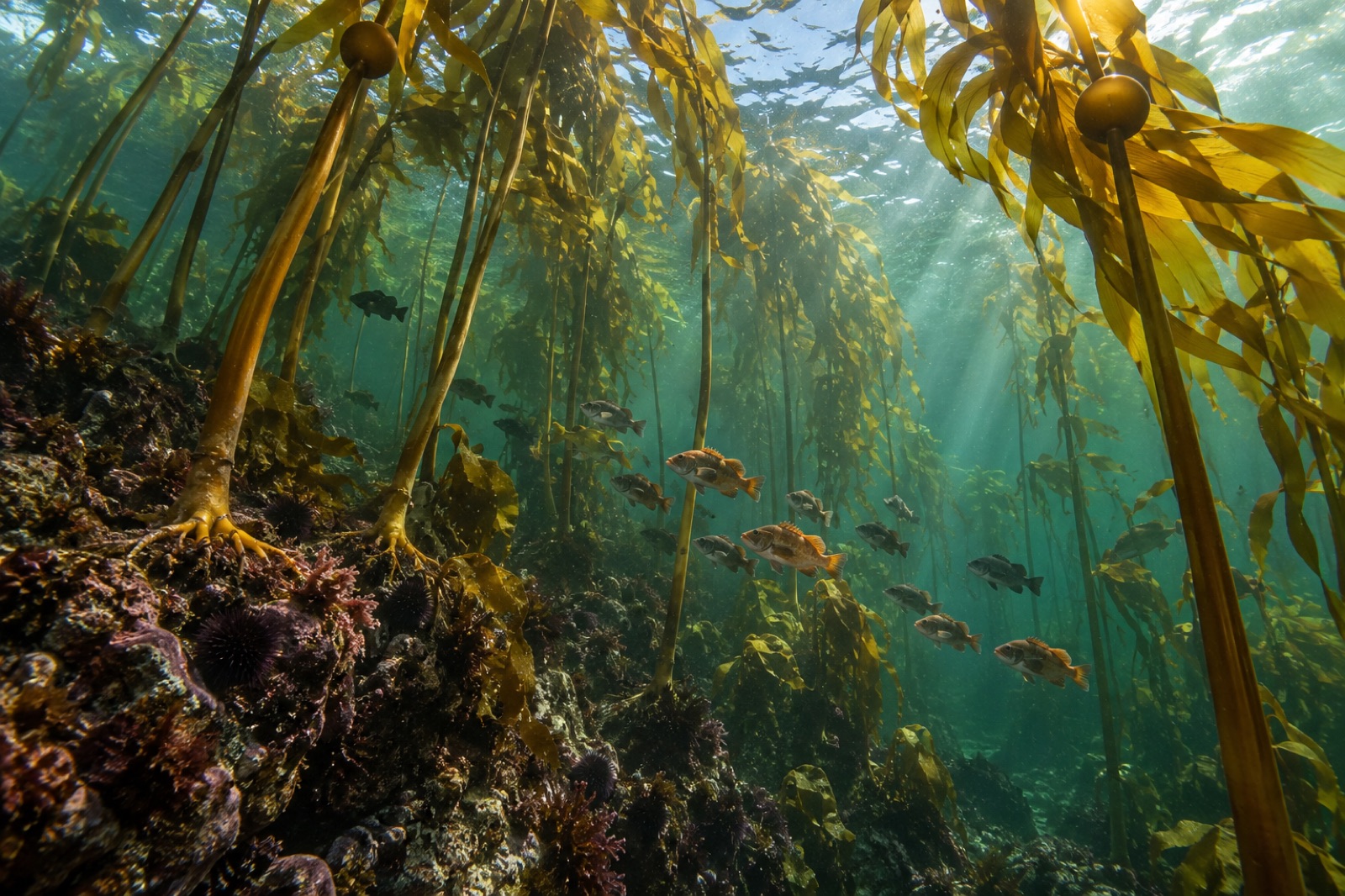
Meet bull kelp, the fast-growing annual giant of North America's Pacific coast — its biology, Indigenous heritage, dramatic decline and the race to restore it.
Dr. Mara Ellison ·
Golden kelp forms the backbone of Australia's Great Southern Reef. Learn to identify Ecklonia radiata and why this habitat-maker is on the move as oceans warm.
Dr. Mara Ellison ·