Encyclopedia9 min read
Sugar Kelp (Saccharina latissima): Species Profile
Sugar kelp is the sweet-tasting cold-water kelp that farmers love. Explore its biology, range, life cycle and why it anchors a new wave of ocean farming.
Dr. Theo Nakamura ·
Oarweed is the digitate kelp marking the low-water line of North Atlantic shores. Learn its biology, industrial past, and the warm-water rival now replacing it.
Oarweed (Laminaria digitata) is the kelp of the low-water line — the olive-brown, fingered seaweed that lays down a living border around the islands and headlands of the northeast Atlantic, from the Arctic to Brittany. Walk any British or Norwegian shore at a big spring low tide and you will step out across its forest floor, blades fanning over the wet rock like the fingers of upturned hands. For centuries it was cut, dried and burned for industry; today it is a sentinel of warming seas, ceding its southern range to a golden relative invading from the south. Here is everything that makes oarweed worth knowing.
Oarweed is one of the few seaweeds with its own shoreline address. On wave-exposed rocky coasts it occupies a distinct band at and just below the low-water mark — a strip you walk onto only at the biggest spring tides, where its slippery holdfasts carpet the rock. Below it, the deeper, rough-stiped cuvie or forest kelp (Laminaria hyperborea) takes over and extends the forest into the subtidal; above it, wracks and sugar kelp hold the more sheltered extremes.
To identify the plant itself, look for three features together:
The name "oarweed" is thought to come from those flat, oar-like digits — blades shaped as if to row through the surf.
Oarweed plays the kelp long game. Its stipe, far from being replaced each year, persists through four, five, sometimes six winters, gaining girth slowly. The blade, by contrast, is an annual structure: through winter and early spring, new tissue grows rapidly at the meristem where blade meets stipe, pushing a fresh fan of fingers ahead of it; the old blade, tattered by summer epiphytes and storms, is shed whole near midsummer. Divers and foragers see the transition plainly — a plant carrying a dark, ragged old blade above a fresh, pale collar of new growth.
Growth peaks, counterintuitively, in the gloom and cold of earliest spring, when nitrate is richest. By autumn the plant has banked enough carbon to reproduce: contiguous spore-producing areas develop across the blade, and clouds of motile spores settle around the parent. The microscopic gametophyte generation does its work unseen on the reef surface, and a new sporophyte may — if light, grazers and storms cooperate — be visible by the following winter.
As a foundation species, oarweed works a shoreline like a prairie works open land: in vast, swaying monotony, rich in hidden abundance. Under its canopy, the understory is shaded into a mosaic of red and coralline algae; each holdfast shelters a miniature community of worms, amphipods and juvenile fishes. The fronds themselves become grazing and settlement ground for snails and bryozoans, and storms tear loose huge tonnages of biomass that wash ashore to feed beach ecosystems or sink to deeper water — part of the blue-carbon pathway studied on Tidewright's Science hub.
On wave-thrashed headlands, oarweed beds are also a wave-energy sieve, gently damping surge across the intertidal. Where oarweed thins, neighbours move quickly: filamentous turf algae and grazers colonise the freed rock.
No European kelp has a longer working history. For centuries, coastal communities from Scotland's Hebrides to Brittany cut and gathered tangle kelps — oarweed and cuvie together — as winter cash crops:
Oarweed is a cold-water species, and the northeast Atlantic is warming. The most telling evidence comes from Britain's southwest, where long studies off Plymouth and along the Channel have tracked the spread of the golden kelp Laminaria ochroleuca — a warmth-loving relative long confined to Iberia and the Mediterranean's fringe. Where oarweed retreats or is scoured back, golden kelp now recruits, and on some reefs it is replacing oarweed outright.
The ecological consequences are still being understood. The two kelps shape similar forests, but not identical ones — differences in blade chemistry and structure ripple into the understory communities, grazers and epiphytes each supports (a story echoed, on another continent, by golden kelp of the Great Southern Reef, a different Ecklonia with the same common name and the same implications for reef futures). At its warm edge in Brittany and the Channel, oarweed's decline is a visible front line of climate-driven temperate reef change — a trend tracked across Tidewright's monitoring partnerships and its Atlas of coastal regions.
If you live within oarweed's range, responsible gathering is possible and legal in many places (always check local rules): cut a few young spring blades with scissors, well above the meristem, leaving the stipe and holdfast to regenerate. Wash well, then dry, blanch or pickle. In the garden there is a centuries-old logic to using rinsed kelp as a mineral-rich mulch — though for most people, purpose-made kelp biostimulants, including the kind Tidewright's Harvest division produces from farmed restoration kelp, are the simpler route.
"Tangle" is a loose common name applied to several large Laminaria kelps. In most British usage it refers to oarweed or its deeper-water relative cuvie (Laminaria hyperborea). The smooth, oar-fanned blade tells oarweed apart.
Yes — the young spring blade is the palatable part, cooked like a mild kombu-style kelp. Dry it, blanch it or pickle it, use it as seasoning, and as with all kelps eat it in moderation due to variable iodine.
For its broad, flat, oar-shaped blade segments. The scientific name digitata — "digitate," like fingers — describes the same feature from the other end.
The stipe lives several years (commonly 4–6), while the blade is grown and shed each year — so an individual plant sees many blade generations.
At its southern range edge: Brittany, the Channel and southwest Britain, where warming seas and heatwaves coincide with its replacement by Laminaria ochroleuca; regional status is tracked in our regional atlas.
Sugar kelp is the sweet-tasting cold-water kelp that farmers love. Explore its biology, range, life cycle and why it anchors a new wave of ocean farming.
Dr. Theo Nakamura ·
Golden kelp forms the backbone of Australia's Great Southern Reef. Learn to identify Ecklonia radiata and why this habitat-maker is on the move as oceans warm.
Dr. Mara Ellison ·
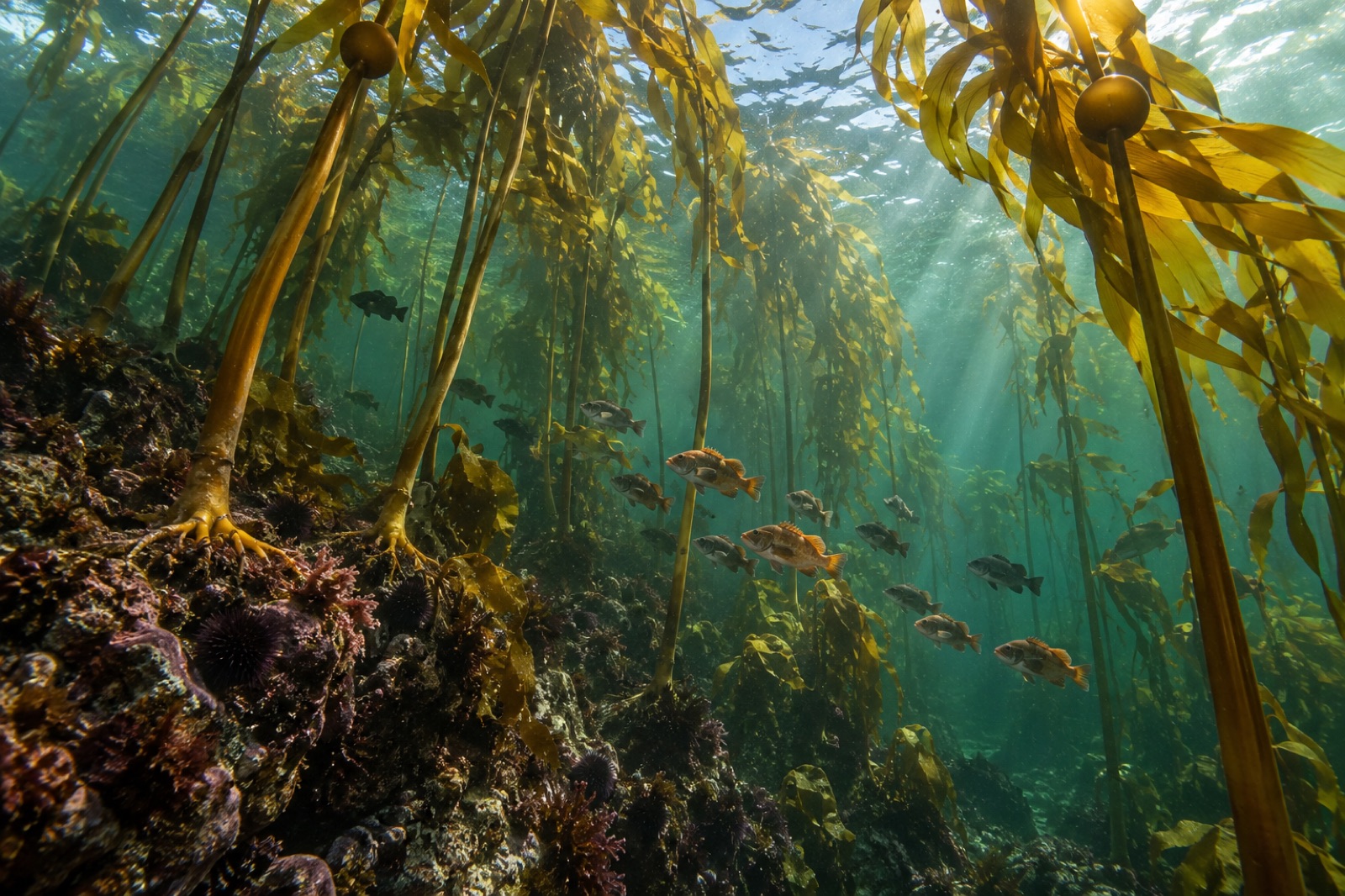
Meet bull kelp, the fast-growing annual giant of North America's Pacific coast — its biology, Indigenous heritage, dramatic decline and the race to restore it.
Dr. Mara Ellison ·